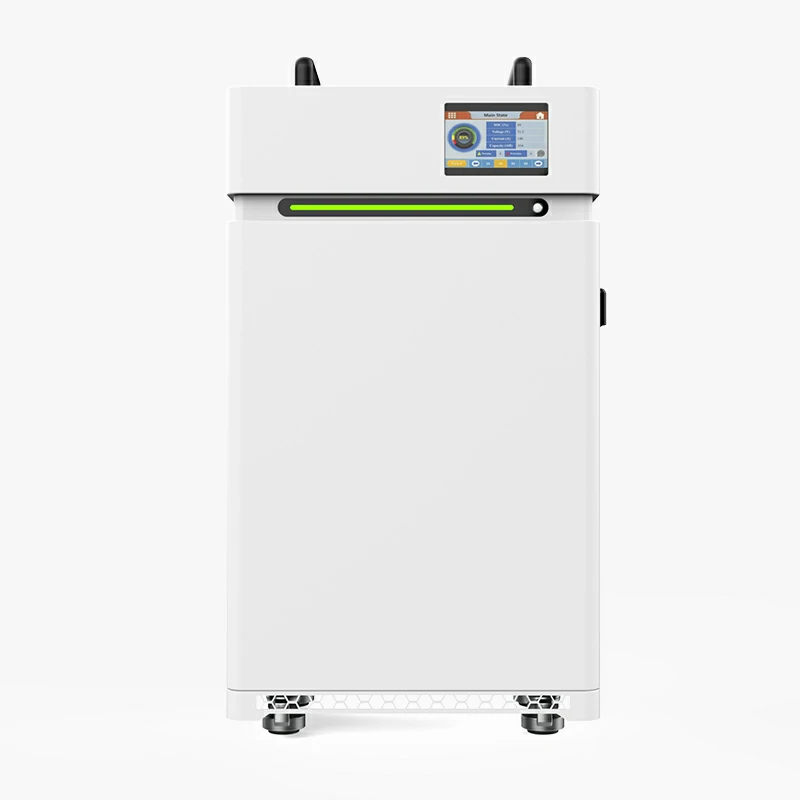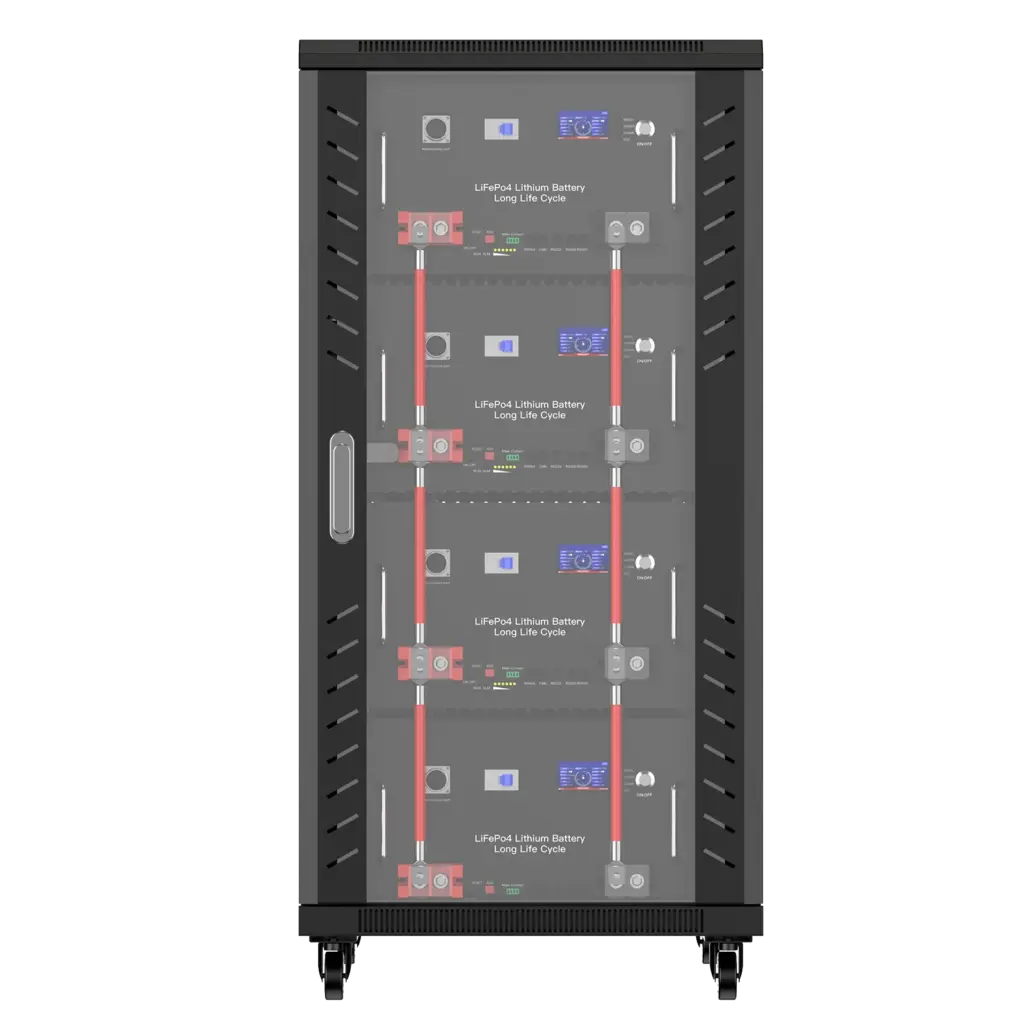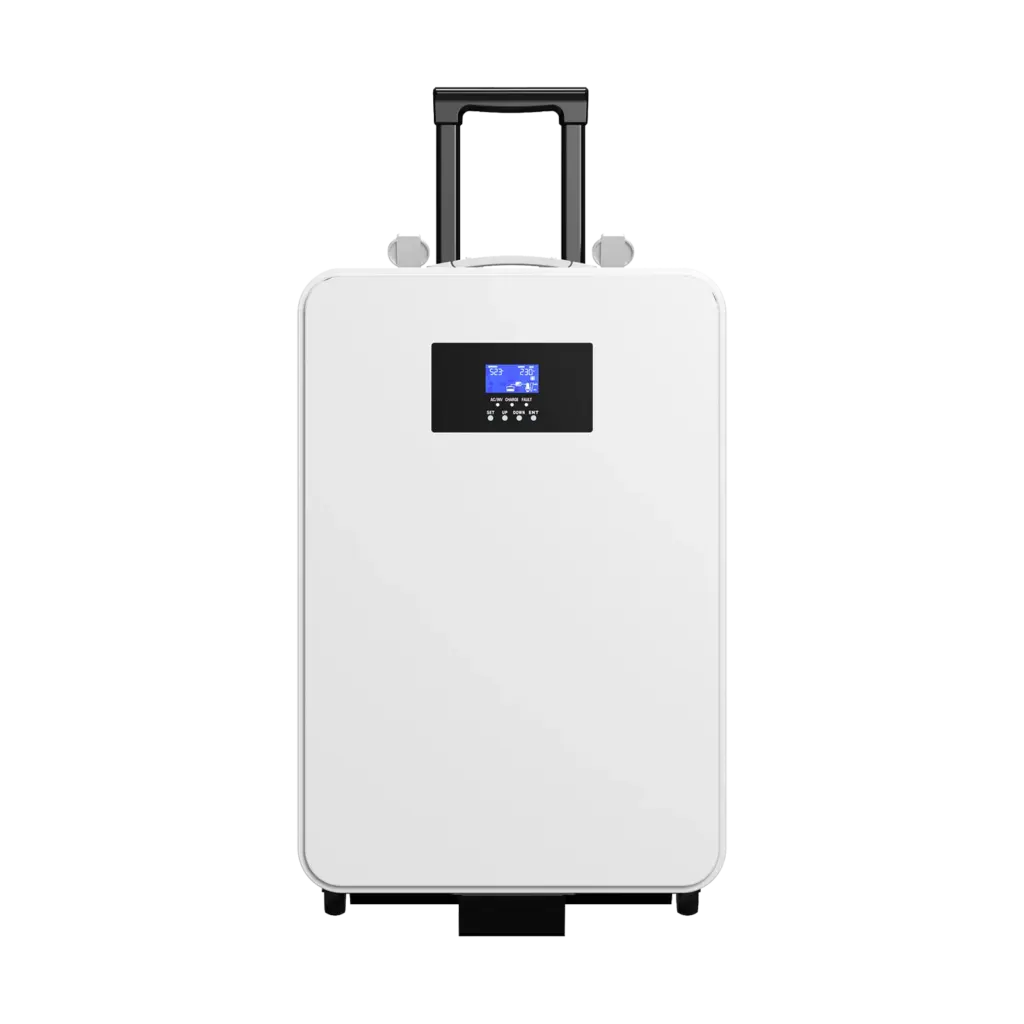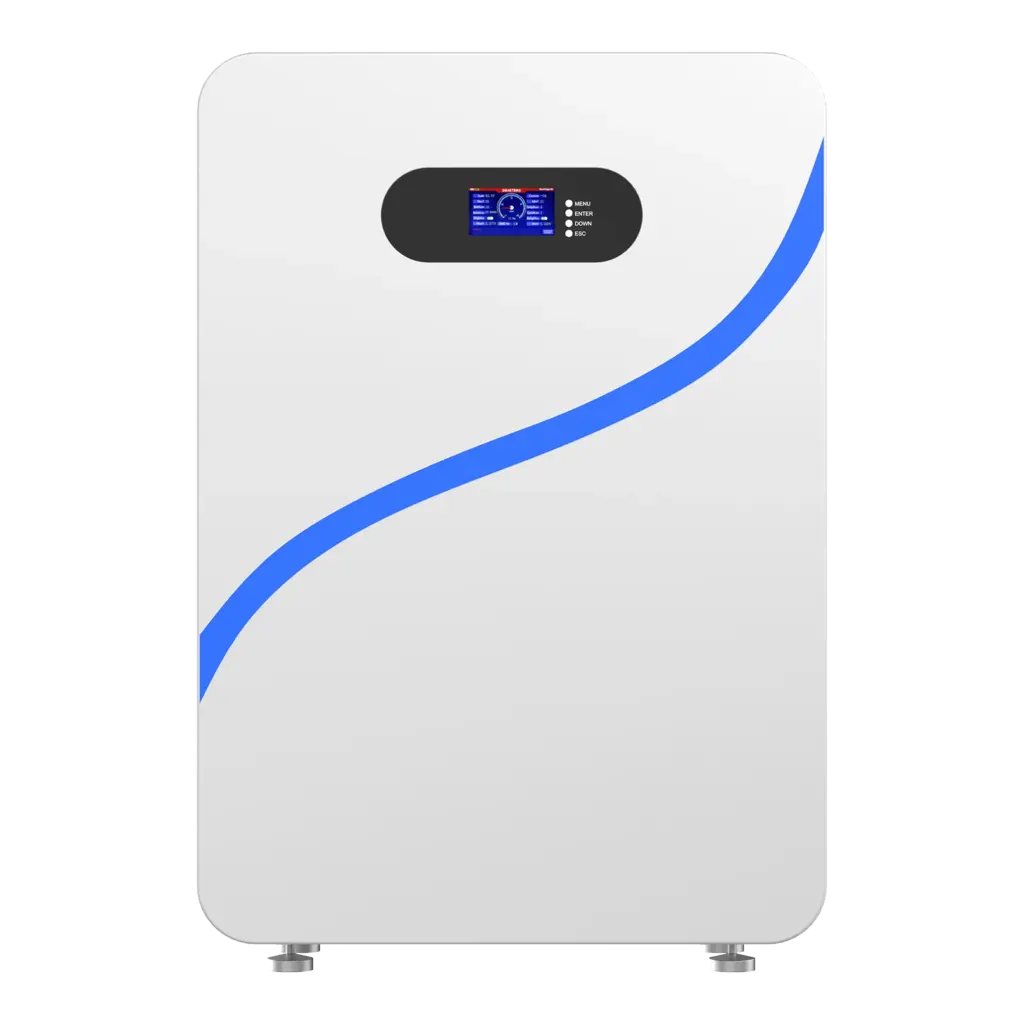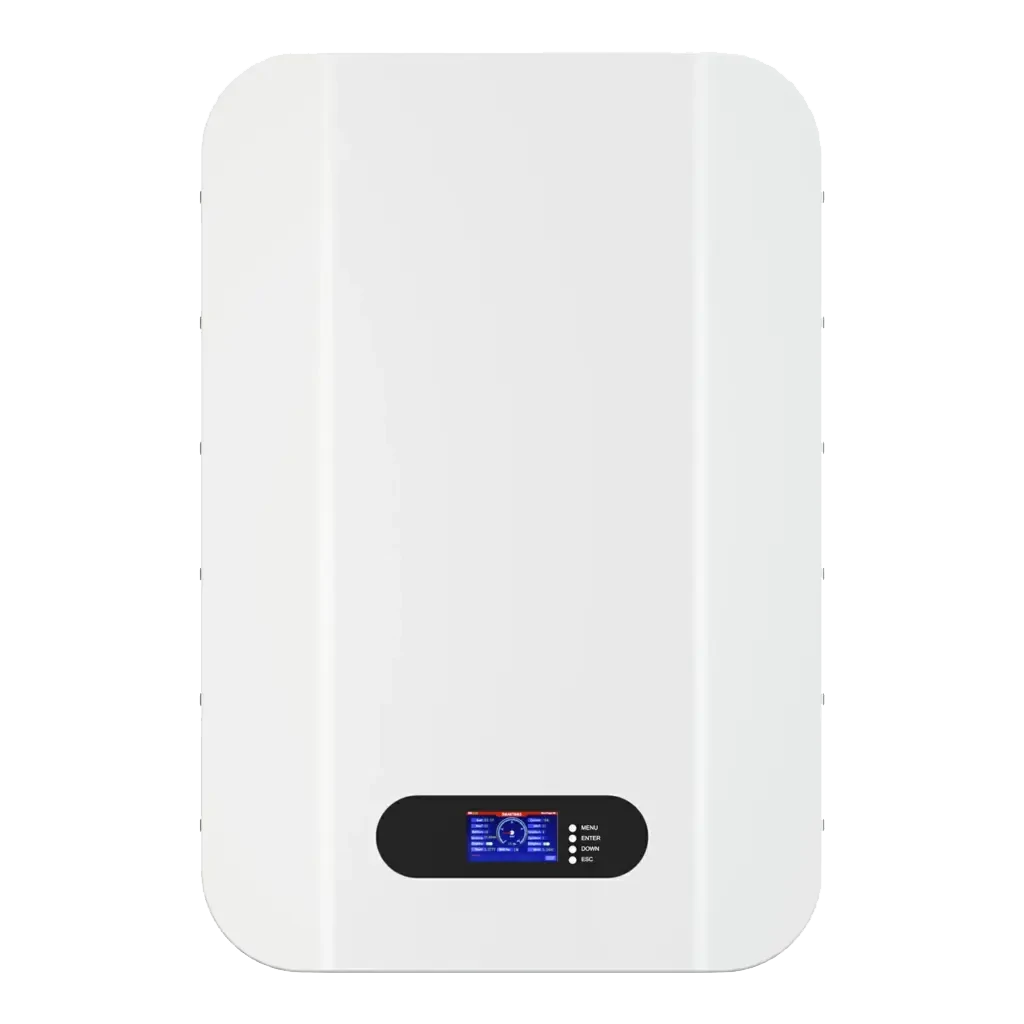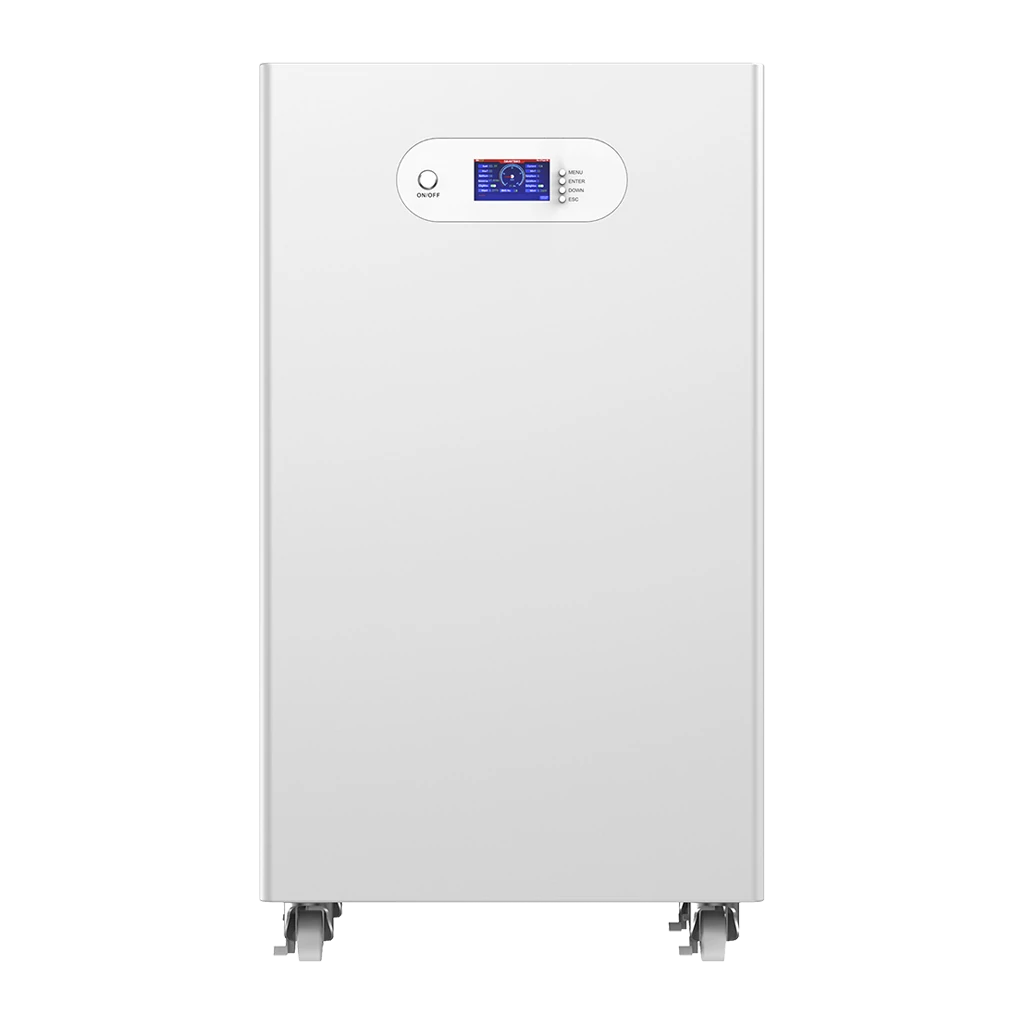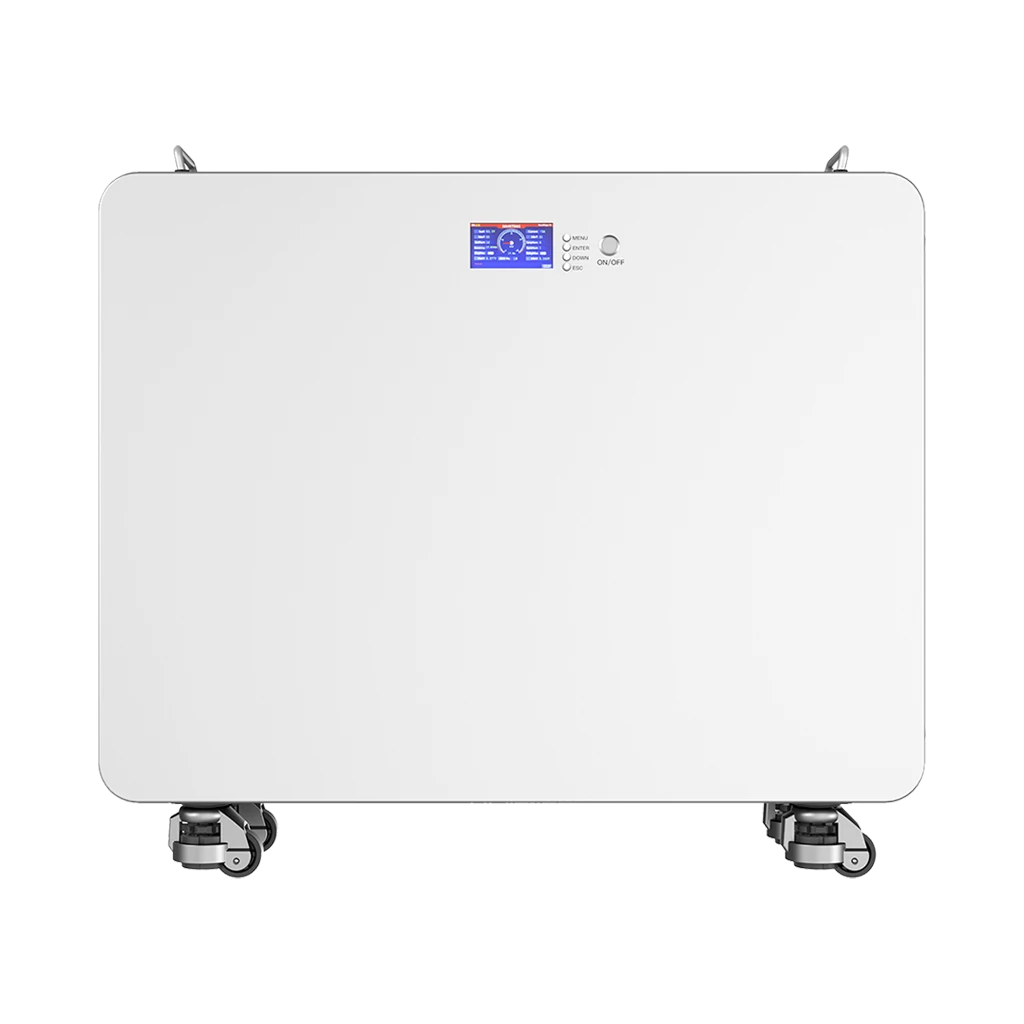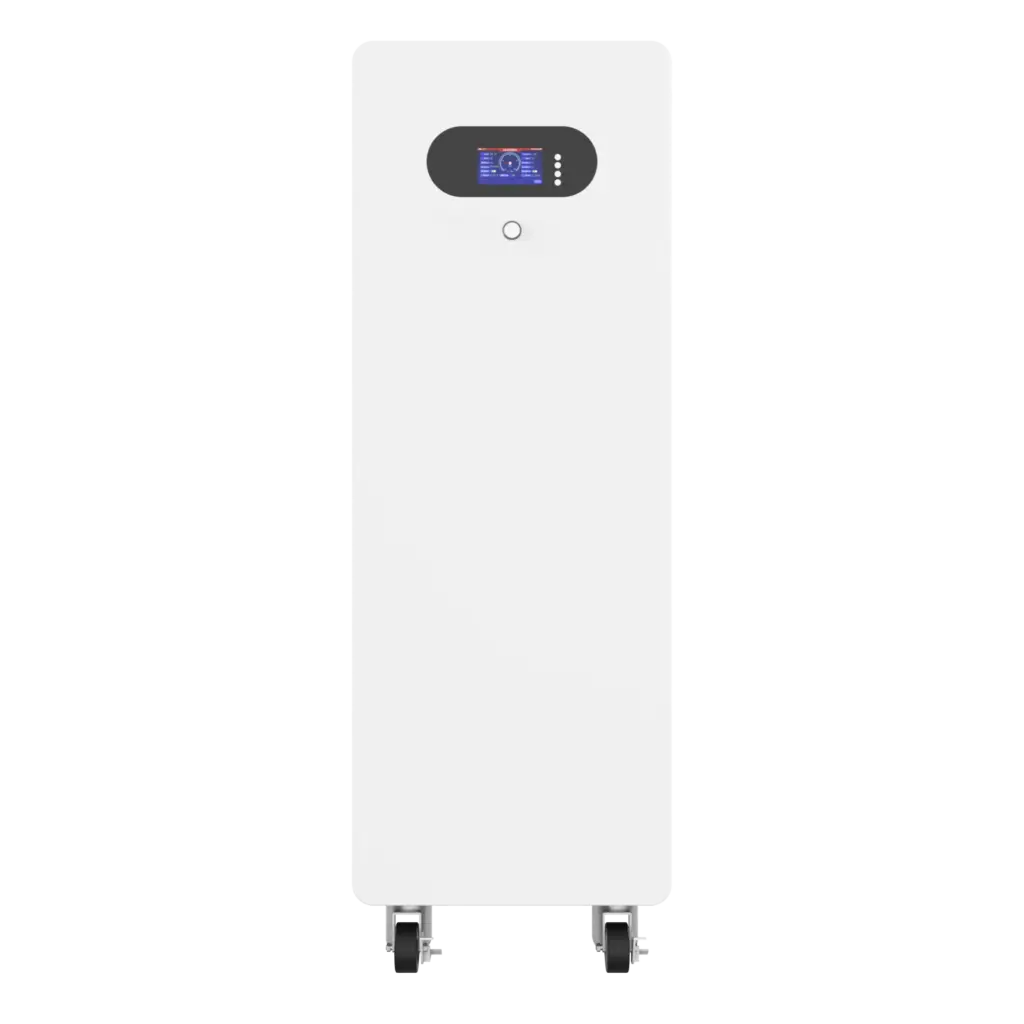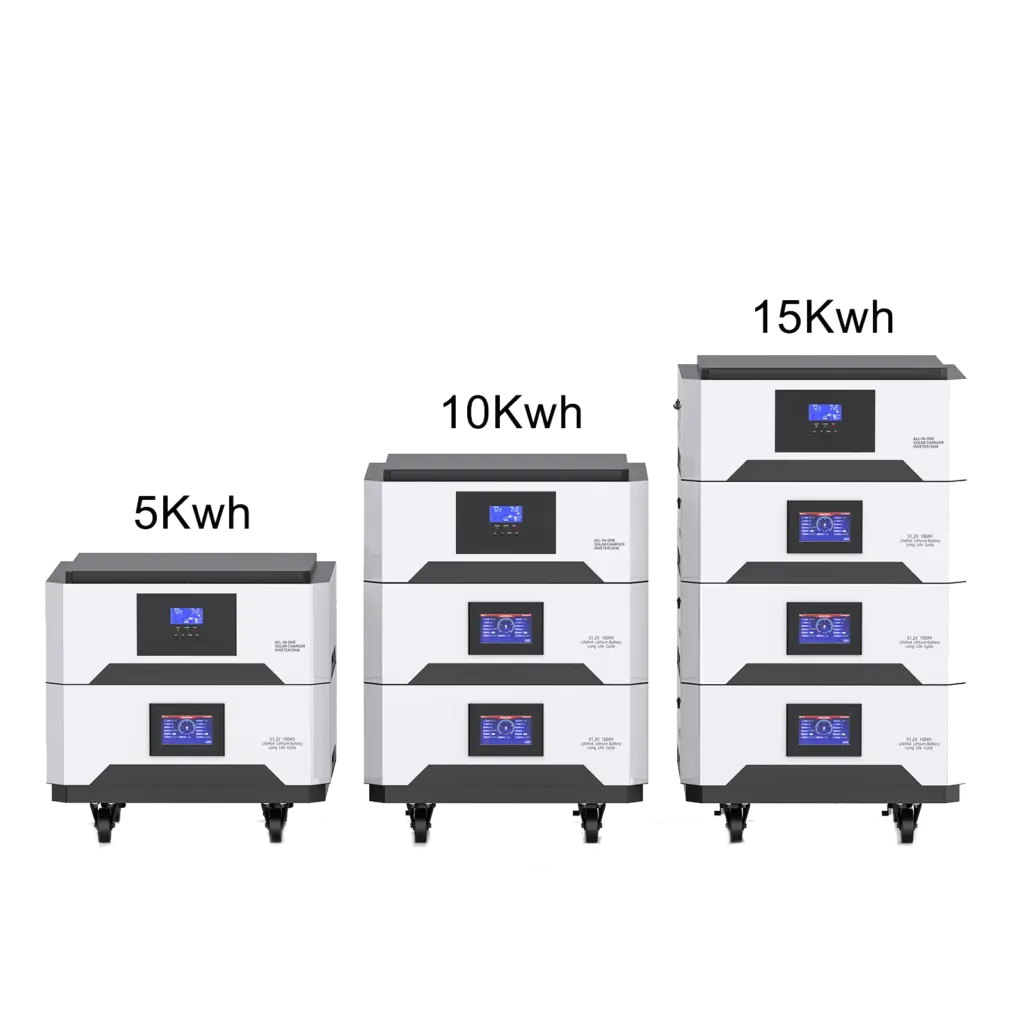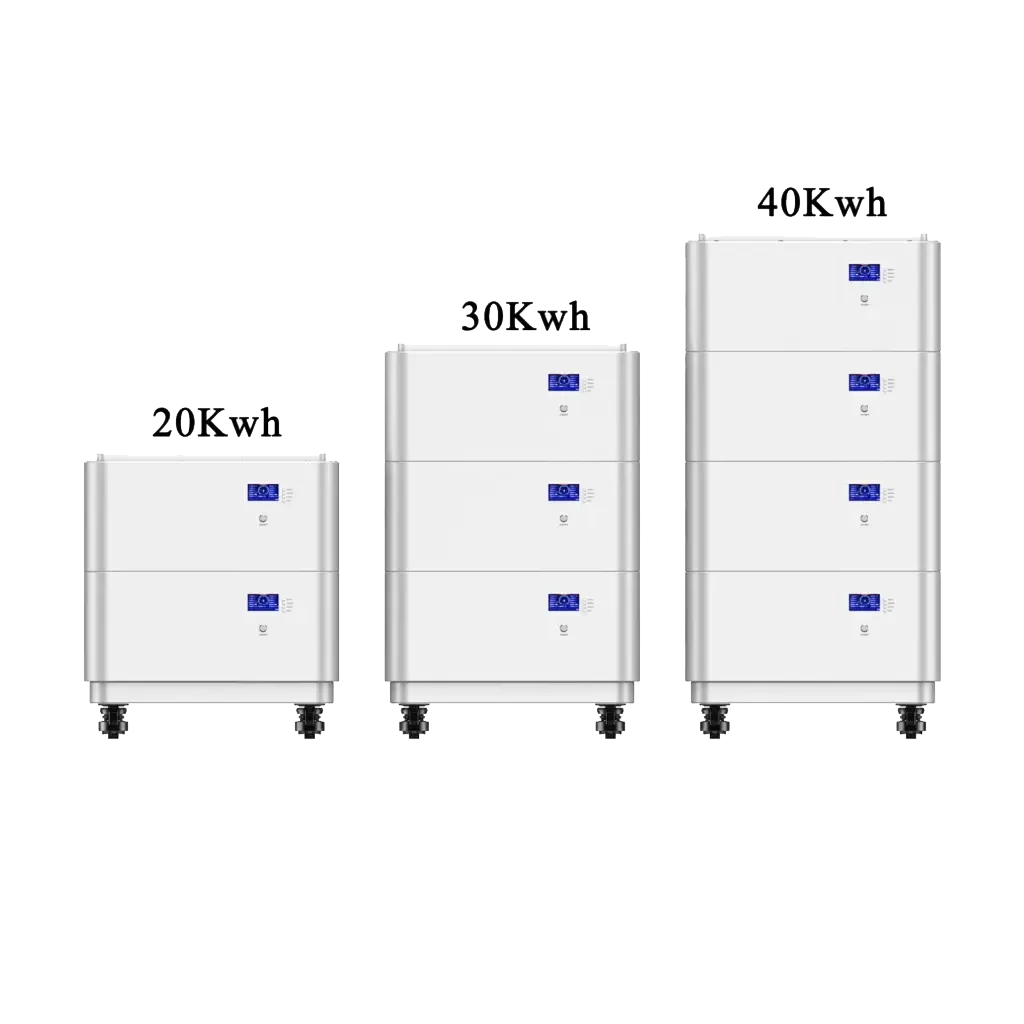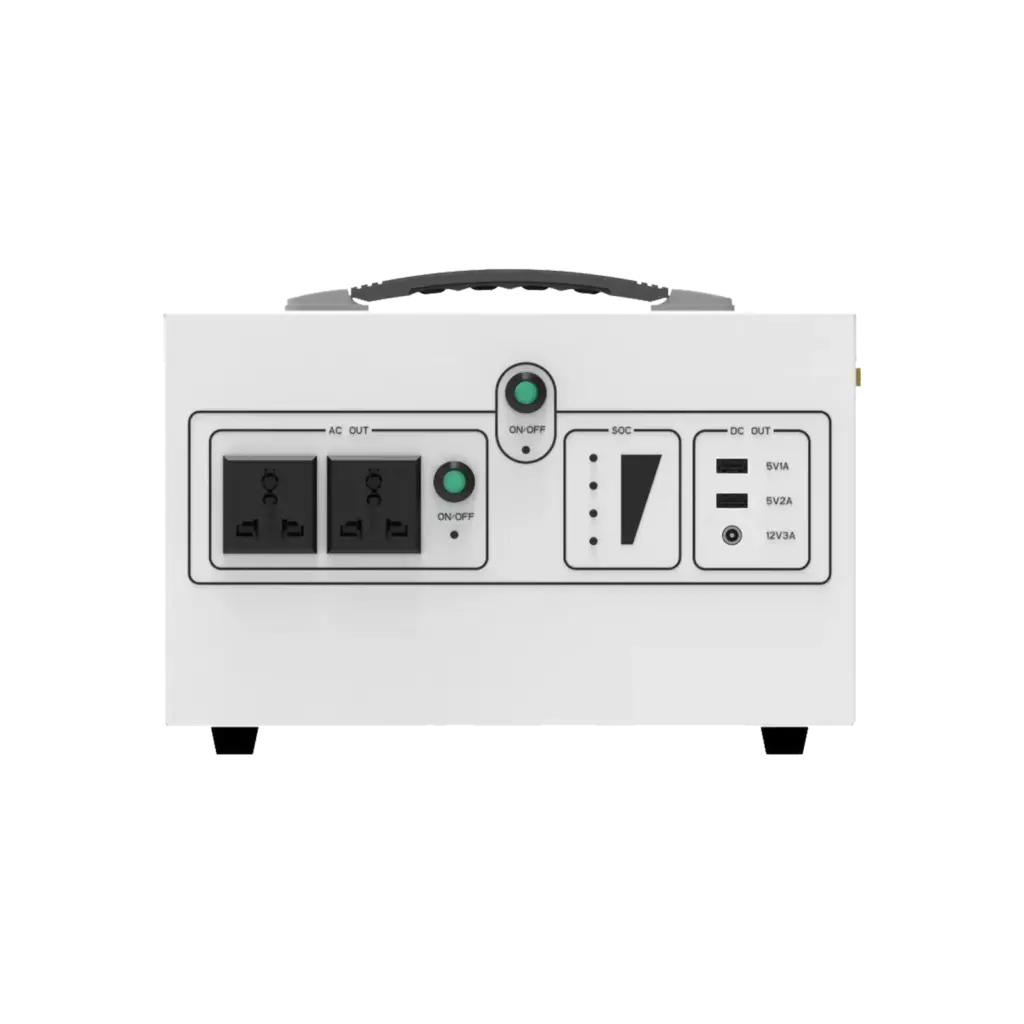

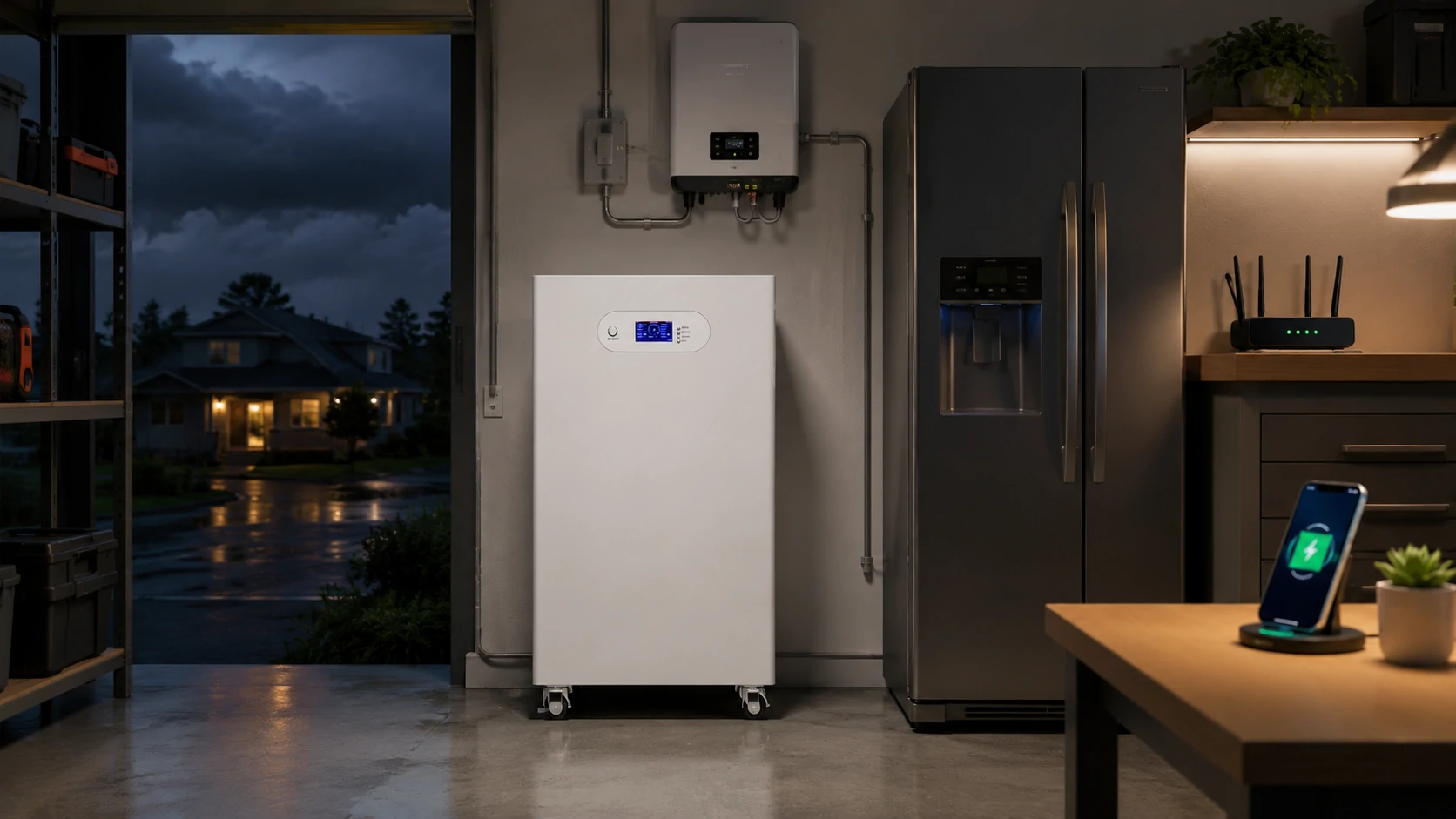
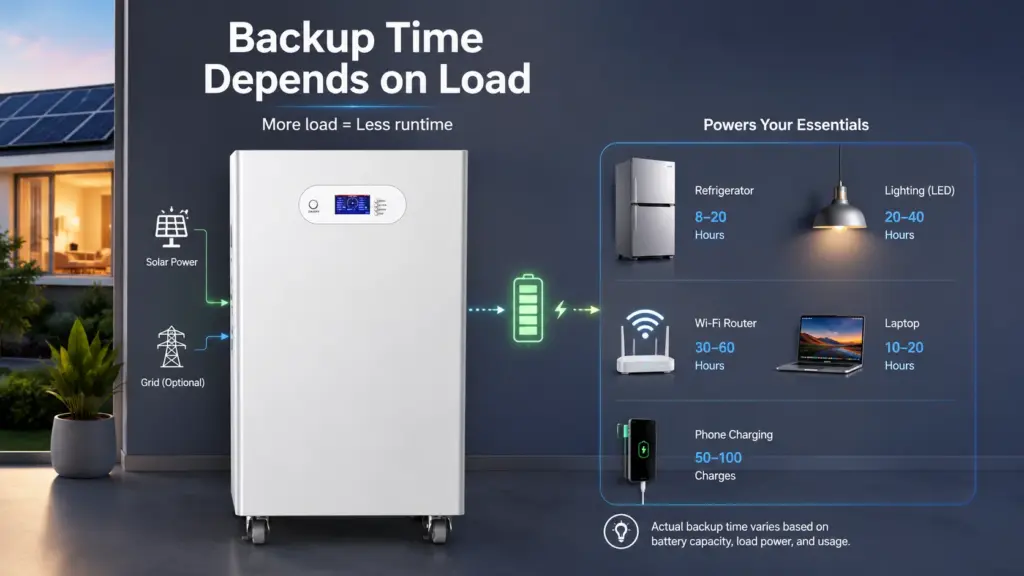
A solar battery will usually last from a few hours to more than 24 hours during a power outage, depending on battery capacity, the appliances you run, the battery’s usable energy, and whether your solar panels can recharge it during the day. As a practical rule, a 10kWh home battery can often keep essential loads such as a refrigerator, lights, Wi-Fi, phone charging and a few outlets running for around one day. If you try to run central air conditioning, electric heating, ovens, pumps or other heavy loads, the same battery may last only a few hours.
The best answer is not one fixed number. It is a simple calculation:
Backup time = usable battery energy ÷ average backup load
For example, if your battery has 9kWh of usable energy and your essential loads average 500W, your estimated backup time is:
9kWh ÷ 0.5kW = 18 hours
If your loads average 1.5kW, the same battery may last:
9kWh ÷ 1.5kW = 6 hours
This is why two homes with the same solar battery can experience very different outage performance.
Quick Answer: Solar Battery Backup Time by Capacity
| Battery Size | Light Essential Loads 300W | Moderate Loads 800W | Heavy Loads 2,000W |
|---|---|---|---|
| 5kWh | 12–15 hours | 4–6 hours | 1.5–2 hours |
| 10kWh | 24–30 hours | 9–11 hours | 3.5–4.5 hours |
| 15kWh | 36–45 hours | 14–17 hours | 5–7 hours |
| 20kWh | 48–60 hours | 18–22 hours | 7–9 hours |
| 30kWh | 72+ hours | 28–34 hours | 11–13 hours |
These are practical estimates, not guaranteed runtimes. Actual backup time depends on usable capacity, inverter efficiency, battery reserve settings, appliance power demand and solar recharge conditions.
For homes, villas, apartments and small energy storage projects, Avepower’s home energy storage systems are designed to store solar energy, support backup power and improve energy independence.
Need a Solar Battery Sized for Real Backup Time?
Not sure whether your project needs 5kWh, 10kWh, 20kWh or a larger system? Avepower can help you calculate backup runtime based on real loads, inverter type and outage duration.
What Determines How Long a Solar Battery Lasts?
The runtime of a solar battery during an outage depends on six main factors:
- Battery capacity: A larger kWh battery stores more energy.
- Usable capacity: Not all rated capacity is always available after DoD limits, reserve settings and efficiency losses.
- Appliance load: High-power appliances drain the battery much faster.
- Backup circuit design: Essential-load backup lasts longer than whole-home backup.
- Solar recharge: Daytime PV generation can extend backup time.
- Inverter output: The inverter must be able to support the running and starting power of connected loads.
A solar-plus-storage system is different from solar panels alone. Most residential solar systems shut off during a grid outage for safety unless they include the right inverter and storage configuration. For outage backup, the system needs a battery and a properly configured inverter that can isolate from the grid and supply selected loads.
Rated Capacity vs Usable Capacity
When you see a battery labeled as 10kWh, that is usually the nominal or rated capacity. The usable capacity may be lower after considering:
- Depth of discharge limit
- Battery reserve setting
- Inverter conversion efficiency
- Battery age and temperature
- BMS protection limits
- Installer settings for emergency backup reserve
For a simple estimate, many homeowners and installers use this formula:
Usable energy = battery capacity × usable DoD × inverter efficiency
Example:
| Battery Size | DoD | Inverter Efficiency | Estimated Usable Energy |
|---|---|---|---|
| 5kWh | 90% | 92% | 4.14kWh |
| 10kWh | 90% | 92% | 8.28kWh |
| 15kWh | 90% | 92% | 12.42kWh |
| 20kWh | 90% | 92% | 16.56kWh |
This is one reason LiFePO4 batteries are widely used in home energy storage. They are designed for deep-cycle use, stable daily cycling and long service life. Avepower’s home energy storage battery systems use LiFePO4 technology for solar storage, backup power and energy independence.
What Loads Can a Solar Battery Run During an Outage?
A solar battery lasts longer when you prioritize essential loads. Below are common household loads.
| Appliance or Load | Typical Running Power |
|---|---|
| Wi-Fi router | 10–25W |
| LED lights | 50–150W total |
| Refrigerator | 100–250W average |
| Laptop | 40–100W |
| TV | 80–200W |
| Sump pump | 500–1,500W |
| Microwave | 1,000–1,500W |
| Electric kettle | 1,500–2,000W |
| Window AC | 700–1,500W |
| Central AC | 3,000–5,000W+ |
| Electric heater | 1,500W+ |
For most homes, the smartest outage strategy is not to run everything. It is to keep the refrigerator, internet, lighting, phone charging, security equipment, medical devices if required, and selected outlets online.
Essential Loads vs Whole-Home Backup
There are two common backup designs:
| Backup Type | What It Powers | Best For |
|---|---|---|
| Essential-load backup | Refrigerator, lights, Wi-Fi, selected outlets, garage door, security system | Longer runtime, lower cost, most common residential choice |
| Whole-home backup | Most or all circuits, possibly HVAC and kitchen appliances | Larger homes, premium backup, higher capacity and inverter requirements |
If your goal is to ride through short outages, a 5kWh to 10kWh battery may be enough for essential circuits. If your goal is overnight comfort, refrigeration, lighting and some appliance use, 10kWh to 20kWh is more practical. If your goal is whole-home backup with HVAC, pumps or EV-related loads, you may need 20kWh, 30kWh or a larger custom system.
Avepower’s wall-mounted LiFePO4 battery series is suitable for compact residential backup projects, while the stackable LiFePO4 battery series is better when installers or distributors need a modular system that can expand from smaller residential backup to larger home storage configurations.
Can Solar Panels Recharge the Battery During an Outage?
Yes, but only if the system is designed for backup operation. A standard grid-tied solar system may shut down during a power outage for safety reasons. To keep working during an outage, the system typically needs a backup-capable inverter, battery storage and proper isolation from the grid.
If your system is correctly configured, solar panels can recharge the battery during the day. This can greatly extend backup time, especially during multi-day outages.
Solar recharge depends on:
- Solar array size
- Weather and sunlight
- Season
- Shading
- Battery state of charge
- Inverter settings
- Household load during the day
A solar battery may last one night on stored power alone. With enough daytime solar recharge, it may support essential loads for several days.
Solar Battery Backup Example Scenarios
Scenario 1: Short Evening Outage
A small home needs to run:
| Load | Power |
|---|---|
| Refrigerator | 150W average |
| Wi-Fi router | 20W |
| LED lights | 80W |
| Phone and laptop charging | 100W |
| Total | 350W |
With a 10kWh battery and about 8.5–9kWh usable energy:
9kWh ÷ 0.35kW = about 25.7 hours
This setup can often cover an evening outage and continue into the next day.
Scenario 2: Overnight Family Backup
A family home runs:
| Load | Power |
|---|---|
| Refrigerator | 180W |
| Freezer | 120W |
| Wi-Fi and security | 50W |
| Lights | 150W |
| TV and small devices | 200W |
| Total | 700W |
With a 10kWh battery:
9kWh ÷ 0.7kW = about 12.8 hours
With a 20kWh battery:
18kWh ÷ 0.7kW = about 25.7 hours
This is why a 20kWh system is often more comfortable for families that want overnight backup plus some normal household use.
Scenario 3: Whole-Home Backup With High Loads
A larger home runs lights, refrigerator, internet, a well pump, cooking appliances and air conditioning. Average load may reach 2–4kW or more.
With a 10kWh battery:
9kWh ÷ 3kW = about 3 hours
With a 30kWh battery:
27kWh ÷ 3kW = about 9 hours
For this type of project, battery capacity is only one part of the design. The inverter output, surge capacity, wiring, protection, communication protocol and battery BMS must all match the load profile.
For high-power residential or commercial backup, Avepower can also support custom high-voltage battery storage systems where the voltage platform, cabinet layout, BMS communication and capacity are designed around the project.
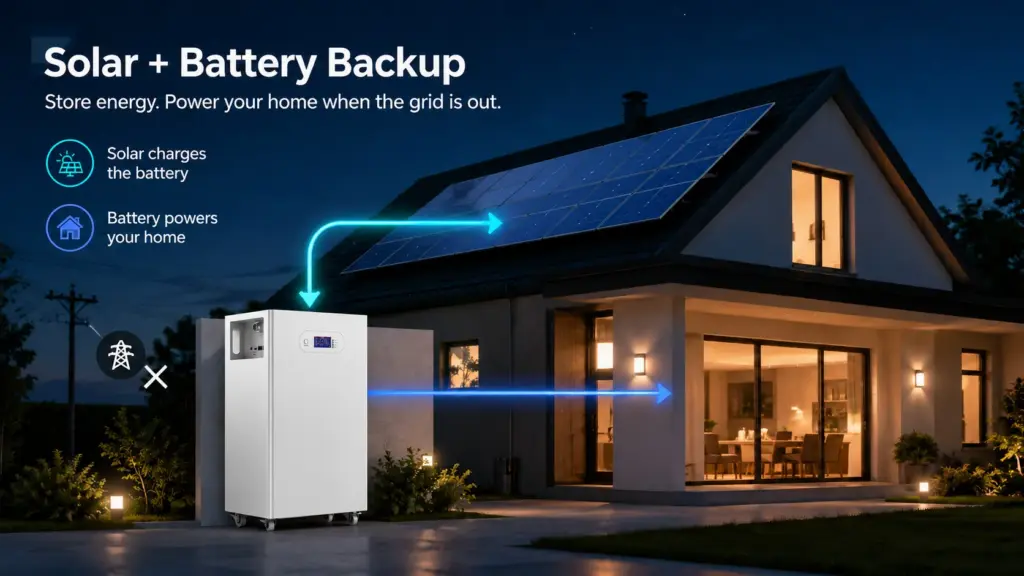
Build Reliable Backup Systems with Avepower LiFePO4 Batteries
Avepower provides customized LiFePO4 battery solutions for residential solar storage, backup power and installer-led energy projects.
How to Calculate the Solar Battery Size You Need
Use this simple process:
- List the appliances that must stay on.
- Write down the running wattage of each appliance.
- Estimate how many hours each appliance will run.
- Convert watts to kilowatt-hours.
- Add a reserve margin of 15–30%.
- Check inverter power and surge requirements.
- Confirm whether solar can recharge the battery during outage mode.
Formula:
Energy needed = appliance watts × hours ÷ 1,000
Example:
| Load | Watts | Hours | Energy |
|---|---|---|---|
| Refrigerator | 150W | 24h | 3.6kWh |
| Wi-Fi | 20W | 24h | 0.48kWh |
| Lights | 100W | 6h | 0.6kWh |
| Laptop and phones | 120W | 5h | 0.6kWh |
| TV | 120W | 3h | 0.36kWh |
| Total | 5.64kWh |
Add a 25% reserve:
5.64kWh × 1.25 = 7.05kWh
In this case, a 10kWh battery is a reasonable minimum for one day of essential backup.
What Size Solar Battery Is Best for Outages?
| Backup Goal | Recommended Battery Range |
|---|---|
| Router, lights, phone charging only | 2–5kWh |
| Refrigerator, lights, Wi-Fi, basic outlets | 5–10kWh |
| Full essential-load panel overnight | 10–15kWh |
| 24-hour family backup with comfort loads | 15–25kWh |
| Larger home or partial HVAC support | 20–40kWh |
| Whole-home or small commercial backup | Custom 30kWh+ system |
Avepower offers flexible options for these different project levels, including residential battery energy storage systems, wall-mounted batteries, stackable batteries and customized ESS solutions for installers, distributors and OEM/ODM buyers.
Why LiFePO4 Is a Strong Choice for Backup Power
LiFePO4 batteries are commonly used in modern solar storage because they offer:
- Long cycle life
- Stable chemistry
- Deep-cycle performance
- High safety profile
- BMS protection
- Modular expansion
- Compatibility with common hybrid and off-grid inverter systems
Avepower LiFePO4 home energy storage products are designed for residential solar storage, backup power, installer-led projects, distribution channels and custom battery programs. Product options include wall-mounted batteries, stackable batteries, rack-mounted batteries, vertical batteries and project-based high-voltage systems.
For installers and distributors, this matters because outage backup is not only a battery sale. It is a system design task. Battery capacity, inverter communication, discharge current, cable sizing, protection devices and local installation standards all affect the final user experience.
Common Mistakes That Reduce Backup Time
Avoid these mistakes when planning outage backup:
- Assuming rated capacity equals usable capacity.
- Backing up the whole home when only essential circuits are needed.
- Trying to run electric heating from a small battery.
- Ignoring inverter surge requirements for pumps and compressors.
- Forgetting that cloudy weather reduces solar recharge.
- Setting the backup reserve too low.
- Choosing a battery that does not match the inverter protocol.
- Installing a system without a proper backup gateway or transfer function.
- Overselling runtime without checking the real load profile.
The safest approach is to size the battery around real loads, not generic averages.
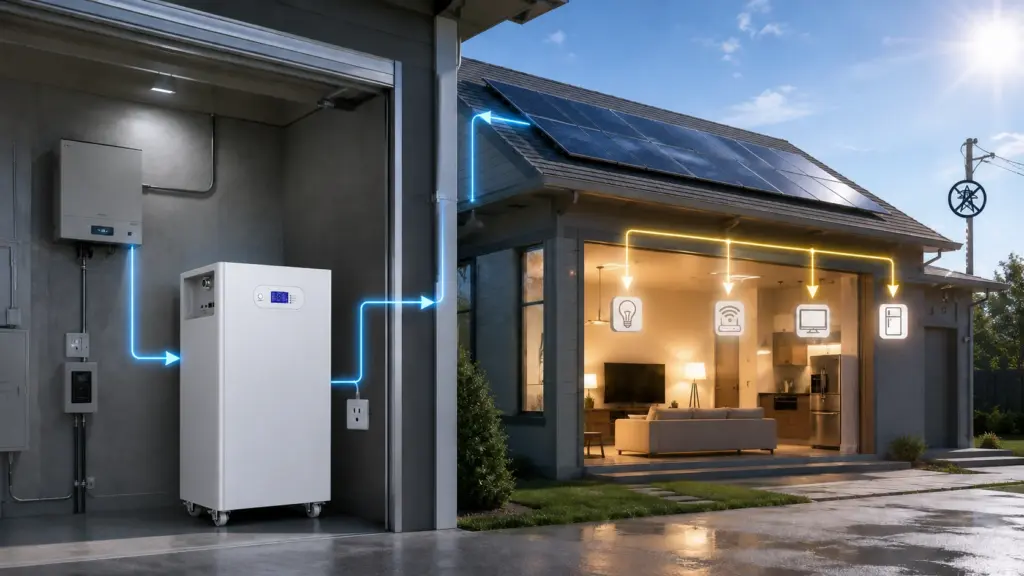
Can a Solar Battery Run Air Conditioning?
Yes, a solar battery can run air conditioning, but it depends on the battery capacity, inverter output, AC power demand, and how long you want the AC to run.
A small window AC or mini-split may run for several hours on a properly sized battery system. Central air conditioning uses much more power and often needs a larger battery bank, a high-output inverter, and careful surge-current planning.
Key factors:
- AC power rating: Larger AC units drain batteries faster.
- Battery capacity: A 10kWh battery may only run AC for a few hours.
- Inverter size: The inverter must handle both running power and startup surge.
- Solar recharge: Daytime solar can extend runtime during an outage.
- Other loads: Refrigerator, lights, Wi-Fi, and appliances will reduce available backup time.
For reliable AC backup, installers should calculate the AC’s running watts, startup surge, expected runtime, and total home loads before choosing the battery size. For most homes, air conditioning backup usually requires a larger system than basic essential-load backup.
Does a Solar Battery Work at Night During an Outage?
Yes. A solar battery can work at night during a power outage because it stores electricity generated earlier by your solar panels or charged from the grid.
During the day, your solar system can charge the battery. At night, when solar panels are not producing power, the battery discharges stored energy to run essential loads such as lights, Wi-Fi, refrigerator, phone charging, security systems, and selected outlets.
However, the battery will only last as long as its stored energy allows. If you run low-power essentials, it may last through the night. If you run heavy loads like air conditioning, electric heating, ovens, or pumps, the battery will drain much faster.
For best nighttime backup performance:
- Keep only essential circuits running.
- Avoid high-power appliances.
- Make sure the battery is charged before nightfall.
- Use a backup-capable inverter and proper transfer system.
- Size the battery based on your overnight load demand.
For a deeper system explanation, Avepower’s guide to a home solar system with battery storage explains how solar panels, inverters, batteries and home loads work together.
Solar Battery Backup for Installers, Distributors and OEM Buyers
For B2B buyers, the better question is: What battery platform gives customers the backup time they expect while staying compatible, safe and scalable?
Avepower supports installers, distributors, wholesalers and OEM/ODM customers with LiFePO4 battery products for different project levels:
| Buyer Type | Typical Need | Suitable Avepower Direction |
|---|---|---|
| Residential installer | 5–20kWh backup systems | Wall-mounted or stackable LiFePO4 batteries |
| Distributor | Flexible stock for different home sizes | 5kWh, 10kWh, 15kWh and expandable systems |
| Solar EPC | Project-based storage design | Residential ESS or high-voltage ESS |
| OEM/ODM buyer | Custom brand, capacity, appearance, BMS logic | Customized battery solutions |
| C&I project developer | Backup, peak shaving, load shifting | High-voltage or cabinet ESS |
For smaller residential backup, start with Avepower’s wall-mounted battery series. For flexible expansion, consider the stackable solar battery series. For larger power or commercial applications, review Avepower’s high-voltage battery storage system.
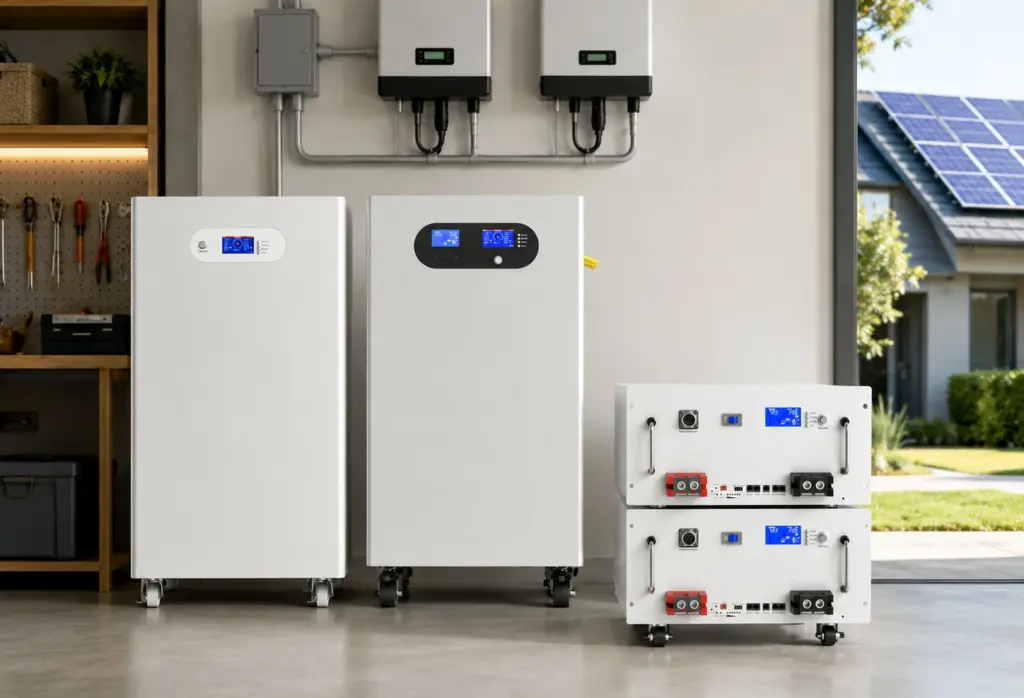
Take Control of Your Energy with Avepower!
Reliable home solar battery solutions with OEM/ODM customization and in-house manufacturing, tailored to the needs of distributors, installers, and energy partners.
Final Answer: How Long Will It Last?
A solar battery can last:
- A few hours if you run heavy loads such as AC, electric heating, ovens or pumps.
- Around 12–24 hours if you run essential household loads from a 10kWh battery.
- More than 24 hours if you use a larger battery bank or reduce loads.
- Multiple days if the system is paired with enough solar panels and daytime weather allows regular recharging.
The most accurate way to estimate runtime is to calculate your essential loads in kWh, apply usable battery capacity, and check whether your solar system can recharge the battery during outage mode.
For homeowners, the goal is peace of mind. For installers and distributors, the goal is a battery system that matches the customer’s real backup expectation. Avepower’s LiFePO4 home energy storage systems provide a scalable product platform for solar backup, self-consumption, outage protection and long-term energy independence.
FAQ
A 10kWh solar battery may last around 12–24 hours for essential loads. If the home runs heavy appliances such as air conditioning, electric heating or cooking equipment, runtime can drop to only a few hours.
Yes, but whole-home backup usually requires more battery capacity and a larger inverter than essential-load backup. Many homes need 20kWh to 40kWh or more for meaningful whole-home outage support.
They can, but only if the system is designed for backup operation. Most standard grid-tied solar systems shut down during outages unless paired with a compatible battery, inverter and transfer or backup control system.
Electric heating, central AC, ovens, kettles, dryers, pumps and other high-power appliances drain batteries fastest. Refrigerators, LED lights, routers and phone chargers use much less energy.
A 5kWh battery can support basic loads such as lights, Wi-Fi, phone charging and possibly a refrigerator for a limited period. For overnight family backup, 10kWh or more is usually more practical.
LiFePO4 is a strong choice for solar backup because it offers long cycle life, stable chemistry, deep-cycle performance and strong safety characteristics when managed by a quality BMS.
For essential loads, many homes can start with 10kWh to 20kWh. For whole-home backup or HVAC loads, the required capacity may be much higher. The correct size depends on your actual load profile.
Start with the customer’s critical loads, expected outage duration, inverter model, solar size, installation environment and future expansion needs. Then choose the battery capacity and architecture around those real requirements.