
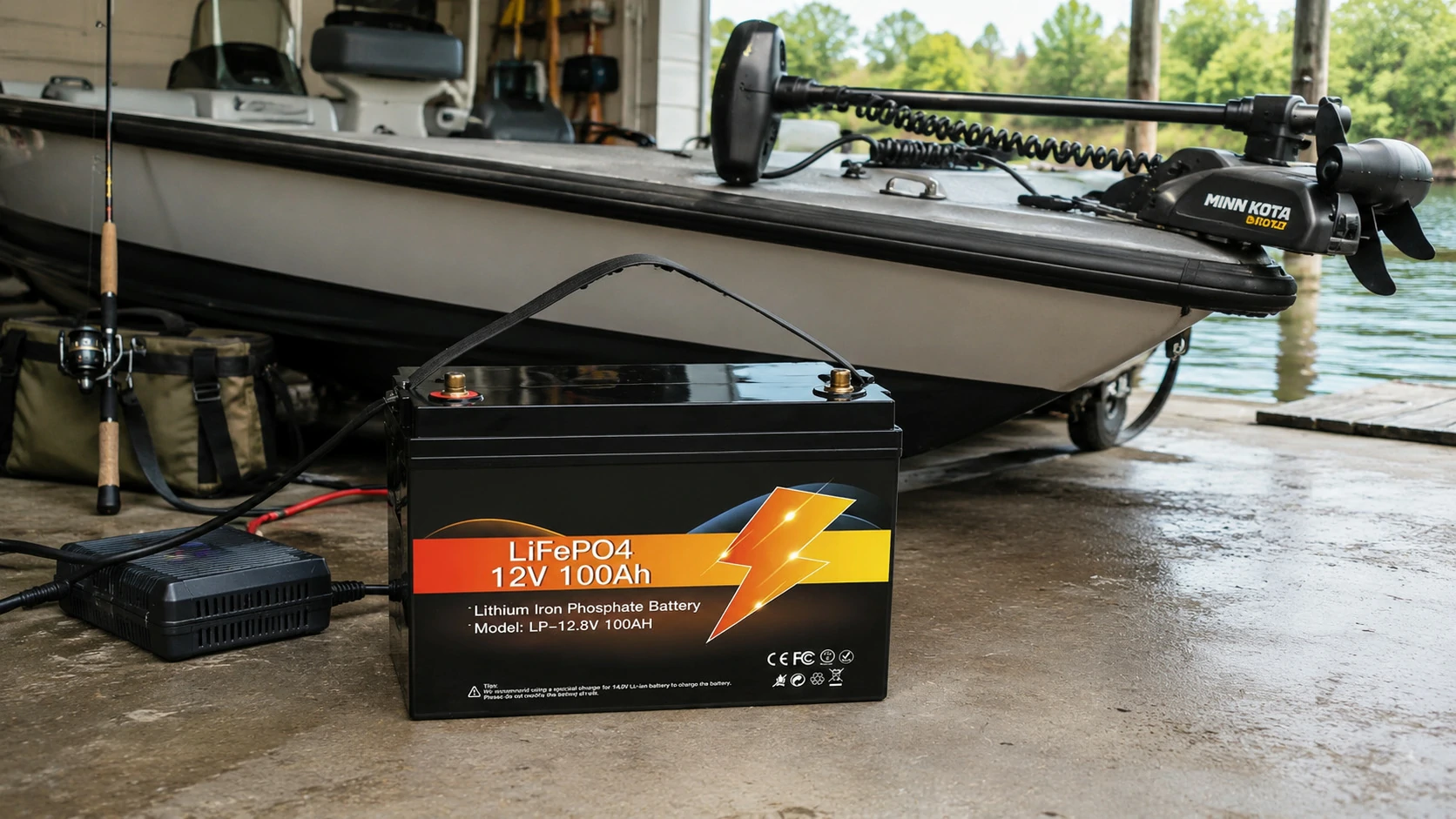
Choosing the right lithium battery for a 12V trolling motor is not only about buying the largest battery you can fit in the boat. A better way to think about it is this: how much current does your trolling motor draw, how long do you want to stay on the water, and how much reserve capacity do you need when wind, current, weeds, boat weight or repeated repositioning makes the motor work harder?
For most anglers searching for what size lithium battery for 12v trolling motor, the practical answer is simple: a 12V 100Ah LiFePO4 battery is the best starting point for many 30 lb to 55 lb trolling motors. Smaller kayaks and short calm-water trips may be fine with 30Ah to 50Ah. Long fishing days, heavier boats, strong wind, river current or frequent high-speed use often justify 120Ah, 150Ah, 200Ah or two matched 12V lithium batteries in parallel.
Avepower’s recommendation is to size the battery from real current draw and runtime needs, not from thrust rating alone. A 55 lb trolling motor can pull close to its maximum current at full speed, but it may draw much less current when used only for slow positioning. That is why two boat owners with the same 12V motor may need very different battery capacities.
Quick Answer: Best Lithium Battery Size for a 12V Trolling Motor
If you want a fast decision, use this guide.
| 12V Trolling Motor Use Case | Recommended Lithium Battery Size | Best For |
|---|---|---|
| Small kayak or canoe, short calm-water trips | 12V 30Ah to 50Ah | Light use and low weight |
| Kayak or inflatable boat, half-day fishing | 12V 50Ah to 100Ah | Better reserve without too much weight |
| 30 lb thrust trolling motor | 12V 50Ah to 100Ah | Small boats and moderate use |
| 40 lb to 45 lb thrust trolling motor | 12V 100Ah | General fishing use |
| 50 lb to 55 lb thrust trolling motor | 12V 100Ah minimum | Common small boat setup |
| 55 lb thrust, windy lakes or long days | 12V 150Ah to 200Ah | Longer runtime and reserve capacity |
| Heavy 12V setup with accessories | 12V 200Ah or 2 × 100Ah in parallel | Long runtime while staying at 12V |
For most 12V trolling motor users, a 12V 100Ah LiFePO4 battery is the most balanced option. If your fishing style involves long days, strong current, heavier boats or frequent full-speed operation, a 12V 200Ah LiFePO4 battery gives more usable reserve.
Understanding Amp-Hours (Ah) and Your Motor’s Needs
Amp-hours, written as Ah, describe how much current a battery can theoretically deliver over time. A 100Ah battery can theoretically deliver:
100 amps for 1 hour
50 amps for 2 hours
25 amps for 4 hours
10 amps for 10 hours
In real use, runtime changes because a trolling motor does not always pull the same current. Full speed uses much more power than slow maneuvering. Boat weight, wind, water current, propeller condition, cable length and even hull resistance can all change the actual amp draw.
A simple runtime formula is:
Estimated Runtime = Battery Capacity Ah ÷ Average Motor Current A
For example, if your trolling motor averages 20A and you use a 12V 100Ah lithium battery:
100Ah ÷ 20A = about 5 hours
However, this is only a sizing estimate. Real-world runtime may be shorter if you run at high speed, carry more load, fish in windy conditions or use the motor as your main propulsion source. For practical battery sizing, Avepower recommends adding a 20% to 30% reserve margin instead of sizing the battery to the exact theoretical number.
First Check: Is Your Trolling Motor Really 12V?
Before choosing battery capacity, confirm the required voltage of your trolling motor. Many small and mid-size trolling motors are 12V, but higher-thrust motors often move to 24V or 36V systems.
As a practical rule:
| Motor Thrust | Common Voltage |
|---|---|
| 30 lb | 12V |
| 40 lb to 45 lb | 12V |
| 50 lb to 55 lb | 12V |
| 70 lb to 80 lb | Usually 24V |
| 100 lb+ | Usually 36V |
Minn Kota’s own power guidance states that trolling motors with 55 lb of thrust or less typically need one 12V battery, while higher-thrust motors usually require multiple 12V batteries connected in series for 24V or 36V systems. You can check the official Minn Kota trolling motor power considerations before changing your battery layout.
This matters because wiring batteries incorrectly can damage your motor. If your trolling motor is 12V, you should not connect two 12V batteries in series and send 24V into it. For a 12V motor, additional batteries should normally be connected in parallel to increase amp-hour capacity while keeping system voltage at 12V.
How Much Current Does a 12V Trolling Motor Draw?
The best source is always your trolling motor manual. If you cannot find the exact amp draw, use the table below as a practical field estimate.
| 12V Motor Thrust | Typical Maximum Amp Draw | Practical Battery Choice |
|---|---|---|
| 30 lb | Around 30A | 50Ah to 100Ah |
| 40 lb to 45 lb | Around 40A to 42A | 100Ah |
| 50 lb to 55 lb | Around 50A | 100Ah to 200Ah |
Many 12V trolling motors have a maximum amp draw roughly close to their thrust class. For example, a 30 lb 12V motor may draw around 30A at full power, while a 55 lb 12V motor may draw around 50A.
Maximum amp draw is not the same as average amp draw. If you run at half speed most of the day, your average current may be much lower. If you push a heavy boat into wind or current, the motor may stay near high draw for much longer.
Runtime Examples for 12V Lithium Trolling Motor Batteries
The following table uses estimated average current, not just maximum current. This makes it closer to real fishing use.
| Battery Size | 10A Average Draw | 20A Average Draw | 30A Average Draw | 50A Full-Power Draw |
|---|---|---|---|---|
| 12V 50Ah | 5 hours | 2.5 hours | 1.7 hours | 1 hour |
| 12V 100Ah | 10 hours | 5 hours | 3.3 hours | 2 hours |
| 12V 150Ah | 15 hours | 7.5 hours | 5 hours | 3 hours |
| 12V 200Ah | 20 hours | 10 hours | 6.7 hours | 4 hours |
These numbers are mathematical estimates. Real runtime can change based on wind, water conditions, hull drag, propeller load, cable voltage drop and battery temperature.
If you want to better understand how usable capacity affects battery runtime, read Avepower’s guide to Depth of Discharge in batteries.
Calculating Your Lithium Battery Run Time
Battery Runtime Calculator
Is a 12V 50Ah Lithium Battery Enough for a Trolling Motor?
A 12V 50Ah lithium battery can work well for small boats, kayaks, canoes and short fishing trips. It is usually not the best choice for a full day with a 50 lb or 55 lb trolling motor.
Choose 50Ah if:
- Your boat is small and lightweight
- You use the trolling motor mainly for positioning
- You fish on calm lakes or slow-moving water
- Your trip usually lasts only a few hours
- Saving weight is more important than maximum runtime
Avoid 50Ah if:
- You use a 50 lb or 55 lb trolling motor
- You often run the motor at medium or high speed
- You fish in wind, current or open water
- The trolling motor is your main propulsion source
- You power fish finders, lights or other electronics from the same battery
For kayak anglers, 50Ah can be attractive because it keeps weight low. For a larger fishing boat, 100Ah is usually a more practical baseline.
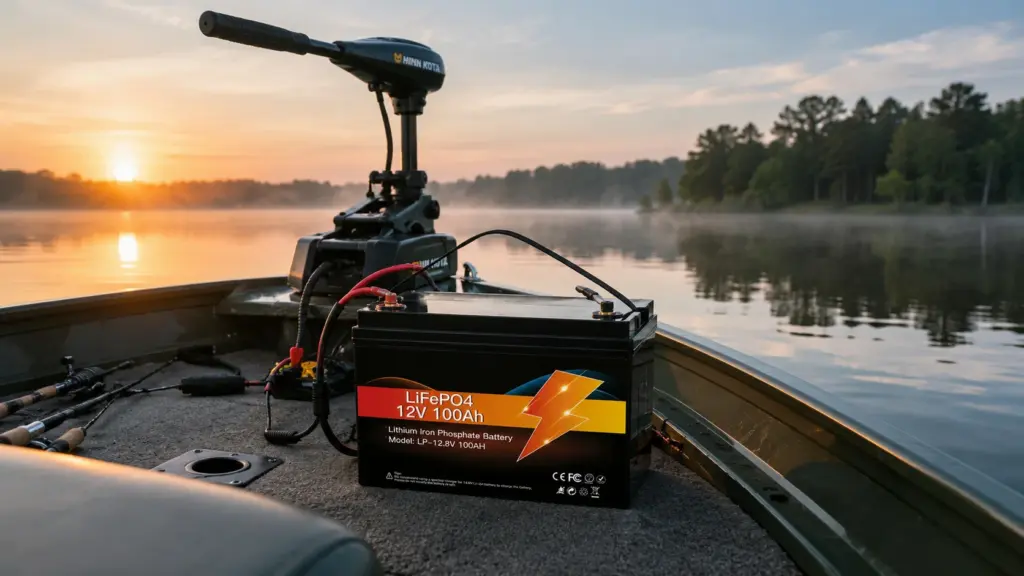
Is a 12V 100Ah Lithium Battery Good for a Trolling Motor?
Yes. A 12V 100Ah lithium battery is the most practical choice for many 12V trolling motors because it balances runtime, weight, price and discharge capability.
Avepower recommends deep-cycle marine batteries with strong amp-hour capacity for trolling motor use, and its trolling motor battery selection guide explains why amp-hour rating matters for longer runtime.
A good 12V 100Ah LiFePO4 battery should have:
- Enough capacity for mixed-speed fishing
- A BMS that supports the trolling motor’s current draw
- Stable voltage through most of the discharge cycle
- A LiFePO4-compatible charging profile
- Secure terminals and reliable internal protection
- Proper installation in a dry and protected area
- Clear manufacturer guidance for parallel connection if needed
For many users, the Avepower 12V 100Ah LiFePO4 battery is a suitable starting point for marine, RV, solar and backup power applications. For trolling motor use, the key point is not only the 100Ah capacity, but also whether the battery’s BMS can safely support the motor’s peak current.
When Should You Choose a 12V 200Ah Lithium Battery?
A 12V 200Ah lithium battery is not necessary for every boat, but it makes sense when runtime matters more than the lowest upfront cost.
Choose 200Ah if:
- You fish long days
- You use a 50 lb or 55 lb 12V trolling motor
- You often run at medium or high speed
- You fish windy lakes, tidal water or rivers
- You carry more passengers, gear or batteries
- You want more reserve capacity at the end of the day
- You prefer one larger battery instead of two smaller batteries in parallel
The Avepower 12V 200Ah LiFePO4 battery is a better fit for users who want extended runtime from a single 12V battery. Compared with using a smaller battery near its limit, a larger battery gives more headroom and reduces the chance of ending the day with very low remaining capacity.
Lithium vs Lead-Acid for 12V Trolling Motors
Many older trolling motor systems use flooded lead-acid or AGM batteries. They still work, but LiFePO4 lithium batteries have become popular because they solve several practical boating problems.
| Factor | Lead-Acid / AGM | LiFePO4 Lithium |
|---|---|---|
| Usable capacity | Lower in practical use | Higher usable capacity |
| Weight | Heavy | Much lighter |
| Voltage output | Drops more during discharge | More stable voltage curve |
| Maintenance | Flooded types need care | Maintenance-free |
| Charging | Slower | Faster with correct charger |
| Cycle life | Lower | Often thousands of cycles |
| Upfront cost | Lower | Higher |
| Long-term value | More frequent replacement | Better over repeated use |
The biggest on-water difference is voltage stability. A LiFePO4 battery holds voltage more consistently, so the trolling motor feels stronger for longer instead of slowly fading as the day goes on.
If you want to compare lithium battery chemistry in more detail, Avepower’s LiFePO4 battery guide can help you understand why LiFePO4 is widely used in deep-cycle energy storage applications.
Do Not Ignore BMS Continuous Discharge Current
Capacity tells you how long the battery can run. BMS discharge rating tells you whether the battery can safely deliver enough current.
This is one of the most common mistakes when people choose a lithium battery for a trolling motor. A small 12V lithium battery may have enough amp-hours for a short trip, but its BMS may not support the peak current of a 40 lb, 45 lb or 55 lb trolling motor.
For example, if your motor can draw about 50A at full power, the battery should have a continuous discharge rating above that level. A 100A BMS gives a better safety margin than a 40A BMS for this type of load.
When comparing lithium batteries, check:
- Maximum continuous discharge current
- Peak discharge current and duration
- Low-temperature charge protection
- Overcurrent protection
- Short-circuit protection
- Battery case protection level
- Series or parallel connection limits
- Manufacturer warranty and technical support
Avepower recommends choosing a battery with a BMS rating that exceeds the trolling motor’s maximum draw, not just its estimated average draw.
Series vs Parallel: How to Add More Battery Capacity Safely
For a 12V trolling motor, parallel wiring is the usual way to increase runtime.
Parallel Wiring for 12V Motors
Two 12V 100Ah batteries in parallel create:
12V 200Ah
Voltage stays at 12V. Capacity doubles. Runtime increases.
Series Wiring for Higher-Voltage Motors
Two 12V 100Ah batteries in series create:
24V 100Ah
Voltage doubles. Amp-hour capacity does not double.
Series wiring is used only when the trolling motor requires higher voltage. Do not connect two 12V batteries in series for a 12V trolling motor.
If you want to understand the difference more clearly, read Avepower’s guide on batteries in series and parallel.
For safe battery expansion, only connect batteries with the same voltage, same chemistry, same capacity, same model, similar age and similar state of charge. Always follow both the battery manufacturer’s and trolling motor manufacturer’s installation instructions.
Charging a 12V LiFePO4 Trolling Motor Battery
A lithium trolling motor battery needs a charger that matches LiFePO4 chemistry. Do not assume an old lead-acid charger is always suitable.
For many 12V LiFePO4 batteries, charging voltage is commonly around 14.2V to 14.6V, but the exact setting depends on the battery manufacturer. Always follow the battery datasheet.
A simple charge-time estimate is:
Charge Time = Battery Ah ÷ Charger Amps + charging overhead
Example:
- 100Ah battery
- 20A charger
- Estimated time from low state of charge: about 5 to 6 hours
A lower charge current is gentler. A higher charge current is faster, but only use it if the battery BMS and manufacturer specifications allow it.
For more detail, read Avepower’s guide on how to charge LiFePO4 batteries correctly.
Should You Use One Large Battery or Two Smaller Batteries?
Both options can work. The better choice depends on space, weight, wiring preference and how often you remove the battery from the boat.
One Large 12V Battery
A single 12V 200Ah battery is simple. It has fewer cables, fewer terminals and easier charging. It is often the cleaner option if you have enough space and do not need to lift the battery frequently.
Two 12V 100Ah Batteries in Parallel
Two matched 12V 100Ah batteries in parallel provide similar total capacity while making each battery easier to handle. This can be useful for kayaks, small aluminum boats or battery compartments with limited dimensions.
The key is to use matching batteries and wire them correctly. Mixed batteries may charge and discharge unevenly, which can reduce performance or cause protection issues.
Avepower Recommendation by Fishing Style
For Kayak Anglers
Choose 12V 50Ah if you need low weight and use the motor lightly. Choose 12V 100Ah if you want more confidence for longer trips or less predictable water conditions.
For Small Aluminum Boats
Choose 12V 100Ah for a practical balance between runtime, cost and weight. If you regularly fight wind or current, move to 150Ah or 200Ah.
For 50 lb to 55 lb Trolling Motors
Start with 12V 100Ah as the minimum practical lithium battery size. For serious fishing days, use 12V 150Ah to 200Ah or two 12V 100Ah batteries in parallel.
For Long Days and Heavier Loads
Choose a larger battery bank and leave reserve capacity. Running a small battery close to empty every trip is not the best strategy for reliability.
For Dealers, Boat Builders and OEM Projects
If you source trolling motor lithium batteries in quantity, Avepower can support capacity selection, BMS configuration, Bluetooth monitoring, casing design, label customization and project-based battery configuration through its custom LiFePO4 battery solutions.

Power That Lasts
If you want a battery you can just install and forget, go with an Avepower LiFePO4.
You get 4000+ cycles, around 10 years of use, a built-in BMS, and capacity you can expand later as your needs grow—just talk to Avepower for easy sizing advice and a no-pressure quote.
Conclusion
For most 12V trolling motors, choose a 12V 100Ah LiFePO4 battery as the best all-round size. It fits many 30 lb to 55 lb trolling motors, gives practical runtime for mixed-speed fishing, and keeps weight much lower than traditional lead-acid batteries.
- Choose 12V 50Ah if you have a kayak, short trips and light use.
- Choose 12V 100Ah if you want the most balanced option.
- Choose 12V 150Ah to 200Ah if you use a 50 lb to 55 lb motor heavily, fish long days, run in wind or current, or want extra reserve.
- Choose two matched 12V batteries in parallel if you want more runtime while keeping the motor at 12V.
Avepower’s practical advice is to size by four numbers: motor voltage, maximum amp draw, expected average current and desired runtime. Once you know those, battery selection becomes much easier.
Need help choosing the right battery capacity for your boat, marine project or distribution program? Contact Avepower for LiFePO4 battery sizing, BMS configuration and custom battery pack support.
FAQ
Most users should start with a 12V 100Ah LiFePO4 battery. Small kayaks may use 30Ah to 50Ah, while long fishing days or 55 lb trolling motors may need 150Ah to 200Ah.
A 50Ah lithium battery can be enough for a kayak, canoe or short calm-water trip. It is usually too small for all-day use with a 50 lb or 55 lb trolling motor.
A 12V 100Ah battery can work for moderate use with a 55 lb trolling motor. If you often run at higher speed, fish in wind or need longer runtime, 150Ah to 200Ah is safer.
It depends on average amp draw. At 20A average draw, it may run about 5 hours. At 50A full-power draw, it may run closer to 2 hours.
Yes. A 12V 200Ah LiFePO4 battery is a strong option for longer runtime, heavier boats and 50 lb to 55 lb trolling motors.
It is not recommended. Trolling motors need deep-cycle batteries designed for continuous discharge. Starting batteries are designed for short engine-starting bursts.
For most users, the Avepower 12V 100Ah LiFePO4 battery is the best starting point. For longer runtime, the Avepower 12V 200Ah LiFePO4 battery is a stronger choice.