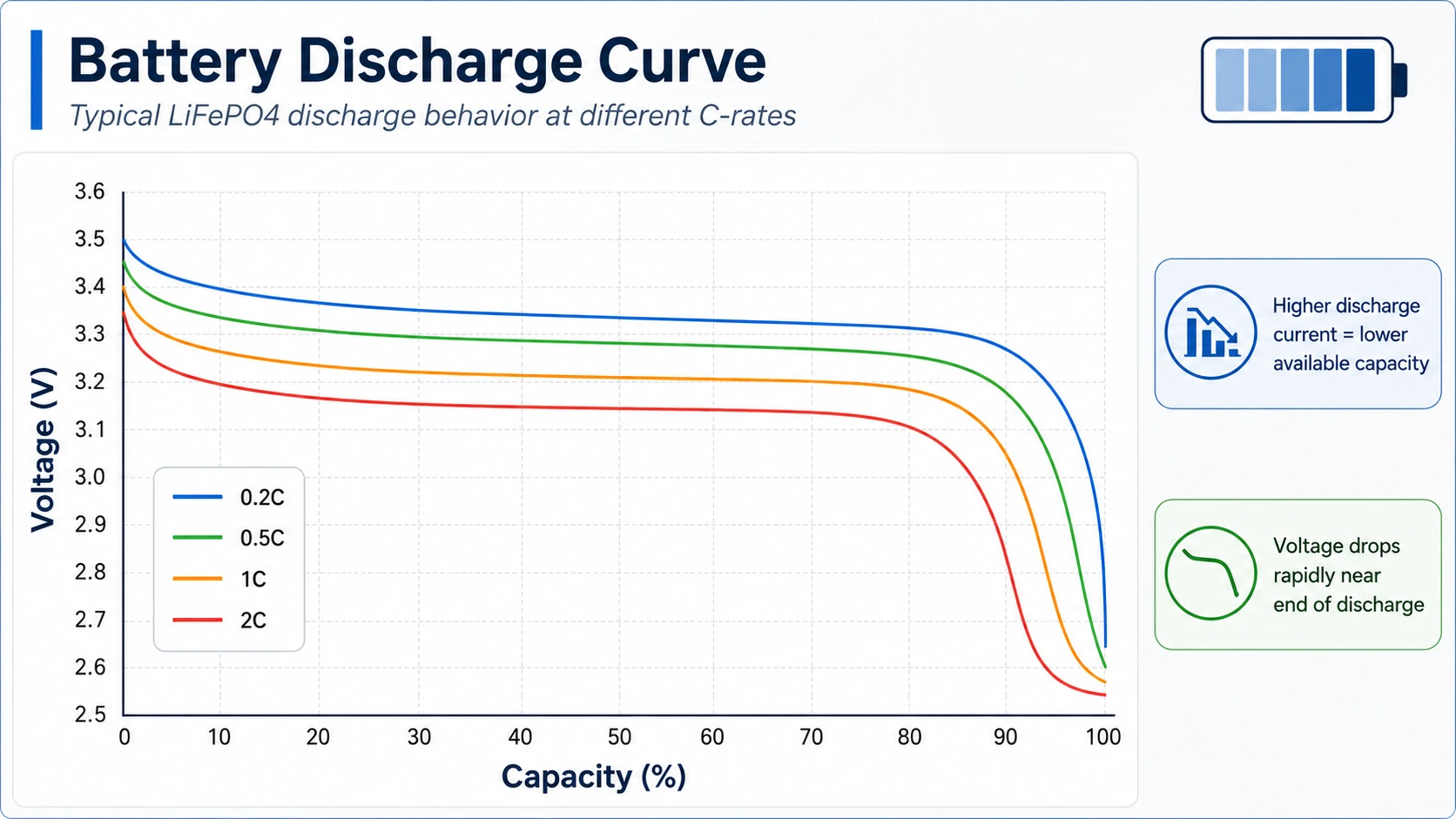

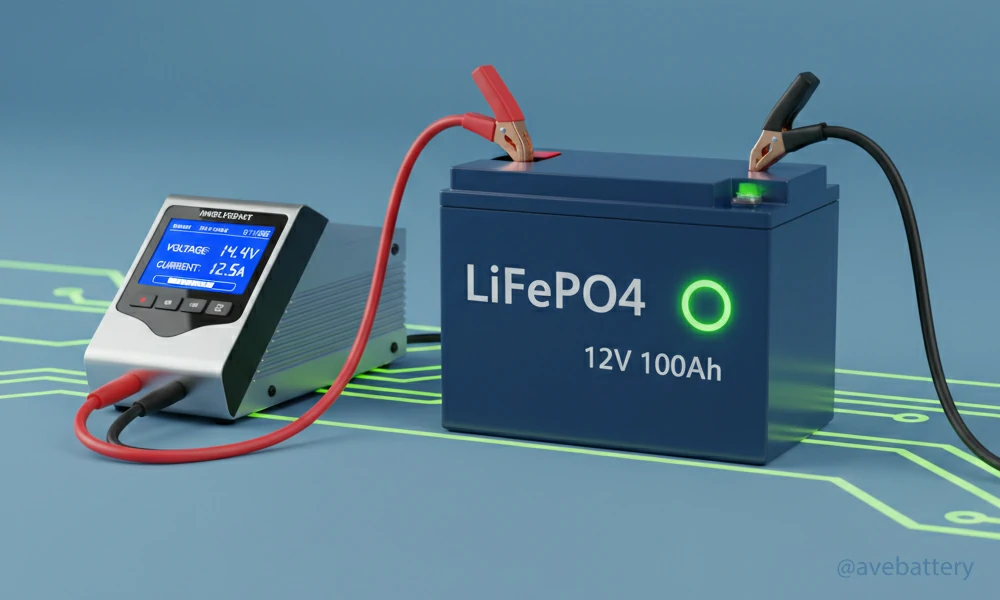
Charging a LiFePO4 (lithium iron phosphate) battery seems straightforward, but there are some important details you need to know to do it safely and effectively. Using the right charger and following proper procedures will protect your battery, extend its life, and ensure it performs at its best. This guide will walk you through everything you need to know, from choosing the right charger to handling different charging scenarios.
Basics of LiFePO4 Charging
LiFePO4, or lithium iron phosphate, batteries are different from other types of batteries. LiFePO4 cells have a nominal voltage of about 3.2 V per cell. Battery manufacturers design 12.8 V, 25.6 V, 38.4 V and 51.2 V packs by grouping cells in series. Manufacturers commonly recommend a full charge voltage around 3.6–3.65 V per cell. Systems that use 4 cells in series (12.8 V nominal) normally charge to 14.4 V (3.6 V × 4).
Battery packs will age faster if the charger routinely pushes the cells above the recommended top voltage. Battery systems will give the longest service life when you avoid keeping the pack at high voltage for long periods.
The charging process for these batteries has two main stages: constant current and constant voltage.
- Constant Current (Bulk Charge): This is the first and fastest part of the charging process. During this stage, your charger delivers a steady, high current to the battery. This current stays the same until the battery’s voltage reaches a specific level.
- Constant Voltage (Absorption Charge): Once the battery’s voltage hits the target, the charger switches to this second stage. It holds the voltage at a fixed level, and the current slowly decreases as the battery gets closer to being full. When the current drops to a very low level, the battery is considered fully charged.
Unlike lead-acid batteries, LiFePO4 batteries do not need a float charge. A float charge is a small, continuous current that keeps lead-acid batteries from losing their charge over time. Because LiFePO4 batteries hold their charge very well, this step is not necessary and can even be harmful if a charger is not designed for it.
Choosing the Right LiFePO4 Battery Charger
You should always use a charger that is specifically made for LiFePO4 batteries. These chargers are designed to stop charging at the right voltage, which prevents overcharging. Most LiFePO4 chargers follow a two-stage charging process, unlike the three-stage process used for lead-acid batteries. This two-stage method is all that LiFePO4 batteries need to reach a full charge safely and efficiently.
What About My Old Lead-acid Charger?
If you are thinking about using a lead-acid battery charger, you must be very careful. A lead-acid charger might have a “repair” or “desulfation” mode, which sends a high pulse of current. This kind of pulse can damage the battery’s internal management system, known as the BMS, and can even harm the cells themselves. Also, some older lead-acid chargers have a battery voltage detection function that may not recognize a deeply discharged LiFePO4 battery, especially if its voltage has dropped to zero volts after the BMS has shut it off for protection.
To be safe, you should always check the charger’s output voltage and current. You can find this information in the charger’s manual or by using a voltmeter. If the charger’s output voltage is outside the recommended range for a LiFePO4 battery, you should not use it. For a 12.8V LiFePO4 battery, the recommended charge voltage is 14.4V, but a charger that outputs between 14.0V and 14.6V is usually acceptable.
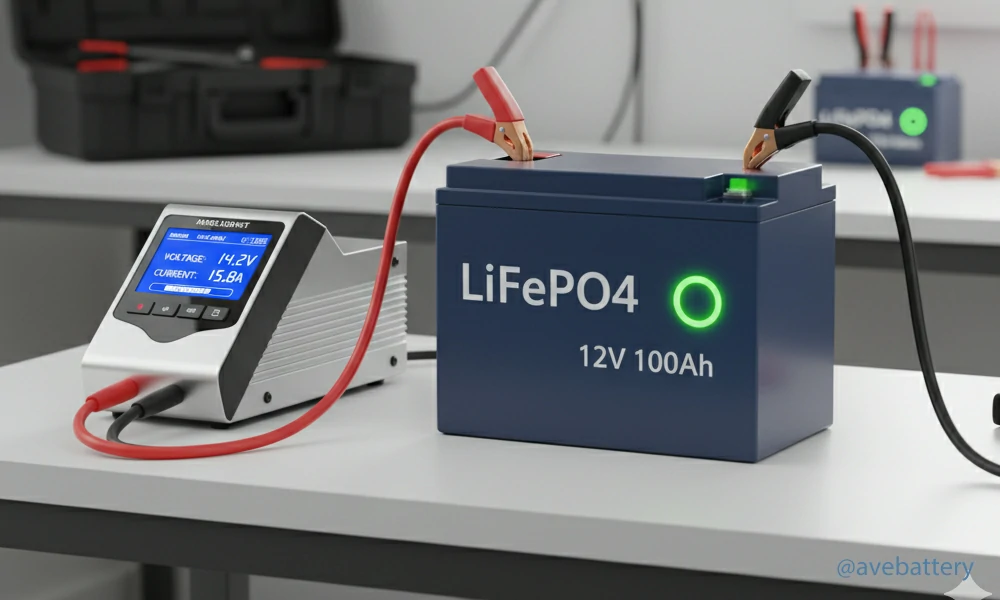
Recommended Charging Voltages
The nominal voltage for a single LiFePO4 cell is 3.2V. A 12.8V battery is made up of four cells connected in series. Here are the recommended charging voltages for common battery packs:
| Battery Voltage | Best Charge Voltage | Accepted Charge Voltage Range |
|---|---|---|
| 12V (12.8V) | 14.4V | 14.0V ~ 14.6V |
| 24V (25.6V) | 28.8V | 28.0V ~ 29.2V |
| 36V (38.4V) | 43.2V | 42.0V ~ 43.8V |
| 48V (51.2V) | 57.6V | 56.0V ~ 58.4V |
Note: If your solar charge controller has a float setting, you can set it to a lower voltage like 13.6V. This will simply hold the battery at a high state of charge without causing any harm.
Why LiFePO4 is Different from Lead-acid
Lead-acid batteries often use a float charge to keep the battery topped up. LiFePO4 batteries react differently to float charge because they tolerate high voltage less well. Battery University warns that maintaining Li-ion chemistry at high float voltage shortens life, and the group recommends keeping the time at high voltage short.
LiFePO4 does not need a float charge. You should only use float mode when the charger provides a LiFePO4-safe float level (for a 12.8 V pack, many suppliers say ~13.6 V) and when the manufacturer confirms that float is acceptable.
Step-by-Step LiFePO4 Battery Charging Instructions
Once you have the right charger, charging your LiFePO4 battery is very straightforward.
- Connect the Charger: Make sure the charger is turned off before you connect it to the battery. Connect the positive (+) lead of the charger to the positive (+) terminal of the battery. Then, connect the negative (-) lead of the charger to the negative (-) terminal of the battery. Always ensure you have a secure connection.
- Start Charging: Turn on your charger. Many modern LiFePO4 chargers will automatically go through the two-stage process and turn off when the battery is full.
- Monitor the Process: While the battery is charging, you can use a multimeter to check the voltage and current. You can also monitor the temperature, especially if you are in a warm environment.
- Finish Charging: When the charging process is complete, the charger will either turn off automatically or a light will indicate that the battery is full. Once the battery is full, disconnect the charger.
How Long Does It Take to Fully Charge a LiFePO4 Battery?
Charging a LiFePO4 battery typically takes 5 to 8 hours. A 100 Ah battery at 20 A will charge in about 5 hours during the bulk stage, with an additional 1-3 hours for the absorption stage as the current slows down near full charge.
You can calculate the charging time according to the actual situation using the following calculator.
Battery Charging Time Calculator
Fast charging can shorten the time but may impact the battery’s lifespan. It’s best to charge at 0.2C to 0.5C for optimal balance between speed and longevity, following manufacturer guidelines.
For more information, please read: How Long Will a 100Ah Battery Last
What to do When a LiFePO4 Battery Will Not Charge
The user should first check the charger output with a meter to confirm the charger produces voltage. The user should check the wiring for loose or reversed connections. The user should check the BMS for a protection state that may have disconnected the pack internally. The user should try a charger that does not include a battery-voltage sensing shutdown if the BMS has pulled the voltage near zero, but the user should proceed with caution. The owner should contact the battery maker for guidance when the pack appears at zero volts or when the BMS shows a persistent fault.
Special LiFePO4 Battery Charging Considerations
Sometimes, you need to charge multiple batteries at once, or you might be in a cold environment. These situations require extra attention.
Charging Batteries in Parallel
When you connect two or more batteries in parallel to increase your total power capacity, you must be careful about how you charge them. The main thing to remember is that the charging current will be split among the batteries.
For example, if you have two 12V 100Ah batteries in parallel, and the max charging current for a single battery is 50A, you should try to keep the total charging current under 100A. If you charge at 100A, one battery might reach its full charge before the other and its BMS will shut off its circuit. The other battery will then be forced to take on all 100A, which could cause its own BMS to shut off due to over-current.
Because LiFePO4 batteries have such low internal resistance, even small differences in cable length or quality can affect the current flow. You want to make sure that the resistance in each cable path is as similar as possible.
The best practice is to connect the positive charging lead to one end of the battery bank and the negative charging lead to the other end. This ensures that the current travels through an equal number of cables and connections to each battery, creating a more balanced charge.
Read this article to learn more about How to Charge Two Batteries in Parallel.
Charging Batteries in Series
If you connect batteries in series to increase the voltage (e.g., four 12V batteries for a 48V system), you need to make sure the individual batteries are “balanced.” This means their voltage should be very close to each other, ideally within 0.05V, before you connect them. If one battery has a much higher voltage than the others, it will reach its full charge first and shut off the whole circuit, preventing the other batteries from getting a full charge.
Regular balancing is important to ensure all the batteries in the series work well together and have a long life. Read this article to learn more about Batteries in Series vs. Parallel.
Solar Charging
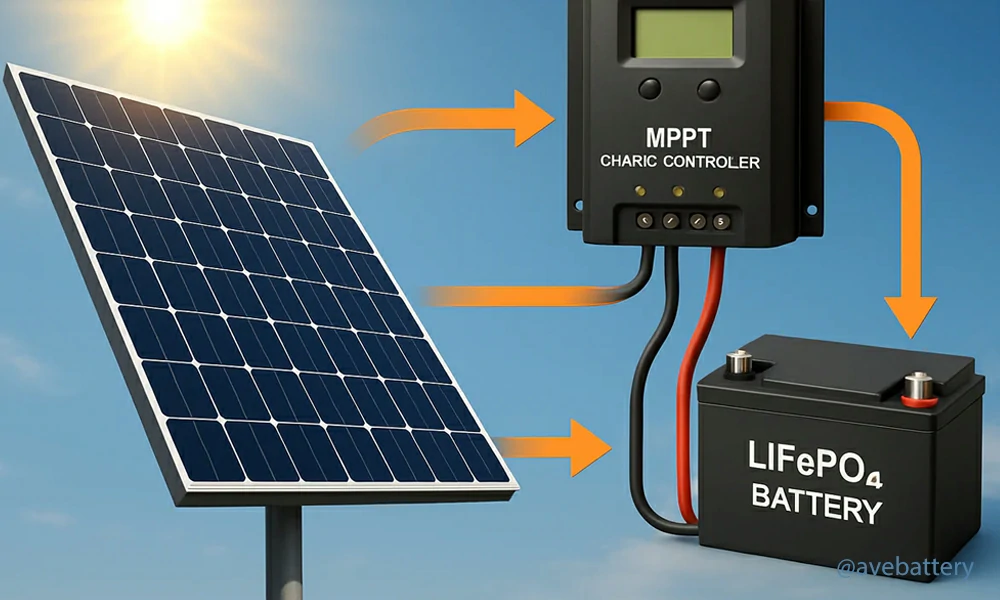
If you are using a solar system, the charge controller is what regulates the power from the solar panels to the battery. Many older charge controllers are designed for three-stage charging (bulk, absorption, and float).
For LiFePO4 batteries, you should adjust the settings on your charge controller to a two-stage profile. Set the absorption voltage to the recommended level (e.g., 14.4V for a 12V battery). If your controller requires a float voltage setting, set it to a lower value (e.g., 13.6V for a 12V battery) to avoid putting constant stress on the cells.
Alternator Charging
You can charge a LiFePO4 battery from a car or boat alternator, but it’s not as simple as just connecting the two. LiFePO4 batteries have very low internal resistance and can draw a very high current, which can overheat and damage the alternator. It is essential to use a DC-to-DC charger between the alternator and the battery. This device will regulate the current and voltage, protecting both the alternator and the battery.
Charging Below 0°C (32°F)
You should never charge a standard LiFePO4 battery when the temperature is below freezing. Charging in cold temperatures can cause a process called “lithium plating,” where lithium metal forms on the anode of the battery. This can permanently damage the battery cells, reduce their capacity, and increase the risk of a fire.
Some LiFePO4 batteries come with a built-in heating feature. These “self-heating” batteries use a small amount of the charging current to warm the cells to a safe temperature (above 5°C or 41°F) before they begin charging. If you plan to use your battery in cold climates, this feature is highly recommended.
Why LiFePO4 Battery Wiring Layout Matters
Your wiring layout determines how evenly current flows in a bank. A “bad” layout will put both charge leads on the same battery and create uneven resistance paths that force some batteries to do more work. A “good” layout will place the positive and negative leads on opposite ends of the bank so each battery sees similar path length and resistance.
A “better” layout will use pairing or cross-feeds to further equalize path resistance across multiple units. A “best” layout will use a low-resistance busbar so each battery connects directly to the same pair of bars and the wiring resistance becomes negligible.
Storing Your LiFePO4 Battery
You should store LiFePO4 batteries following the vendor guidance because different manufacturers sometimes recommend different steps.
You should store LiFePO4 batteries at a partial state-of-charge. Many independent sources recommend around 40–60% SOC for long storage to slow calendar aging. You should avoid leaving the pack at 100% or at very low SOC for long periods if the vendor does not recommend that. You should check the vendor manual because some vendors (for example, some consumer vendors) may advise full charge and disconnection for certain models.
Troubleshooting Common Charging Problems
You should use this short checklist when you prepare to charge or when the system behaves oddly.
Before you charge
- You should confirm the battery manual for recommended CV voltage and max charge current.
- You should check that the charger is set to the correct LiFePO4 profile and that the CV voltage matches the pack.
- You should verify that wire sizes, fuses, and connectors match expected current levels.
- You should confirm that parallel batteries have similar voltages and that series strings are within a few tens of millivolts before connecting.
During charge
- You should monitor battery temperature, voltage, and charge current.
- You should watch the charger behavior during the CV stage and confirm that the current falls to a low tail current before you assume the battery is full.
- You should stop charging immediately if the pack heats unexpectedly, if the BMS reports faults, or if the charger behaves erratically.
If charging from an alternator
- You should install a DC-DC charger or proper alternator regulator to prevent excessive alternator load and to protect the alternator from BMS disconnect spikes.
- You should confirm that the vehicle wiring and alternator cooling are sufficient if you plan to draw high currents for long periods.
Conclusion
A LiFePO4 battery needs a charger made for LiFePO4 or a charger that you can set to 3.60–3.65 V per cell. For a 12.8 V (4-cell) battery, people usually set 14.4 V. The charger should supply a safe current (commonly 0.2C to 0.5C for long life, where C is the battery capacity in Ah). The charger should use two stages (constant current then constant voltage). The battery does not need continuous float charging, and the battery should sit near 50% state of charge during long storage.
By using a compatible charger with the correct voltage settings, ensuring proper connections for multi-battery setups, and avoiding extreme temperatures, you can maximize your battery’s lifespan and get the most out of your investment. Always remember that the right tools and a little knowledge go a long way in ensuring the safety and performance of your LiFePO4 power system.
Avepower offers high-quality LiFePO4 batteries that are a superior alternative to traditional lead-acid batteries. Experience reliable, long-lasting power for your RV, boat, or off-grid system. Contact us now to get a quote.

Power That Lasts
If you want a battery you can just install and forget, go with an Avepower LiFePO4.
You get 4000+ cycles, around 10 years of use, a built-in BMS, and capacity you can expand later as your needs grow—just talk to Avepower for easy sizing advice and a no-pressure quote.
FAQ
You can charge from an alternator, but you should add a DC–DC converter to control current and protect both the alternator and the battery.
The ideal charge voltage for a 12V (12.8V nominal) LiFePO4 battery is 14.4V. A range of 14.0V to 14.6V is generally acceptable.
Charging time depends on the charger’s current output and the battery’s capacity. A 50A charger will charge a 100Ah battery in about two hours, for example.
It is generally not recommended. Many lead-acid chargers have “desulfation” or “repair” modes that can damage a LiFePO4 battery’s internal management system (BMS).