
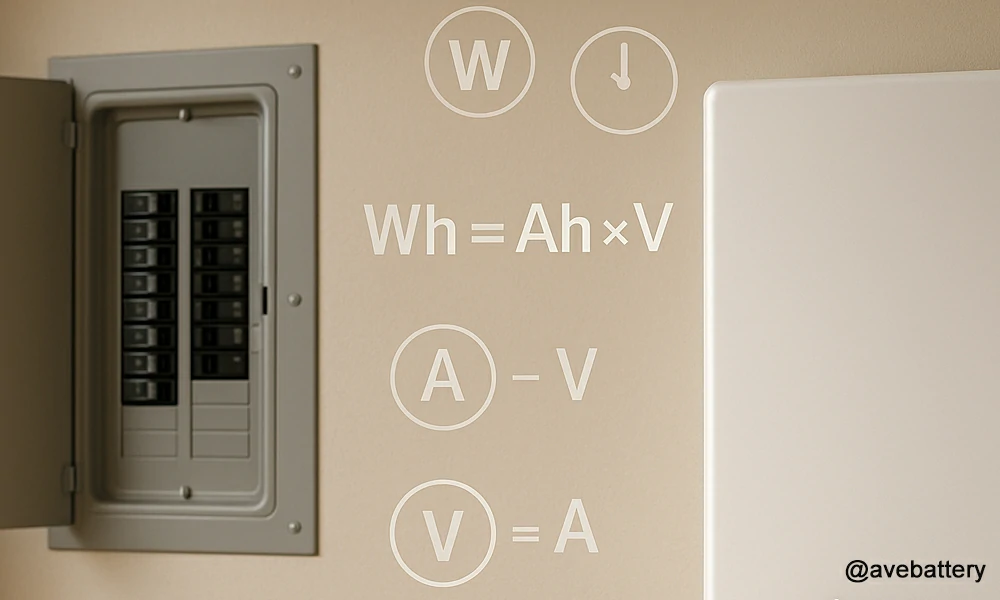
If you want to know how long a battery can really run your devices, watt-hours are the key number. This guide will show you, in simple steps, how to calculate watt hours of a battery, even if the label does not show Wh directly.
Basic Concepts You Need Before Calculating Watt Hours
To avoid confusion, it helps if you clearly know what each unit means.
What Is A Watt Hour (Wh)?
A watt hour is a unit of energy. It tells you how much work a battery can do over time.
- 1 Wh means a device that uses 1 watt of power can run for 1 hour.
- 10 Wh could mean:
- 10 W for 1 hour, or
- 5 W for 2 hours, or
- 1 W for 10 hours
The bigger the Wh number, the more total energy the battery can store.
Related resources: Watt Hours to Amp Hours
What Is A Watt (W)?
A watt is a unit of power. It tells you how fast energy is used or produced.
- If a light bulb is rated at 10 W, it uses 10 joules of energy every second.
- If you run it for 2 hours, the energy use is: 10 W × 2 h = 20 Wh
So:
- W = “rate” (power at a moment)
- Wh = “amount” (energy over time)
What Is A Volt (V)?
Voltage is like “pressure” in an electrical system. It tells you how strongly the battery can push current through a device.
Common battery voltages:
| Battery Type | Typical Voltage |
|---|---|
| Small phone power bank | 3.6–3.7 V |
| Car starter battery | 12 V |
| Home backup battery | 24 V / 48 V |
| Large storage rack | 48 V and above |
You usually find the voltage on the battery label as V or Vdc.
What Is An Amp And An Amp Hour (Ah)?
- An ampere (A) measures current – how much charge flows per second.
- An amp hour (Ah) describes capacity – how much current a battery can deliver over time.
If a battery is rated at 100 Ah, in theory it can deliver:
- 100 A for 1 hour
- 10 A for 10 hours
- 5 A for 20 hours
The real time may differ because of efficiency and discharge rate, but this idea is enough for basic calculations.
Related resources: Amp Hours to Watt Hours
Related resources: How to Calculate Battery Amp Hours
How To Calculate Watt Hours Of A Battery
Many small lithium-ion batteries show only mAh on the label, so you often convert mAh to Ah before you calculate watt-hours.
mAh to Ah Converter
Formula: Ah = mAh ÷ 1000
Method 1: From Amp-Hours And Voltage
If you know the amp-hours and voltage, you can use:
Watt-hours (Wh) = Amp-hours (Ah) × Voltage (V)
Example:
- Battery: 12V, 100Ah
- Step 1: Multiply 100 by 12
- 100 × 12 = 1,200
- Result: 1,200Wh
So that 12V 100Ah battery can store about 1.2kWh of energy.
In real life, you usually cannot use 100% of the rated watt-hours because of inverter losses, depth-of-discharge limits, and safety margins. For home backup systems, many designers assume you can safely use 80–90% of the rated Wh.
Battery Watt-Hours (Wh) Calculator
Choose a method and enter values. The tool outputs total Wh, and (optional) usable Wh.
Wh = Ah × V ; Bank Wh = (V_batt × Series) × (Ah_batt × Parallel) ; Usable Wh ≈ Wh_total × DoD × η
Method 2: From Milliamp-Hours And Voltage
If the battery shows mAh instead of Ah:
- Convert mAh → Ah
- Multiply by voltage
Wh = (mAh ÷ 1,000) × V
Example:
- Battery: 5,000mAh, 3.7V
- Step 1: 5,000 ÷ 1,000 = 5Ah
- Step 2: 5 × 3.7 = 18.5
- Result: 18.5Wh
mAh to Wh Calculator
Formula: Wh = (mAh × V) ÷ 1000
Method 3: From Watts And Time
Sometimes you know how many watts a device uses and how long it runs:
Wh = Watts (W) × Hours (h)
Example:
- A 150W device runs for 4 hours
- 150 × 4 = 600Wh
This is helpful when you want to know how much battery capacity you need to run specific loads.
Watt Hours For Common Ah And Voltage Combinations
| Voltage | Capacity | Watt Hours (Wh) |
|---|---|---|
| 12 V | 50 Ah | 600 Wh |
| 12 V | 100 Ah | 1,200 Wh |
| 12 V | 200 Ah | 2,400 Wh |
| 24 V | 50 Ah | 1,200 Wh |
| 24 V | 100 Ah | 2,400 Wh |
| 24 V | 200 Ah | 4,800 Wh |
| 48 V | 50 Ah | 2,400 Wh |
| 48 V | 100 Ah | 4,800 Wh |
| 48 V | 200 Ah | 9,600 Wh |
You can see that doubling the voltage at the same Ah doubles the Wh.
Watt Hours For Common mAh And Voltage Combinations
| Voltage | Capacity | Watt Hours (Wh) |
|---|---|---|
| 3.7 V | 2,000 mAh | 7.4 Wh |
| 3.7 V | 5,000 mAh | 18.5 Wh |
| 3.7 V | 10,000 mAh | 37 Wh |
| 3.7 V | 20,000 mAh | 74 Wh |
You can read this as a handy guide when you compare power banks.
How To Use Watt Hours To Estimate Runtime
Once you know the watt-hours of your battery, you can estimate how long it will run your loads.
you can use:
Runtime (hours) = Battery Wh ÷ Load W
Example – 1,200Wh Battery And 100W Load
- Battery: 12V 100Ah = 1,200Wh
- Load: 100W
Steps:
- 1,200Wh ÷ 100W = 12 hours
So, at 100% ideal use, the battery could power a 100W load for about 12 hours.
Battery Runtime Calculator
How To Calculate Watt Hours Of A Battery Bank
Many people do not use a single battery. They use a battery bank with several batteries connected in series, in parallel, or both.
The key idea is still the same:
Total Wh = Total Voltage × Total Ah
But the way voltage and Ah add up depends on how you connect the batteries.
How Many Watt Hours Are In A 100 Ah Battery?
The answer depends on the voltage.
- 12 V 100 Ah → 1.2 kWh
- 24 V 100 Ah → 2.4 kWh
- 48 V 100 Ah → 4.8 kWh
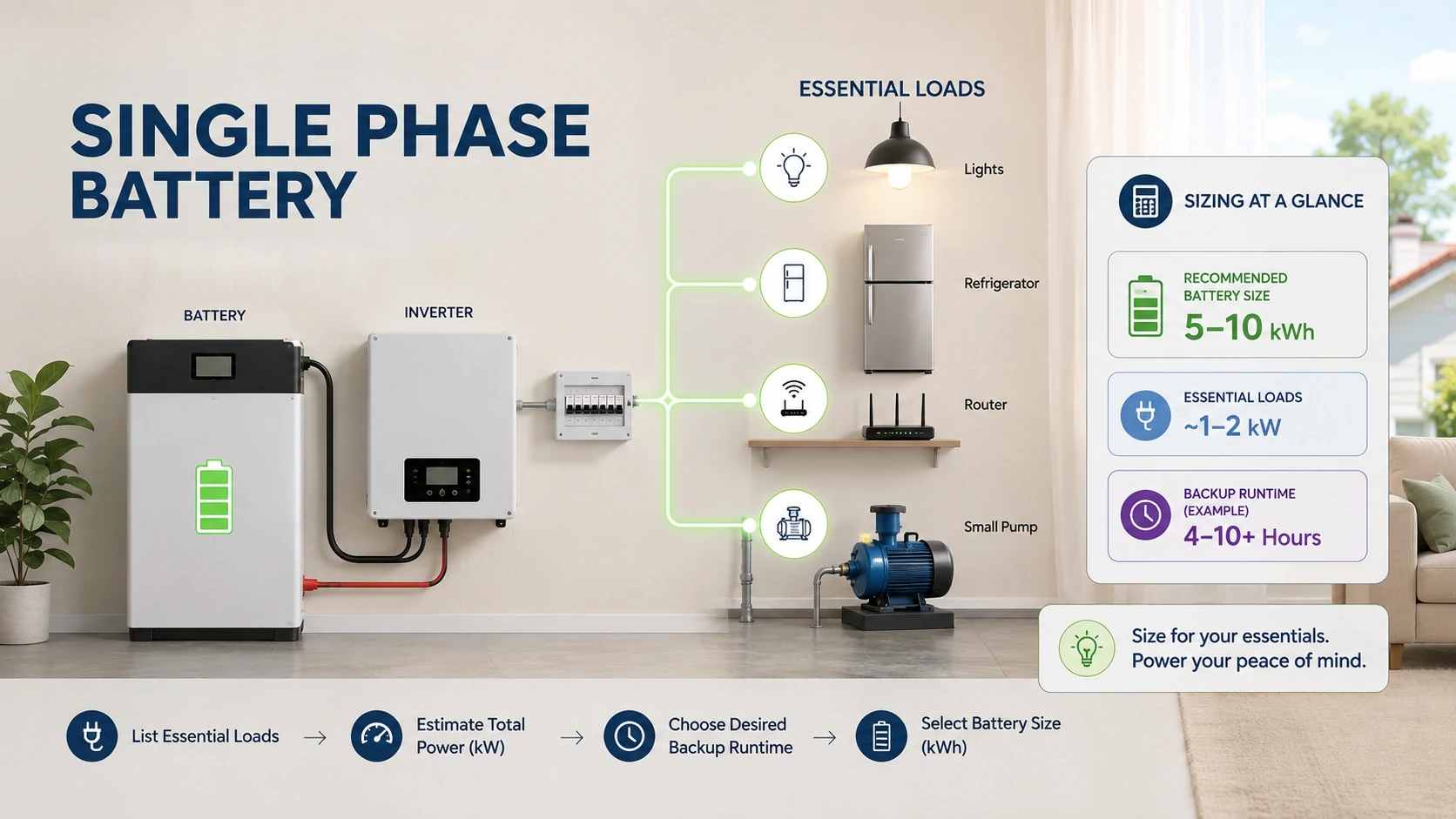
If you are sizing a home backup system, this becomes very useful, because home systems are often described in kilowatt hours (kWh), where:
1 kWh = 1,000 Wh
So a 10 kWh home battery has around 10,000 Wh of energy storage.
How Much Watt Hours Do You Need For Home Backup?
Now that you know how to calculate Wh, the next question is often:
“How many watt hours do I need to keep my home running during an outage?”
The exact number depends on:
- Which devices you want to run
- How long you want to run them
- How efficient your system is
- How much backup you want (just essentials vs whole home)
Calculator – How Many kWh do I Need?
Simple Way To Estimate Your Daily Energy Use
You can make a simple list of devices and their power:
- Note the power (W) of each device from its label.
- Estimate how many hours per day you will use it during an outage.
- Multiply W × hours for each device to get Wh.
- Add all the Wh values to get total Wh per day.
Total daily energy:
50 + 120 + 180 + 960 + 160 = 1,470 Wh ≈ 1.5 kWh per day
If you want one full day of backup for these essentials, you need around 1.5 kWh of usable energy. In real systems, you usually add a safety margin for:
- Inverter losses
- Battery efficiency
- Depth of discharge limits
So you may size the system closer to 2 kWh usable or more.
Why Does My Battery Not Match The Watt-Hours On The Label Exactly?
You may notice that some manufacturers print slightly different Wh values than your math. This can happen because:
- The label may use a nominal voltage (for example, 3.7V per cell) while the actual voltage changes during discharge.
- The manufacturer may round the number for simplicity.
- The test methods used to rate capacity may use specific discharge rates or temperatures.
As long as your calculation and the label are close, that is normal.
How Avepower Can Help With Watt-Hour Planning
You may simply want to understand how to calculate watt hours of a battery, and that is perfectly fine. But if you are thinking about a real home backup system, the same math guides your choice of product.
When you speak with a battery manufacturer or installer, it helps if you can say things like:
- “My daily backup need is about 3kWh.”
- “My fridge is 150W, my router is 20W, my lights are 50W, and I want 10 hours of backup.”
- “I think I need around X watt-hours of storage.”
Companies like Avepower, who design home standby and solar-ready battery systems, can then:
- Check your watt-hour estimates
- Recommend a battery size and voltage
- Suggest how many battery modules you need
- Help you leave some margin for DoD, inverter losses, and future load growth
Because Avepower focuses on household backup batteries, not general electronics, the team can also think in terms of whole-home loads, not just one device at a time.
Contact us now to discuss your project.

Take Control of Your Energy with Avepower!
Reliable home solar battery solutions with OEM/ODM customization and in-house manufacturing, tailored to the needs of distributors, installers, and energy partners.
FAQ
Watts (W) measure power at a moment. Watt-hours (Wh) measure energy over time.
A higher watt-hour battery can store more energy, so it can run devices longer. But: A higher Wh battery usually costs more.