
When you invest in a battery system, the first question is always the same:
“How long will this battery actually run my stuff?”
What the Battery Calculator Can Help You Do
This battery run time calculator helps you quickly understand whether your 12V, 24V, or 48V battery is really enough for your needs. By entering your system voltage, battery capacity, chemistry (LiFePO₄ or lead-acid), and the power of your loads, you can see an instant estimate of how many hours your battery will run.
You can also work in reverse: set your desired run time for a home backup system, RV setup, or trolling motor, and the calculator will tell you how much battery capacity you should choose. Instead of guessing or relying on rough rules of thumb, this tool gives you a clear, data-based way to size your battery bank for real-world use.
Battery Run Time Calculator
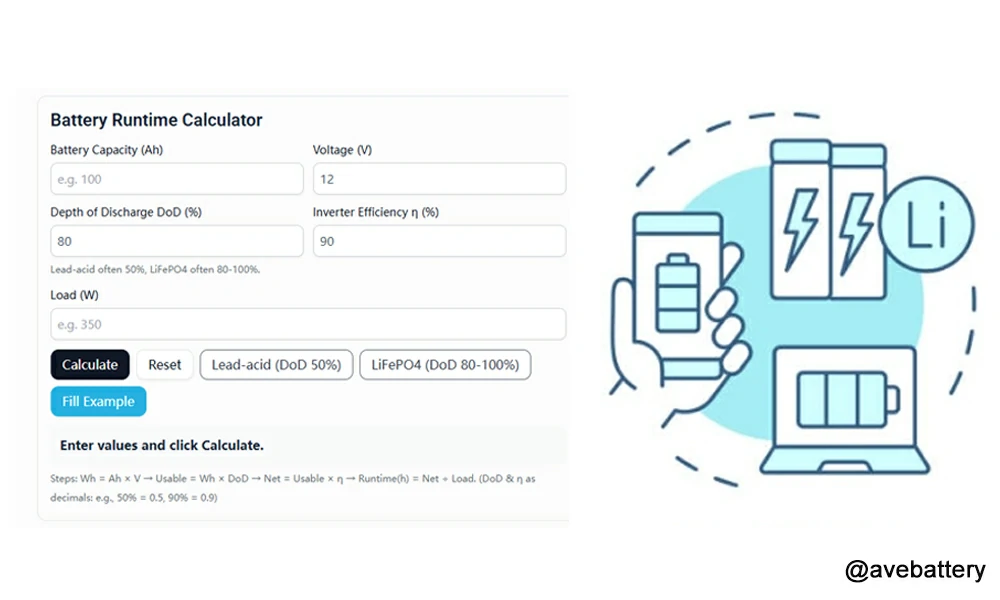
You enter the battery voltage (12 / 24 / 48V), capacity (Ah or Wh), and your average load (W or A). The calculator gives you an estimated run time in hours.
Battery Runtime Calculator
Battery Size Calculator
You enter how long you want to run your loads (hours), and your power usage. The calculator tells you the recommended battery capacity for that use case.
Battery Size Calculator — How Many kWh do I Need?
You can select battery type – LiFePO4 or lead-acid – and the calculator automatically adjusts for usable capacity (depth of discharge), so the results match real-world performance more closely.
How the Battery Run Time Calculator Works
Behind the scenes, the calculator is based on a simple idea:
Battery energy (Wh) ÷ Load power (W) = Approximate run time (hours)
Where:
- Battery energy (Wh) is calculated from:
- Battery voltage (12V / 24V / 48V)
- Battery capacity in Ah
- Usable percentage (depends on LiFePO₄ vs lead-acid)
For example, a 12V, 100Ah LiFePO4 battery with 90% usable capacity has:
- 12V × 100Ah × 0.9 ≈ 1080Wh of usable energy
If your load is 200W, the theoretical run time is:
- 1080Wh ÷ 200W = 5.4 hours
In reality, inverter losses and other small inefficiencies reduce this slightly, so the calculator can include an efficiency factor to give a more practical estimate.
Related resources: How Long Will a 100Ah Battery Last
LiFePO4 vs. Lead-Acid Batteries
There’s a good reason the calculator lists both LiFePO4 and lead-acid batteries:
even if the two batteries have the same amp-hour rating, their actual usable runtime is very different.
Related resources: AGM Battery vs Lithium
Lead-Acid Battery
- Typical safe depth of discharge: ≈50%
- Voltage usually drops more significantly during discharge
- Heavier, with a shorter cycle life
- A 12V 100Ah lead-acid battery provides only about 600Wh of usable capacity (50% of 1200Wh)
LiFePO4 Battery
- Typical safe depth of discharge: 80–90%
- Much more stable voltage during discharge
- Longer cycle life
- A 12V 100Ah LiFePO4 battery provides about 960–1080Wh of usable capacity (80–90% of 1200Wh)
Conclusion
A 12V, 24V, or 48V battery system can be the heart of your home backup power, RV, or trolling motor setup — provided it’s properly sized.
With the LiFePO4 and lead-acid battery runtime calculator, visitors don’t have to guess or rely on rough estimates. You can:
- See how long your current battery will last,
- Plan the capacity for your next-generation battery based on real needs.
By using the calculator to adjust the numbers according to your actual situation, you’ll know exactly which capacity and voltage system suits your home, RV, or boat — before spending a single dollar on a battery.
FAQ
Simply enter your battery voltage (12V, 24V, or 48V), the battery capacity in Ah, and the estimated power of your load in watts. Then select the battery type (LiFePO4 or lead-acid). The calculator will estimate how many hours your battery can power that load. You can also reverse the process by entering your desired run time to find the battery capacity you need.
LiFePO4 batteries typically allow deeper usable discharge (around 80–90% of their capacity), while lead-acid batteries are usually limited to about 50% if you want good cycle life.
Yes. If you know your average power usage (for example, 300W for lights, fridge, and electronics) and how many hours you want to run everything, you can enter those values. The calculator will show you the minimum battery capacity (Ah) you should consider at 12V, 24V, or 48V, and for both LiFePO₄ and lead-acid options.
Yes. It doesn’t matter where the battery is charged from—solar panels, a generator, or the grid. The calculator is focused on how long the stored energy in your battery can run your loads, so it works for off-grid cabins, hybrid solar systems, RVs, and home backup batteries.
For the same Ah, a 24V battery stores twice the energy of a 12V battery, and a 48V battery stores four times as much. The calculator uses your chosen voltage to correctly convert Ah into watt-hours and then into run time.