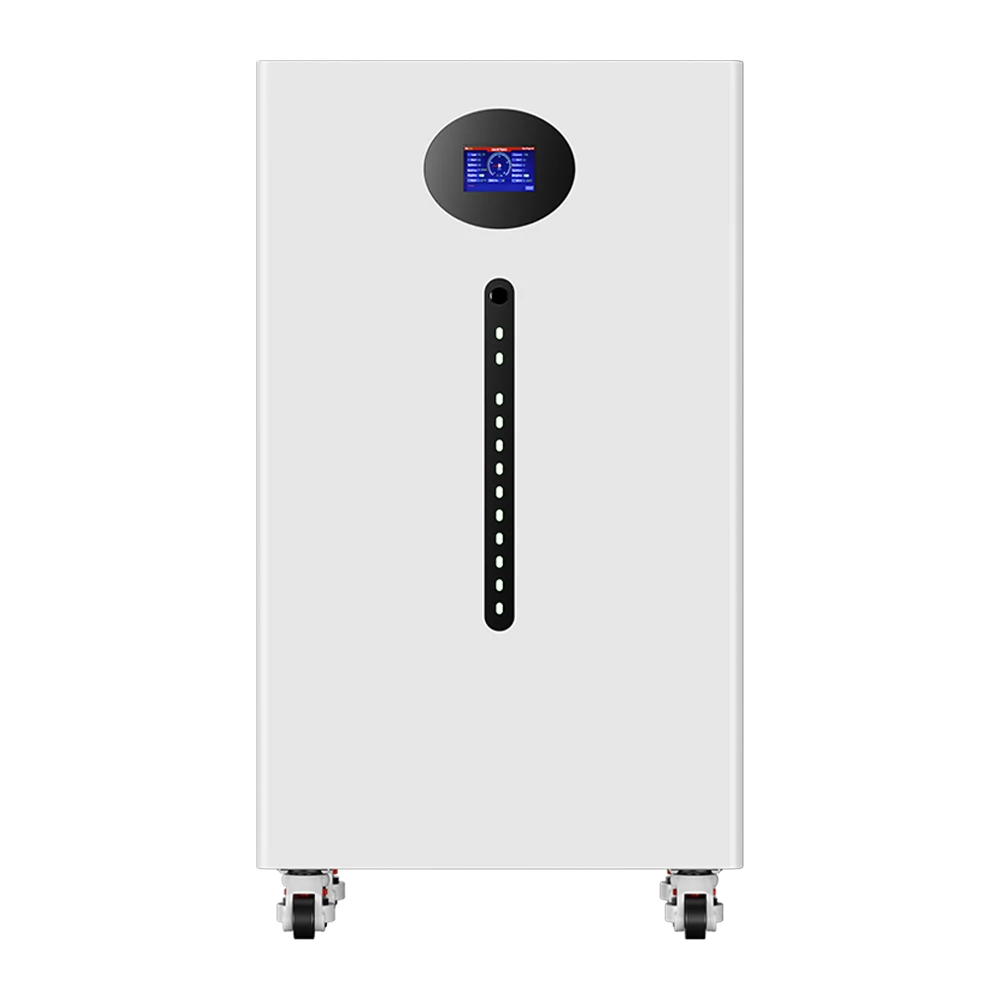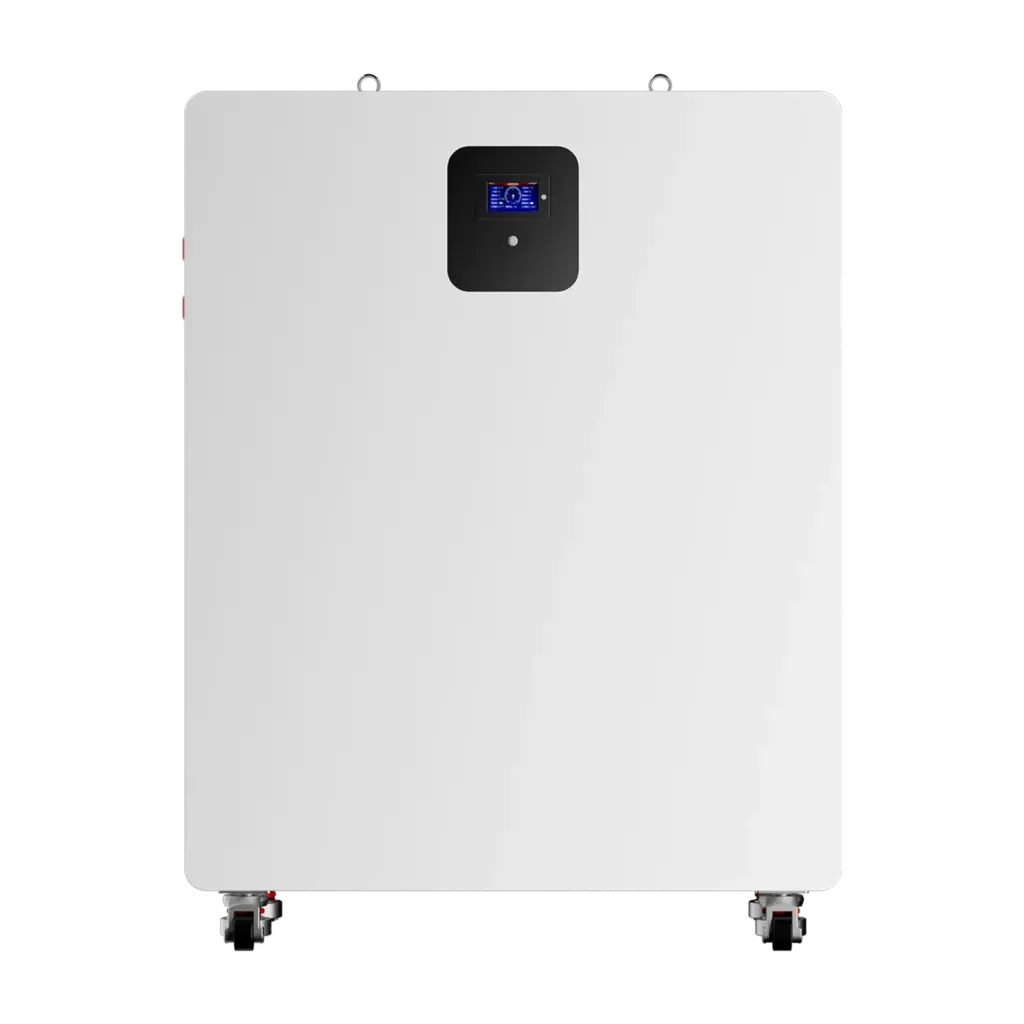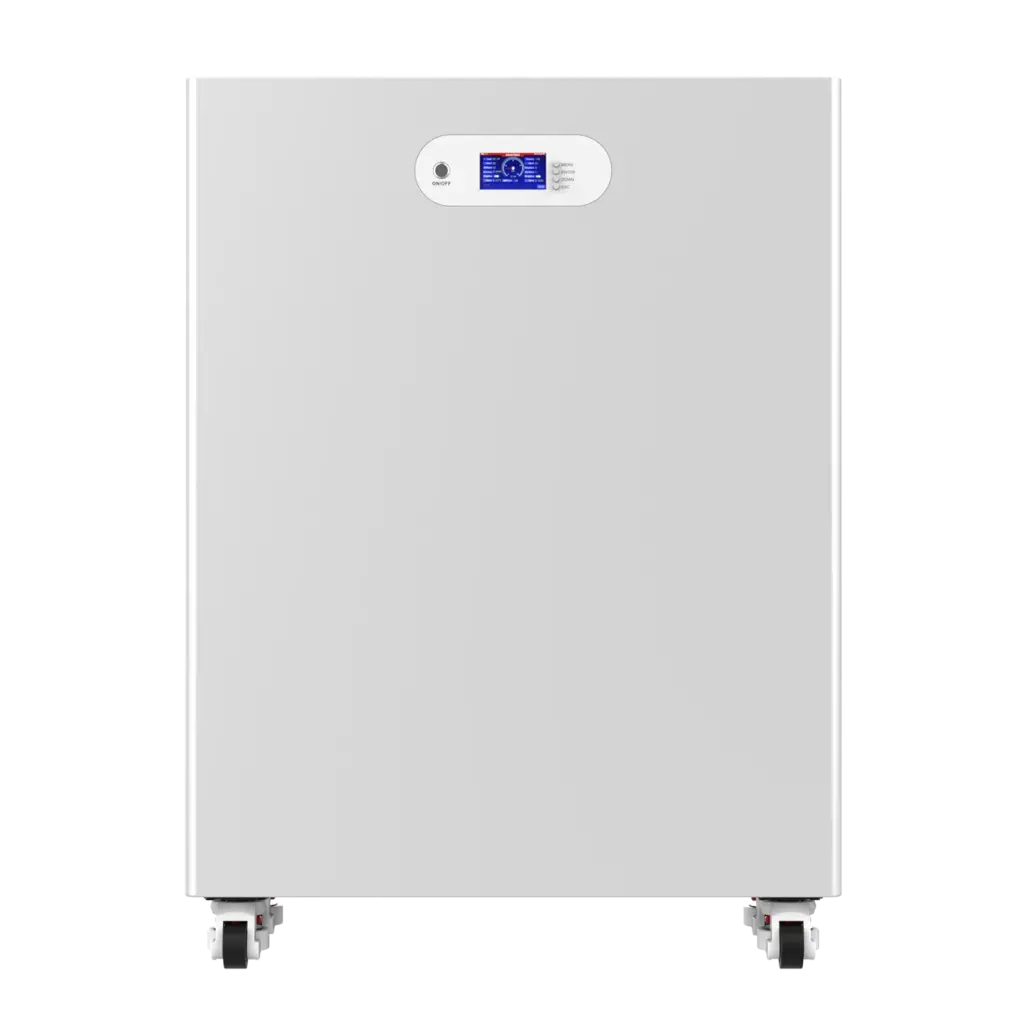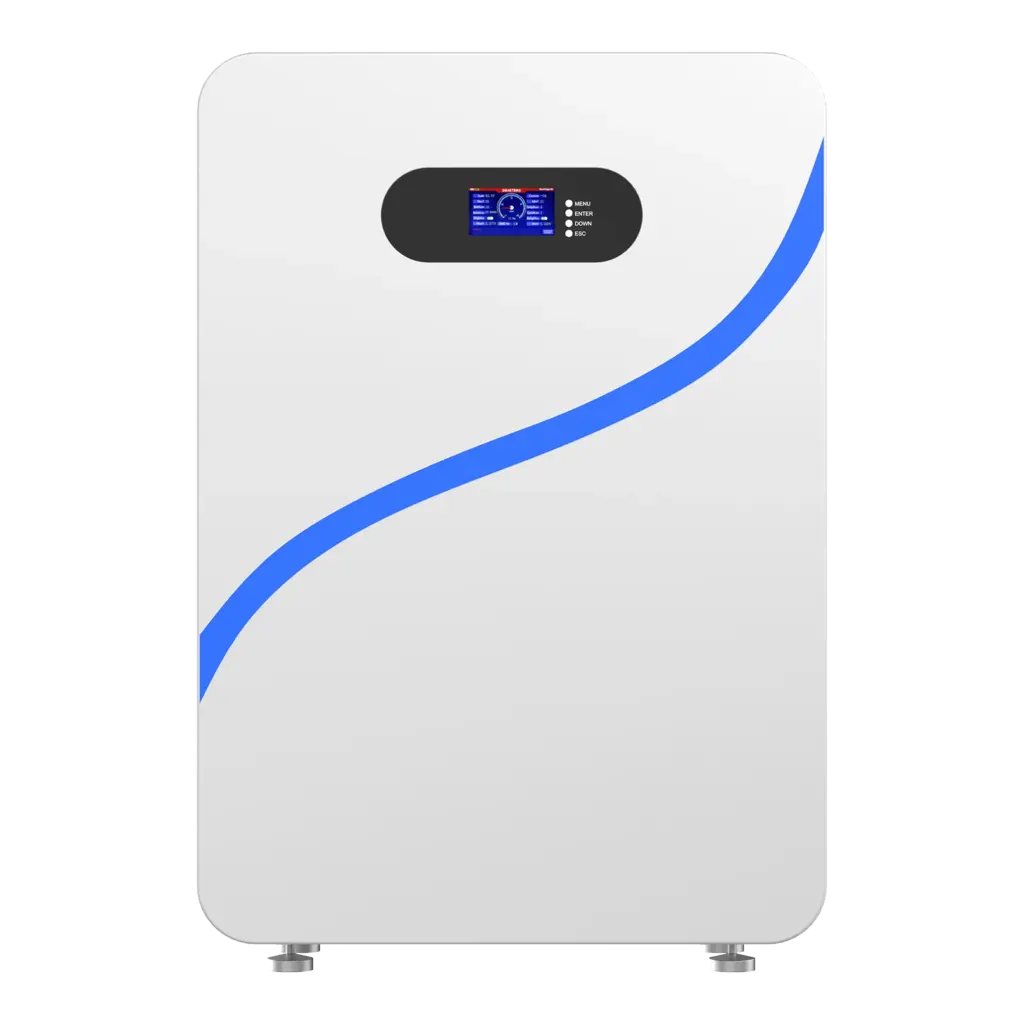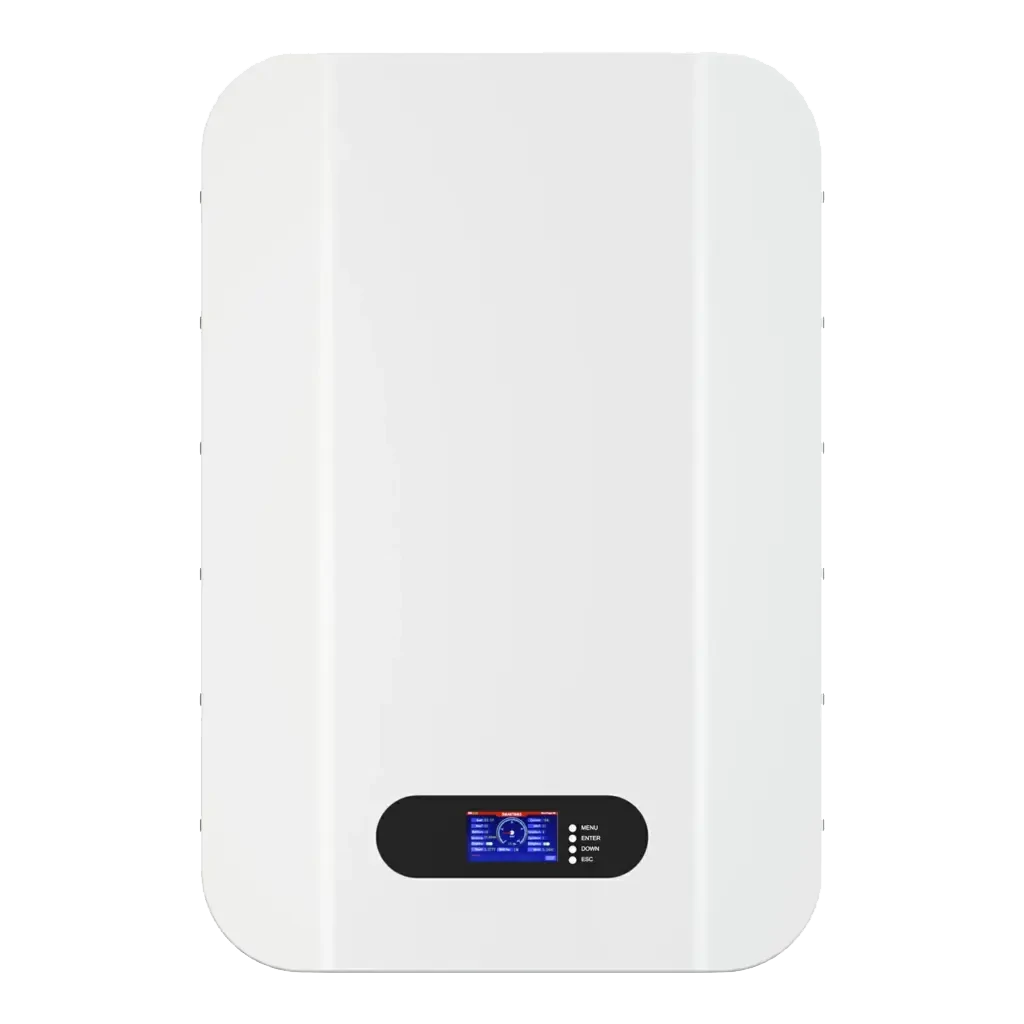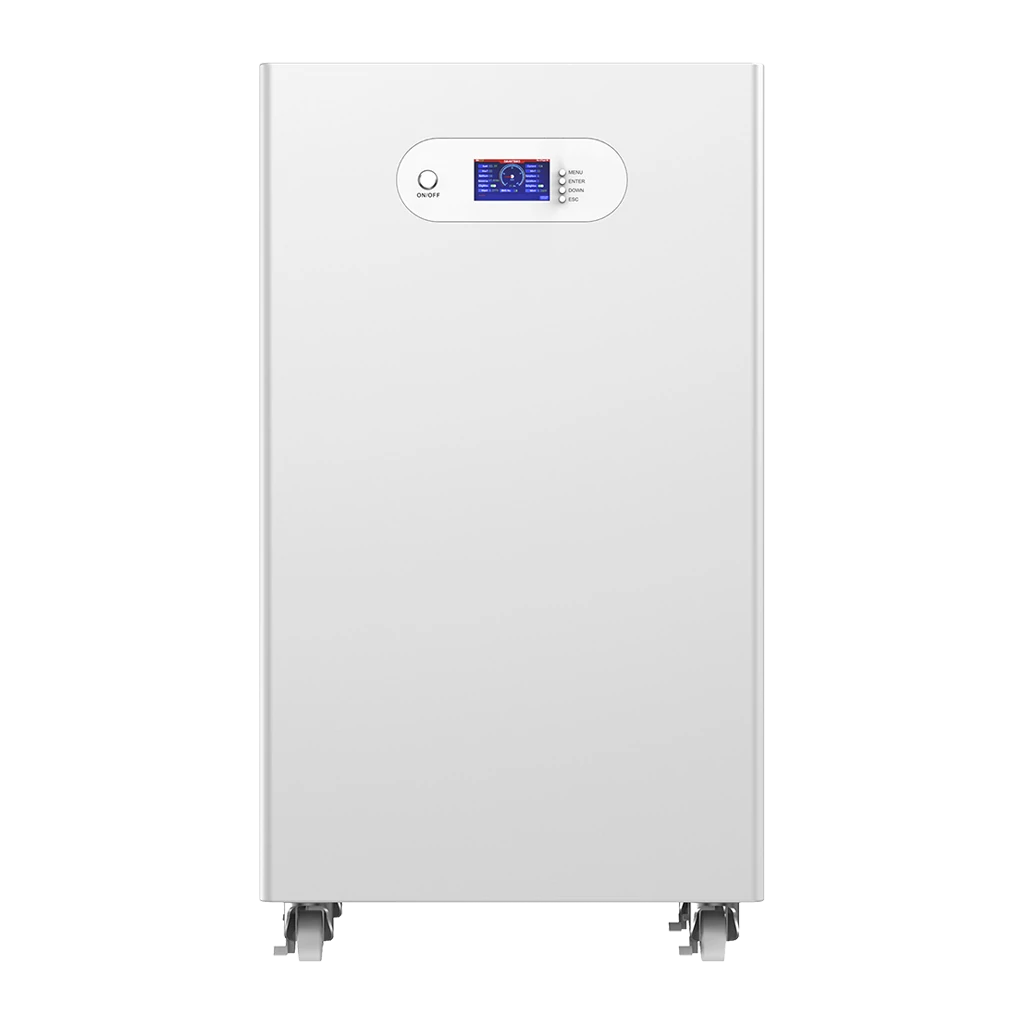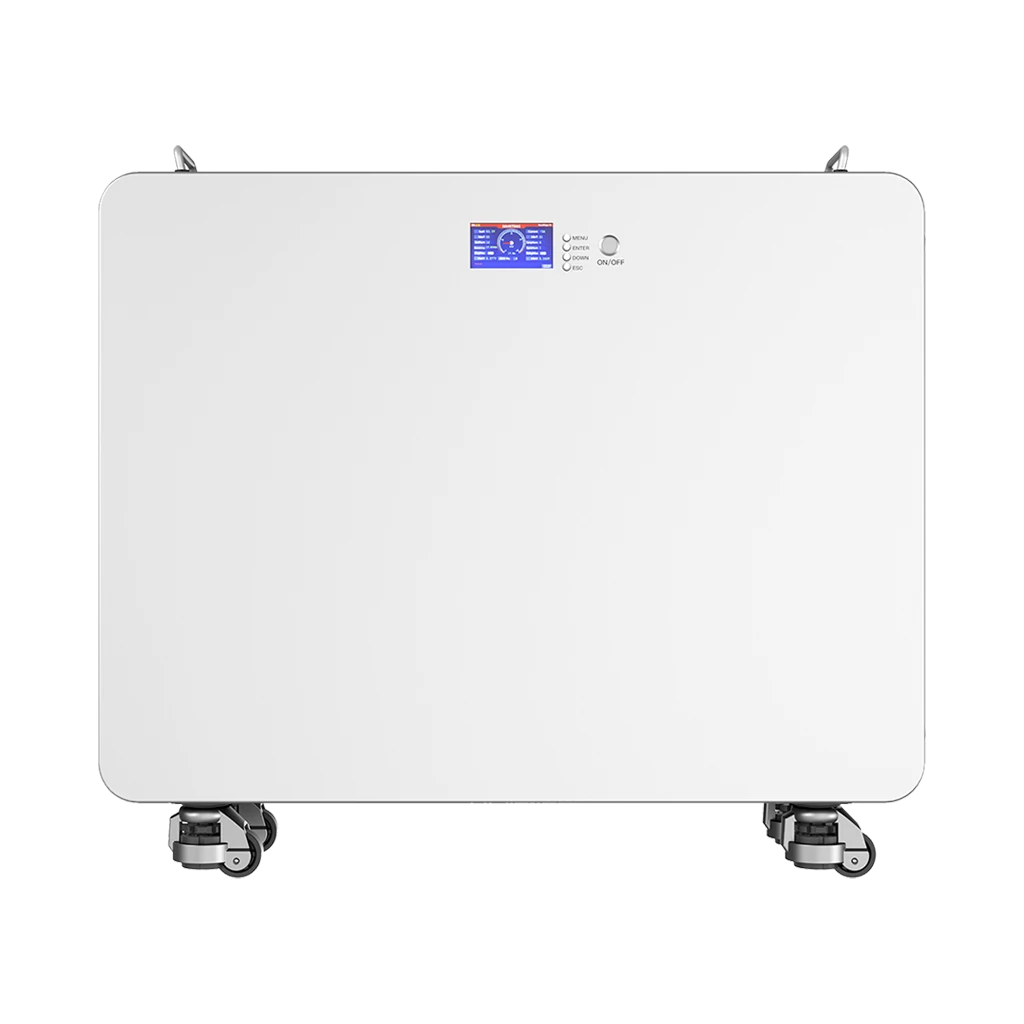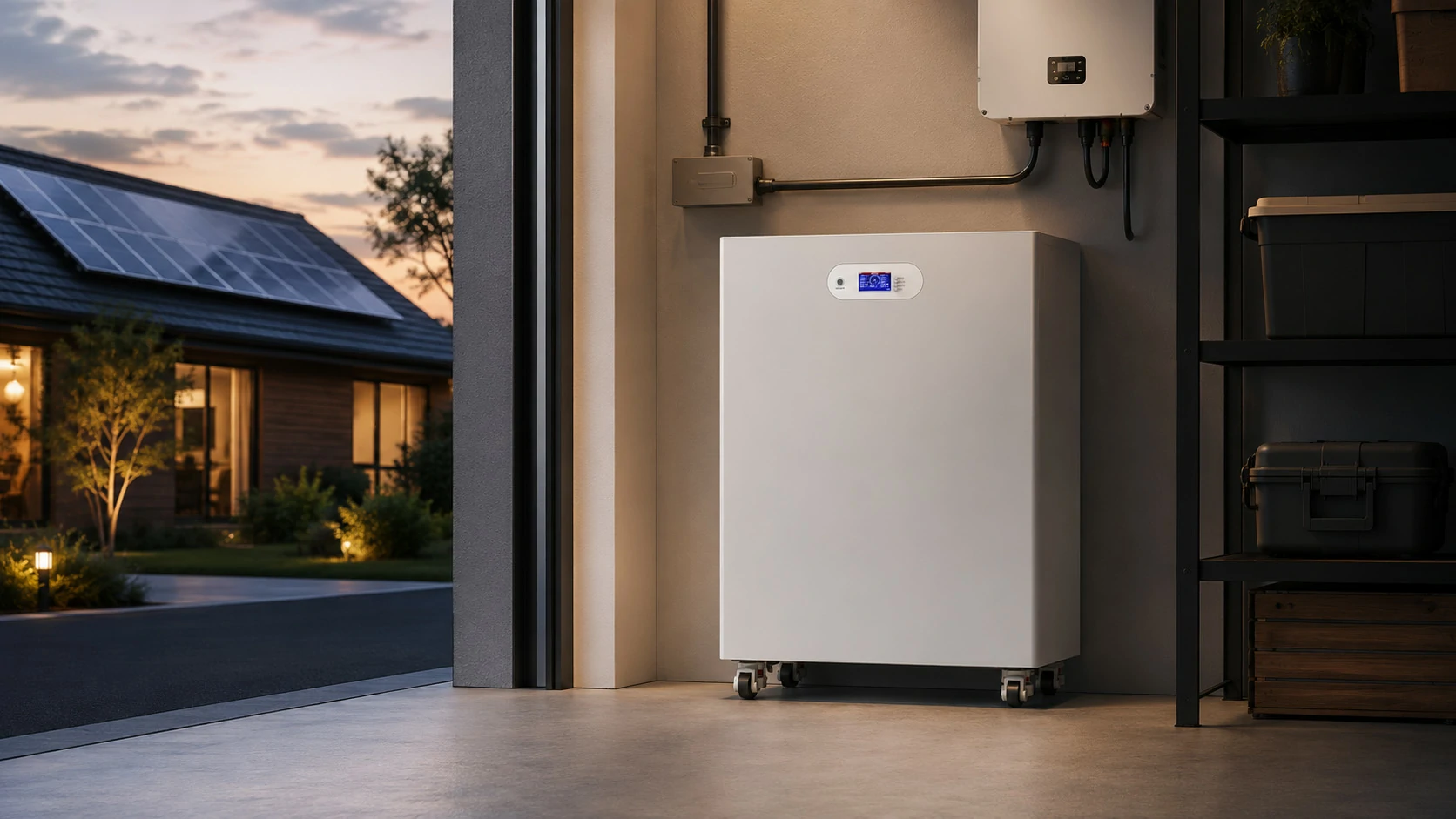

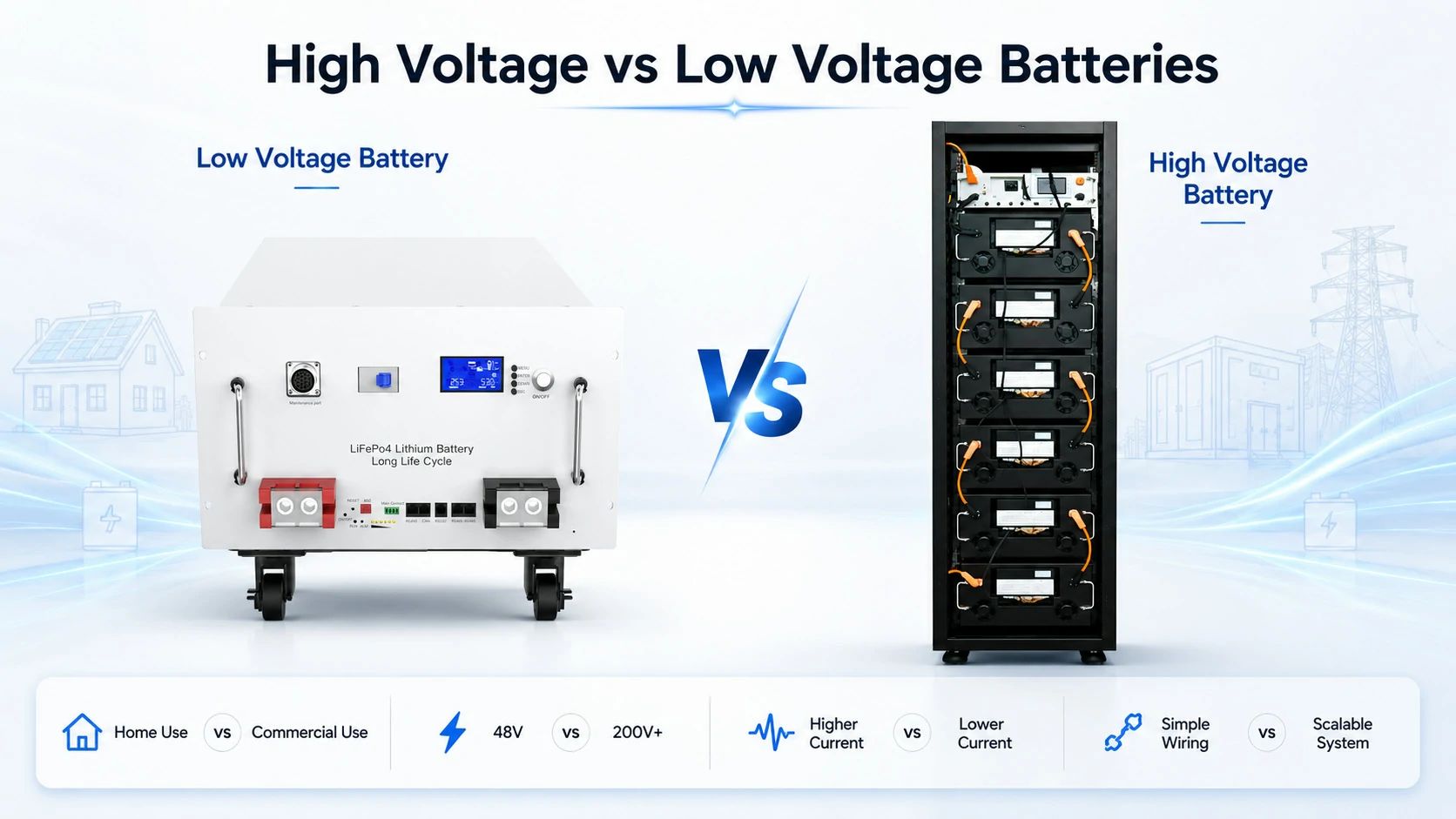
When comparing high voltage vs low voltage batteries, the better choice depends on system size, inverter design, power demand, installation environment, and budget.
For small home backup systems, off-grid cabins, telecom rooms, RVs, and budget-sensitive solar storage projects, low-voltage batteries, especially 48V or 51.2V LiFePO4 batteries, are often the practical choice. They are easier to install, widely compatible with many low-voltage inverters, and flexible for parallel expansion.
For whole-home backup, large residential solar systems, EV charging support, commercial and industrial energy storage, microgrids, and high-power hybrid inverter systems, high-voltage batteries are usually more efficient and scalable. Because high-voltage systems deliver the same power with lower current, they can reduce cable losses, improve system efficiency, and support larger loads more comfortably.
In simple terms:
| Project Type | Better Fit |
|---|---|
| Small home backup | Low voltage battery |
| Off-grid cabin | Low voltage battery |
| Whole-home solar backup | High voltage battery |
| Home with EV charger or heat pump | High voltage battery |
| Commercial solar storage | High voltage battery |
| Peak shaving for factories | High voltage battery |
| Telecom or server backup | Low voltage or rack-mounted LV battery |
| Large C&I ESS or microgrid | High voltage battery |
What Is a Low Voltage Battery?
A low voltage battery in the energy storage industry usually refers to a battery system operating around 12V, 24V, 48V, or 51.2V. In modern home solar storage, the most common low-voltage lithium battery platform is 48V or 51.2V LiFePO4.
A 51.2V LiFePO4 battery is typically built from 16 cells in series because each LiFePO4 cell has a nominal voltage of about 3.2V. This makes 51.2V a very common architecture for home battery packs.
Low-voltage batteries are widely used in:
- Home solar backup systems
- Off-grid cabins
- Small residential ESS
- Rack-mounted server backup
- Telecom backup power
- RV and marine energy storage
- Small commercial backup systems
- Modular battery banks
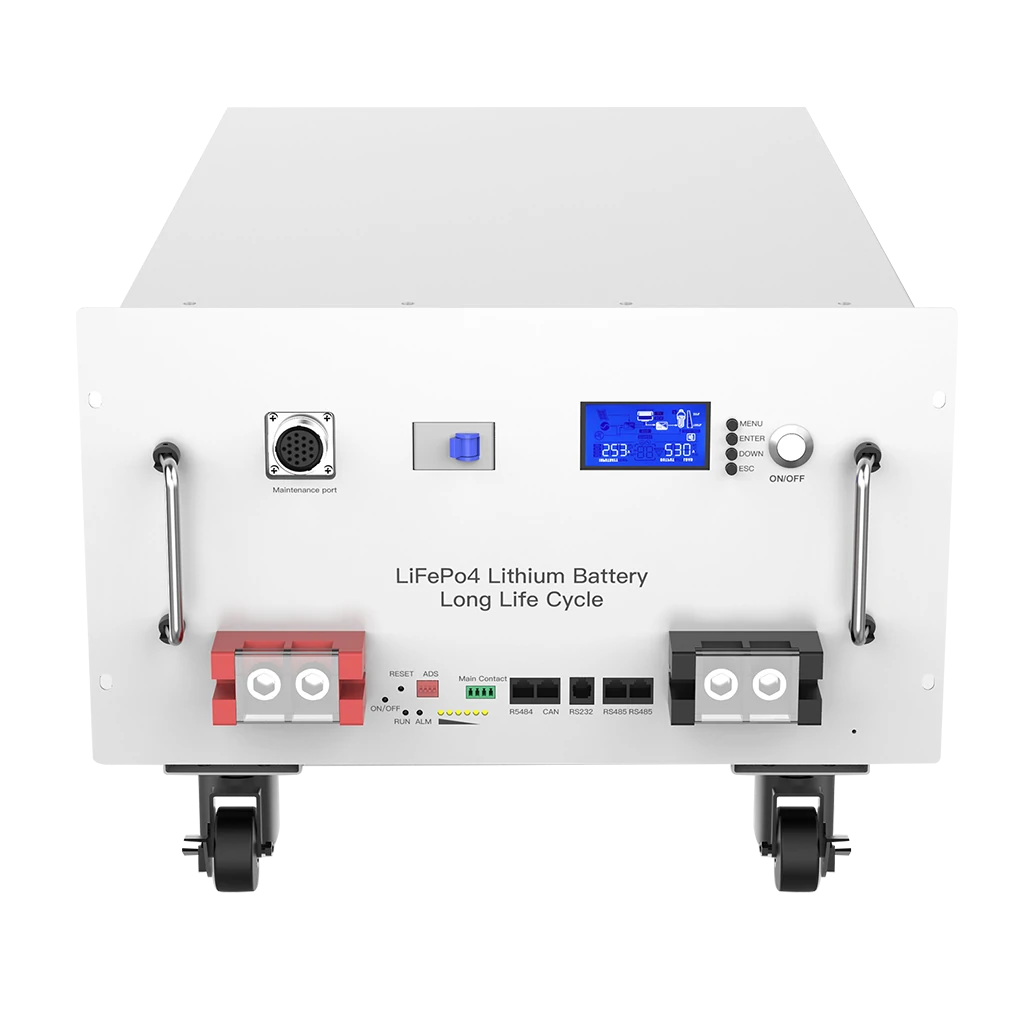
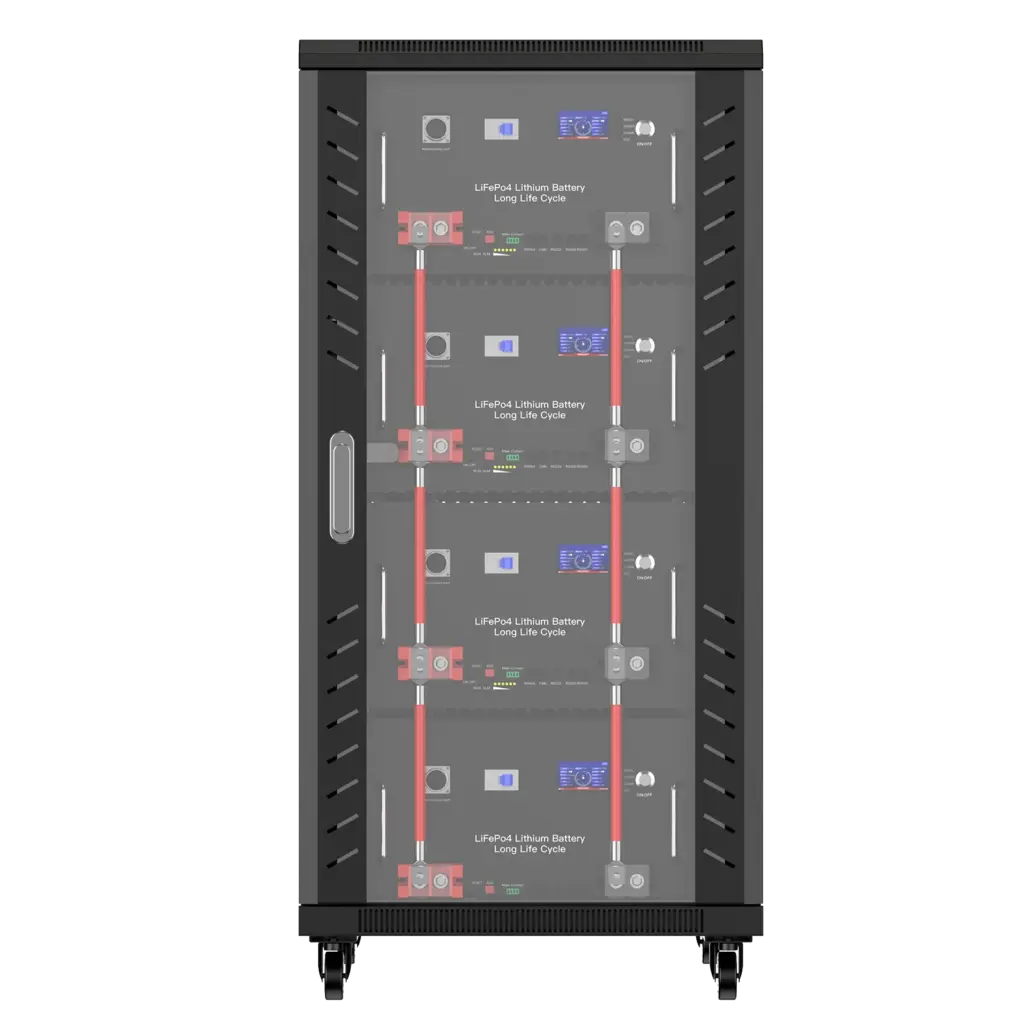
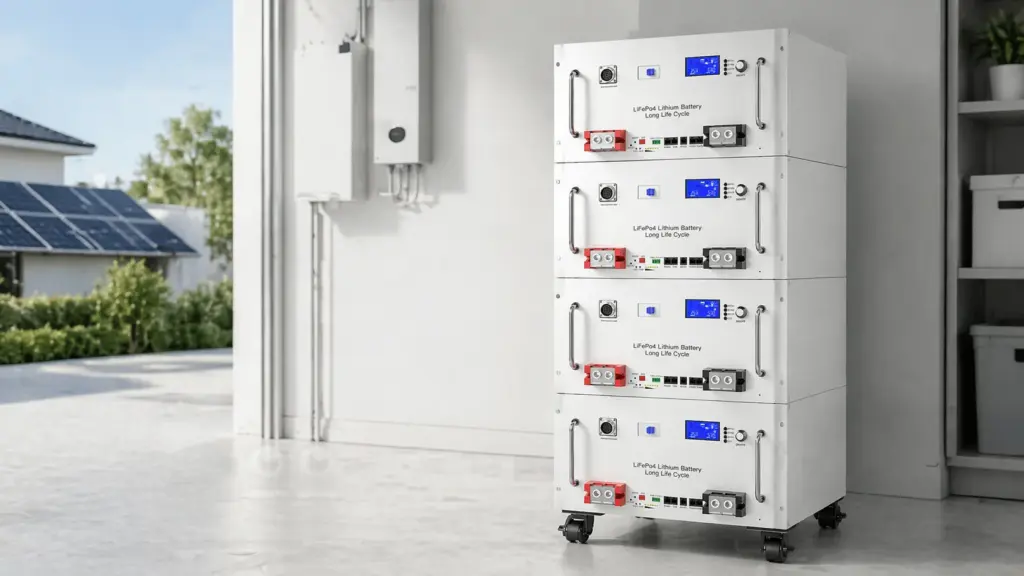
For example, a rack mount LiFePO4 battery is often built around a 48V or 51.2V platform because this design is familiar, modular, and suitable for parallel expansion.
Main Advantages of Low Voltage Batteries
Low-voltage batteries remain popular because they are straightforward and widely supported.
1. Easier System Design
Many installers already understand 48V battery systems. Wiring, breakers, communication settings, and inverter pairing are usually easier to handle than high-voltage systems.
2. Broad Inverter Compatibility
Low-voltage batteries can work with many off-grid inverters, hybrid inverters, telecom power systems, and backup power platforms. This makes them attractive for distributors, installers, and OEM buyers who serve different markets.
3. Flexible Parallel Expansion
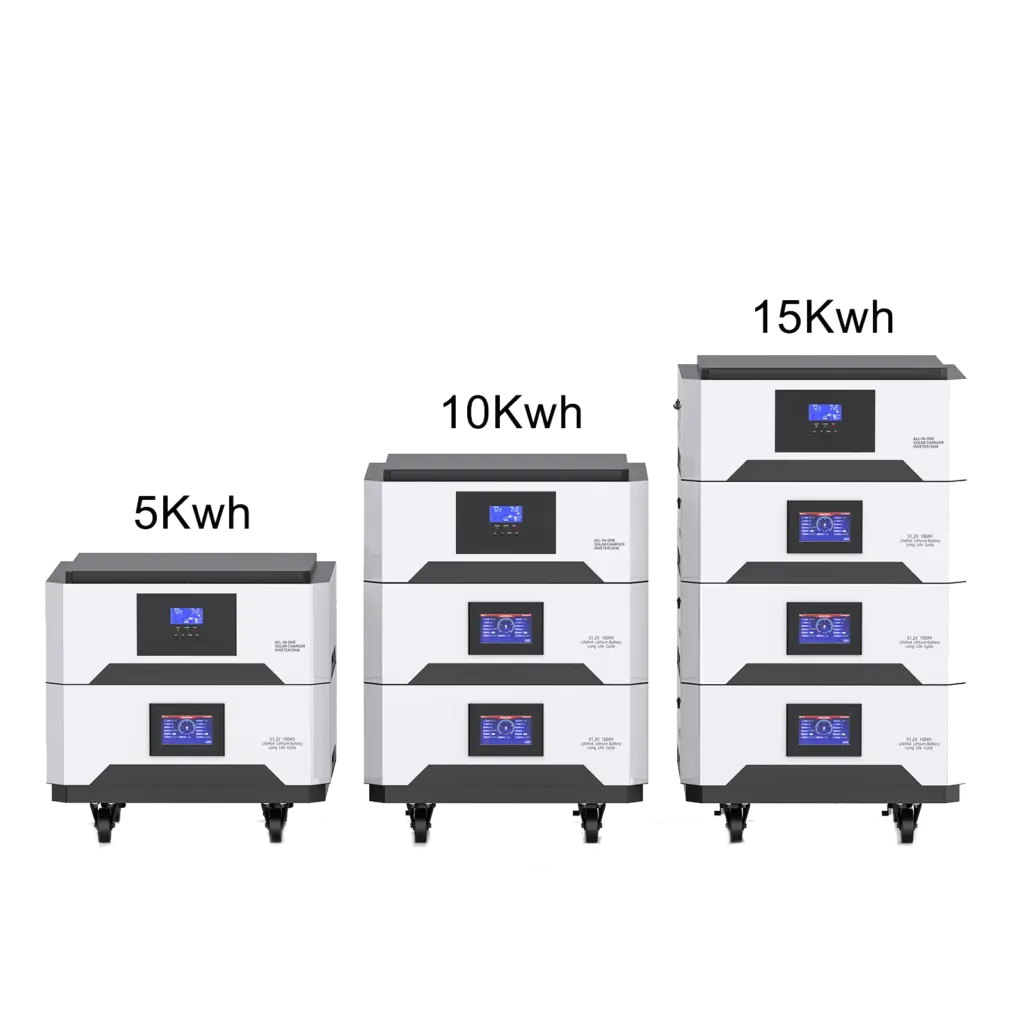
Many low-voltage batteries can be connected in parallel to increase capacity while keeping the same voltage. A homeowner might start with one 10kWh or 15kWh battery and later add more units as energy demand grows.
4. Lower Upfront Cost
For small systems, low-voltage batteries often cost less to purchase and install. The battery modules, protection components, and installation labor can be more affordable.
5. Practical for Moderate Loads
If the goal is to power lighting, refrigerators, internet equipment, small appliances, and selected backup circuits, a low-voltage system can be enough.
Main Limitations of Low Voltage Batteries
Low voltage does not mean low quality. But it does create electrical limits.
Because voltage is lower, the system must use higher current to deliver the same power. Higher current can require thicker cables, larger busbars, stronger breakers, and careful thermal management.
For example:
- A 5kW load at 50V requires about 100A.
- A 10kW load at 50V requires about 200A.
- A 20kW load at 50V requires about 400A.
That is why very large low-voltage systems can become heavy, cable-intensive, and harder to manage. For whole-home backup or C&I storage, high current can become a practical design challenge.
Choose the Right Battery Voltage for Your Project
Not sure whether a high-voltage or low-voltage battery system is the better fit? Avepower can help you evaluate your load profile, inverter compatibility, backup needs, and expansion plan to design a safer and more efficient energy storage solution.
What Is a High Voltage Battery?
A high voltage battery in solar and energy storage usually refers to a battery system operating above traditional 48V architecture. In residential ESS, high-voltage batteries often operate somewhere around 100V to 600V DC. In commercial, industrial, and utility-scale applications, battery system voltage can be even higher, depending on PCS design and project requirements.
High-voltage batteries usually connect modules in series to raise the voltage. This architecture is common in:
- Whole-home backup systems
- Large residential solar storage
- High-power hybrid inverter systems
- EV charging support
- Commercial and industrial ESS
- Microgrids
- UPS systems
- Grid-connected battery energy storage systems
- Large solar-plus-storage plants
A custom high voltage battery storage system is usually designed around the project’s voltage platform, inverter or PCS requirements, cabinet layout, communication protocol, safety design, and capacity target.
Main Advantages of High Voltage Batteries
1. Higher Efficiency At Larger Power Levels
High-voltage systems can deliver the same output power with lower current. Lower current reduces I²R losses in cables and connectors, which helps improve system efficiency.
2. Better Fit for Modern Hybrid Inverters
Many modern hybrid inverters and commercial PCS platforms operate more efficiently with high-voltage DC battery input. This can reduce conversion steps between PV, battery, inverter, and AC loads.
3. Stronger High-Power Performance
High-voltage systems are better suited for large loads such as:
- Central air conditioning
- Heat pumps
- Commercial refrigeration
- Pumps and motors
- EV chargers
- Induction cooking
- Workshop equipment
- Three-phase commercial loads
4. Reduced Cable Size
Because current is lower, cable size can often be reduced compared with an equivalent low-voltage high-power system. This can simplify installation for larger projects.
5. Better Scalability for C&I Systems
For commercial and industrial energy storage, high-voltage architecture is usually more practical. Systems in the 100kWh, 200kWh, 500kWh, or MWh-class range are rarely designed around simple 48V architecture because the current would become too high.
Main Limitations of High Voltage Batteries
High-voltage batteries require more professional engineering.
They normally need:
- HV-compatible inverter or PCS
- Certified installer
- High-voltage disconnects
- Proper insulation coordination
- BMS and EMS integration
- Arc fault and short-circuit protection
- Emergency shutdown design
- Correct commissioning procedures
- Compliance with local codes and safety standards
Safety certification also becomes more important.
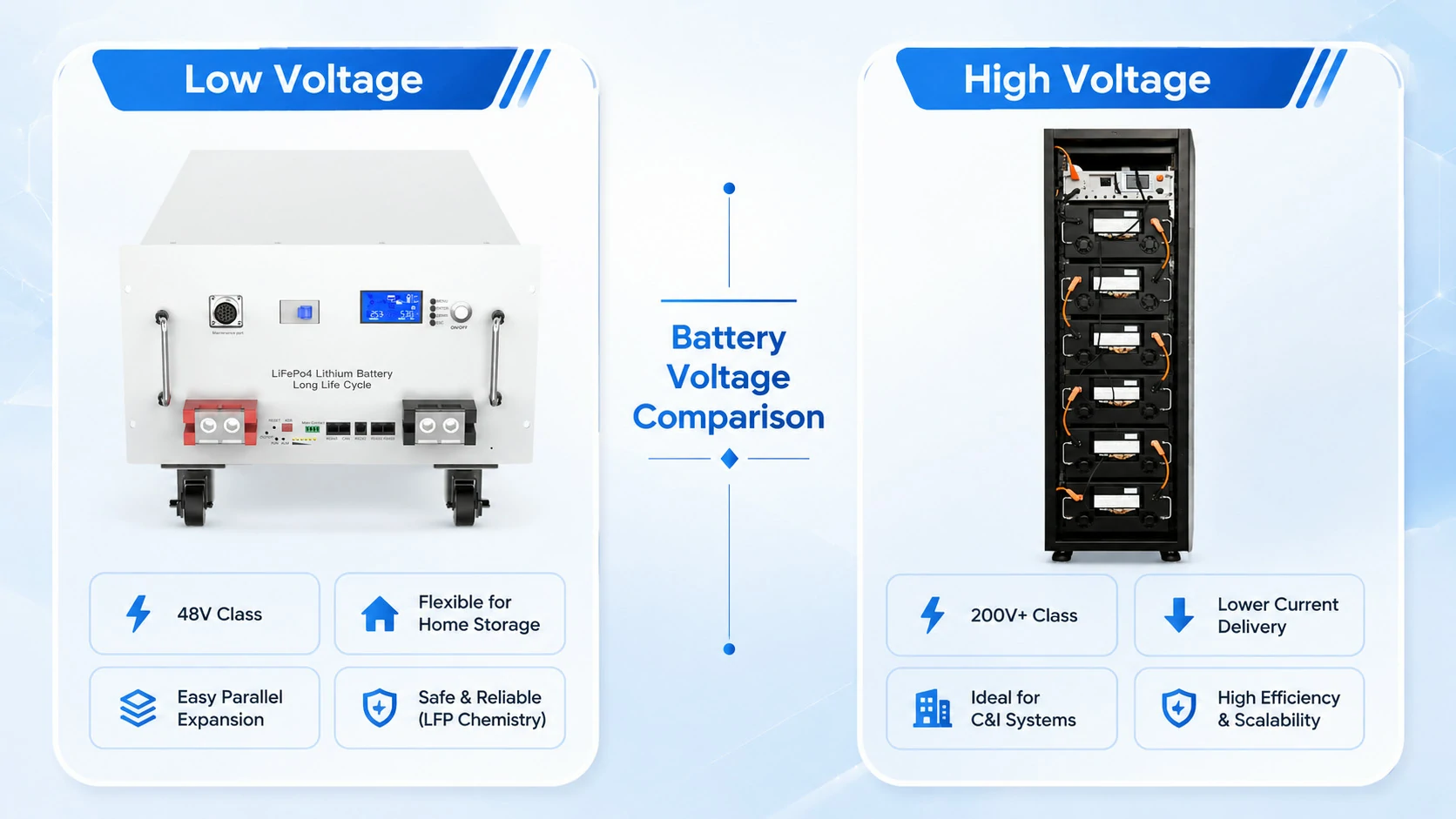
High Voltage vs Low Voltage Batteries: Detailed Comparison
| Comparison Factor | Low Voltage Battery | High Voltage Battery |
|---|---|---|
| Typical ESS voltage | 12V, 24V, 48V, 51.2V | 100V–600V for many residential systems, higher for C&I |
| Current at same power | Higher | Lower |
| Cable requirement | Thicker cables at high power | Smaller cables at high power |
| System efficiency | Good for small systems | Better for larger systems |
| Installation difficulty | Easier | More complex |
| Safety risk | Lower voltage shock risk | Requires stricter HV protection |
| Inverter match | Wide 48V inverter support | Requires HV-compatible inverter |
| Expansion method | Mostly parallel expansion | Usually series module stacks or cabinet-level design |
| Best for | Small home backup, off-grid, telecom, modular ESS | Whole-home backup, EV loads, C&I ESS, microgrids |
| Upfront cost | Usually lower | Usually higher |
| Lifetime value | Strong for small systems | Stronger for large, high-throughput systems |
The Core Technical Difference: Current and Losses
The most important technical difference between high voltage and low voltage batteries is current.
For a given power level:
Higher voltage = lower current
Lower current is useful because electrical losses in cables are related to current squared. In practical terms, when current rises, heat and resistance losses can increase quickly. That is why a high-power low-voltage system can require very large cables and careful protection design.
Consider a 10kW load:
| Battery Voltage | Approximate Current for 10kW |
|---|---|
| 51.2V | About 195A |
| 200V | About 50A |
| 400V | About 25A |
This is a simplified calculation and does not include inverter losses, BMS limits, cable length, temperature, surge loads, or safety margins. But it clearly shows why voltage architecture matters.
A 51.2V battery can absolutely support serious residential loads if the BMS, inverter, cables, and breakers are properly rated. However, as systems grow beyond 10kW, 20kW, or 30kW output, high-voltage architecture becomes more attractive.
High Voltage vs Low Voltage Batteries for Home Energy Storage
Home energy storage is not one single use case. A small apartment, a family home, an off-grid cabin, and a large villa with EV charging may need very different battery systems.
When Low Voltage Batteries Make Sense for Homes
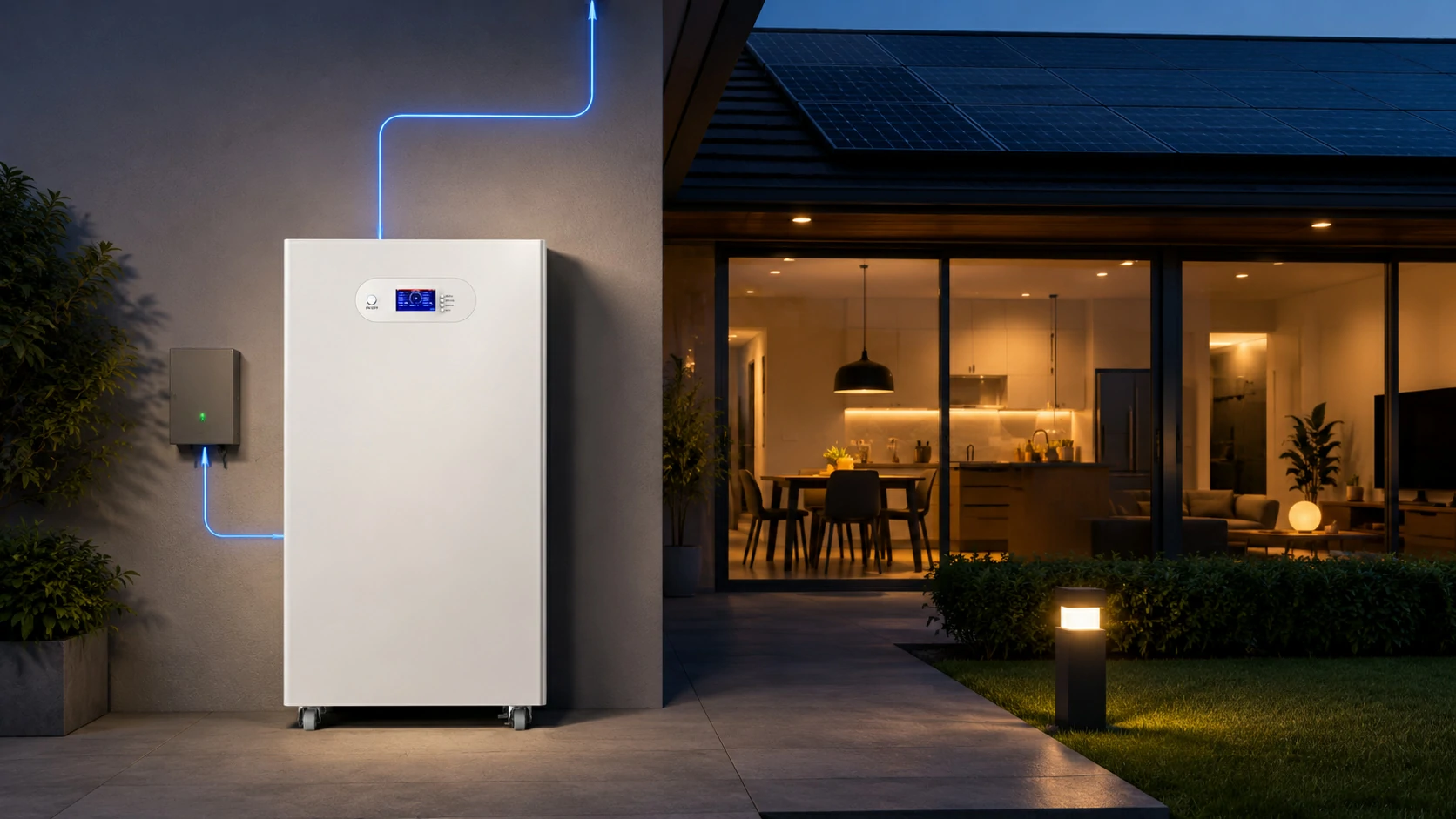
A low-voltage battery is often the better fit when the home needs a simple, affordable, and modular backup system.
Choose low voltage if:
- The home only needs essential load backup
- The inverter is a 48V low-voltage model
- The project has a limited budget
- The user wants modular capacity expansion
- The system is off-grid or semi-off-grid
- The loads are moderate
- The installation team is familiar with 48V architecture
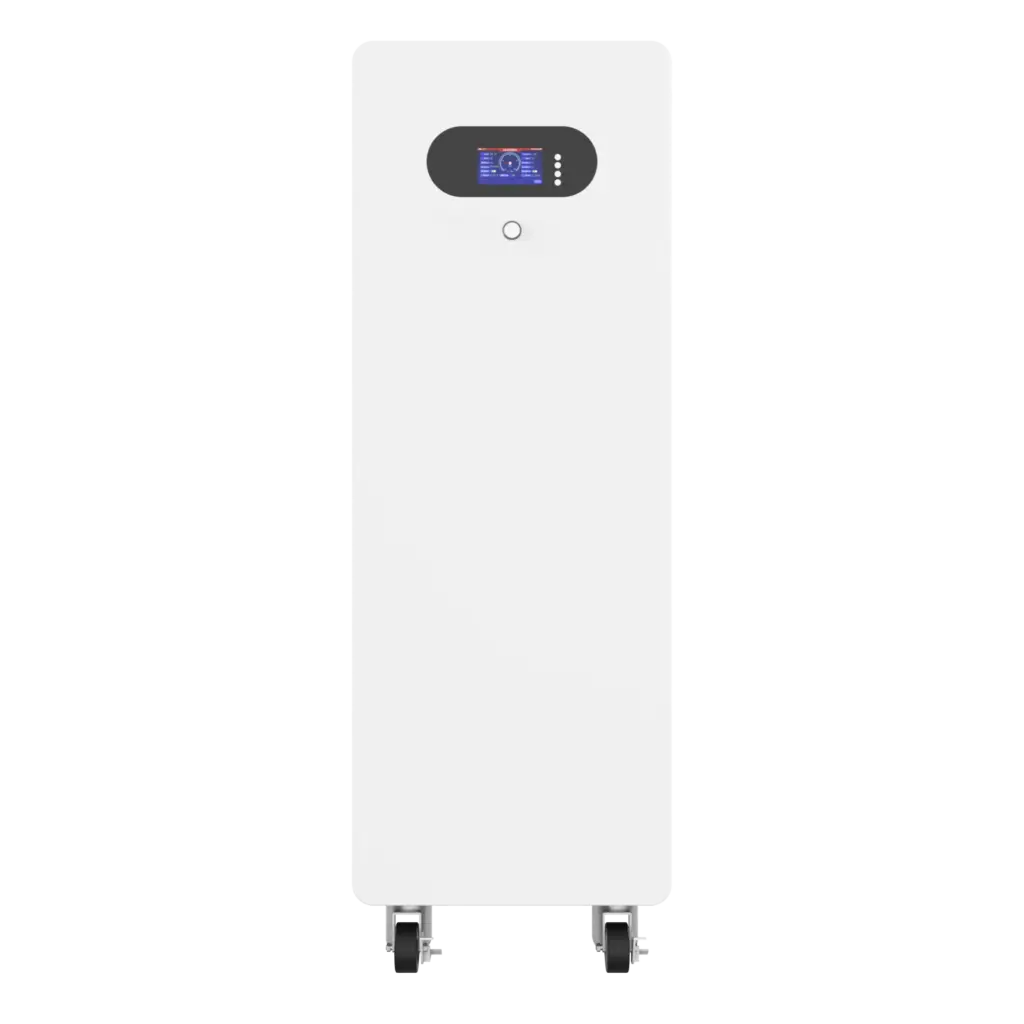
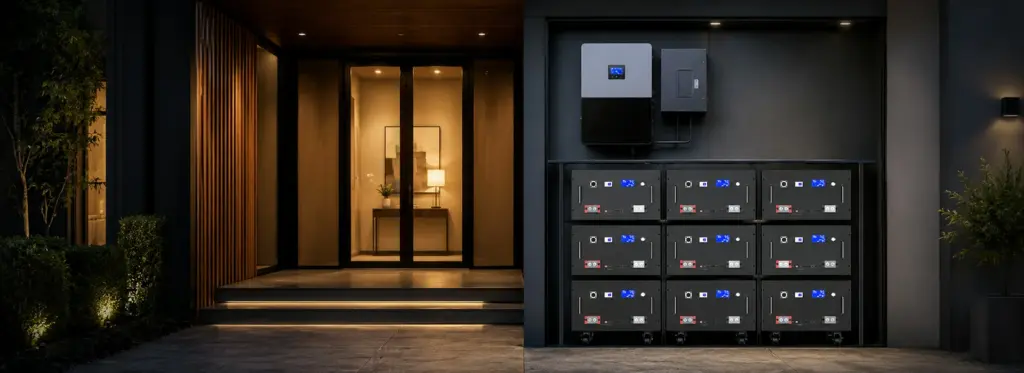
For example, a homeowner who wants to run lighting, internet, a refrigerator, security systems, and a few outlets during outages may not need a high-voltage battery. A vertical LiFePO4 battery or wall-mounted 51.2V battery can be a practical choice.
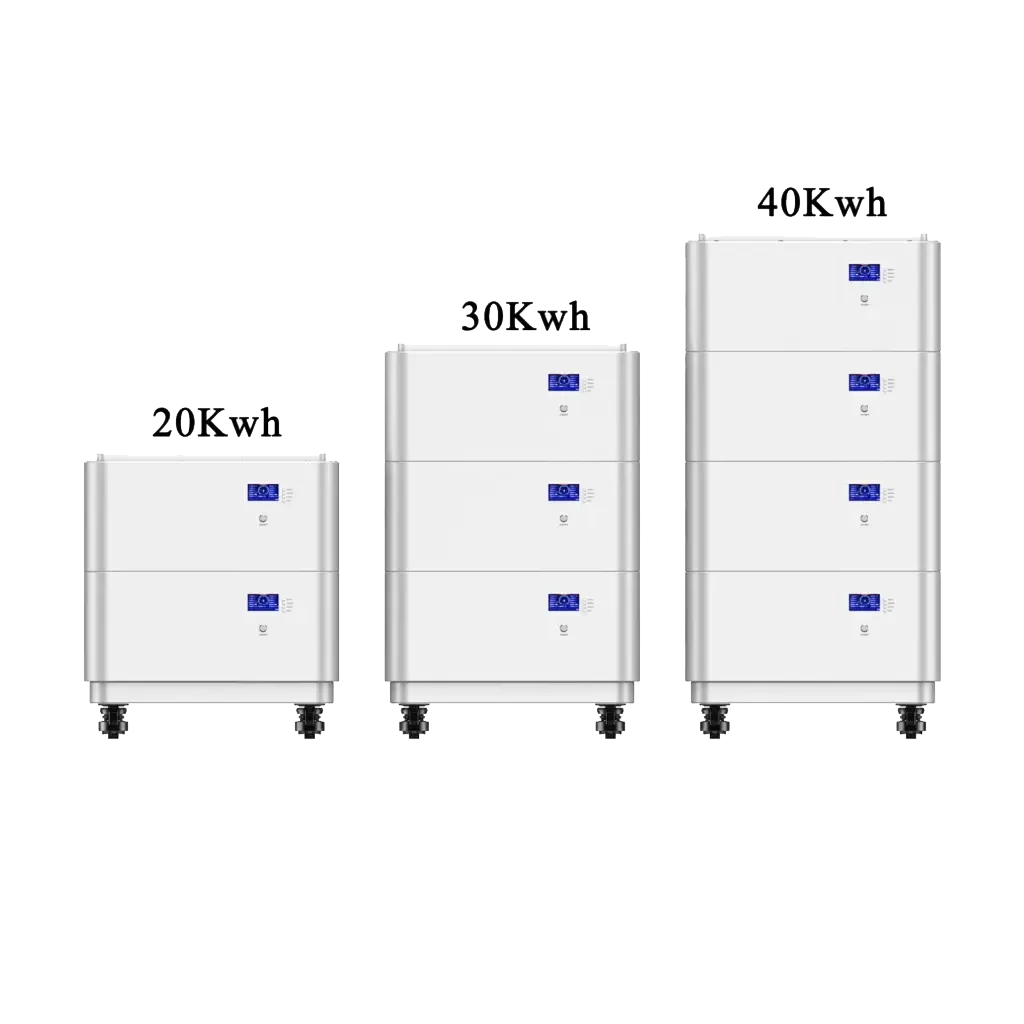
Low-voltage batteries are also useful when installers want to build a flexible system from multiple parallel units. A 15kWh battery bank can be expanded to 30kWh, 45kWh, or more if the BMS, inverter, and wiring design support it.
When High Voltage Batteries Make Sense for Homes
A high-voltage battery becomes more attractive when the home needs higher power, faster response, and stronger inverter integration.
Choose high voltage if:
- The home needs whole-home backup
- The system includes a high-power hybrid inverter
- The user wants to support HVAC, heat pumps, or induction cooking
- The home has or plans to add EV charging
- The solar array is large
- The battery will cycle daily
- The homeowner wants a future-ready architecture
Modern homes are becoming more electrified. Heat pumps, EV chargers, pool pumps, large refrigerators, smart appliances, and induction cooktops all increase peak power demand. A high-voltage system can handle these loads with lower current stress.
This is especially important for larger solar plus storage systems where the battery may charge during the day, discharge during evening peaks, and support backup power during grid outages.
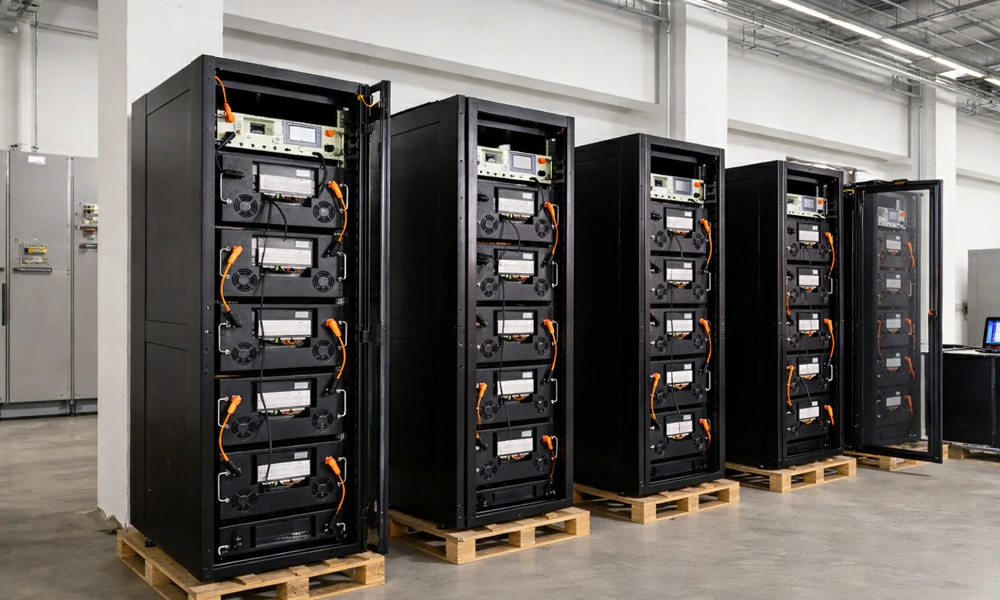
High Voltage vs Low Voltage Batteries for Commercial and Industrial ESS
For C&I projects, the comparison changes significantly. In commercial and industrial energy storage, the battery must support larger loads, longer duty cycles, stronger safety requirements, and more complex control strategies.
A C&I energy storage system may be used for:
- Peak shaving
- Demand charge reduction
- Solar self-consumption
- Backup power
- Load shifting
- Microgrid operation
- EV charging station support
- Power quality improvement
- Diesel generator reduction
- Grid services
For these applications, high-voltage batteries are usually the preferred architecture.
Why High Voltage Is Common in C&I Energy Storage
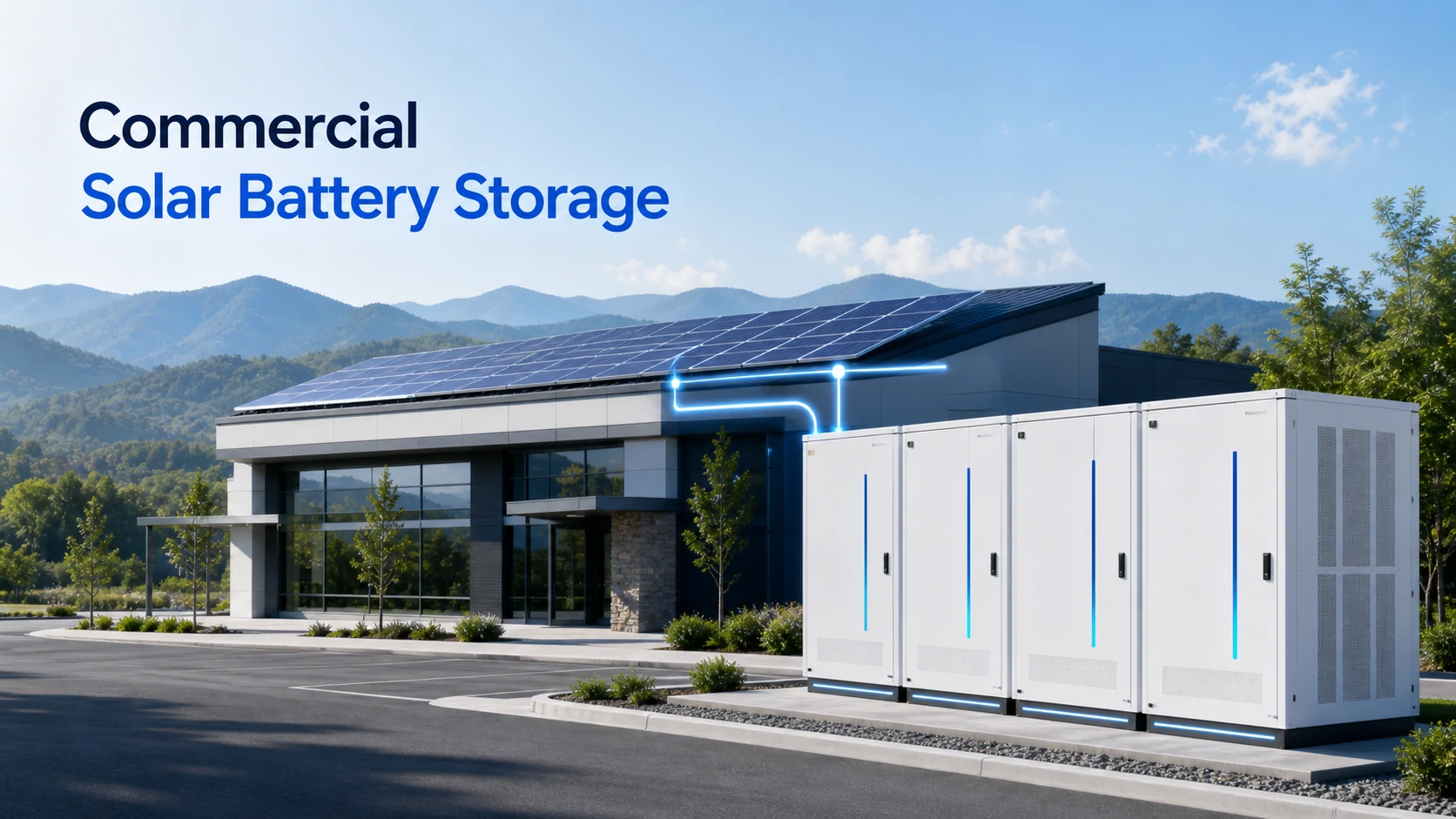
Commercial and industrial facilities often deal with high power levels. A small business may need 30kW to 100kW of discharge power. A factory, hotel, warehouse, farm, or EV charging site may need hundreds of kilowatts.
At these power levels, a low-voltage battery bank would require extremely high current. That can increase cable cost, heat, installation complexity, and protection requirements.
High-voltage architecture helps solve this problem by reducing current and making the system easier to scale.
For example, commercial and industrial energy storage solutions typically integrate batteries, BMS, PCS, EMS, protection devices, thermal management, and cabinet-level system design. The voltage platform is selected to match the PCS and the application, not simply to follow a generic battery category.
Where Low Voltage Still Works in Commercial Projects
Low-voltage batteries can still be useful in smaller commercial applications.
They may fit:
- Telecom backup
- Small server rooms
- Retail store backup
- Security system backup
- Small office solar storage
- Low-power equipment backup
- Modular rack battery systems
A server rack LiFePO4 battery can be a good fit for telecom rooms, IT backup, and small commercial storage where 48V architecture is already common.
But once the project moves toward peak shaving, large PV integration, industrial loads, or three-phase PCS platforms, high voltage normally becomes the more professional direction.
Efficiency: Does High Voltage Really Save Energy?
High-voltage batteries can improve efficiency, but the real answer depends on the whole system.
A battery’s voltage alone does not determine total efficiency. System efficiency also depends on:
- Battery chemistry
- BMS design
- Inverter efficiency curve
- DC-DC conversion steps
- Cable length
- Operating current
- Temperature
- Charge and discharge rate
- System control strategy
- Depth of discharge
- PCS or hybrid inverter design
That said, high-voltage systems often have a real advantage in larger systems because they reduce current and wiring losses.
For example, in a DC-coupled solar storage system, a high-voltage battery may align better with the inverter’s internal DC bus. This can reduce conversion losses compared with stepping voltage up or down repeatedly.
For a small backup system, the efficiency difference may not justify the higher cost or complexity of HV. But for a daily-cycling system with high throughput, the efficiency advantage can become more meaningful over years of operation.
Safety: Is Low Voltage Always Safer?
Low-voltage batteries generally have lower electric shock risk because the voltage is lower. This is one reason 48V systems are widely used in small home and off-grid applications.
However, low voltage does not remove all safety risks. A 48V battery bank can still deliver very high current. High current can create overheating, short-circuit hazards, damaged connectors, and cable fire risks if the system is poorly designed.
High-voltage batteries have higher shock and arc risks, so they require stricter design and installation controls. But a professionally engineered HV system with a reliable BMS, insulation monitoring, disconnects, fuses, contactors, thermal monitoring, and certified enclosures can be very safe.
Key Safety Checks for Both HV and LV Batteries
Before choosing a battery, verify:
- Battery chemistry, preferably stable LiFePO4 for stationary ESS
- BMS protection functions
- Overcharge and over-discharge protection
- Overcurrent and short-circuit protection
- Temperature monitoring
- Cell balancing
- Communication with inverter or PCS
- Proper breaker and fuse selection
- Cable sizing
- Enclosure rating
- Certification documents
- Installation manual
- Warranty terms
- Installer qualification
For project buyers, safety documentation should not be treated as a formality. It is part of system value.
Inverter Compatibility: The Most Common Selection Mistake
One of the biggest mistakes in battery selection is choosing the battery before checking the inverter voltage range.
A low-voltage battery cannot be connected to a high-voltage inverter unless the inverter supports that battery range. A high-voltage battery cannot be connected to a 48V inverter. Doing so can damage equipment and create serious safety risks.
Before buying a battery, check:
- Battery input voltage range of the inverter
- Maximum charge current
- Maximum discharge current
- Communication protocol
- CAN or RS485 compatibility
- BMS brand or protocol mapping
- Firmware version
- Single-phase or three-phase inverter design
- Parallel inverter support
- Backup output rating
- Grid code requirements
Avepower provides an inverter compatibility list to help installers and project partners check supported inverter brands, communication methods, and protocol matching. This step is especially important for OEM/ODM buyers, distributors, and installers who need predictable commissioning across multiple projects.
Battery Lifespan: Does Voltage Decide Battery Life?
Battery lifespan depends more on chemistry, cell quality, BMS control, temperature, depth of discharge, and charge/discharge rate than voltage alone.
A well-designed low-voltage LiFePO4 battery can last many years. A poorly designed high-voltage battery can fail early. Voltage is only one part of the system.
Important lifespan factors include:
- Cell consistency
- LiFePO4 vs NMC chemistry
- Cycle depth
- Operating temperature
- Charging current
- Discharging current
- BMS balancing accuracy
- Thermal design
- Inverter communication
- Installation environment
- Maintenance and firmware support
For stationary energy storage, LiFePO4 is widely used because it offers strong thermal stability, long cycle life, and good safety characteristics. This is why many home energy storage batteries and C&I ESS products use LFP chemistry.
In high-power applications, HV systems may experience lower current stress than LV systems, which can help reduce heat in cables and connectors. But that does not automatically mean every HV battery lasts longer. Always compare datasheets, cycle life conditions, warranty terms, and operating limits.
How to Match Battery Voltage to Real Projects
From a manufacturer and project support perspective, Avepower does not recommend choosing high voltage or low voltage based on trend alone. The correct approach is to match the battery architecture with the project’s inverter, power demand, capacity target, installation environment, and safety requirements.
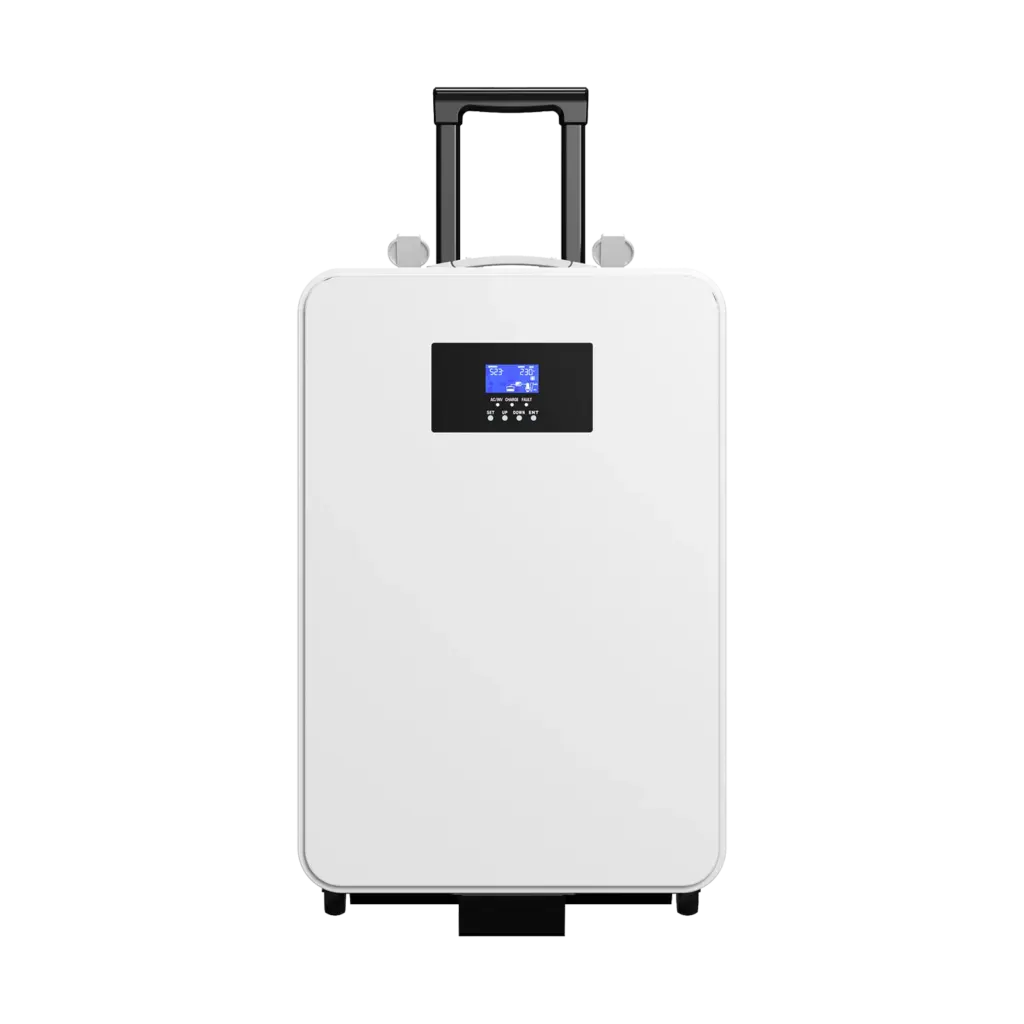
For residential users, Avepower’s low-voltage LiFePO4 systems can support solar self-consumption, backup power, and scalable home storage. Options such as wall-mounted, rack-mounted, stackable, and vertical batteries are suitable for installers and distributors who need flexible product categories.
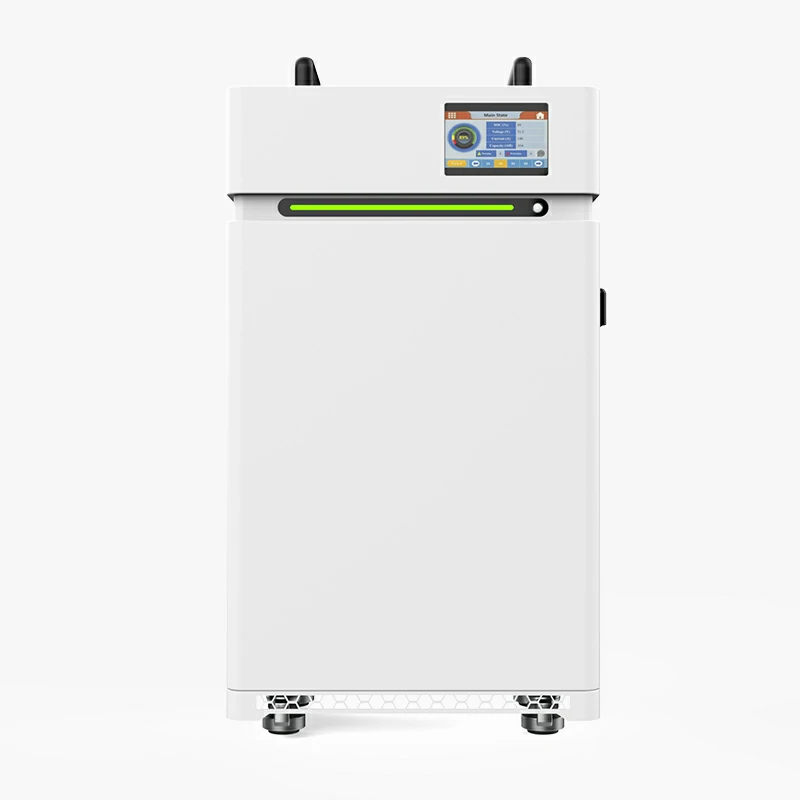
For high-power residential and C&I users, Avepower can provide high-voltage energy storage systems designed around project-specific voltage platforms, BMS logic, cabinet layout, communication protocols, and inverter or PCS compatibility.
Avepower’s project support is especially useful when buyers need:
- Residential or commercial battery solutions
- OEM/ODM battery design
- Capacity customization
- BMS communication support
- CAN/RS485 protocol matching
- Inverter compatibility checks
- Cabinet or rack configuration
- Certification document support
Power Your Business with Scalable Energy Storage
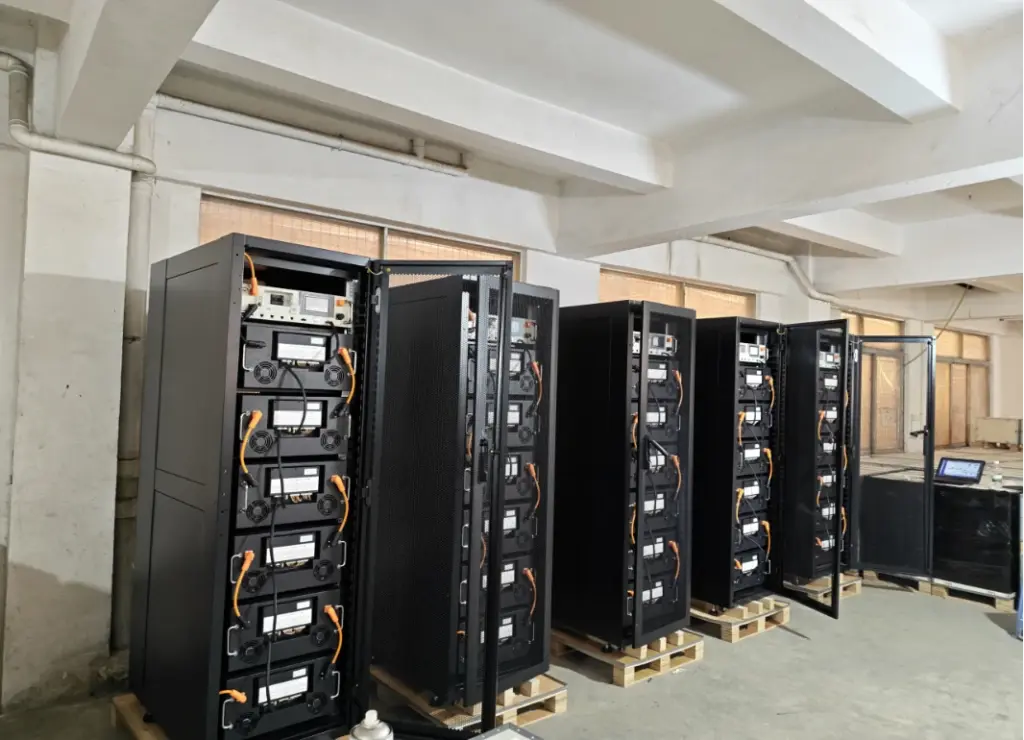
For commercial buildings, factories, hotels, farms, and solar-plus-storage projects, Avepower offers high-voltage ESS solutions designed for peak shaving, load shifting, backup power, and long-term energy cost control.
Final Verdict: High Voltage vs Low Voltage Batteries
In the debate over high voltage vs low voltage batteries, there is no universal winner.
A low-voltage battery is usually better when the system is small, budget-sensitive, modular, easy to service, and based on 48V inverter architecture. It is a strong choice for essential home backup, off-grid solar, telecom backup, and smaller storage projects.
A high-voltage battery is usually better when the system needs higher power, better efficiency, lower current, whole-home backup, EV charging support, or C&I scalability. It is the more suitable choice for large residential solar storage, commercial energy storage, peak shaving, and microgrid projects.
The best battery system is the one that matches the real electrical design:
- What inverter will be used?
- How much power is required?
- How much energy must be stored?
- How often will the battery cycle?
- What loads must be backed up?
- What safety standards apply?
- Will the system expand later?
If you answer those questions first, the choice between HV and LV becomes much clearer.
FAQ
The main difference is the operating voltage. Low-voltage batteries usually operate at 12V, 24V, 48V, or 51.2V, while high-voltage batteries usually operate above 100V. Higher voltage allows the system to deliver the same power with lower current, which can reduce cable losses and improve performance in larger systems.
High-voltage batteries are better for large systems, whole-home backup, EV charging support, and commercial energy storage. Low-voltage batteries are better for small systems, essential backup, off-grid cabins, and budget-sensitive projects.
No. A high-voltage battery must be used with a compatible high-voltage inverter or PCS. Always check the inverter’s battery voltage range and communication protocol before selecting a battery.
Start with load demand, backup duration, inverter type, solar system size, installation space, and future expansion. If the system is small and simple, low voltage may be enough. If the system needs high power, strong scalability, and commercial-grade performance, high voltage is usually the better direction.