

Charging two batteries simultaneously by connecting them in parallel is a common and highly effective method for increasing the total energy available to a system. By connecting two or more batteries this way, you effectively get more runtime because you increase the total amp-hour (Ah) capacity.
However, simply connecting the positive terminals together and the negative terminals together and then hooking up a charger involves more nuance than many people realize. Getting the process wrong can lead to serious safety hazards, premature battery aging, and even system failure. This comprehensive guide will walk you through the concept of parallel charging, explain the potential risks, and provide detailed, step-by-step instructions and best practices to ensure a safe and efficient charging process.
What Does Parallel Charging Mean?
When two or more batteries are connected in parallel, their positive terminals are linked together, and their negative terminals are also connected. This configuration keeps the voltage of the battery system the same as a single battery while increasing the overall capacity, measured in ampere-hours (Ah)【Read this article to learn What Does Ah Mean on a Battery】.
For example, consider two 12V batteries, each with a capacity of 100Ah. If connected in parallel, the total voltage remains 12V, but the combined capacity doubles to 200Ah. This increased capacity allows devices connected to the battery system to operate longer without increasing the voltage supplied to them.
The main advantage of parallel connection is the extended runtime for your devices. However, charging batteries in parallel is not as straightforward as simply connecting them. Even when the batteries have the same voltage rating, differences in capacity, internal resistance, and chemical composition can create issues during charging.
Why Do People Choose Parallel Over Series?
People choose parallel connections primarily when they need to increase their available energy without changing the system voltage. For instance, an RV that runs on a 12V DC system must maintain that 12V. If the user were to connect two 12V batteries in series, the voltage would double to 24V, which would fry the RV’s 12V appliances and electronics. The parallel setup allows the owner to double their runtime for things like lights, refrigerators, and entertainment systems while keeping everything safely operating at 12V.
Read this article to learn batteries in series vs parallel.
Common Issues with Parallel Battery Charging
If you connect batteries of the same chemistry and voltage but with different capacities (measured in Amp-hours or Ah), they will have different internal resistances.
- Uneven Current Distribution: The battery with the lower internal resistance (usually the higher-capacity or newer one) will accept a larger share of the charging current.
- Overheating and Damage: If one battery takes too much current, it can lead to overheating and premature damage or failure of that battery.
- Slow and Incomplete Charging: The battery with the higher internal resistance (usually the lower-capacity or older one) will receive a smaller current, meaning it will charge slowly or might never reach a full state of charge (SOC) before the charger switches off.
- Risk of Overcharging: In a bank without a proper Battery Management System (BMS), the lower-capacity battery might reach full charge faster. If the charger is powerful, the smaller battery could be overcharged before the larger one is full, leading to dangerous conditions like swelling, leaking, or a significantly shortened lifespan.
Safety Role of a Battery Management System (BMS)
Modern lithium batteries, especially LiFePO4 battery, usually come with a built-in BMS. This system monitors voltage, current, and temperature to prevent overcharging, over-discharging, short circuits, or thermal runaway.
When charging in parallel:
- A BMS helps balance charging currents.
- It reduces the risk of one battery charging too quickly compared to the other.
- However, a BMS is not a perfect solution. If the batteries are very different in size or age, one battery could still become stressed while the other operates normally.
Therefore, even with a BMS, you should match your batteries as closely as possible.
Avepower batteries come equipped with an advanced Battery Management System (BMS) that provides multiple layers of protection. It safeguards against overcharging, over-discharging, short circuits, overcurrent, and overheating, ensuring that each battery operates safely during both charging and discharging.
Bottom line: Always use batteries of the same type, voltage, and capacity when charging in parallel.
Essential Precautions Before Connecting Batteries
Regardless of whether you are connecting batteries in series or parallel, taking specific precautions is absolutely critical for both safety and efficiency.
Battery Matching
This point cannot be overstressed: use only identical batteries. This prevents the current imbalance that can lead to overcharging or undercharging and subsequent damage.
- Identical Specifications: The batteries must have the same capacity (Ah), BMS current rating (A), and voltage (V).
- Same Manufacturer/Brand: Different brands of lithium batteries often use proprietary BMS programming. Sticking to the same brand is the safest way to ensure compatibility.
- Similar Age/Purchase Date: Ideally, the batteries should be purchased very close to each other (e.g., within one month) to ensure they have had a similar lifespan and state of health.
- Voltage Synchronization: Before connecting them, use a voltmeter to confirm all batteries have an identical state of charge and voltage.
Physical Inspection and Quality of Components
A physical check can prevent major issues.
- Inspect the Batteries: Look for any visible damage, leaks, or corrosion on the battery cases. Make sure the terminals are clean and free of any corrosion to maintain a good, low-resistance connection.
- High-Quality Connectors and Cables: Use connectors and cables that are rated for the maximum expected current load. Using undersized or low-quality components can lead to abnormal heat buildup from electrical resistance or sparking, greatly increasing the risk of fire and other dangers.
- Tight Connections: Always ensure all connections are firmly secured to prevent sparking or poor conductivity.
Personal and Workplace Safety
Your personal safety is paramount.
- Wear Protective Gear: Always wear protective gear, including gloves and safety glasses, to shield yourself from potential battery acid (if using lead-acid) and electrical sparks.
- Ensure Proper Ventilation: Charge batteries in a well-ventilated area, especially when dealing with lead-acid batteries, which can release flammable hydrogen gas during charging.
- Use Insulated Tools: Only use insulated tools to prevent accidental short circuits if the tool touches both terminals at once.
- Safety Zone: Keep a fire extinguisher (rated for electrical fires) nearby. Never charge batteries near flammable materials.
Avoiding Short Circuits and Proper Handling
A short circuit is the most immediate danger in battery work.
- Triple-Check Connections: Carefully check and re-check all connections to be certain there are no short circuits.
- Remove Jewelry: Be extra careful when working with metal tools and jewelry, as they can accidentally bridge the positive and negative terminals, causing an immediate short circuit.
- Do Not Leave Unattended: Never leave the charging process unsupervised, especially during the initial setup or when using new equipment.
Regular Maintenance for Longevity
A little bit of maintenance goes a long way.
- Routine Checks: Regularly inspect and maintain the battery terminals and connections to ensure long-term reliability and safety.
- Cleaning Corrosion: If you find corrosion on the terminals, clean it with a mixture of baking soda and water. Rinse the area with clean water and dry it completely afterward.
- Follow Manufacturer Instructions: Always adhere strictly to the manufacturer’s specifications and guidelines for battery wiring, charging, and maintenance.
By following these detailed precautions, you ensure a safe and effective parallel battery setup that provides reliable power for your needs.
How to Safely Charge Two Batteries in Parallel
Let’s walk step by step through the process of charging two batteries in parallel.
Step 1: Battery Preparation and Matching
Before you connect anything, you must ensure the batteries are compatible. Ignoring this step is the most common cause of parallel charging failure.
| Requirement | Why it Matters | Recommendation |
|---|---|---|
| Matching Chemistry | Different battery types (e.g., Lead-Acid and LiFePO4) have different charging voltage profiles. Mixing them will inevitably damage one or both. | Use only batteries of the same chemistry (e.g., two LiFePO4s, or two AGM Lead-Acids). |
| Matching Voltage | The rated voltage of the batteries must be identical. | Use two 12V batteries or two 24V batteries. |
| Matching Capacity (Ah) | Capacity differences lead to uneven current distribution and premature failure. | Ideally, use batteries with identical capacity (e.g., two 100Ah batteries). |
| Matching Age/Condition | New and old batteries behave differently due to internal wear. | Use batteries that were purchased and used together from the start, or at least purchased within a month of each other. |
| Matching Charge State | Different states of charge create instant current flow between batteries, which can cause sparks or stress. | Discharge the batteries under the same load for a short period, or individually charge them to the same voltage (within 0.1V) before making the final parallel connection. |
Step 2: The Physical Connection of the Batteries
Once the batteries are matched and ready, you can make the parallel connection. Use high-quality, appropriately sized cables for this step.
- Positive-to-Positive: Use a robust cable to link the positive terminal of the first battery to the positive terminal of the second battery.
- Negative-to-Negative: Use a second, identical cable to link the negative terminal of the first battery to the negative terminal of the second battery.
- Secure All Connections: Ensure all cable connections are tight and clean. Loose connections can create excessive resistance, generate heat, and even cause sparks, which is a major fire hazard.
Step 3: Connecting the Charger to the System
This step is crucial for ensuring the charging current is distributed evenly across both batteries, not just one.
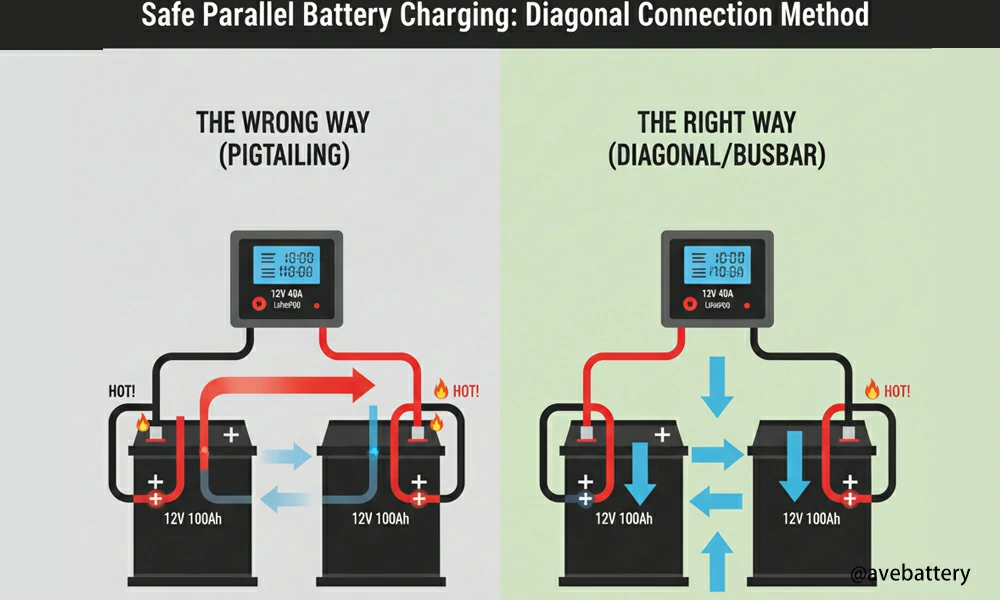
The Wrong Way (Pigtailing): If you connect the charger’s positive cable to Battery 1’s positive terminal and the charger’s negative cable to Battery 1’s negative terminal, all the charging current flows through Battery 1 first before reaching Battery 2. This risks overheating the terminals of Battery 1 and can cause significant charging imbalance.
The Right Way (Diagonal or Busbar Connection): You should connect the charger leads across the entire battery bank.
- Positive Charger Lead: Connect the charger’s positive lead to the positive terminal of Battery 1.
- Negative Charger Lead: Connect the charger’s negative lead to the negative terminal of Battery 2.
By connecting the charger diagonally, you force the current to travel through the entire circuit before returning, which promotes a more uniform distribution of current between the two batteries. For larger systems, using a busbar (a metallic strip used to distribute power) to connect all positive terminals and a second busbar for all negative terminals is the best practice for even current flow.
Step 4: Initiating and Monitoring the Charge Process
Once everything is connected, you can start the charge. This is not a “set it and forget it” process, especially the first time.
- Final Check: Do a last visual check to ensure all connections are tight, properly insulated, and not touching any metal surfaces.
- Turn On the Charger: Start the charging process.
- Active Monitoring: Stay with the system, especially for the first 30 minutes. You need to look for signs of trouble:
- Excessive Heat: Do any battery terminals or cables feel unusually hot to the touch? A little warmth is normal, but anything too hot to hold indicates a resistance or connection problem. Shut off the charger immediately if you detect excessive heat.
- Smell: Any smell of burning plastic or sulfur (from lead-acid batteries) is a signal to stop charging immediately.
- Voltage Checks (Using a Multimeter): Regularly use a multimeter to check the voltage of each individual battery. If one battery’s voltage is significantly higher than the other (more than 0.2V difference), your charging is uneven, and you should stop and re-examine the system.
Step 5: Regular Maintenance and Balancing
Battery systems, especially those in parallel, benefit from periodic balancing.
- Periodic Disconnect and Charge: Every two to three months, it is highly recommended to disconnect the parallel setup. Charge each battery individually to its full capacity using its own separate charger. This simple step forces each battery to reach a true 100% state of charge, which helps balance the individual cells within each battery and recalibrates the BMS units. This is key to maintaining the expected total system capacity.
- Inspect Terminals and Cables: Check for signs of corrosion on the terminals. Use a mild solution of baking soda and water to clean any corrosion (rinse thoroughly and dry completely afterward). Check cables for fraying or damage.
- Use a Battery Monitor: Consider installing a dedicated battery monitor. This device gives you real-time data on the total system’s voltage, the current flowing in or out (Amps), and the remaining capacity (Ah). This information is invaluable for catching problems early and ensuring peak battery health.
What to Do if One Battery is Weaker Than the Other
You should avoid pairing a weak battery with a strong battery if possible. If you must pair them, you should charge the weaker battery separately first and then place it in service. You should plan to replace the weaker battery soon because it will shorten the life of the whole bank. You should use a battery isolator or a combiner if the batteries must remain separate but share a charging source.
How Parallel Charging Differs from Series Charging
It’s easy to confuse parallel and series connections, but they serve very different purposes.
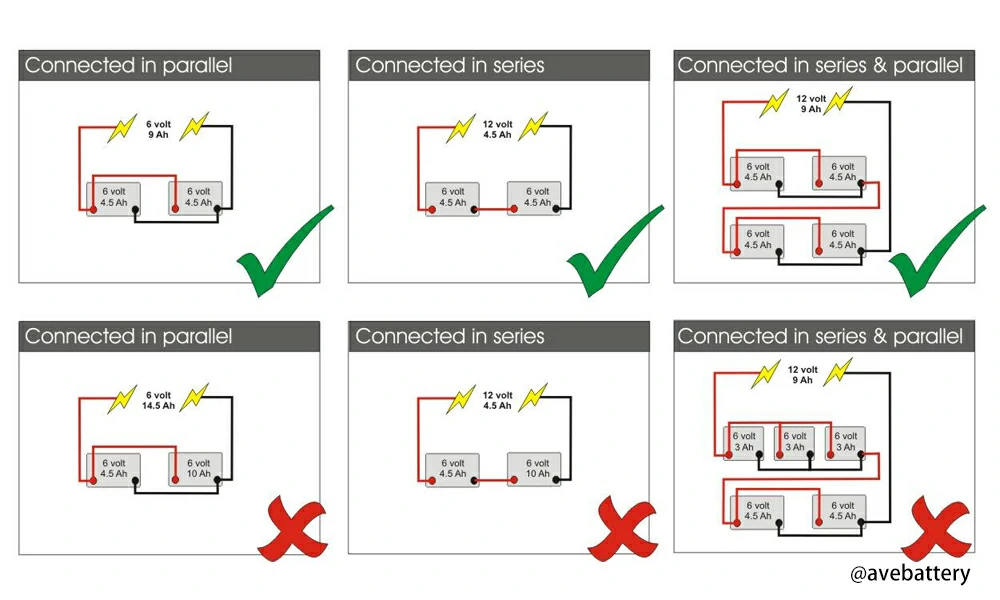
| Feature | Series Connection | Parallel Connection |
|---|---|---|
| Voltage | Adds up (two 12V = 24V) | Stays the same (two 12V = 12V) |
| Capacity (Ah) | Same as one battery | Adds up (two 100Ah = 200Ah) |
| Current Flow | Limited by one battery | Shared between batteries |
| Use Case | When you need higher voltage (24V or 48V systems) | When you need more capacity at the same voltage |
So, if you want to power a 24V inverter, you connect two 12V batteries in series. But if you want longer runtime for a 12V system, you connect them in parallel.
Conclusion
Charging two batteries in parallel is a practical way to increase total capacity while maintaining the same voltage. However, it requires careful preparation, appropriate equipment, and close monitoring. By using matched batteries, ensuring proper connections, following safe charging practices, and periodically maintaining your system, you can enjoy a reliable and long-lasting battery setup.

Power That Lasts
If you want a battery you can just install and forget, go with an Avepower LiFePO4.
You get 4000+ cycles, around 10 years of use, a built-in BMS, and capacity you can expand later as your needs grow—just talk to Avepower for easy sizing advice and a no-pressure quote.
FAQ
Yes, you can charge two batteries in parallel simultaneously. When batteries are connected in parallel, the voltage remains the same as a single battery, and the total capacity increases. However, it is important to use batteries with the same voltage and similar capacity, and to monitor the charging process carefully to avoid uneven charging or overheating.
It depends on your needs. Charging batteries in series increases the total voltage while keeping the capacity the same. Charging in parallel keeps the voltage the same but increases the total capacity, allowing for longer runtime. If you need higher voltage for a specific device, series charging is better. If you need longer battery life or runtime without increasing voltage, parallel charging is preferable.
Charging batteries in parallel can present some challenges:
1. Uneven charging if batteries have different capacities or internal resistances.
2. Overheating of batteries receiving too much current.
3. Slower charging for smaller or higher-resistance batteries.
4. Risk of overcharging smaller batteries, which can cause swelling, leakage, or reduced lifespan.
Using matched batteries and a BMS or balancing circuit can help prevent these issues and ensure safe, efficient charging.
To connect two 12V batteries in parallel:
1. Connect the positive terminal of the first battery to the positive terminal of the second battery.
2. Connect the negative terminal of the first battery to the negative terminal of the second battery.
3. Use high-quality cables and ensure all connections are secure. Once connected, you can attach your charger to the system, taking care to distribute the current evenly.