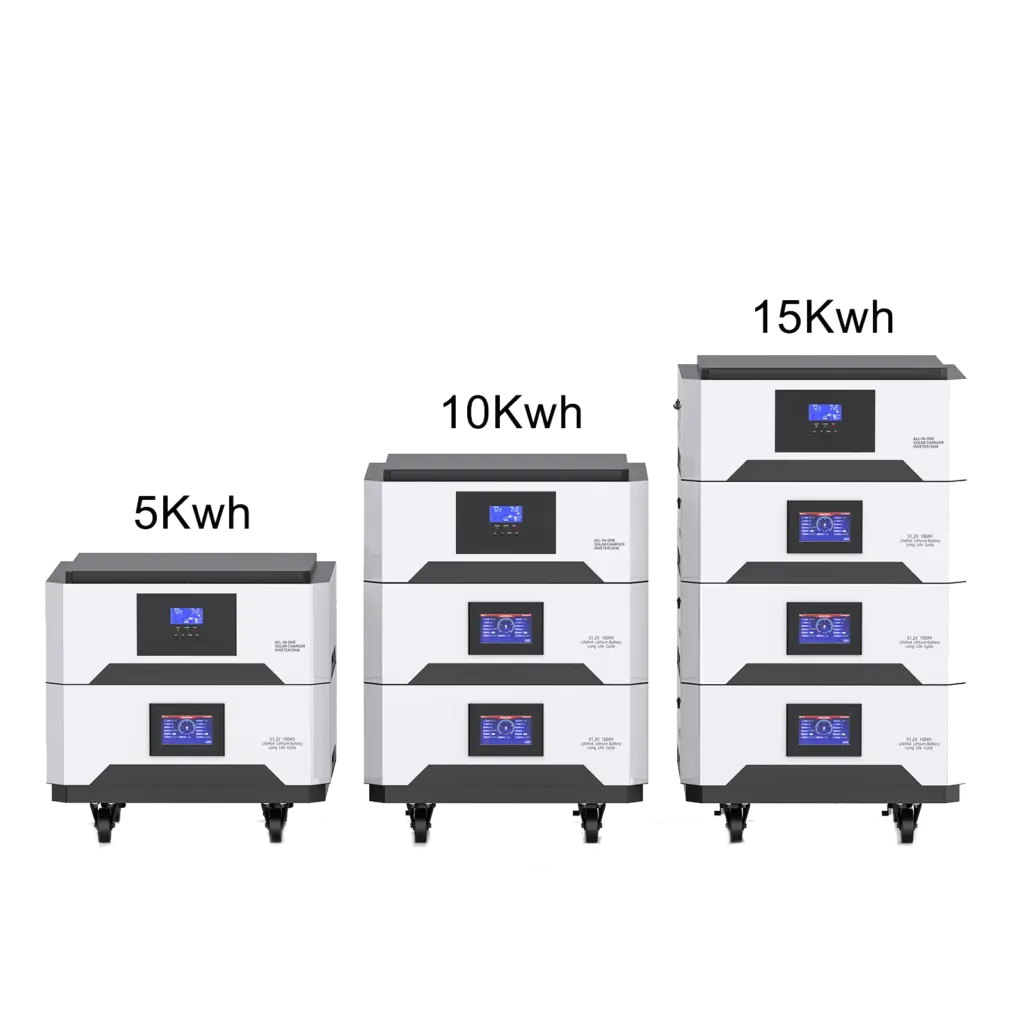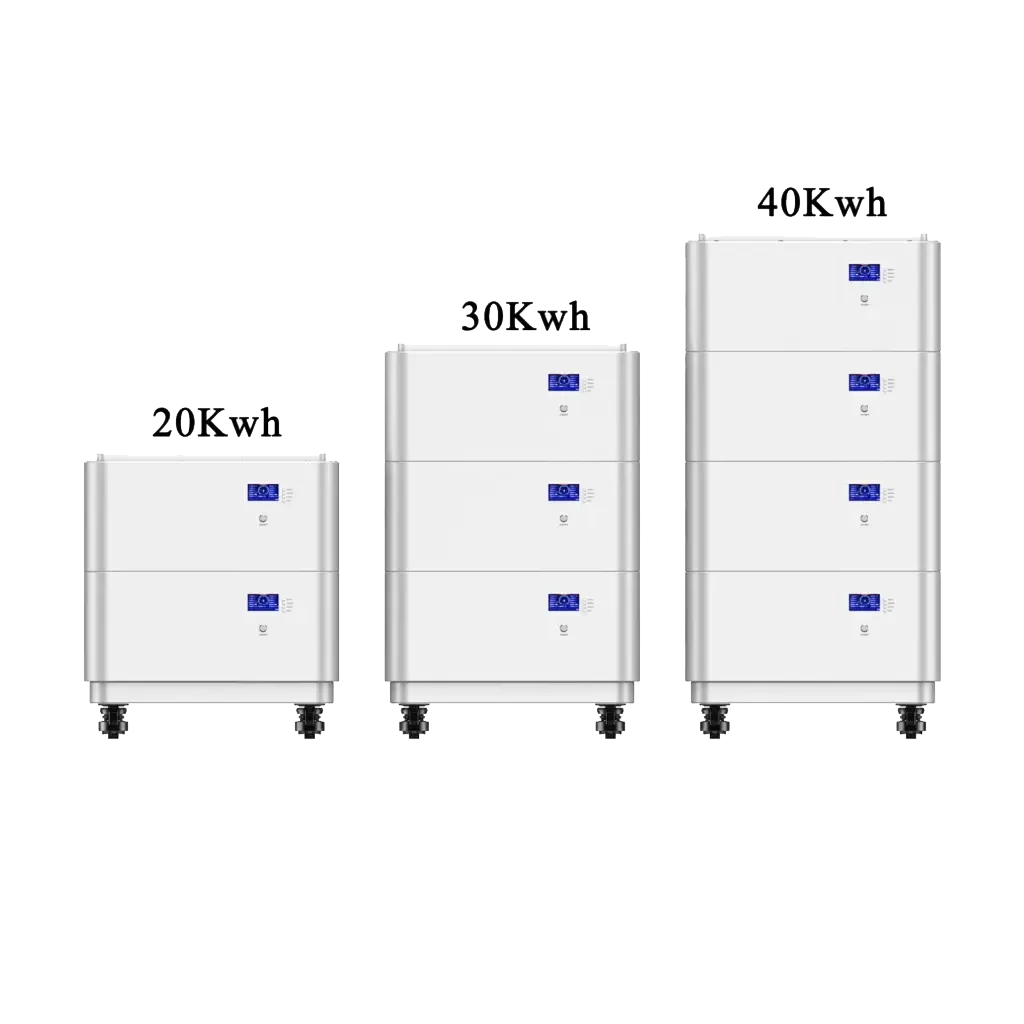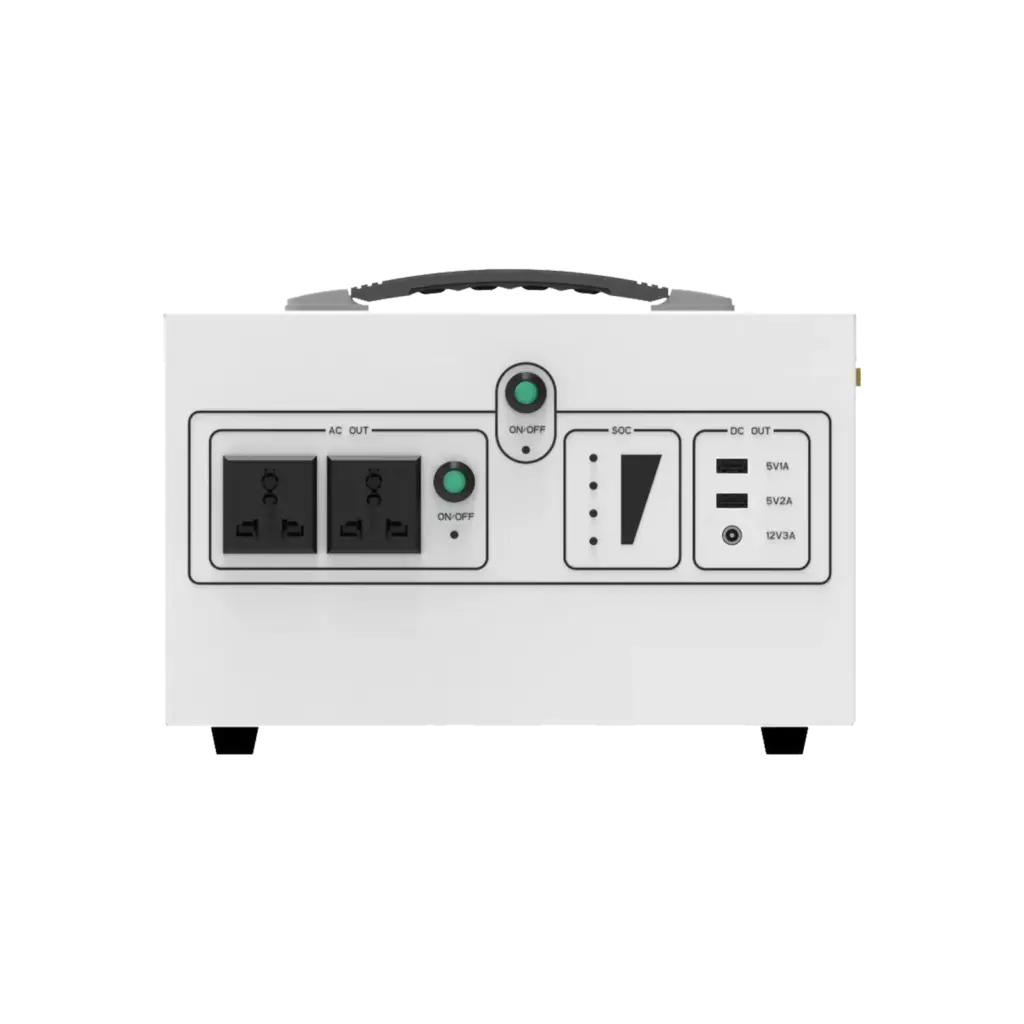

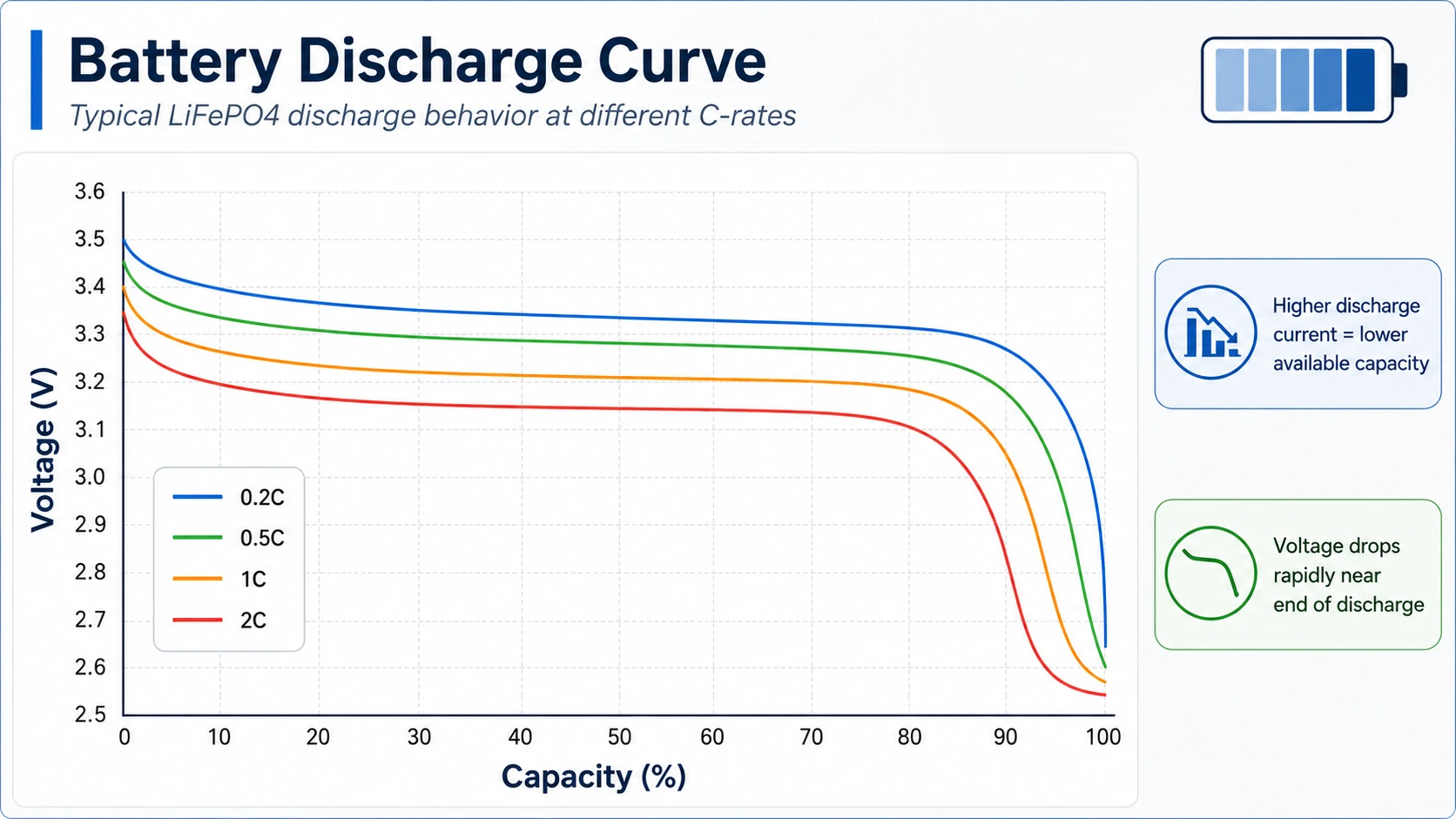
Battery discharge current is the amount of electrical current a battery can safely deliver to a load, inverter, motor, or energy storage system. For solar battery buyers, it is not enough to compare only kWh capacity. You must also check continuous discharge current, peak discharge current, BMS current limit, battery voltage, temperature derating, cable size and inverter compatibility.
In simple terms, battery capacity tells you how long a battery can run, while discharge current tells you how much power it can deliver at one time. A battery may have enough stored energy but still fail to support a large inverter if its discharge current is too low.
For example, a 51.2V battery with a 100A discharge limit can deliver roughly 5.12kW at battery level before losses. A similar 51.2V battery with a 200A discharge limit can theoretically support about 10.24kW at battery level, if the BMS, cables, terminals, protection devices and inverter settings are all properly matched.
What Is Battery Discharge Current?
Battery discharge current is the current flowing out of a battery during use, and it determines how much power the battery can supply at any moment. It should always be judged together with voltage, C-rate, BMS limit, temperature and load demand, not as an isolated number.
In a battery datasheet, discharge current is usually shown in amperes, or A. You may see terms such as standard discharge current, recommended discharge current, maximum continuous discharge current, peak discharge current, pulse discharge current, or BMS discharge limit.
The basic relationship is:
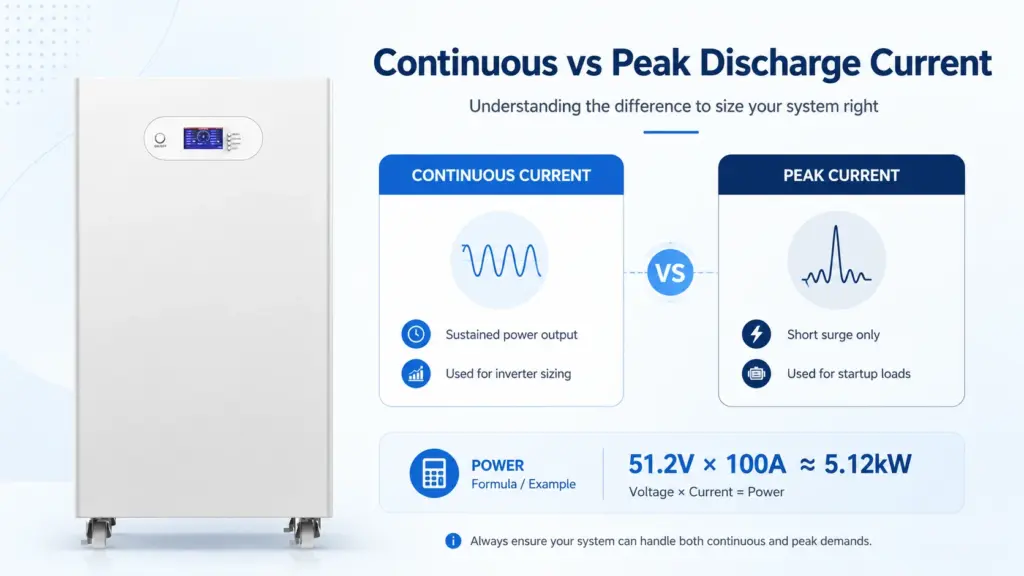
Power = Voltage × Current
So if a battery is operating at 51.2V and discharging at 100A:
51.2V × 100A = 5,120W, or about 5.12kW
This is why discharge current is critical for solar batteries, home backup systems, UPS systems, telecom backup, RV batteries, marine batteries and commercial energy storage systems. It directly affects whether the battery can support high-power loads such as pumps, air conditioners, refrigerators, motors, power tools, medical devices or whole-home backup circuits.
Need help matching battery discharge current with your inverter and project load? Contact Avepower with your inverter brand, inverter model, load profile, required backup time and target capacity. Our team can recommend a LiFePO4 battery configuration for installers, distributors, wholesalers, EPC teams and OEM/ODM energy storage partners.
How Do You Calculate Battery Discharge Current?
The simplest battery discharge current formula is current equals battery capacity multiplied by C-rate. For inverter systems, you can also estimate battery-side current by dividing inverter AC power by battery voltage and inverter efficiency. Both methods are useful, but they answer different questions.
Use this formula when you know the battery capacity and C-rate:
Discharge current = Battery capacity × C-rate
Example:
| Battery Capacity | C-rate | Discharge Current | Ideal Discharge Time |
|---|---|---|---|
| 100Ah | 0.2C | 20A | 5 hours |
| 100Ah | 0.5C | 50A | 2 hours |
| 100Ah | 1C | 100A | 1 hour |
| 100Ah | 2C | 200A | 30 minutes |
| 280Ah | 0.5C | 140A | 2 hours |
| 280Ah | 0.71C | about 200A | about 1.4 hours |
This formula is widely used in battery C-rate explanations because C-rate expresses current relative to battery capacity. Avepower’s battery C-rate calculation guide uses the same principle: C-rate equals current divided by capacity, and current equals capacity multiplied by C-rate.
Use this formula when you are matching a battery to an inverter:
Battery-side DC current ≈ Inverter AC power ÷ Battery voltage ÷ Inverter efficiency
Example for a 5kW inverter, 51.2V battery and 92% inverter efficiency:
5,000W ÷ 51.2V ÷ 0.92 = about 106A
This means a 51.2V battery system should safely support more than 106A continuous discharge current, plus practical headroom for surge loads, temperature variation and BMS derating. Avepower’s inverter size chart uses the same DC-side current logic when explaining why higher inverter power requires higher battery current capability.
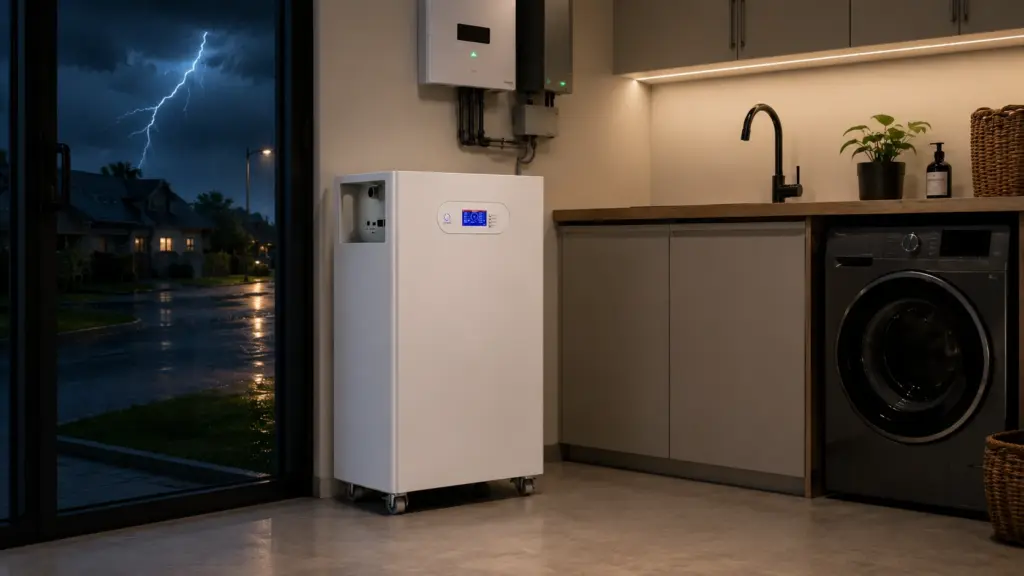
Need Help Matching Battery Discharge Current with Your Inverter?
Send us your inverter model, load power, backup time and project voltage range. Avepower can help you evaluate the right LiFePO4 battery capacity, discharge current and communication protocol before ordering.
How Is Battery Discharge Current Related to C-Rate?
C-rate expresses discharge current relative to battery capacity, making it easier to compare batteries of different sizes. A 100Ah battery discharged at 100A is operating at 1C, while a 200Ah battery discharged at 100A is operating at 0.5C and will usually run cooler.
The formula is:
C-rate = Discharge Current ÷ Battery Capacity
Or:
Discharge Current = Battery Capacity × C-rate
Example table:
| Battery Capacity | 0.2C Current | 0.5C Current | 1C Current | Approx. Full-Load Runtime |
|---|---|---|---|---|
| 100Ah | 20A | 50A | 100A | 5h / 2h / 1h |
| 200Ah | 40A | 100A | 200A | 5h / 2h / 1h |
| 280Ah | 56A | 140A | 280A | 5h / 2h / 1h |
| 314Ah | 62.8A | 157A | 314A | 5h / 2h / 1h |
A high C-rate does not automatically mean a better battery. It means the battery can deliver energy faster, but higher current usually creates more heat, more voltage sag, and more stress on cells and connection components. Battery University notes that different lithium cell designs prioritize either high energy capacity or high current delivery, and that low internal resistance helps high-current cells reduce heat rise.
For most home energy storage projects, lower daily discharge rates are usually better for long-term reliability. Higher discharge rates are useful for heavy backup loads, peak shaving, commercial demand response, or short surge events.
What Is the Difference Between Continuous and Peak Discharge Current?
Continuous discharge current is the current a battery can deliver for normal sustained operation, while peak discharge current is a short-duration limit for startup surge or temporary high loads. For solar storage, continuous current matters more for daily use, while peak current helps with motor startup.
A battery datasheet may show several current values:
| Current Type | Meaning | Typical Use | Can It Be Used Continuously? |
|---|---|---|---|
| Recommended discharge current | Preferred daily operating current | Long cycle life, stable performance | Yes, within conditions |
| Standard discharge current | Normal rated discharge condition | Capacity and performance reference | Usually yes |
| Maximum continuous discharge current | Highest sustained current under approved conditions | High-load inverter operation | Yes, but not always ideal for lifespan |
| Peak or pulse discharge current | Short burst current for seconds | Motor startup, compressor surge | No |
| Short-circuit current | Fault current under abnormal condition | Protection and safety design | No |
For procurement decisions, the most important value is usually maximum continuous discharge current, not peak current. A battery advertised with high peak discharge may still be unsuitable for a large inverter if its continuous discharge limit is low.
For solar installers and EPC teams, Avepower provides battery systems for solar installers with product matching and project support. The installer page specifically targets technical support, product matching and quotation communication for installation businesses.
How Much Discharge Current Do You Need for an Inverter?
The required discharge current depends on inverter power, battery voltage and inverter efficiency. Higher battery voltage reduces current for the same power, which is why 48V, 51.2V and high-voltage battery systems are commonly used for larger solar storage projects.
Here is a quick reference table using 92% inverter efficiency:
| Inverter AC Output | 12V Battery Current | 24V Battery Current | 48V Battery Current | 51.2V Battery Current |
|---|---|---|---|---|
| 1kW | about 91A | about 45A | about 23A | about 21A |
| 3kW | about 272A | about 136A | about 68A | about 64A |
| 5kW | about 453A | about 226A | about 113A | about 106A |
| 6kW | about 543A | about 272A | about 136A | about 127A |
| 8kW | about 725A | about 362A | about 181A | about 170A |
| 10kW | about 906A | about 453A | about 226A | about 212A |
This table shows why low-voltage high-power systems need careful design. A 10kW inverter on a 12V battery would require extremely high current, which means heavy cables, large protection devices and higher losses. For home and small commercial storage, 48V or 51.2V systems are more practical. For larger commercial systems, a custom high-voltage battery system may be more suitable.
Avepower’s high-voltage battery solution page focuses on customized capacity, voltage configuration, cabinet design, BMS, communication protocols and project-based technical support for EPCs, project developers, distributors and OEM/ODM customers.

Looking for Reliable LiFePO4 Batteries for Solar Storage Projects?
Avepower supplies wall-mounted, rack-mounted, vertical, stackable and high-voltage battery systems for residential and small commercial applications. Get factory pricing and technical support for your next project.
What Is a Good Discharge Current for LiFePO4 Batteries?
A good LiFePO4 discharge current depends on the application, but many solar storage batteries are designed around moderate discharge rates rather than extreme high-C output. For long cycle life, lower daily C-rate, proper temperature control and correct BMS settings are usually better than constantly using maximum current.
For home solar batteries, a 0.3C to 1C discharge range is common, depending on cell type, pack design, BMS rating and cooling condition. A 100Ah battery at 0.5C delivers 50A. A 280Ah battery at 0.5C delivers 140A. A 280Ah battery at about 0.71C delivers roughly 200A.
How Does Temperature Affect Battery Discharge Current?
Temperature affects battery discharge current because high current creates heat, and battery performance changes under cold or hot conditions. A battery may meet its rated discharge current at room temperature but reduce output when cells are too cold, too hot or unevenly heated.
For lithium batteries, high discharge current increases internal heat generation. If heat cannot escape quickly, cell temperature rises, voltage drops faster, and the BMS may derate or stop discharge to protect the pack.
How Does the BMS Limit Battery Discharge Current?
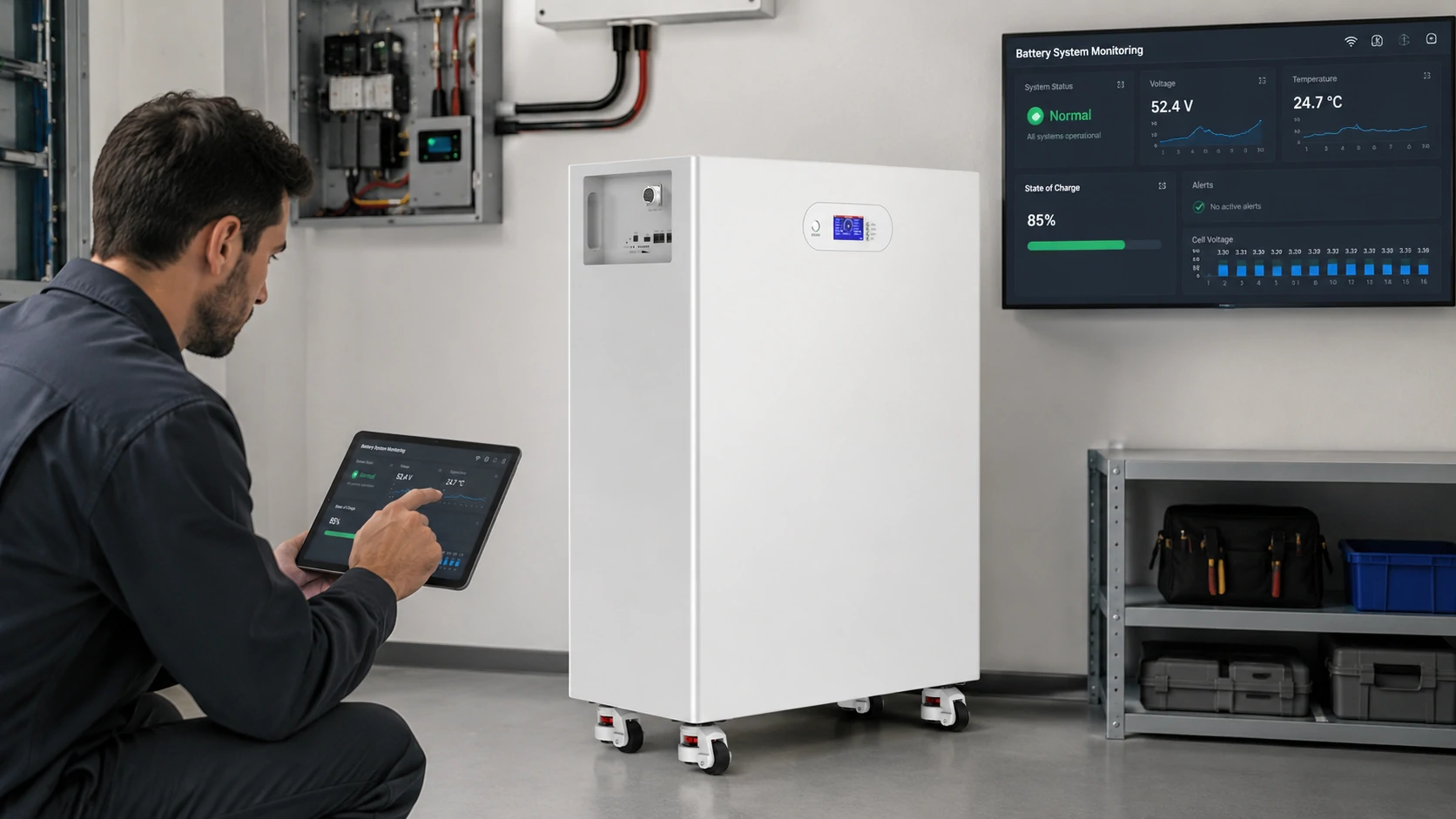
The BMS limits discharge current by monitoring voltage, current, temperature, SOC, alarms and protection thresholds. In modern solar battery systems, the BMS may send a discharge current limit to the inverter so the system derates before reaching a hard shutdown.
A BMS is not only a protection switch. In a communicating battery system, it can provide operating limits to the inverter or PCS. These limits may include charge current limit, discharge current limit, voltage limits, SOC, temperature and alarm status.
Avepower’s Battery Communication: CAN, RS485 and BMS Protocol Guide explains that closed-loop communication normally includes battery status and operating limits. It also notes that discharge limits help the inverter limit AC load output.
Avepower’s inverter compatibility list includes many inverter brands and communication types, and the page allows users to request an engineering compatibility check if a model is not listed.
Example: How to Check Discharge Current for a 15kWh Battery
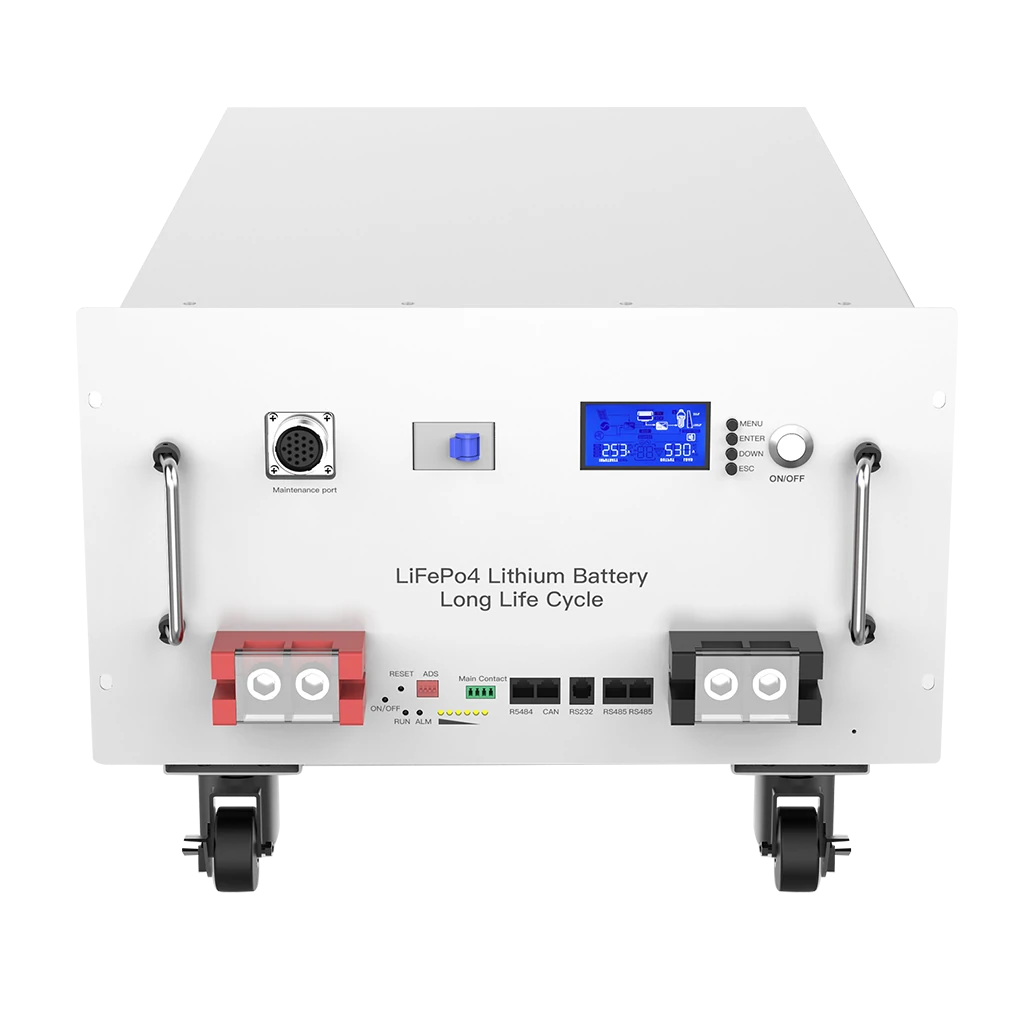
A practical way to evaluate discharge current is to compare inverter demand with the battery’s rated current. Avepower’s 48V 280Ah 15kWh vertical LiFePO4 battery lists 140A standard discharge current and 200A maximum discharge current, making it suitable for many residential and small commercial inverter systems.
Avepower’s 48V 280Ah 15kWh LiFePO4 battery is built with a 200A BMS and supports CAN/RS485/RS232 communication, Bluetooth, WiFi and up to 16 units in parallel. The product page lists 15kWh nominal energy, 48V nominal voltage, 280Ah capacity and 200A max discharge current.
The battery supports 140A standard discharge current and 200A maximum discharge current. Based on a 51.2V nominal voltage reference, the maximum battery-level output is approximately:
51.2V × 200A = 10,240W, or about 10.24kW
This does not automatically mean every project should continuously run at 10.24kW. The real usable output depends on inverter efficiency, BMS settings, cable design, operating temperature, SOC, surge duration and local installation rules.
Example Calculation for a 6kW Inverter
Assume:
| Item | Value |
|---|---|
| Inverter output | 6,000W |
| Battery voltage | 51.2V |
| Inverter efficiency | 92% |
| Estimated DC current | 6,000 ÷ 51.2 ÷ 0.92 = 127A |
A 127A estimated battery-side current is below the 140A standard discharge current and below the 200A maximum discharge current. This makes the match reasonable under normal conditions, provided installation and communication settings are correct.
Example Calculation for An 8kW Inverter
Assume:
| Item | Value |
|---|---|
| Inverter output | 8,000W |
| Battery voltage | 51.2V |
| Inverter efficiency | 92% |
| Estimated DC current | 8,000 ÷ 51.2 ÷ 0.92 = 170A |
A 170A current is above the 140A standard value but below the 200A maximum value. This may be acceptable for some short or controlled load conditions, but it leaves less margin. For daily heavy discharge, installers should consider a higher-capacity parallel battery bank, a battery with stronger continuous current capability, or a high-voltage system.
Case Study Calculation: Choosing Between a 51.2V Battery and a High-Voltage ESS
A small commercial site needing 8kW to 10kW of backup power should calculate current before choosing the battery. In many cases, a low-voltage battery can work, but high-voltage storage may reduce current, simplify conductor sizing, and provide better headroom for larger systems.
Assume:
- Continuous AC load: 10kW
- Inverter efficiency: 92%
- Option A: 51.2V low-voltage battery
- Option B: 345.6V high-voltage ESS
Option A current:
10,000W ÷ 51.2V ÷ 0.92 = 212A
Option B current:
10,000W ÷ 345.6V ÷ 0.92 = 31A
The power demand is the same, but the required battery current is very different. A 51.2V system may need multiple battery modules in parallel or a 200A-class battery design. A 345.6V high-voltage system can deliver the same AC load with much lower current on the battery side.
This is why installers and project developers should decide between low-voltage and high-voltage storage based on current, not only kWh. For essential home backup, a 51.2V home energy storage battery system is often practical. For small commercial, hospitality, and larger project loads, a high-voltage ESS may be more efficient to integrate.
How Does Parallel Battery Expansion Affect Discharge Current?
Parallel batteries can increase total available discharge current only when the manufacturer allows parallel operation and the batteries share current correctly. The total current should not be assumed blindly, because cable resistance, SOC imbalance, firmware, BMS settings and installation quality affect current sharing.
In theory, if two identical batteries are connected in parallel and each can safely deliver 100A, the bank may support up to 200A. In real projects, this must be confirmed by the product manual and system design.
Check these points before using parallel discharge current:
- Same battery model and chemistry.
- Same voltage platform.
- Similar age and SOC.
- Equal-length cables where required.
- Proper busbar layout.
- Correct battery addressing.
- Master/slave or communication setup.
- BMS current limit per unit.
- Inverter current setting.
- Manufacturer-approved maximum parallel number.
When Should You Choose a Higher Discharge Current Battery?
Choose a higher discharge current battery when the project has high simultaneous loads, large inverter output, frequent surge demand, commercial peak shaving, off-grid operation or future expansion needs. For light backup and long runtime, capacity may matter more than maximum current.
A higher discharge current battery is useful for:
- Whole-home backup with multiple circuits.
- Heat pumps, well pumps or motor loads.
- Off-grid homes with large inverter systems.
- Small commercial sites with demand peaks.
- Telecom or equipment-room backup.
- Hybrid inverter systems above 5kW.
- Parallel battery banks with scalable output.
- Commercial peak shaving and demand management.
- Fast transient load support.
- Future inverter upgrade plans.
However, higher current is not always better. If the system only powers lights, Wi-Fi, a refrigerator and a few outlets, a moderate-current battery may be more economical. For long backup runtime, adding capacity may deliver more value than chasing a higher peak current number.
Match Your Battery Current to the Real Project
Avepower supports installers, distributors, EPC contractors and OEM/ODM partners with low-voltage and high-voltage LiFePO4 battery systems, inverter protocol confirmation and project-specific configuration support.
Send Avepower your inverter or PCS model, continuous and surge load, required backup duration, system voltage, installation temperature and expansion plan. The engineering team can evaluate the required battery discharge current, recommend a suitable configuration and provide the relevant technical and certification documentation.
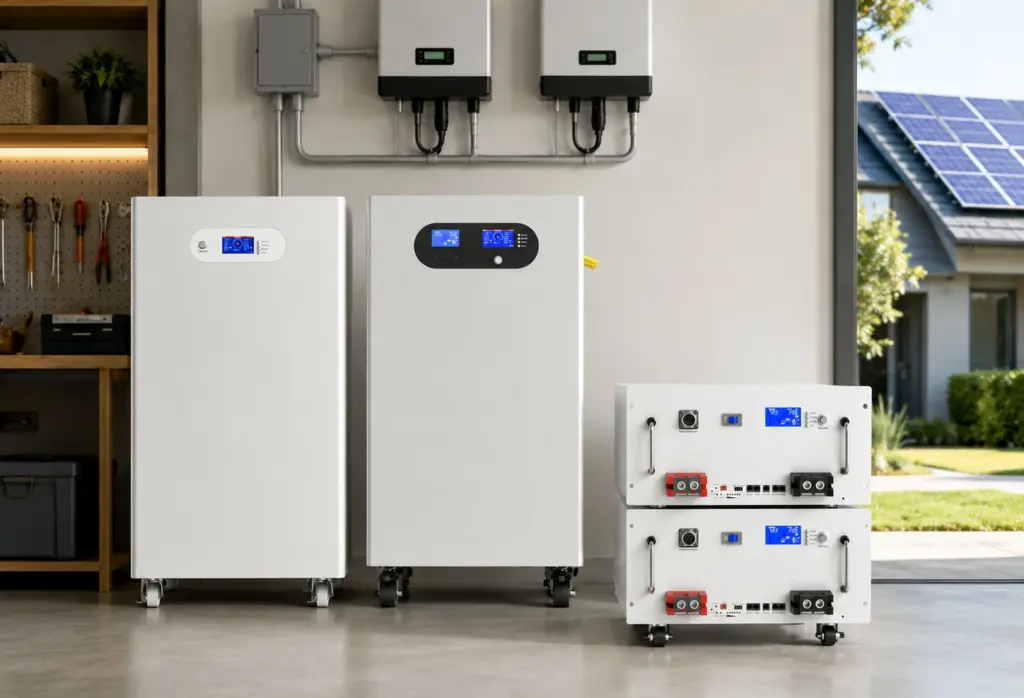
Take Control of Your Energy with Avepower!
Reliable home solar battery solutions with OEM/ODM customization and in-house manufacturing, tailored to the needs of distributors, installers, and energy partners.
FAQ
A good discharge current is one that supports the required load while remaining below the battery’s continuous limit across the expected voltage, SOC and temperature range. There is no universal safe amperage for all batteries.
It can provide 100A only if its cells, BMS and complete battery assembly are approved for a 1C discharge. The 100Ah label describes charge capacity, not an automatic 100A current rating.
A 1C discharge current equals the battery’s Ah capacity expressed in amperes. A 100Ah battery at 1C supplies 100A, while a 314Ah battery at 1C supplies 314A, assuming the manufacturer permits that rate.
A higher current rating means greater power capability, but it does not mean more stored energy. High current can require larger conductors, stronger terminals, more thermal management and a higher-rated BMS.
Not by itself. Runtime depends primarily on usable energy and average load. Maximum discharge current determines whether the battery can support the required instantaneous power without exceeding its operating limits.
Possible causes include low SOC, one weak cell, low temperature, high MOSFET temperature, voltage sag, a short overcurrent delay, undersized cables or an inverter surge that exceeds the permitted duration.
Charge current flows into the battery, while discharge current flows out to the load. The permitted values can be different because charging and discharging create different electrochemical and thermal conditions.
At 51.2V and 92% efficiency, a full 5kW AC load requires approximately 106A. At 44.8V, the same load requires about 121A. Surge loads can require substantially more current.