
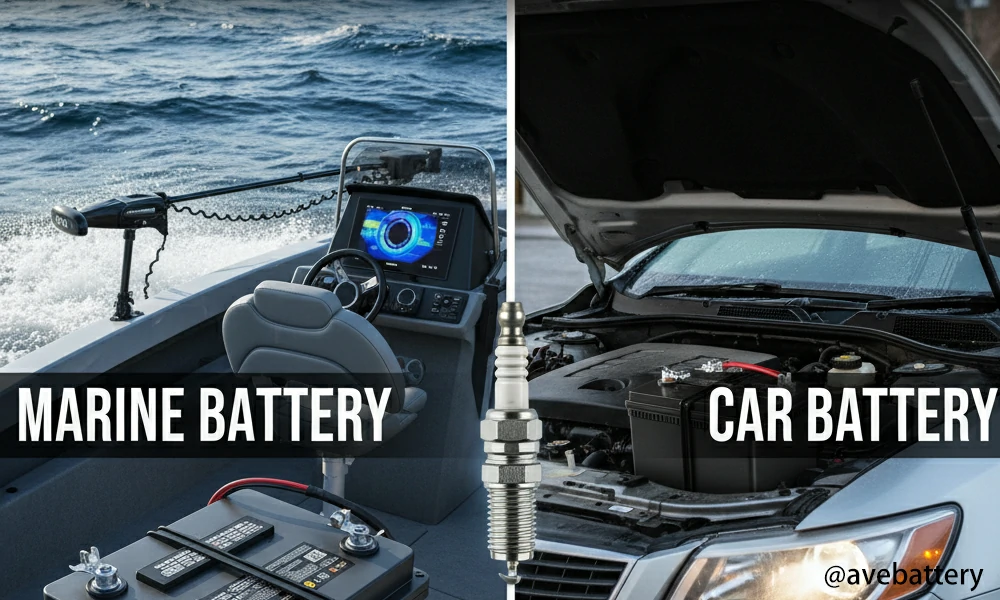
Have you ever looked at a marine battery and wondered if it could replace the battery in your car? Or maybe you have a spare car battery and thought about using it on your boat. They both typically provide 12 volts, they look alike, and they can physically fit in similar spaces. However, these batteries are designed for very different tasks, and using one in place of the other can lead to poor performance, faster wear, or even safety risks.
In this article, we will explore the differences between marine and car batteries. We will also explain why using the wrong battery for a specific vehicle or vessel can cause problems.
What Is a Marine Battery?
A marine battery is specifically designed to power boats and other watercraft. Unlike car batteries, which are primarily meant to start engines, marine batteries serve dual purposes:
- Starting the boat engine – Just like a car battery, a marine battery delivers a strong burst of energy to start the engine quickly.
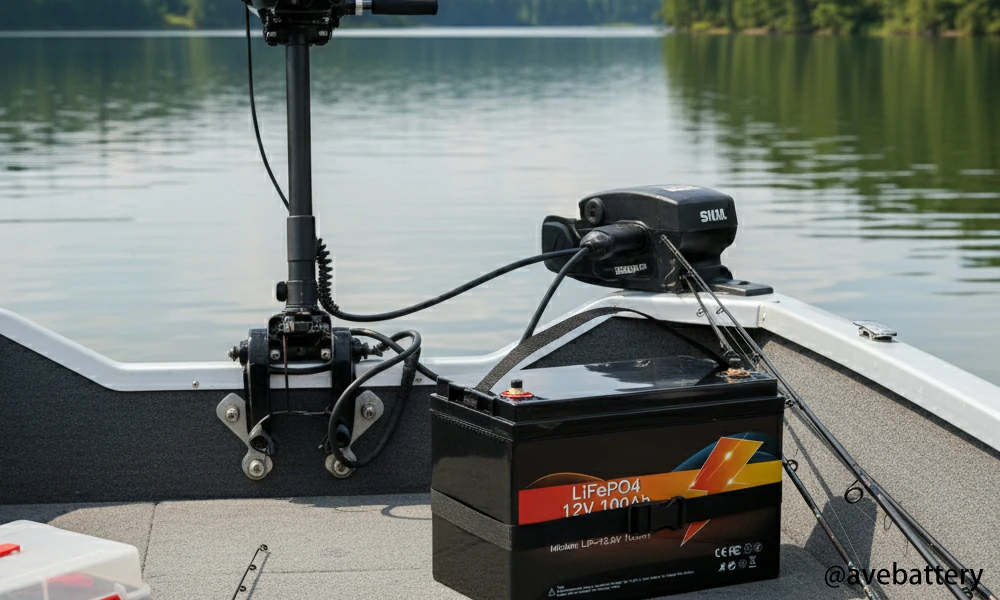
- Running onboard accessories – Marine batteries supply power over extended periods for devices such as trolling motors, GPS systems, radios, bilge pumps, and fish finders.
Many marine batteries are designed as either deep-cycle batteries or dual-purpose batteries. A deep-cycle battery provides steady power over long periods and can withstand repeated deep discharges and recharges without damage. A dual-purpose battery can handle both engine starting and prolonged accessory use, but it may not be as effective as specialized batteries in either role.
Marine batteries are built to withstand harsh environments. They are resistant to vibration, shocks, and saltwater corrosion, making them more robust than typical car batteries. They also often have specialized terminals for easy connection to various onboard devices. In addition, car batteries are not designed to be shaken constantly—on a boat the combination of pounding waves and engine vibration can make an automotive battery shed material from its plates, and in bad cases it can even leak acid, which is a safety and corrosion risk.
How Marine Batteries Work
Marine batteries store electrical energy like a reservoir. While the engine or onboard charger supplies power, the battery charges up. When needed, the battery releases this energy to start the engine or power electronics.
Marine batteries are built to withstand harsh conditions. They often feature:
- Threaded terminals for easy connection to multiple devices
- Thicker lead plates to resist damage from deep cycling
- Sealed designs to prevent acid leaks even in rough waters
- Vibration resistance up to 15 times higher than standard car batteries
These features make marine batteries well-suited for boats, where reliability is crucial, and the battery may be called upon for both starting and long-term power delivery.
How Car Batteries Differ
A car battery, also called a starting battery, is built primarily to start the engine. Its main job is to provide a very high burst of current for a few seconds until the engine begins running. After that, the alternator takes over, maintaining the battery’s charge while powering the vehicle’s electrical systems.
Car batteries are not meant to provide long-term energy for accessories. While a car battery can power the radio or headlights for a short time when the engine is off, repeatedly drawing high power from a car battery can damage it. Car batteries have thinner lead plates than marine batteries, which allows for high current bursts but limits deep discharge capacity.
This fundamental difference in purpose explains why using a car battery in a boat can be problematic. When asked to provide prolonged power for trolling motors or other marine electronics, a car battery can overheat, fail prematurely, or simply run out of charge too quickly.
Comparing Marine Batteries and Car Batteries
Let’s break down the main differences between car and marine batteries, looking at everything from how they are built inside to how they perform in real-life situations.
| Feature | Car Battery (Starting) | Marine Battery (Dual-Purpose / Deep-Cycle) |
|---|---|---|
| Primary Purpose | Provides a quick, high-power burst to start the engine. | Starts the engine and delivers steady power to accessories over long periods. |
| Plate Thickness | Thin plates designed for short bursts of energy. | Thick plates built for deep discharge and long-term cycling. |
| Design | Optimized for rapid energy delivery; stays near full charge. | Optimized for deep discharge and repeated recharging. |
| Vibration Resistance | Low; not designed for rough environments. | High; often 15× more resistant to shocks and vibrations. |
| Cost | Generally more affordable. | Generally higher cost due to durability and versatility. |
| Typical Terminals | Standard top-post or side-post connectors. | Threaded posts or combination terminals for multiple accessory connections. |
So even though a car battery and a marine battery may both be 12V and similar in size, the internal build is different: automotive = thin plates + fast discharge; marine = thicker plates + vibration resistance + ability to deep-cycle.
Purpose and Power Delivery
Car batteries, which are also known as starting batteries, are built to deliver a massive, quick surge of electric current to start your engine. Once the engine is running, the alternator takes over. The alternator runs the car’s electrical systems and keeps the battery fully charged. Car batteries are not designed to be drained deeply; they are meant to stay near a full charge most of the time.
Marine batteries, on the other hand, are expected to do much more. They often power multiple accessories for extended periods. They need to provide reliable energy, even after hours of use, and still have enough power left to start the boat’s engine. This is why marine batteries are usually dual-purpose or deep-cycle types.
If you install a marine battery in your car, it may work, but it is not the best choice. It will be heavier and more expensive than a standard car battery. More importantly, it might not provide the high Cold Cranking Amps (CCA) that your car needs for a quick, powerful start, especially in cold weather.
Conversely, if you try to use a car battery in your boat to run a trolling motor for several hours, you will quickly drain it. Repeated deep draining will cause the car battery to fail prematurely, which could leave you stranded on the water. This is why most marine experts say “don’t use a car battery as a marine battery”: the chemistry can do it once or twice, but it cannot do it repeatedly without sulphation and early failure.
Internal Structure and Durability
The internal construction is a major point of difference between a car battery and a marine battery.
Marine batteries have thicker lead plates inside. These thicker plates can handle deeper discharges and are more resistant to the constant vibrations and shocks from hitting waves. This makes them much more rugged and suited to the harsh marine environment. Some marine batteries are built to be up to 15 times more resistant to vibration than a regular car battery. Furthermore, many marine batteries are fully sealed, which prevents battery acid from spilling, even in rough conditions.
Car batteries have thinner plates to allow for that quick, powerful energy burst needed to start the engine. However, these thinner plates are not built for sustained power delivery or for being deeply drained and recharged repeatedly (heavy cycling). They are generally less durable when exposed to strong vibrations.
Why This Matters for Boats
The marine environment is incredibly harsh. Boats constantly face vibration and shock from hitting waves. The thicker plates and more robust construction of a marine battery make it significantly more resistant to internal damage, allowing it to handle the constant jarring that would quickly shake apart a standard car battery. An automotive battery mounted in a boat can also be more prone to internal short circuits if a plate breaks loose—another reason to stick to marine-rated batteries.
Terminals and Connections
Marine and auto batteries also often use different types of terminals (the connection points).
Marine batteries frequently have threaded posts or a combination of post types. These are ideal for connecting various accessories easily. Auto batteries typically feature standard top-post or side-post terminals.
If you try to put a marine battery into a car, or vice versa, the terminals might not match your existing wiring. This would require using adapters, which can introduce potential points of failure into your electrical system.
Real-World Issues of Swapping Batteries
Even if both batteries are rated at 12 volts, the similarities largely end there. Swapping batteries between cars and boats can lead to the following problems:
- Sluggish engine starts: Marine batteries may not have enough CCA for cold-weather engine starts in cars.
- Premature battery failure: Car batteries can overheat or fail when used for long periods to power boat accessories.
- Overpayment: Marine batteries are generally more expensive, and using one in a car may be overkill.
The key takeaway is that the best battery for any situation is the one designed for that specific environment. Cars require high bursts of power, while boats require sustained power for accessories and starting capability.In other words: use car batteries for cars, marine batteries for boats—mixing them is possible but rarely optimal, and sometimes unsafe.
Can You Use a Marine Battery in Your Car?
Can you do it? Technically, yes, if it physically fits and the terminals match. Should you do it? Probably not, for a few key reasons:
Marine batteries, even the dual-purpose ones, often have a lower Cold Cranking Amps (CCA) rating than a dedicated car battery. CCA is a measure of the battery’s ability to start an engine in cold weather. If you live in a cold climate, a marine battery might result in sluggish or failed starts when you need them most. Marine batteries are generally heavier and more expensive due to their robust construction. You are paying extra for deep-cycle capabilities and durability that your car’s electrical system does not require.
You can still jump-start a car from a marine battery in an emergency, as long as the marine battery has enough cranking current—but using a deep-cycle/marine battery as your everyday automotive starter battery usually gives you no real advantage for the extra money.
Why Not Use a Marine Battery in a Car?
Because marine batteries are optimized for lower, sustained discharge and high vibration resistance, not for frequent, high-current automotive starts. They can work, but they often won’t last as long in a car as a proper automotive starter battery, and you might notice slower cranking—particularly in cold weather.
Can You Use a Car Battery in Your Boat?
No. You should not use a standard car battery in a boat, especially if the battery will be powering trolling motors, fish finders, pumps, or navigation equipment for long periods. Car batteries are not built for constant pounding from waves, may leak acid if tipped or shaken, and lack the deep-cycling ability that marine batteries have. A marine battery is reinforced internally, has spill-resistant designs, and is meant to power accessories as well as start the engine.
A boat is not a car. If your battery fails in a parking lot, it is an inconvenience. If your battery fails on the water, you are stranded—a much more serious and potentially dangerous situation. The constant vibration from the engine and waves will rapidly loosen and damage the thinner internal plates of a standard car battery, causing a quick and catastrophic failure.
That’s why marine batteries have reinforced plates and hold-downs—to survive conditions that would shake apart an automotive battery.
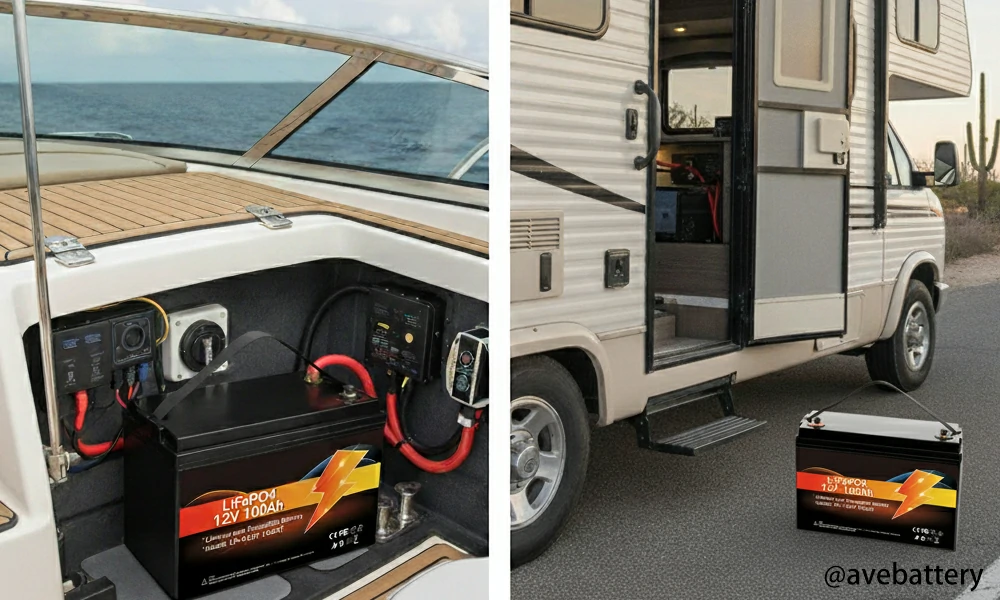
Comparing Marine and RV Batteries
Many people wonder how marine batteries compare to RV batteries. In many cases, marine and RV batteries are interchangeable because both require starting power and sustained energy for accessories. Some batteries are even labeled as Marine/RV hybrid batteries.
For example, if you have a small RV, a standard car battery may be enough to start the engine. But if your RV has numerous electrical appliances, dual-purpose or deep-cycle batteries are the better choice. Avepower offers 12V 100Ah LiFePO4 batteries suitable for both marine and RV use. Larger RVs may need multiple batteries: one for starting and several deep-cycle batteries to power living area electronics.
Chemistry and Lifespan Considerations
Marine batteries can be made using different chemical compositions, such as lead-acid, AGM (Absorbent Glass Mat), or lithium-ion.
- Lead-acid batteries are cost-effective but heavier and have a shorter lifespan.
- AGM batteries are maintenance-free, spill-proof, and better suited for vibrations.
- Lithium-ion batteries are lightweight, long-lasting, and provide more usable capacity, making them ideal for dual-purpose or deep-cycle applications.
Choosing the right chemistry is essential to ensure reliability, durability, and safe operation in either marine or automotive settings. AGM batteries in particular were developed to withstand more vibration, so they are a very good fit for marine applications and can sit for longer without charging due to their low self-discharge.
Why Voltage Alone Is Not Enough
It is easy to assume that any 12-volt battery can be swapped between cars and boats. However, voltage is just one aspect of performance. Current delivery, cycle life, and construction matter more in the long term.
For instance, a marine battery may not deliver the high initial current needed to start a car in freezing weather. A car battery may deliver that current, but it will quickly wear out if used to power electronics in a boat for several hours.
Safety Considerations
Marine batteries are often fully sealed to prevent acid spills even in rough conditions. They are also more resistant to vibration, which is important for a boat constantly moving on waves. Using the wrong battery in the wrong environment can be hazardous. For example, acid spills, overheating, or rapid degradation of battery plates can pose safety risks. In a marine setting, corrosion from spilled electrolyte or a cracked battery case can damage bilge pumps, wiring, or even create a fire hazard, so choosing a marine-rated, spill-resistant battery is part of onboard safety.
Conclusion: Marine Battery vs Car Battery
The difference between a marine battery and a car battery is significant, despite their shared 12-volt rating. Each battery is built for a specific purpose:
- Car batteries excel at delivering quick bursts of energy to start engines. They are lightweight, affordable, and optimized for short-term performance.
- Marine batteries are built for endurance, durability, and versatility. They can start engines, power accessories for long periods, and withstand harsh environments.
Using the right battery for the right application is crucial. A marine battery in a car may work temporarily but is not ideal for long-term use. A car battery in a boat is likely to fail quickly and could leave you stranded.
If you own a boat or RV and need reliable power for extended periods, consider investing in high-quality deep-cycle batteries like the Avepower LiFePO4 line. Matching the battery to your needs ensures safety, performance, and a longer lifespan, whether you’re driving on land or sailing at sea.
FAQ
Marine batteries also have thicker plates and better vibration resistance, so in a boat being slammed by waves, the marine battery will survive longer than a typical automotive starting battery.
That said, in serious marine/deep-cycle use, relying only on an automotive-style alternator with a basic internal regulator is “good enough to protect the alternator,” not “good enough to fully and healthily charge the battery.” A smart/multi-stage or temperature-compensated marine charger will do a much better job.
You can install a deep-cycle battery in a car, but it is generally not ideal. Deep-cycle batteries are designed to provide steady power over long periods, not for delivering high bursts of energy needed to start an engine. Your car might start slower, especially in cold weather, and deep-cycle batteries may not offer the same cold-cranking performance as standard car batteries.
Yes, you can charge a marine battery with a regular battery charger. However, deep-cycle marine batteries don’t like fast, hot charging from an old-style automotive charger—excess heat will shorten life. A smart charger or a charger with a marine/deep-cycle mode is strongly recommended so the battery is charged in stages and not overcooked.
Marine batteries last around 3 or 4 years. Batteries older than that will naturally weaken. If your boat battery shows signs of dying, it may simply be past its prime. With good charging practices, storage at full charge, and avoiding extreme heat, you might stretch this to 5 years, but constant deep discharges without proper recharging will shorten life quickly.
Yes, as long as it’s 12V, fits in the tray, and meets or exceeds the CCA your car needs. Just remember that capacity (Ah) is not the same as starting power (CCA)—for cars, CCA is the critical number.
A car battery might crank the outboard once or twice, but continuous marine use, wave pounding, and deep discharges will wear it out much faster than the 3–5 years you might get in a car.