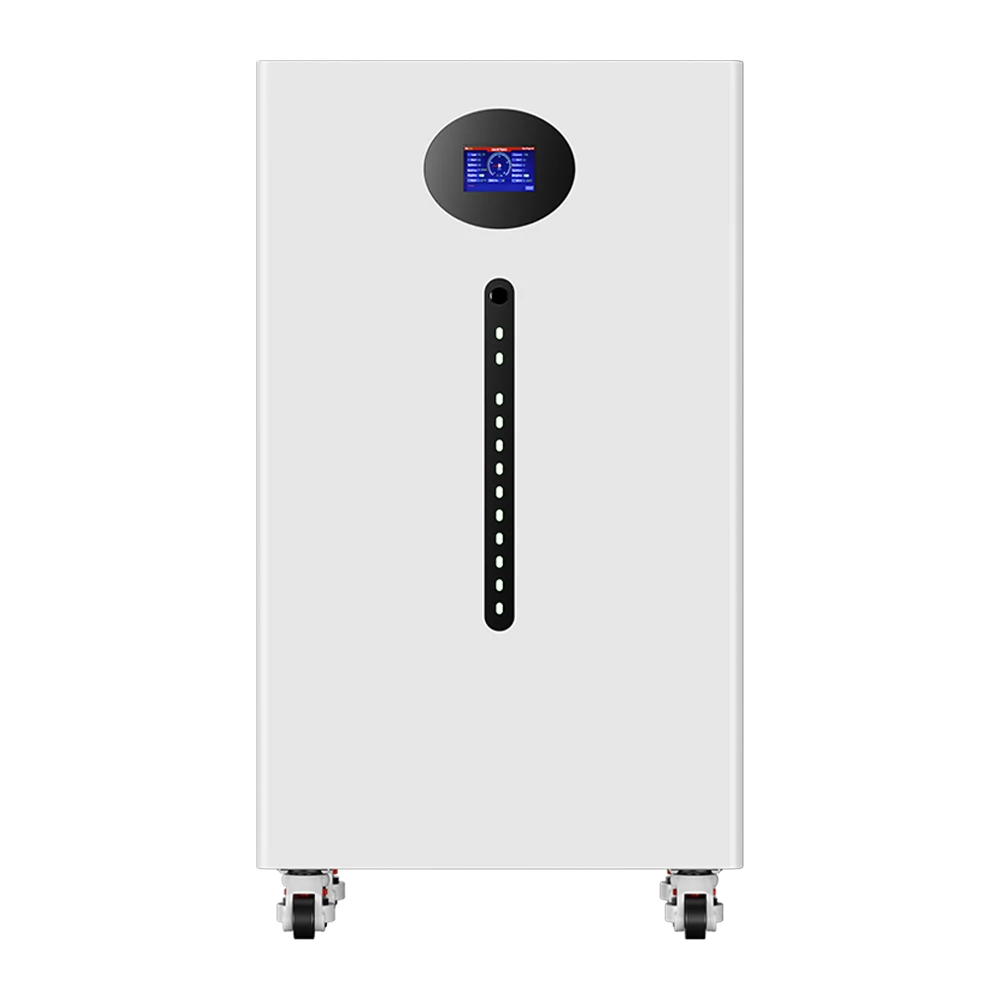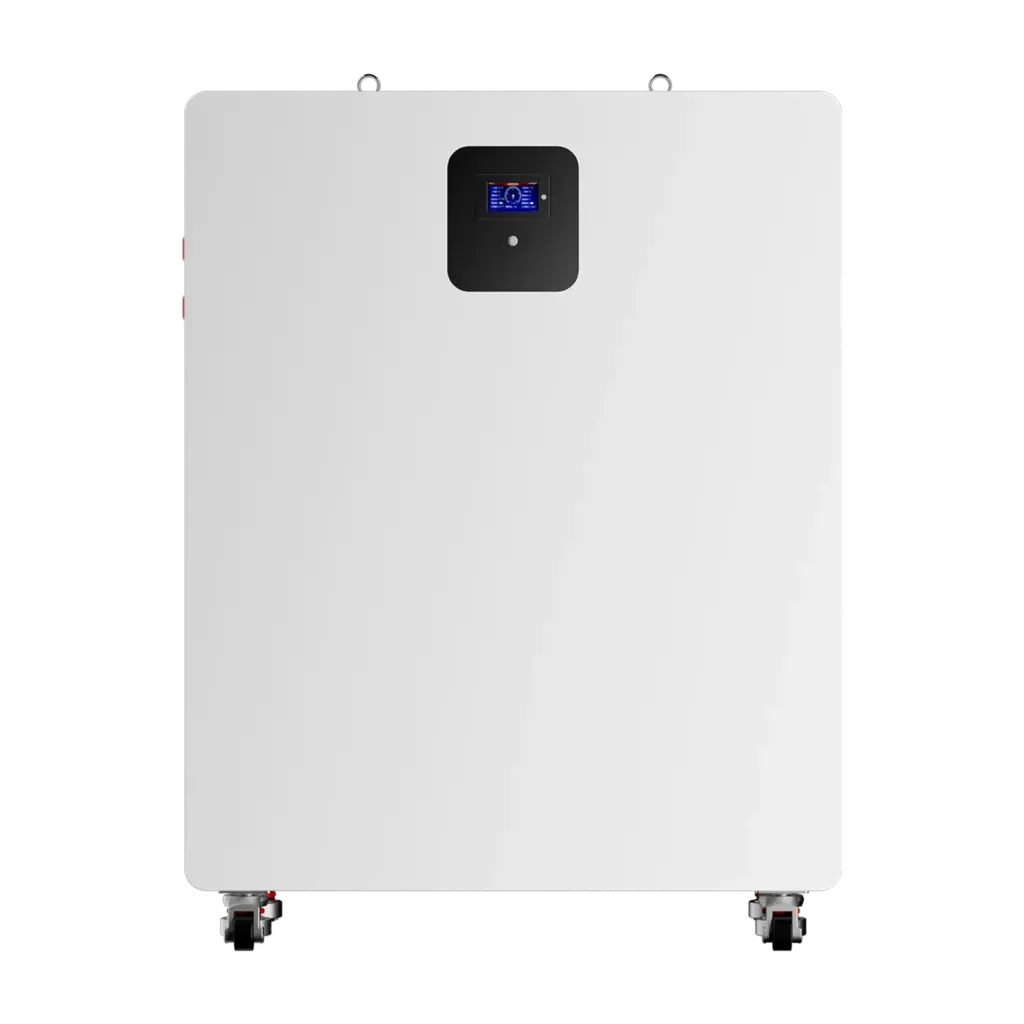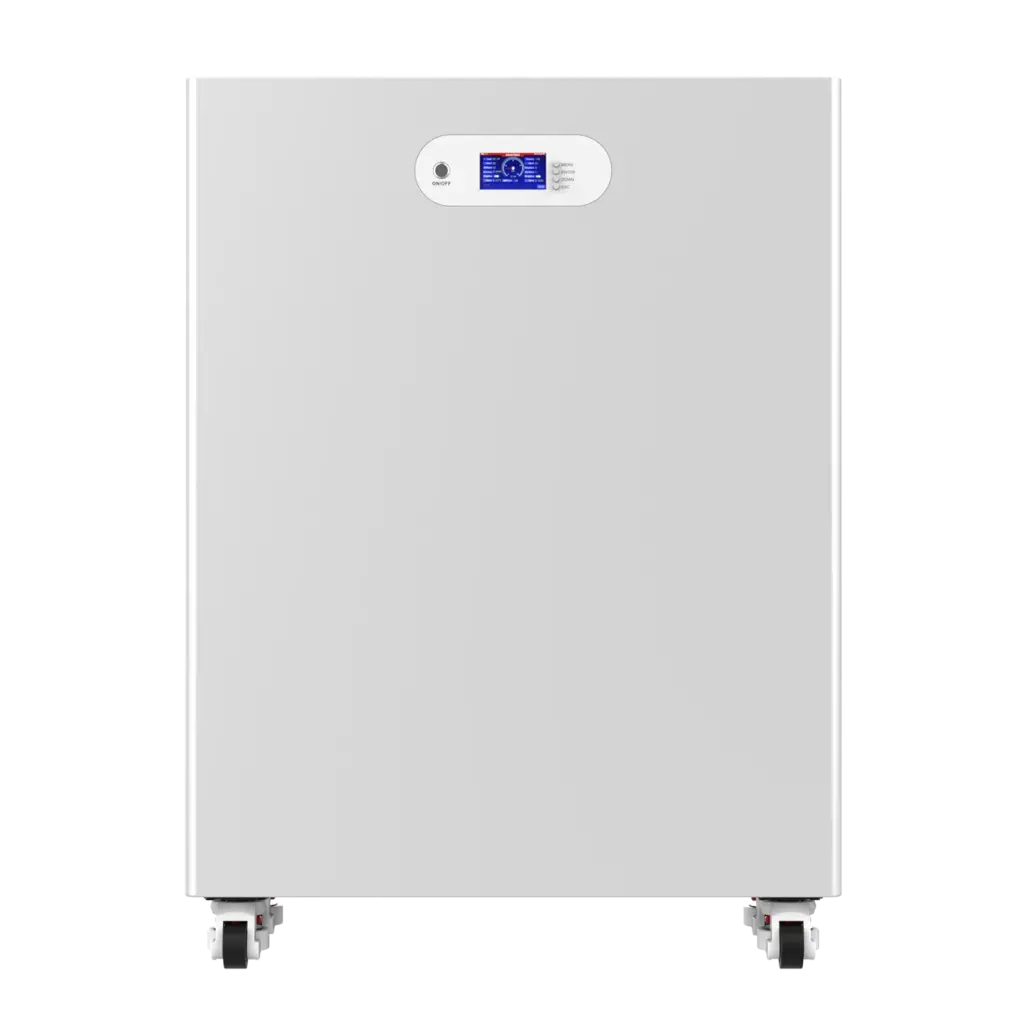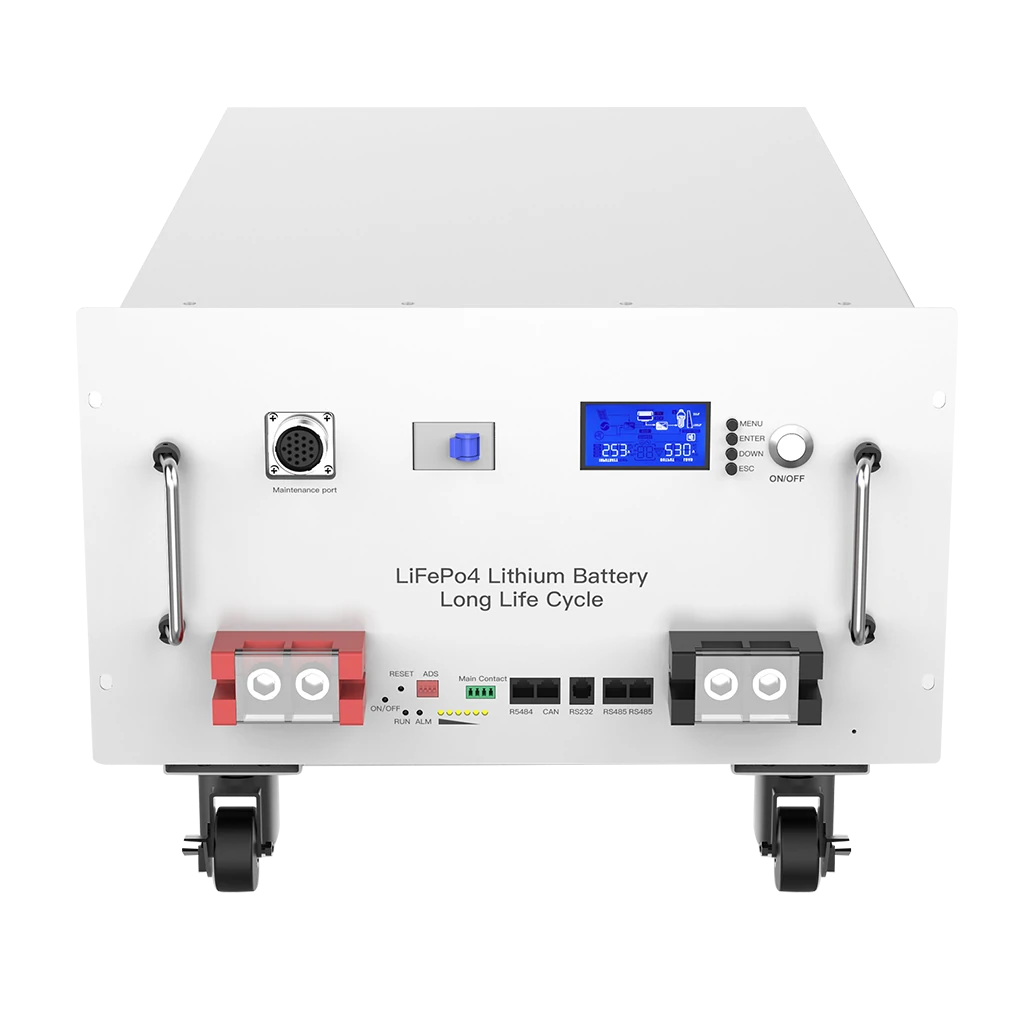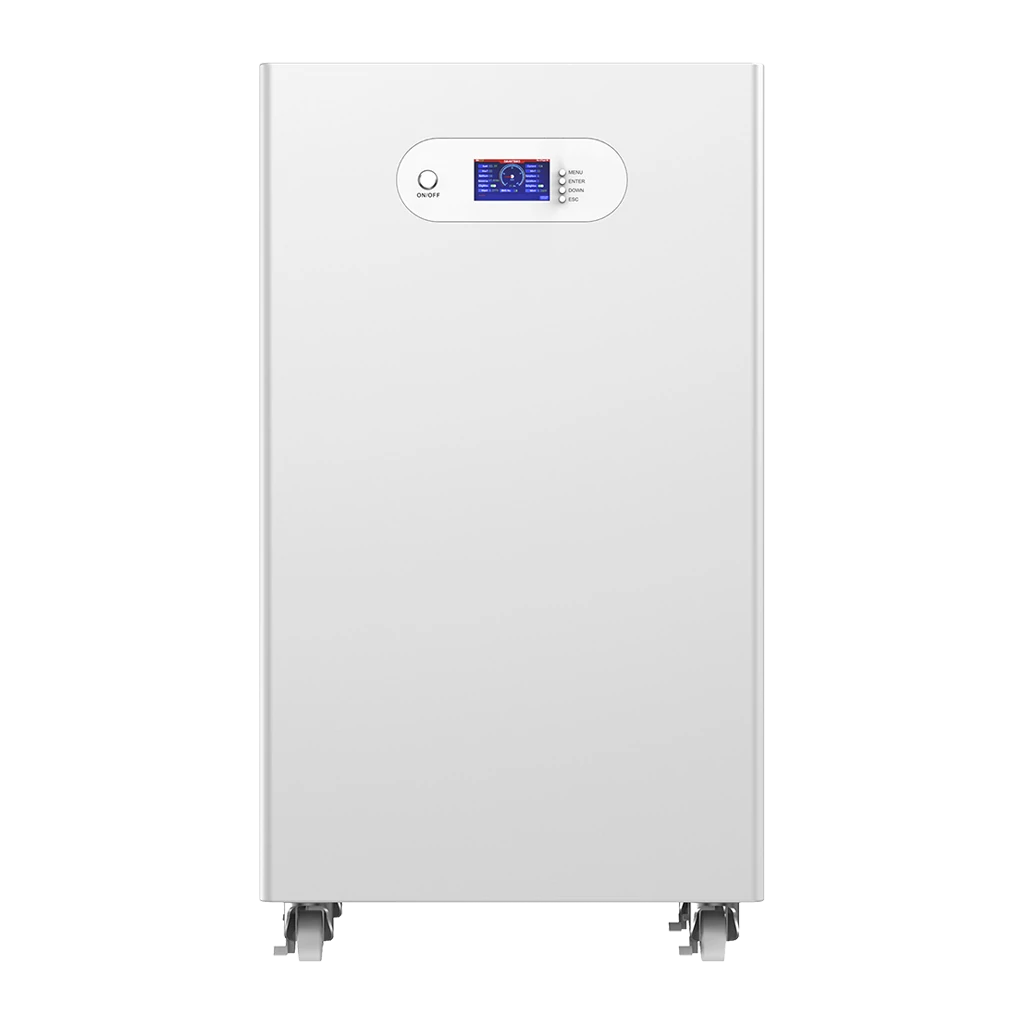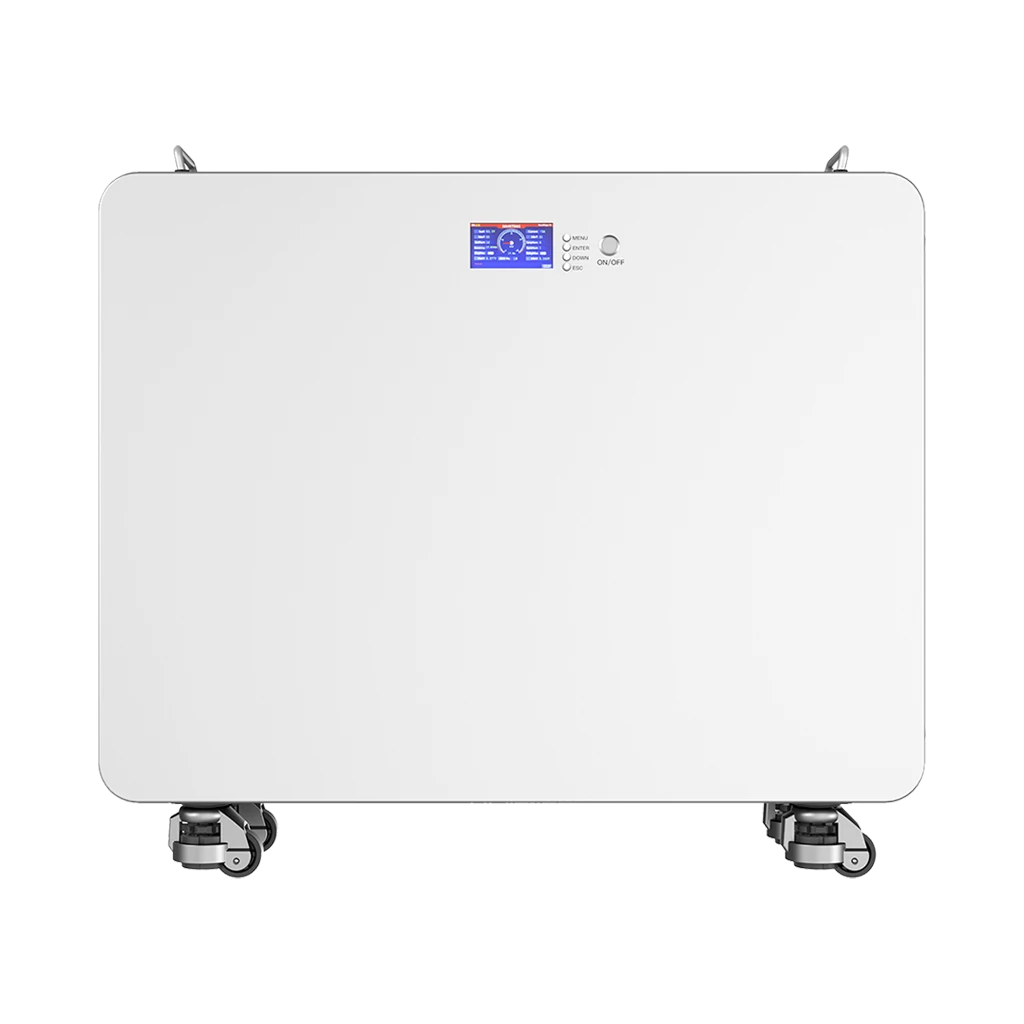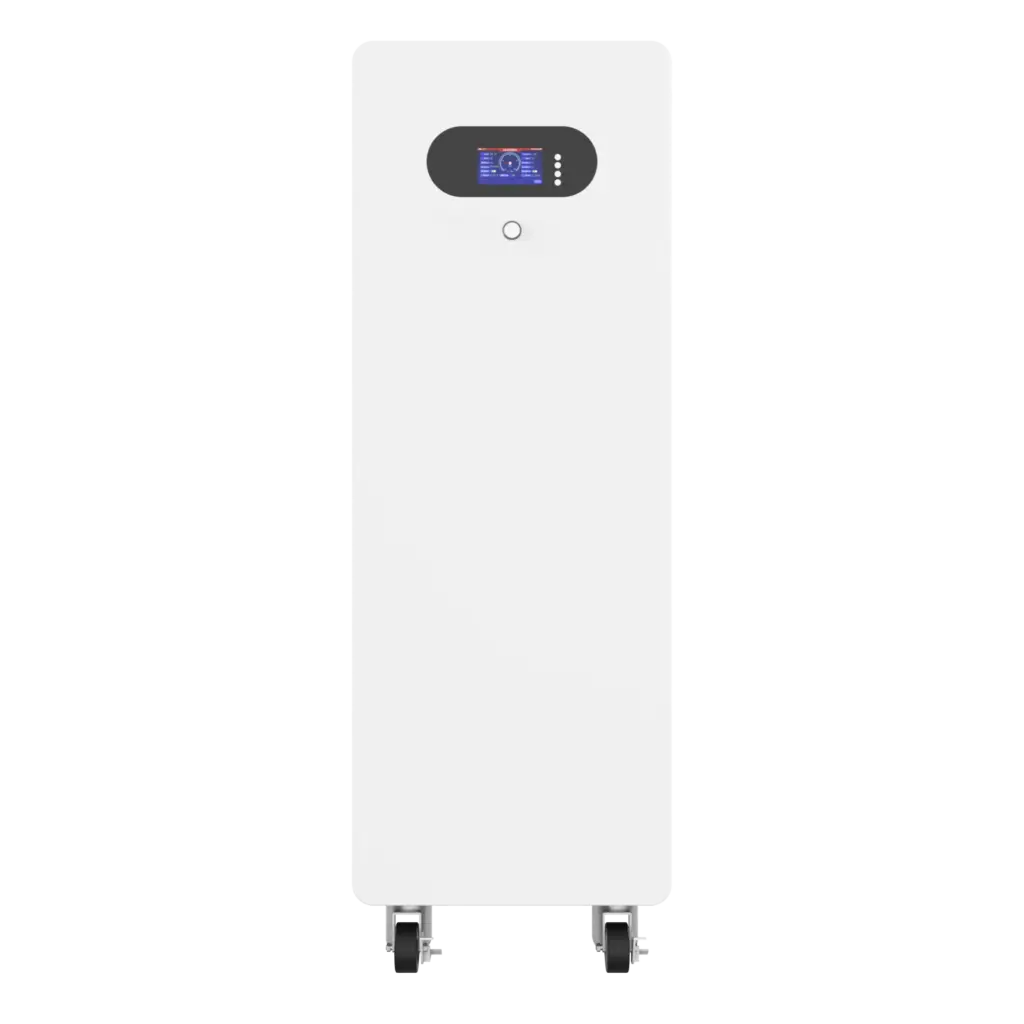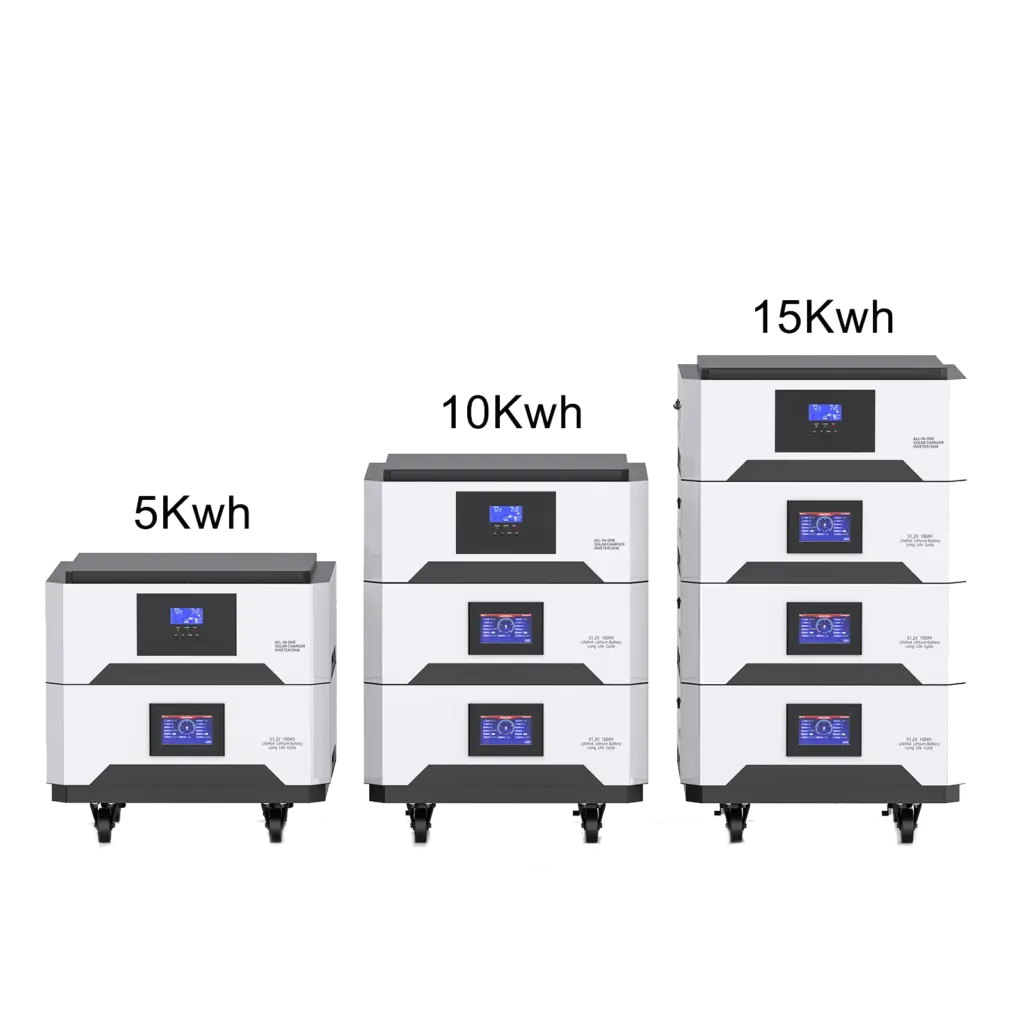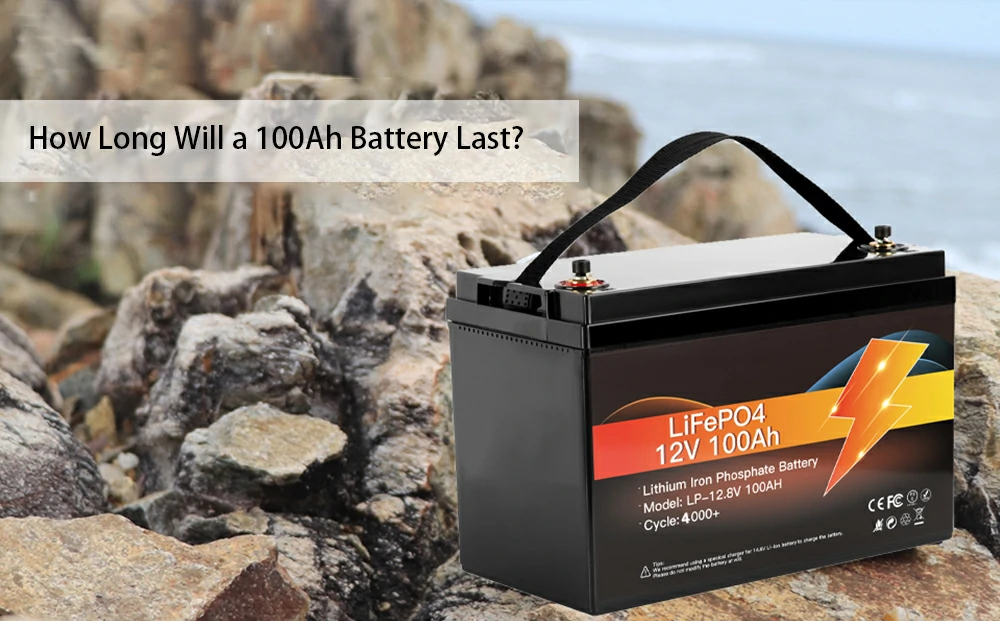

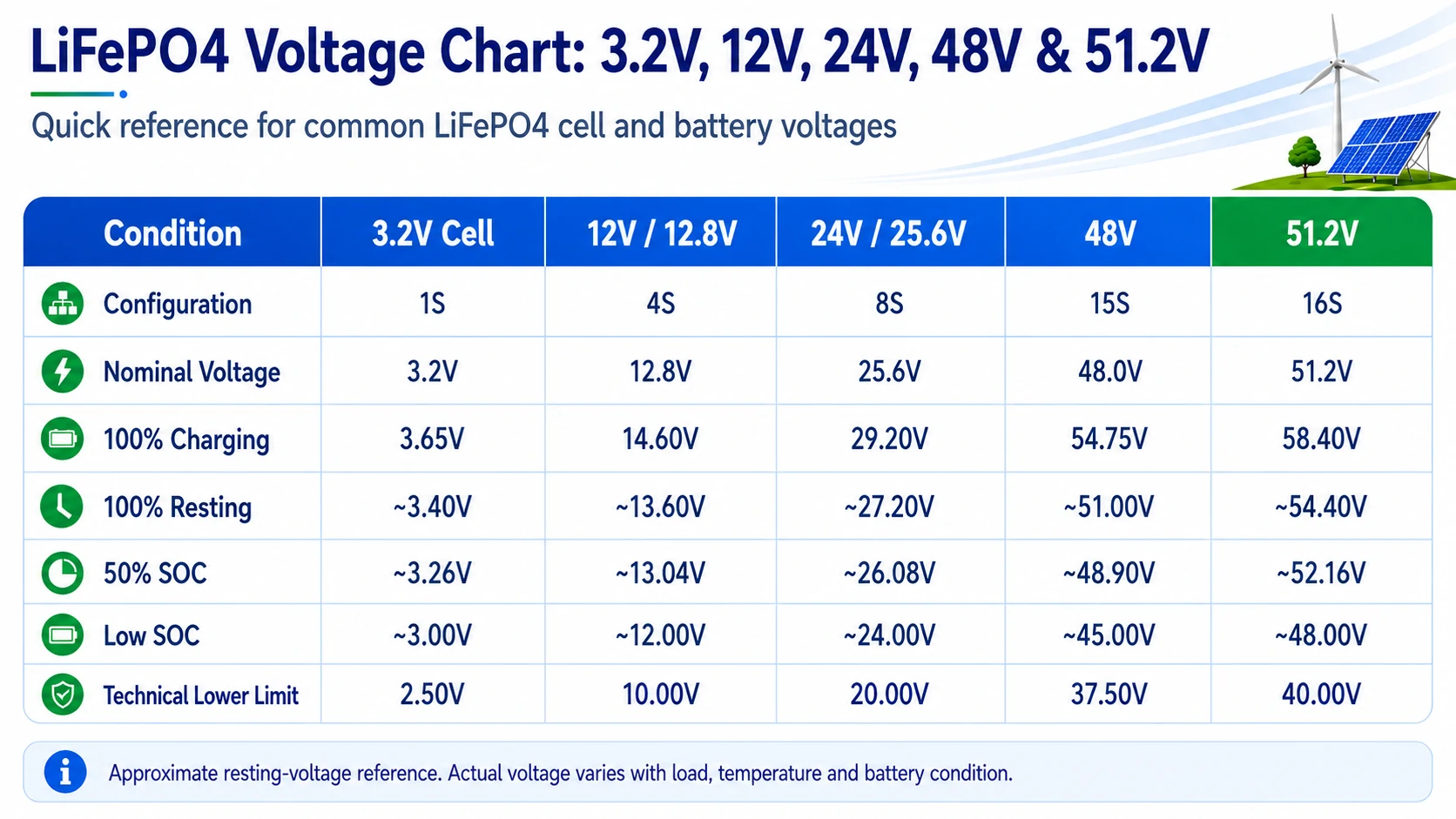
A LiFePO4 cell has a nominal voltage of about 3.2V, while many LiFePO4 charging designs use approximately 3.5–3.65V per cell as the upper charging range. A typical manufacturer discharge test may terminate around 2.5V per cell, but neither 3.65V nor 2.5V should automatically be treated as an everyday operating target.
Quick LiFePO4 Cell Voltage Reference
| Condition | Typical Cell Voltage |
|---|---|
| Nominal voltage | 3.2V |
| Normal operating plateau | About 3.2–3.4V |
| Upper charging region | About 3.5–3.65V |
| Common charge ceiling | 3.65V |
| Low SOC region | About 3.0–3.2V |
| Typical manufacturer test cutoff | Around 2.5V |
| Below cell specification | Cell-dependent |
The important point is that nominal voltage, charging voltage, resting voltage, discharge cutoff voltage and BMS protection voltage are different specifications.
What Voltage Should a LiFePO4 Cell Be?
A healthy LiFePO4 cell will spend much of normal operation between roughly 3.2V and 3.4V, with 3.2V used as its nominal rating. Voltage can temporarily rise toward 3.5–3.65V while charging and fall below 3.2V as the cell approaches a low state of charge.
The key mistake is assuming that a LiFePO4 cell should always measure 3.2V.
The 3.2V figure is a nominal value, meaning it is a reference voltage used for battery specifications and system calculations rather than a fixed operating voltage.
For example:
- 1 LiFePO4 cell: 3.2V nominal
- 4 cells in series: 12.8V nominal
- 8 cells in series: 25.6V nominal
- 16 cells in series: 51.2V nominal
Avepower uses the same 3.2V nominal cell voltage when comparing LiFePO4 with conventional lithium-ion chemistry.
The actual terminal voltage changes with:
- State of charge
- Charge or discharge current
- Cell temperature
- Internal resistance
- Cell age
- Relaxation time
- Cell chemistry and manufacturer
- Recent charging or discharging activity
Therefore, a cell reading of 3.27V, for example, does not automatically mean that something is wrong.
What Is the LiFePO4 Cell Voltage Chart by State of Charge?
A LiFePO4 voltage chart provides a useful reference for estimating battery state of charge, but the reading should ideally be taken after the battery has rested. A single LiFePO4 cell is typically 3.2V nominal, while common battery packs use multiple cells in series to create 12.8V, 25.6V, 48V or 51.2V systems.
The table below compares typical LiFePO4 cell and pack voltages across different states of charge. The values are based on the same cell-voltage relationship across series-connected cells.
| State of Charge | 3.2V Cell (1S) | 12V / 12.8V (4S) | 24V / 25.6V (8S) | 48V (15S) | 51.2V (16S) |
|---|---|---|---|---|---|
| 100% – Charging | 3.65V | 14.60V | 29.20V | 54.75V | 58.40V |
| 100% – Resting | 3.40V | 13.60V | 27.20V | 51.00V | 54.40V |
| 90% | 3.35V | 13.40V | 26.80V | 50.25V | 53.60V |
| 80% | 3.32V | 13.28V | 26.56V | 49.80V | 53.12V |
| 70% | 3.30V | 13.20V | 26.40V | 49.50V | 52.80V |
| 60% | 3.27V | 13.08V | 26.16V | 49.05V | 52.32V |
| 50% | 3.26V | 13.04V | 26.08V | 48.90V | 52.16V |
| 40% | 3.25V | 13.00V | 26.00V | 48.75V | 52.00V |
| 30% | 3.22V | 12.88V | 25.76V | 48.30V | 51.52V |
| 20% | 3.20V | 12.80V | 25.60V | 48.00V | 51.20V |
| 10% | 3.00V | 12.00V | 24.00V | 45.00V | 48.00V |
| Technical Lower Limit | 2.50V | 10.00V | 20.00V | 37.50V | 40.00V |
Cell chemistry formulation, temperature, aging, charge/discharge rate, hysteresis, meter accuracy and how long the battery has been resting can all move the voltage-SOC relationship.
3.2V LiFePO4 Cell Voltage Chart
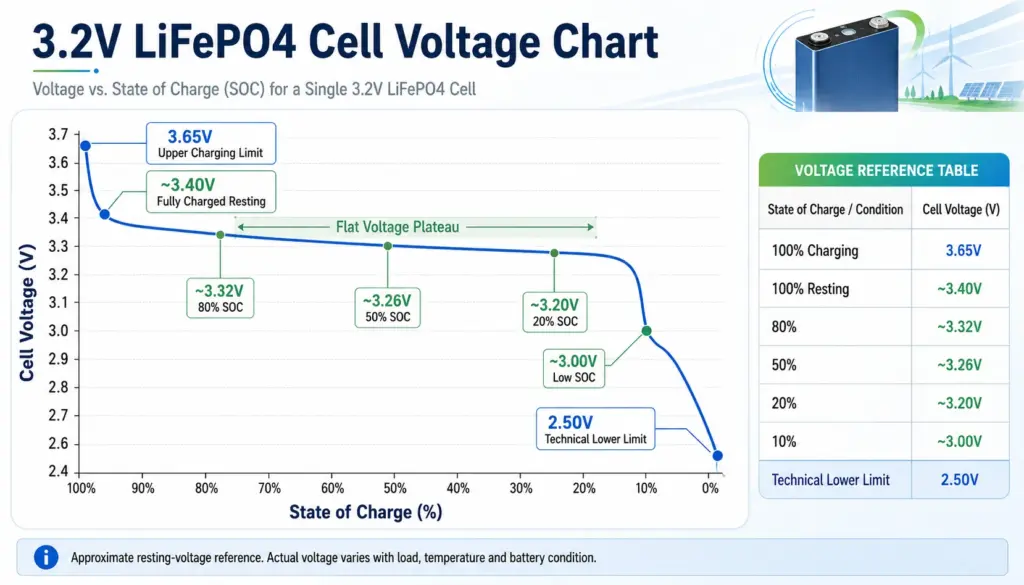
A single LiFePO4 cell has a nominal voltage of about 3.2V and typically reaches up to approximately 3.65V near the end of charging. Through much of its usable capacity, however, the cell remains within a narrow voltage range, so voltage should only be used as an approximate SOC indicator.
12V LiFePO4 Battery Voltage Chart
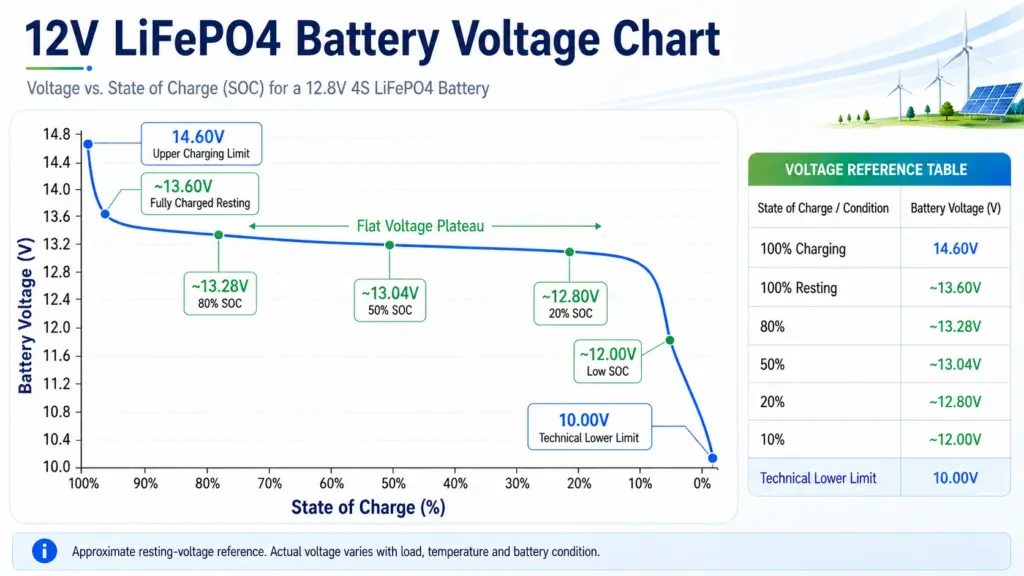
A typical 12V LiFePO4 battery is actually a 12.8V nominal 4S battery made from four 3.2V cells connected in series. Its theoretical upper charging voltage is approximately 14.6V when each cell reaches 3.65V.
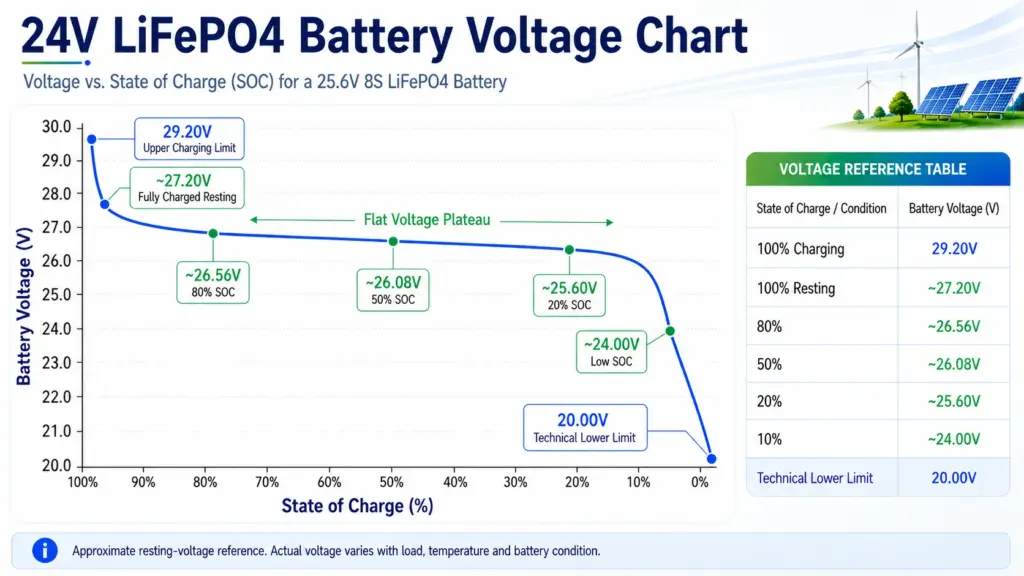
24V LiFePO4 Battery Voltage Chart
A typical 24V-class LiFePO4 battery uses eight cells in series and therefore has a true nominal voltage of 25.6V. With an upper reference of 3.65V per cell, an 8S LiFePO4 battery can reach approximately 29.2V near the end of charging.
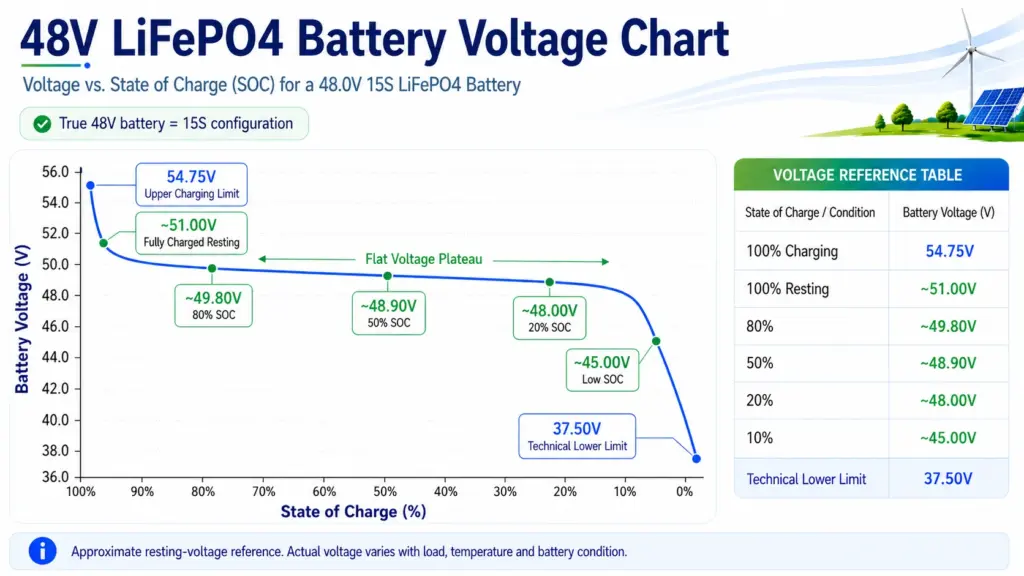
48V LiFePO4 Battery Voltage Chart
A true 48.0V LiFePO4 battery uses fifteen 3.2V cells in series, or 15S. Its nominal voltage is 48V and its theoretical upper voltage is approximately 54.75V at 3.65V per cell. This configuration should be distinguished from the more common 16S 51.2V battery used in many 48V-class solar systems.
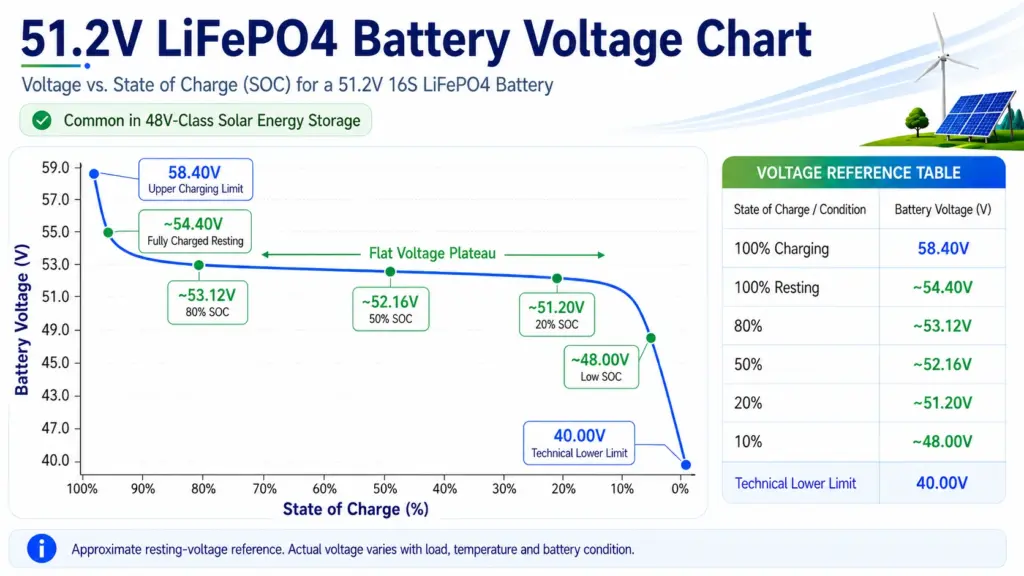
51.2V LiFePO4 Battery Voltage Chart
A 51.2V LiFePO4 battery normally uses sixteen 3.2V cells in series and is one of the most common configurations for residential and small-commercial solar energy storage. At an upper reference of 3.65V per cell, a 16S battery reaches approximately 58.4V.
How Do You Calculate LiFePO4 Pack Voltage From Cell Voltage?
LiFePO4 pack voltage is calculated by multiplying the voltage of one cell by the number of cells connected in series. Series connections increase voltage while maintaining the same amp-hour capacity, whereas parallel connections increase amp-hour capacity without multiplying nominal voltage.
The formula is:
Pack Voltage = Cell Voltage × Number of Series Cells
4S LiFePO4 Battery
4 × 3.2V = 12.8V nominal
At 3.65V per cell:
4 × 3.65V = 14.6V
8S LiFePO4 Battery
8 × 3.2V = 25.6V nominal
At 3.65V per cell:
8 × 3.65V = 29.2V
12S LiFePO4 Battery
12 × 3.2V = 38.4V nominal
At 3.65V per cell:
12 × 3.65V = 43.8V
16S LiFePO4 Battery
16 × 3.2V = 51.2V nominal
At 3.65V per cell:
16 × 3.65V = 58.4V
This explains why many products marketed as 48V LiFePO4 batteries actually have a nominal rating of 51.2V.
For more detail about this distinction, see Avepower’s 48 Volt Battery Guide and low-voltage lithium battery systems.
LiFePO4 Cell-to-Pack Voltage Comparison
| Configuration | Nominal Voltage at 3.2V/Cell | 3.60V/Cell | 3.65V/Cell | 2.50V/Cell |
|---|---|---|---|---|
| 1S | 3.2V | 3.60V | 3.65V | 2.50V |
| 4S | 12.8V | 14.40V | 14.60V | 10.00V |
| 8S | 25.6V | 28.80V | 29.20V | 20.00V |
| 15S | 48.0V | 54.00V | 54.75V | 37.50V |
| 16S | 51.2V | 57.60V | 58.40V | 40.00V |
These numbers are mathematical pack equivalents, not universal inverter or BMS settings.
If you want to understand how series and parallel configurations affect battery voltage and capacity, see Avepower’s batteries in series vs parallel guide.
What Voltage Is a Fully Charged LiFePO4 Cell?
A LiFePO4 cell can reach approximately 3.60–3.65V near the end of charging, but it does not need to remain at 3.65V after charging stops. Terminal voltage normally relaxes downward, so a fully charged resting cell may show a substantially lower voltage without indicating lost capacity or a charging fault.
3.65V is generally an upper charging reference—not a target resting voltage that must be continuously maintained.
For example, if a 16S pack reaches:
16 × 3.65V = 58.4V
during charging and then falls toward the mid-54V range after charging stops and the cells relax, that voltage reduction does not automatically mean the battery suddenly lost significant energy.
The correct value depends on the manufacturer’s charging profile. Avepower provides a more detailed explanation in How to Charge LiFePO4 Batteries Correctly.
Real Example: How Cell Voltage Creates a 51.2V 16kWh Solar Battery
A practical 51.2V solar battery shows how individual 3.2V LiFePO4 cells translate into a complete energy-storage system. A 16S battery combines sixteen cell groups in series, creating 51.2V nominal voltage; the BMS then monitors cell voltage so the pack remains inside its approved charging and discharging boundaries.
Consider the Avepower 51.2V 314Ah 16kWh LiFePO4 battery.
Specifications include:
- 51.2V nominal voltage
- 314Ah nominal capacity
- 16S1P configuration
- 58.4V charging voltage
- 40–58.4V working-voltage range
- 157A continuous discharge
- up to 200A maximum discharge for 300 seconds
- CAN / RS485 / RS232 communication
- more than 8,000 cycles at 25°C and 80% DOD under the stated test condition
The nominal-voltage calculation is:
16 × 3.2V = 51.2V
Its nominal stored energy can then be estimated as:
51.2V × 314Ah = 16,076.8Wh
or approximately:
16.08kWh
The upper voltage calculation also corresponds directly with the pack specification:
16 × 3.65V = 58.4V
This is a useful example of why battery specifications should be internally consistent across cell voltage, series count, amp-hour capacity, pack voltage and kWh rating.
For installers and project developers comparing different capacities on the same voltage platform, Avepower also provides 51.2V multi-capacity LiFePO4 batteries for solar energy storage.
Need a LiFePO4 Battery Matched to Your Inverter or Project?
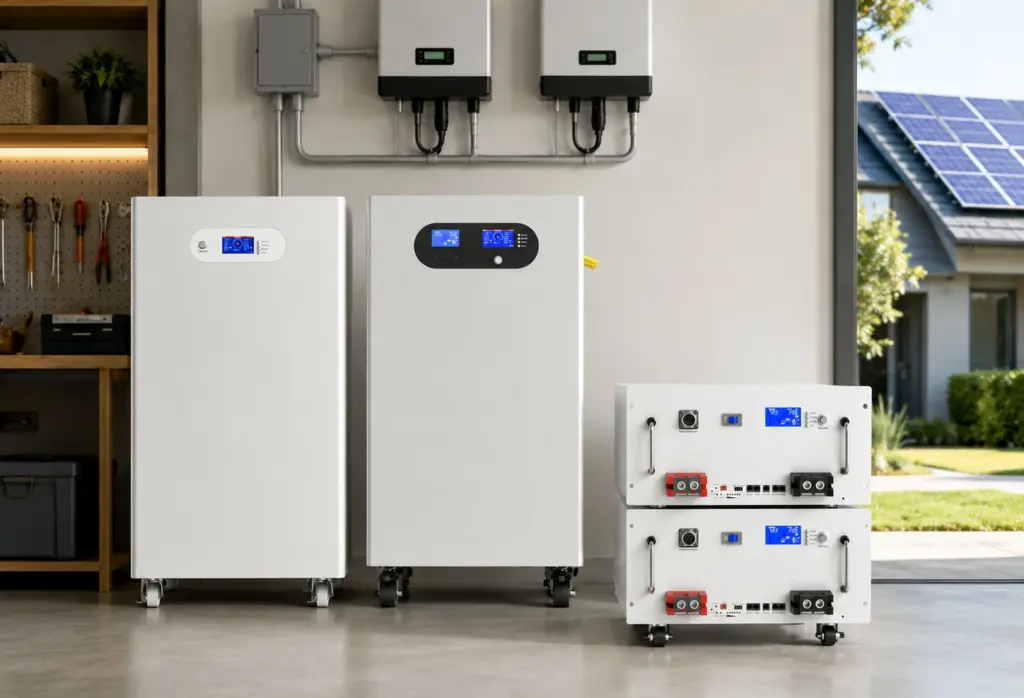
Avepower supports solar installers, distributors, EPC teams and OEM/ODM partners with customized LiFePO4 energy-storage systems. Its manufacturing platform includes battery engineering, cell matching, BMS configuration, CAN/RS485 integration and inverter compatibility support.
If you are planning a battery project, send Avepower your inverter brand and model, required voltage, battery capacity, charge/discharge power, communication protocol and application.
Take Control of Your Energy with Avepower!
Reliable home solar battery solutions with OEM/ODM customization and in-house manufacturing, tailored to the needs of distributors, installers, and energy partners.
How Should You Measure LiFePO4 Cell Voltage Correctly?
For a meaningful LiFePO4 voltage measurement, first decide whether you need operating voltage or approximate open-circuit voltage. Operating measurements should include current and temperature, while SOC-oriented measurements are more useful after the battery has rested without significant charging or discharging current.
For a resting-voltage check:
- Stop major charging sources and loads if the system design permits.
- Allow the battery to rest.
- Measure pack voltage using an appropriate calibrated meter.
- Read individual cell voltages through the BMS where available.
- Compare the highest and lowest cells.
- Record temperature.
- Compare results with the battery manufacturer’s specification.
Do not disconnect, open or probe a finished high-energy battery pack unless you are qualified and the manufacturer’s service procedure permits it.
In professionally integrated systems, using BMS telemetry is generally preferable to manually accessing cells.
What Causes Abnormal LiFePO4 Cell Voltage?
Common causes include genuine low SOC, cell imbalance, excessive current, cold temperature, increased cell resistance, loose connections, incorrect charger settings, aging, SOC calibration errors or a BMS protection event.
| Symptom | Possible Cause | Recommended Check |
|---|---|---|
| One cell reaches high voltage first | Cell imbalance or reduced capacity | Cell delta near top of charge |
| One cell reaches low voltage first | Weak cell or imbalance | Lowest-cell voltage under load |
| All cells sag under load | High current or low temperature | Current, temperature, system sizing |
| Pack voltage normal but BMS disconnects | Individual cell reaches limit | BMS cell-level data |
| Voltage rises unusually fast when charging | High resistance or near-full SOC | Current, cell delta, temperature |
| Resting voltage normal but runtime is short | Capacity loss or SOC error | Controlled capacity test |
| Inverter reports low battery at high load | Voltage sag or cable loss | Battery and inverter-terminal voltage |
| Charger stops earlier than expected | BMS limit or communication command | CCL/CVL, temperature and cell voltage |
If the system repeatedly reaches protection thresholds, do not simply widen BMS limits.
Identify the cause first.
Avepower’s battery discharge warning guide explains how low SOC, current, voltage sag and individual-cell behavior can interact in an energy-storage system.
Final Takeaway
The most useful number to remember is 3.2V nominal per LiFePO4 cell, but proper battery design requires more than multiplying voltage values. Charging state, load current, cell balance, temperature, BMS limits and inverter compatibility determine whether a voltage reading represents normal operation or a developing problem.
Need a LiFePO4 Battery Configuration for Your Solar Project?
Avepower develops LiFePO4 home energy storage systems for solar installers, distributors, project developers and OEM/ODM energy brands.
With a 20,000 m² manufacturing base, 50+ R&D engineers, CAN/RS485/RS232 integration and configurable 24V, 48V and 51.2V battery platforms, Avepower can help evaluate battery voltage, capacity, BMS configuration, inverter communication and system expansion requirements before production.
Send us your inverter model, required kWh capacity, expected load and project application to receive a recommended battery configuration and compatibility review.
FAQ
A LiFePO4 cell normally has a nominal voltage of approximately 3.2V.
A LiFePO4 cell typically reaches approximately 3.60–3.65V near the end of charging. After charging stops, its resting voltage normally decreases.
3.65V per cell is a common upper charging specification for many LiFePO4 cells, but the specific cell and battery datasheets always take priority. Do not assume every pack should continuously charge or float at 3.65V per cell.
A rested LiFePO4 cell may be around 3.25–3.30V near the middle of its SOC range, but voltage alone cannot precisely determine 50% SOC because the LFP voltage curve is very flat.
This can be completely normal after charging stops. A 16S LiFePO4 pack may reach a higher voltage while actively charging and then settle downward after current is removed.