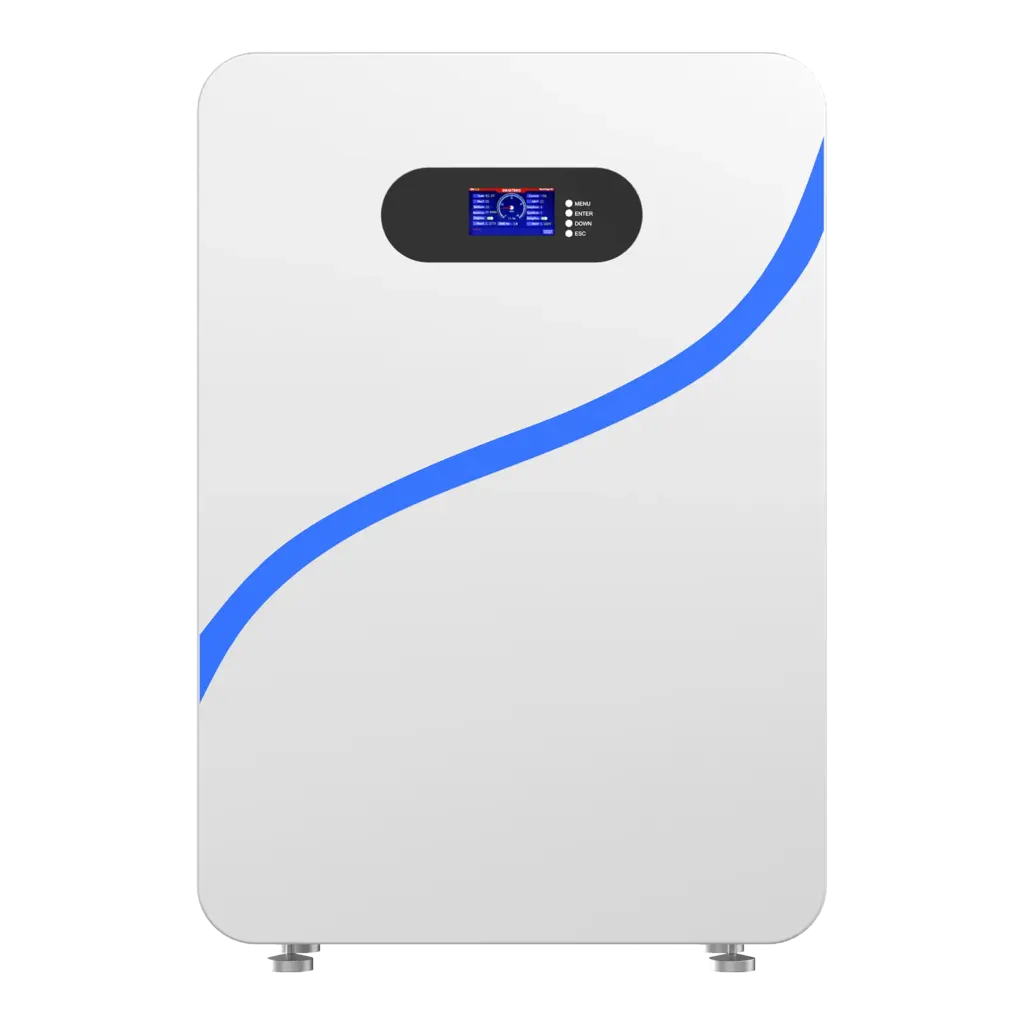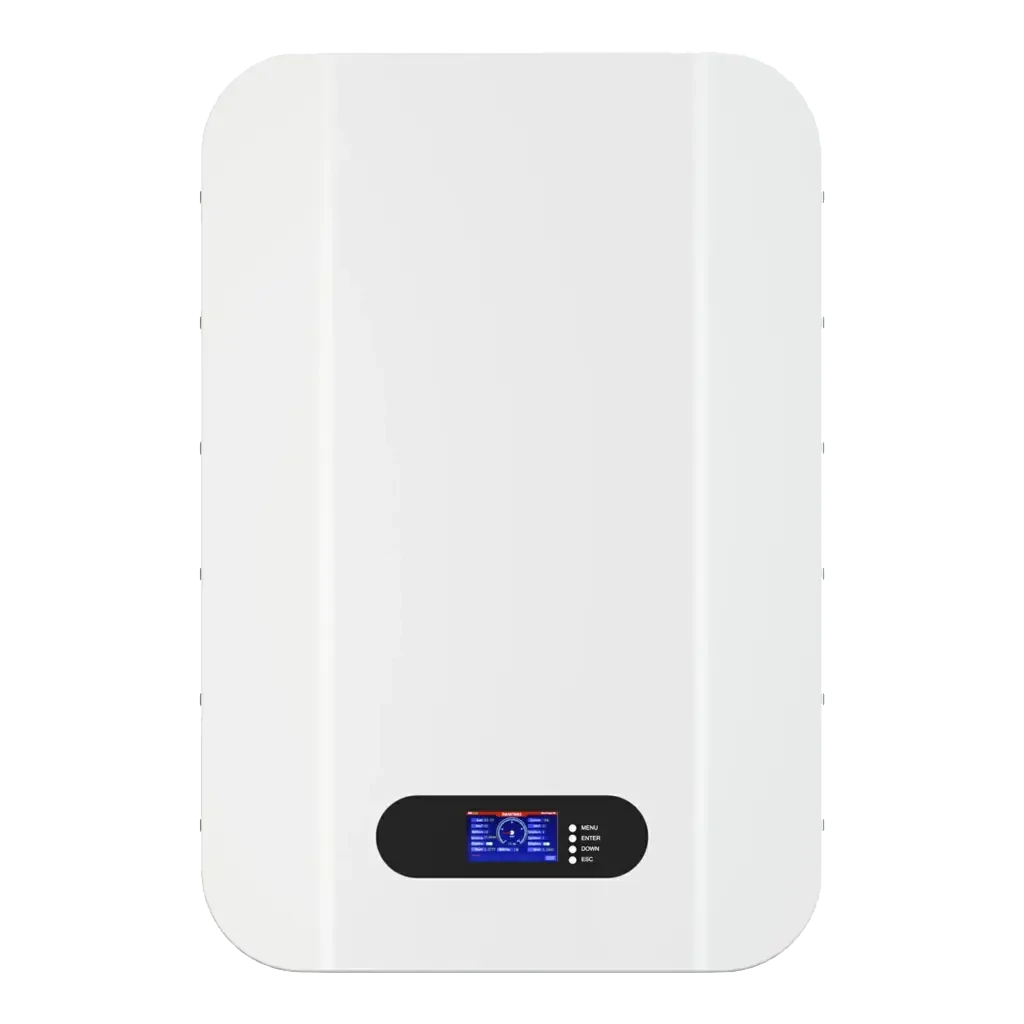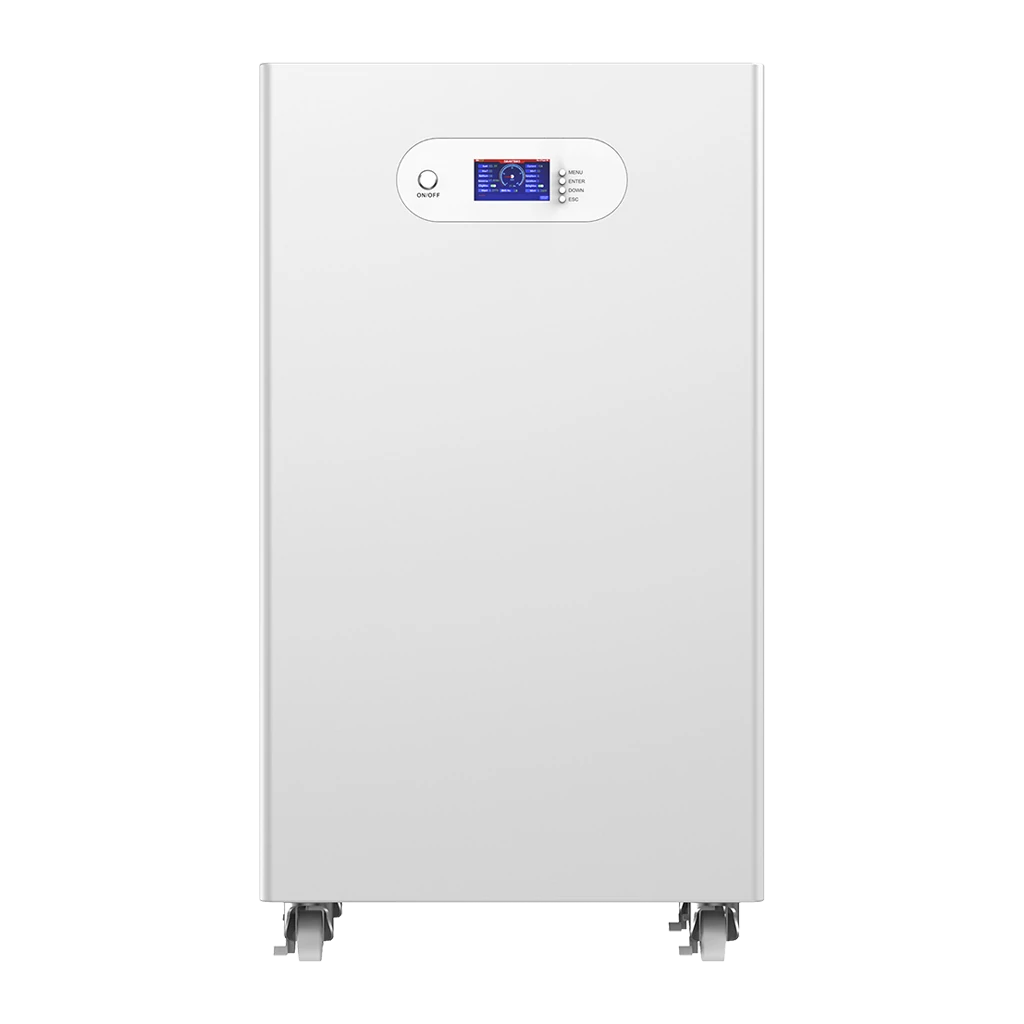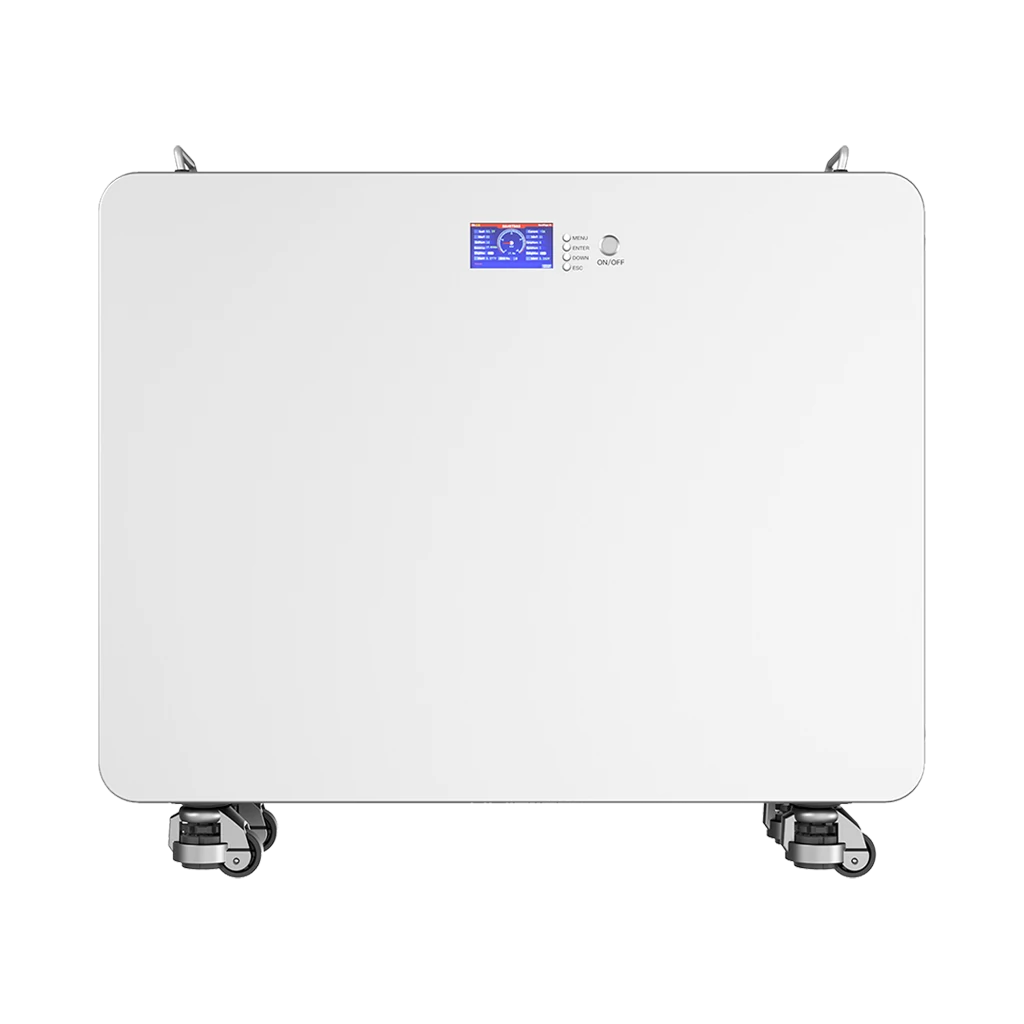

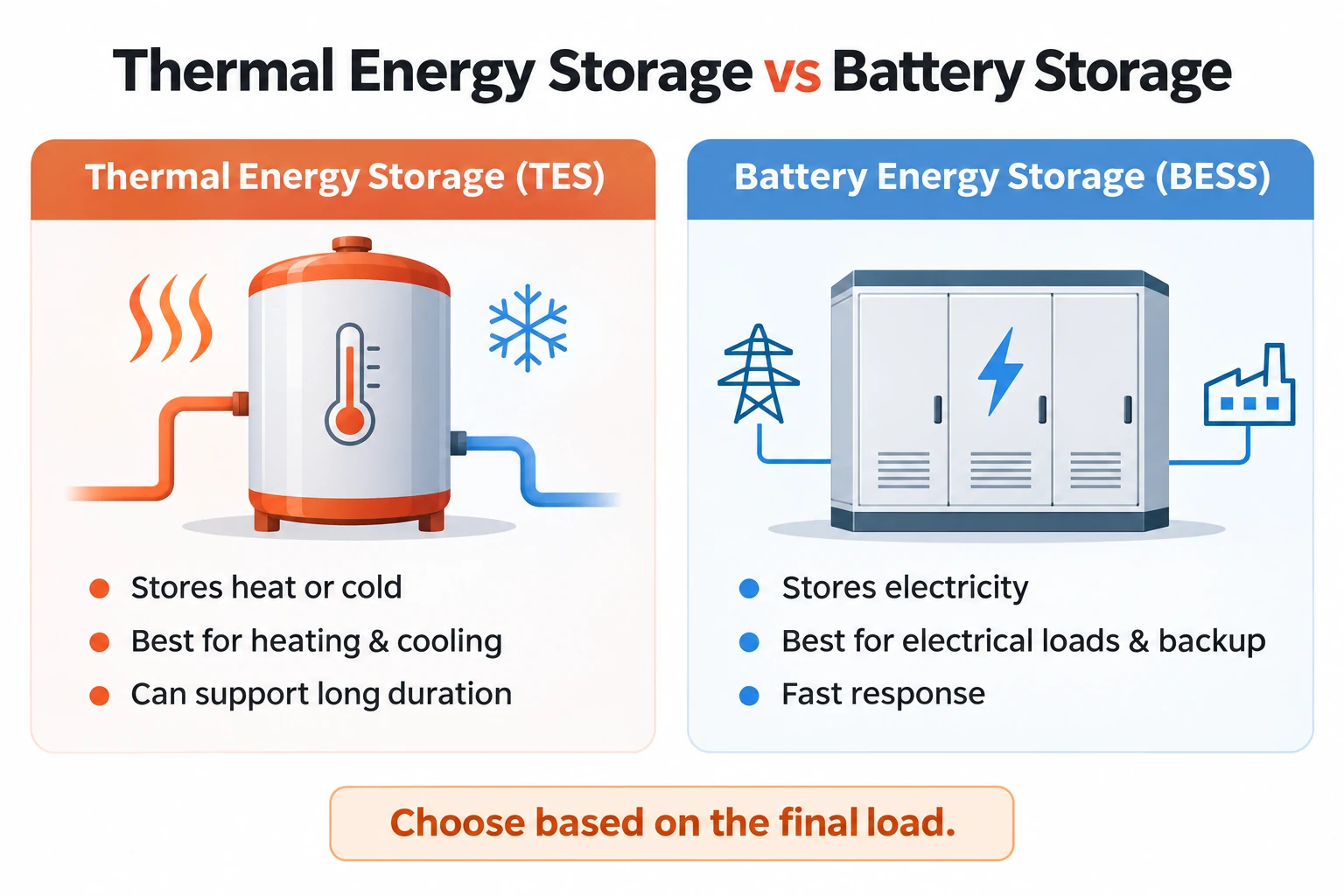
Thermal energy storage is usually the better option when the energy you ultimately need is heat or cooling, while battery storage is usually the better option when you need electricity, backup power, power quality, or flexible support for multiple electrical loads. Neither technology is universally superior. In facilities with substantial thermal and electrical loads, combining TES with BESS can be more rational than oversizing either system alone.
What Is the Difference Between Thermal Energy Storage and Battery Storage?
The main difference is the form of useful energy delivered after storage. BESS stores and returns electricity, while TES stores and supplies thermal energy. This makes battery storage more flexible for electrical loads and thermal storage more directly suited to heating or cooling.
Thermal Energy Storage vs Battery Storage: Quick Decision Table
| Factor | Thermal Energy Storage | Battery Storage |
|---|---|---|
| Stored energy | Heat or cold | Electricity |
| Final output | Heating or cooling | Electricity |
| Best suited to | HVAC, hot water, process heat | Electrical loads, backup, solar storage |
| Response | Depends on thermal system | Very fast |
| Storage duration | Can range from hours to much longer periods | Commonly designed around hours, but flexible |
| Electrical backup | No | Yes, if properly designed |
| Thermal loads | Directly serves them | Powers heating or cooling equipment |
| Space requirement | Can be large | Generally more compact |
| Main equipment | Tanks, pumps, heat exchangers, piping | Batteries, PCS, BMS, EMS |
| Main advantage | Direct thermal storage | Electrical flexibility |
| Main limitation | Cannot power arbitrary electrical loads | Can be unnecessarily expensive if electricity is only being stored to create heat |
Why Does the Choice of Energy Storage Technology Matter?
The right storage technology depends primarily on what type of energy the site needs after storage. If electricity is ultimately being converted into heat or cooling, storing thermal energy directly may sometimes avoid unnecessary conversion stages. If the site needs electricity for multiple loads, a battery provides much greater electrical flexibility.
Energy storage can help a facility:
- shift consumption away from expensive peak periods;
- increase solar self-consumption;
- reduce peak electrical demand;
- recover and reuse waste heat;
- maintain selected loads during grid outages;
- improve renewable energy utilization;
- reduce dependence on real-time grid supply.
What Is a Battery Energy Storage System?
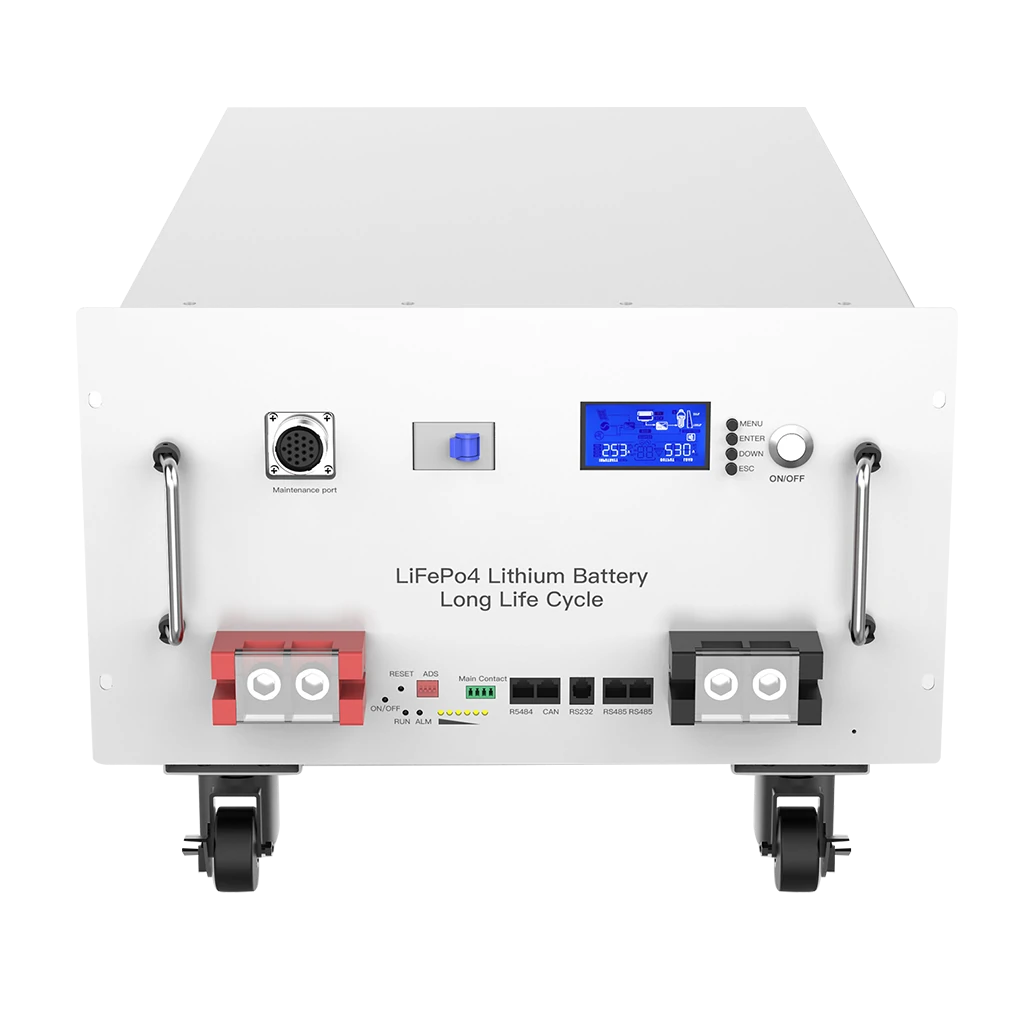
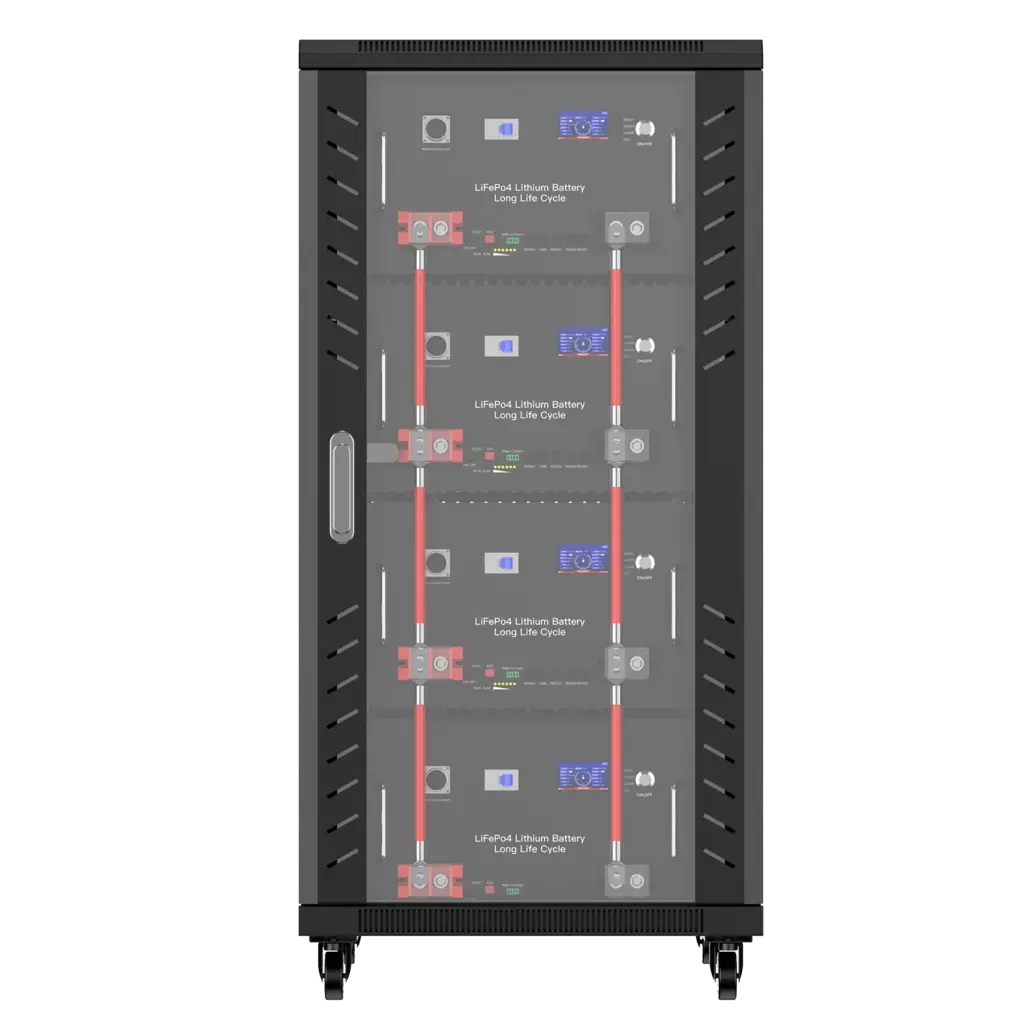
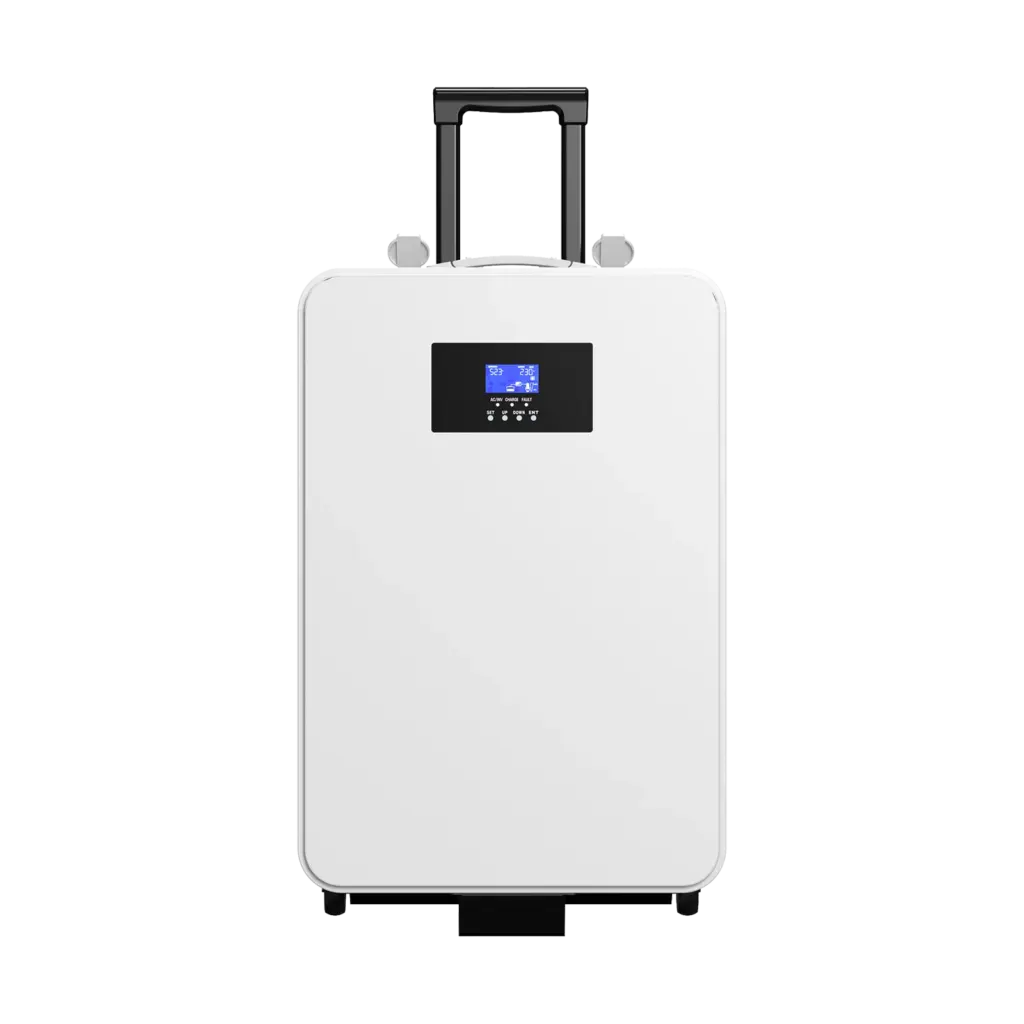
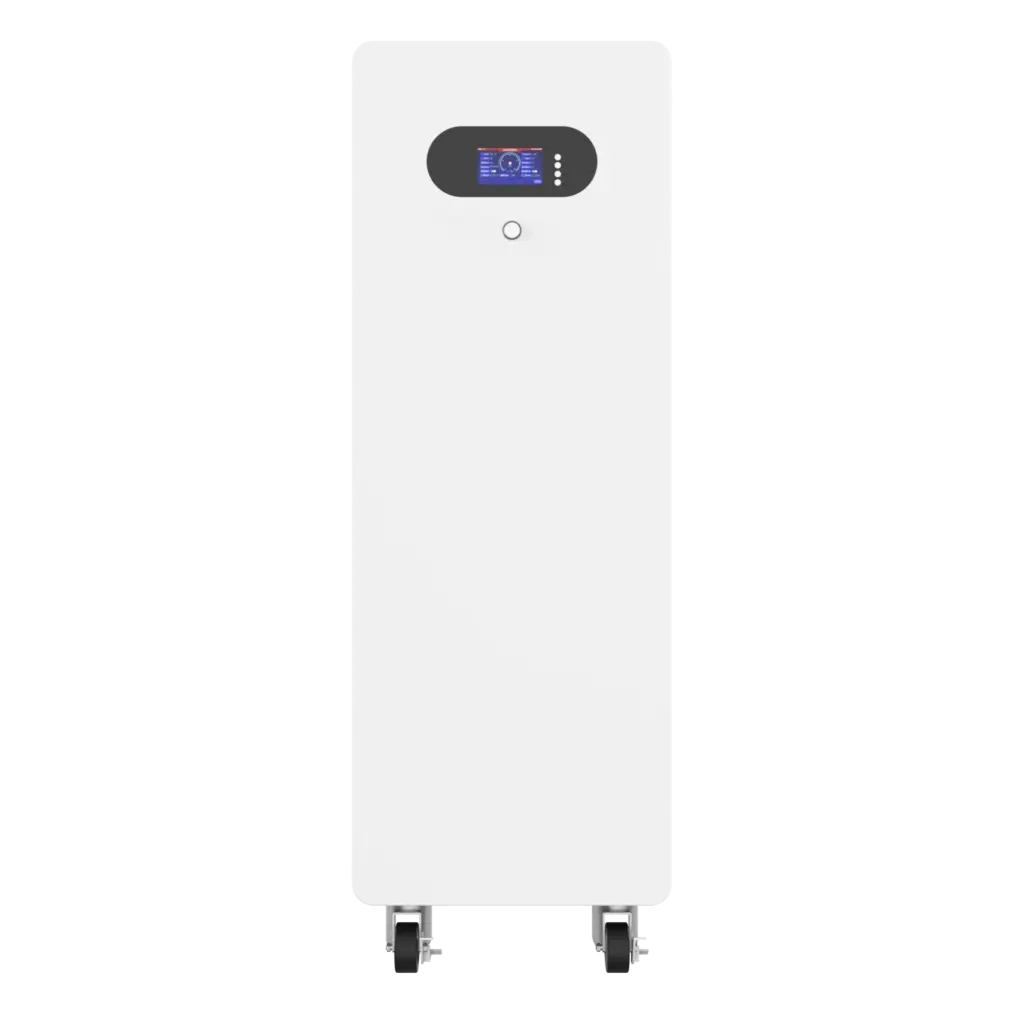
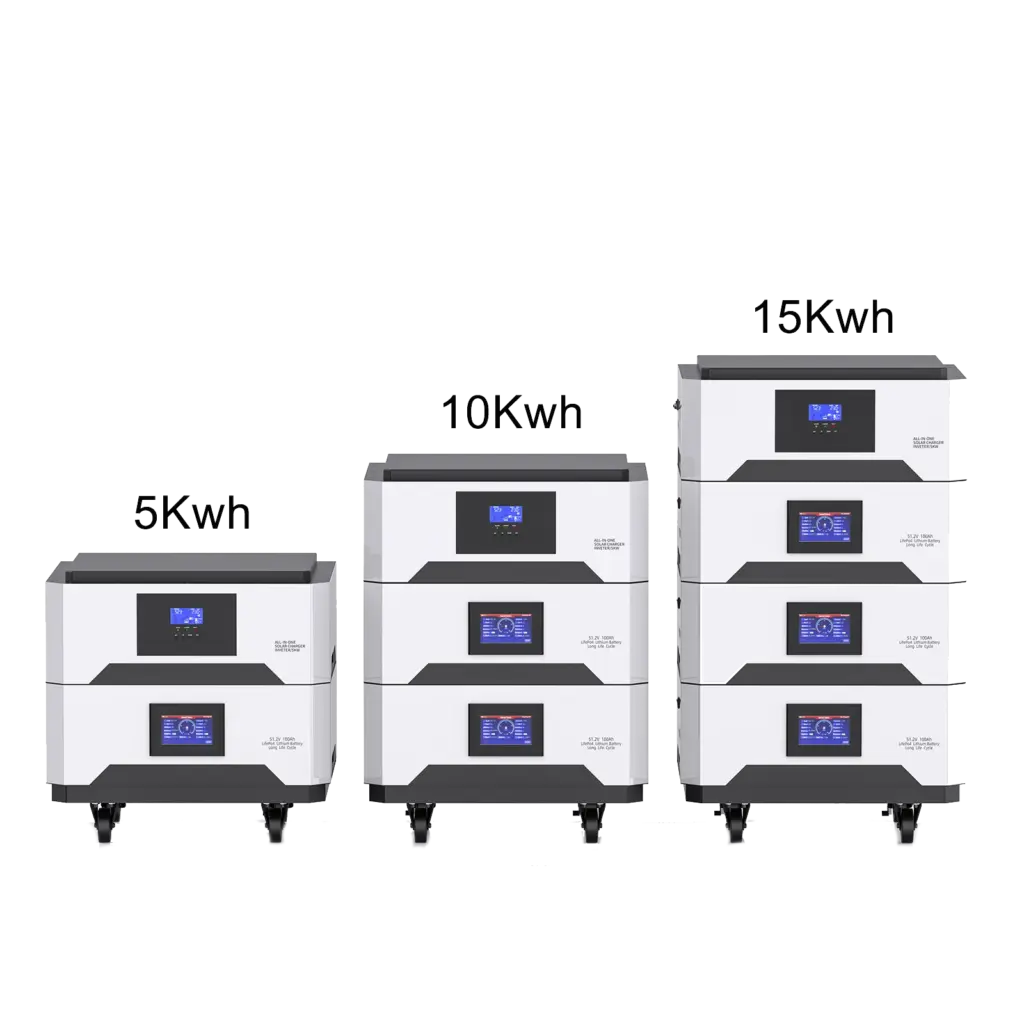
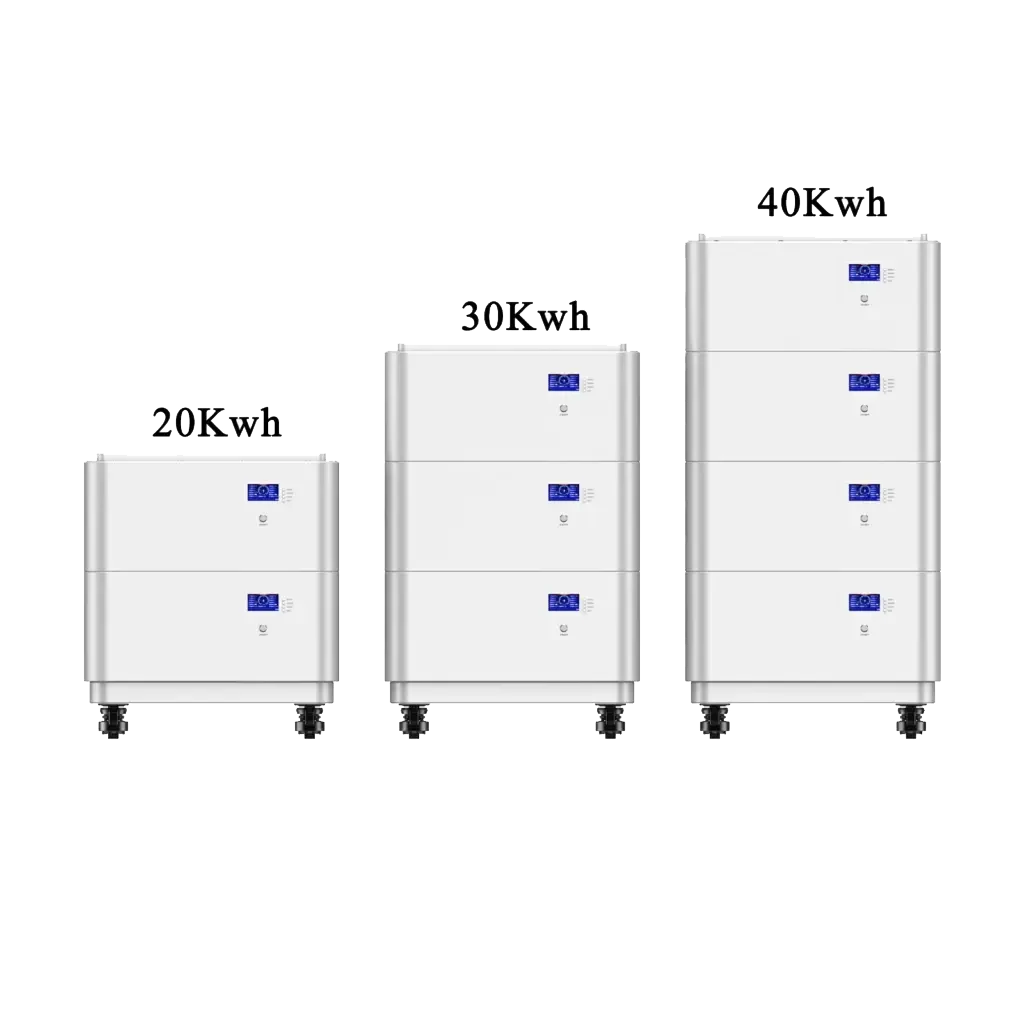
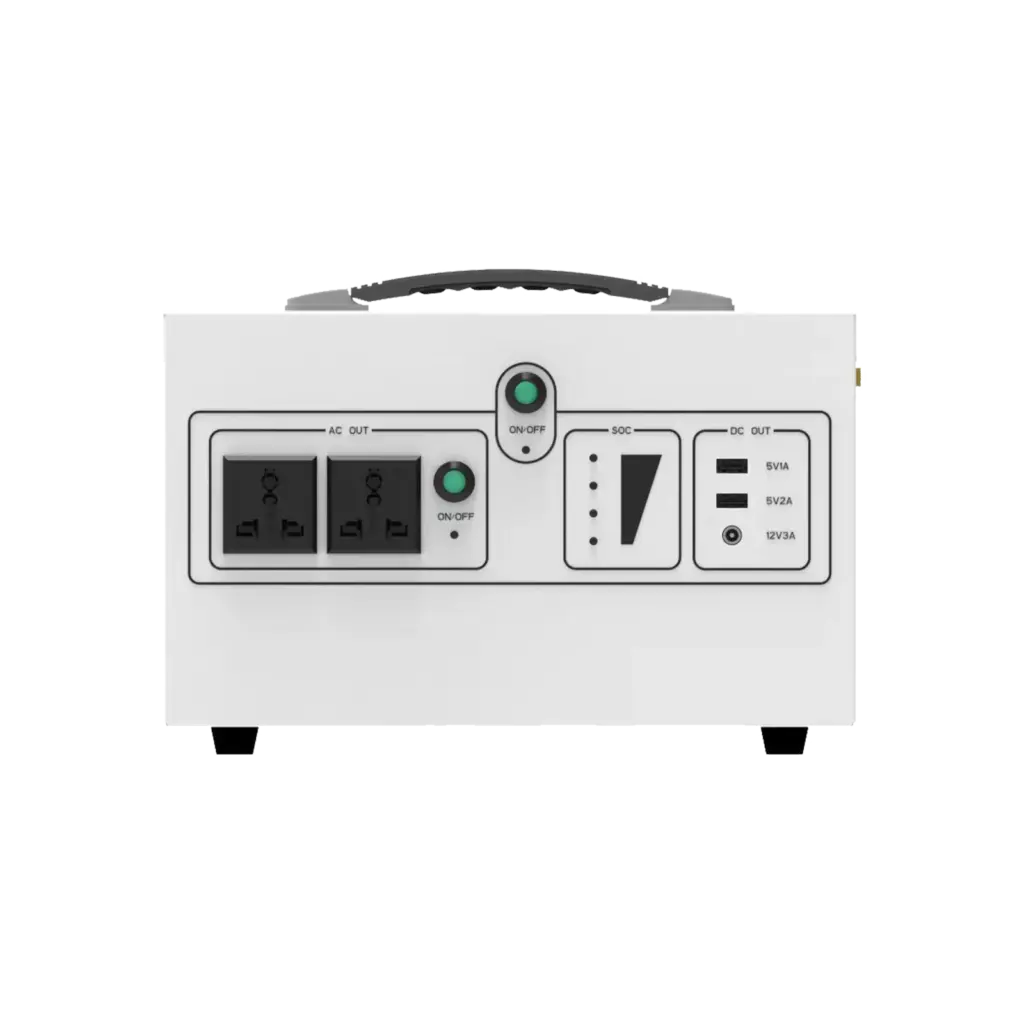
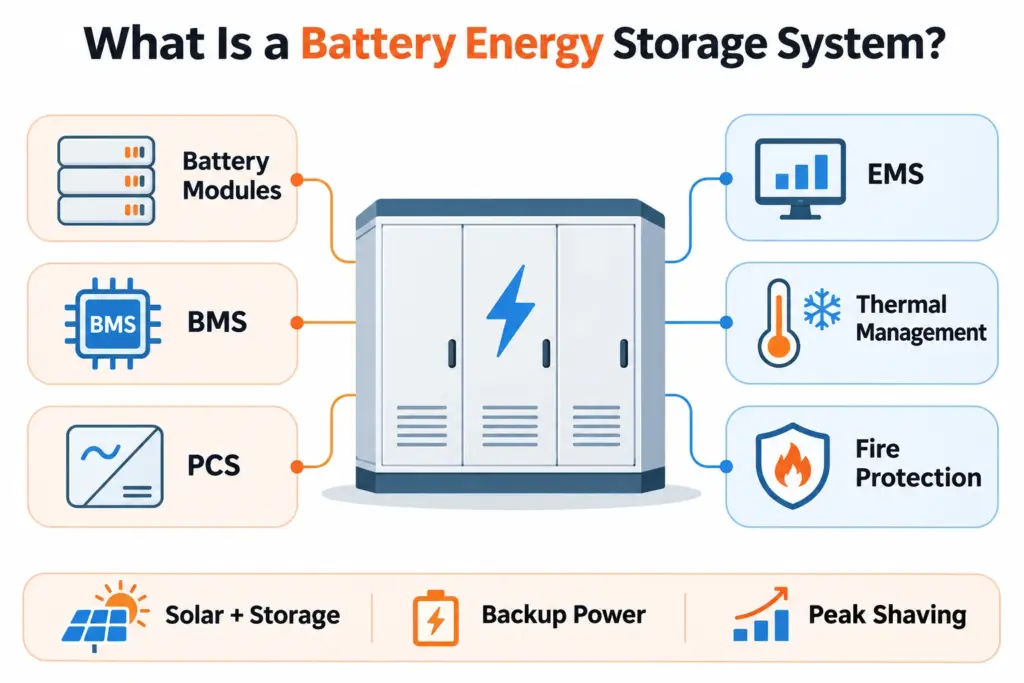
A Battery Energy Storage System, or BESS, stores electrical energy electrochemically and releases electricity when required. Modern stationary systems commonly use lithium-ion batteries, particularly lithium iron phosphate, or LFP, for commercial and industrial applications.
A complete BESS contains much more than battery cells. It normally combines energy storage, power conversion, monitoring, thermal management, safety protection and system controls.
What Are the Main Components of a BESS?
A complete BESS may include:
| Component | Main function |
|---|---|
| Battery cells and modules | Store electrical energy |
| Battery Management System | Monitors battery voltage, temperature, current and SOC |
| Power Conversion System | Converts DC power to AC and AC to DC |
| Energy Management System | Controls charging and discharging strategy |
| Thermal management | Maintains appropriate operating temperature |
| Fire protection | Detects and manages thermal or fire risks |
| Switchgear and protection | Protects and connects electrical equipment |
| Transformer | Matches system voltage when required |
| Cabinet or container | Houses and protects the equipment |
What Are the Main Advantages of Battery Storage?
Battery storage is most valuable when electricity must remain available as electricity.
Its main advantages include:
Fast response
A properly designed BESS can rapidly adjust charging and discharging power, which is useful for fluctuating electrical loads and renewable generation.
Electrical flexibility
The same BESS can support different electrical loads, including:
- machinery;
- pumps;
- lighting;
- servers;
- HVAC equipment;
- EV chargers;
- control systems.
Compact energy storage
Battery systems generally store a large amount of electrical energy within a relatively compact footprint compared with many forms of low-temperature thermal storage.
Modular expansion
Many commercial and industrial BESS designs can be expanded by adding additional battery cabinets or modules, provided the PCS, electrical architecture and control system support the additional capacity.
Backup capability
A BESS can support critical loads during an outage when the system is designed with the correct PCS, switchgear, controls and islanding architecture.
A battery cabinet alone does not automatically provide backup power.
Where Is Battery Storage Commonly Used?
BESS is commonly used for:
- solar-plus-storage;
- peak shaving;
- electricity load shifting;
- demand management;
- backup power;
- microgrids;
- EV charging;
- renewable energy integration;
- commercial and industrial energy management.
Both energy capacity in kWh and power in kW must be considered.
For example, Avepower has documented a commercial and industrial energy storage project in Germany using:
- 215.04 kWh nominal energy;
- 100 kW rated power;
- LFP battery chemistry;
- 768 V nominal voltage;
- liquid cooling;
- integrated BMS, PCS and EMS.
View the 215kWh C&I energy storage project
The combination of 215.04 kWh and 100 kW illustrates why BESS selection cannot be based on capacity alone.
What Is Thermal Energy Storage?
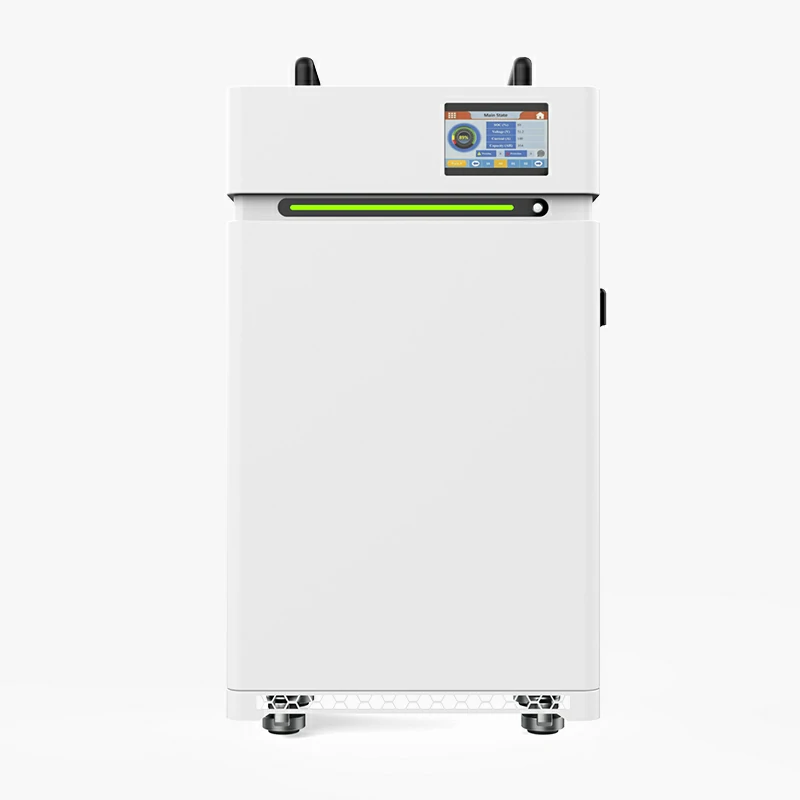
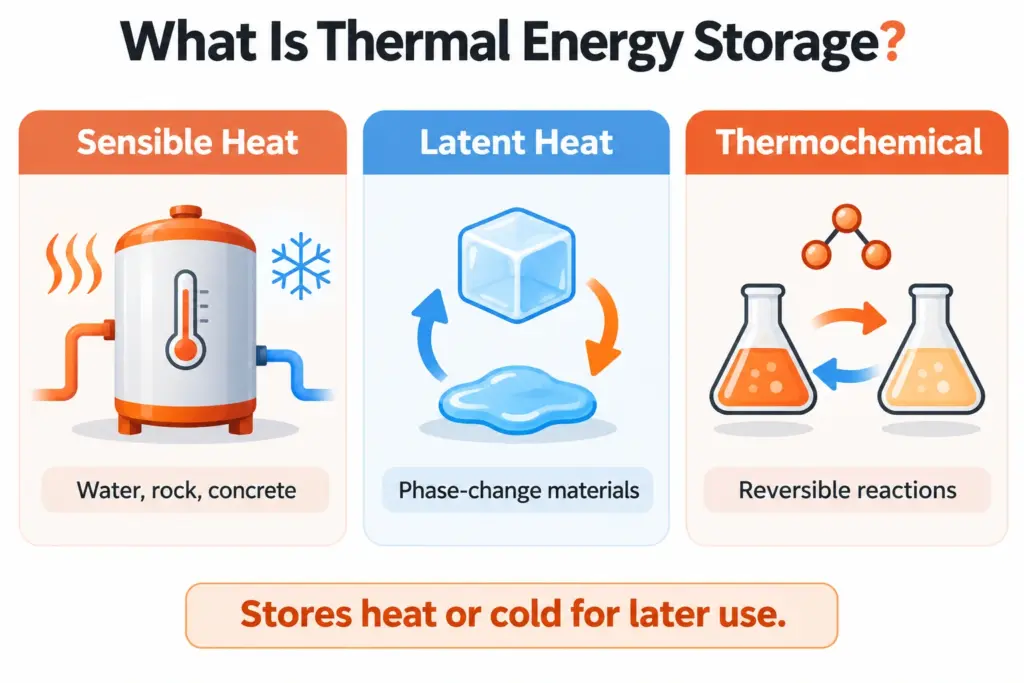
Thermal energy storage, or TES, stores energy as heat or cold and releases that thermal energy later.
Depending on the application, the storage medium may include:
- water;
- ice;
- molten salt;
- rock;
- sand;
- concrete;
- phase-change materials;
- thermochemical materials.
TES is especially useful when the final energy requirement is already thermal.
Instead of:
electricity → battery → electricity → heating or cooling
a system may use:
electricity → heating or cooling → thermal storage → thermal load
Industrial systems may also use:
waste heat → thermal storage → process heat
This difference in the energy pathway can have a major effect on overall system design and economics.
What Are the Main Types of Thermal Energy Storage?
Thermal storage can generally be divided into three categories: sensible heat storage, latent heat storage and thermochemical storage. Each stores thermal energy differently and is suited to different temperature ranges, energy densities and applications.
Sensible Heat Storage
Sensible heat storage stores thermal energy by increasing or decreasing the temperature of a material without changing its physical phase.
Common storage materials include:
- water;
- rock;
- concrete;
- sand;
- molten salt.
The theoretical stored energy can be expressed as:
Q = m × cp × ΔT
where:
- Q = stored thermal energy;
- m = mass of the material;
- cp = specific heat capacity;
- ΔT = usable temperature difference.
Water tanks are one of the simplest examples.
Latent Heat Storage
Latent heat storage uses a phase-change material that absorbs or releases energy as it changes phase.
Examples include materials that transition between solid and liquid states within a defined temperature range.
Potential applications include:
- building heating;
- building cooling;
- cold storage;
- process temperature control.
Ice storage is a common example of latent thermal storage used for cooling.
Thermochemical Energy Storage
Thermochemical storage uses reversible chemical or sorption processes to store thermal energy.
This approach can offer higher storage density and potentially low standing losses, but its system design is generally more complex than conventional water or ice storage.
For most commercial projects, the suitability of thermochemical storage depends heavily on operating temperature, required duration and project scale.
What Materials Are Used for Thermal Storage?
The correct storage material depends on the required temperature, available space, charge and discharge rate, duration and final thermal application.
| Storage medium | Typical application | Main characteristic |
|---|---|---|
| Water | Hot water, HVAC, district energy | Mature and relatively simple |
| Ice | Commercial cooling | Stores cooling through phase change |
| Molten salt | High-temperature heat storage | Suitable for high-temperature systems |
| Rock or sand | Industrial heat storage | Abundant solid materials |
| Concrete | Sensible thermal storage | Durable solid storage medium |
| PCM | HVAC and compact thermal storage | Stores latent heat around a transition temperature |
| Thermochemical materials | Longer-duration thermal storage | Potential for low standing losses |
What Are the Advantages of Thermal Energy Storage?
Thermal storage can be attractive when the final demand is heating or cooling because it stores the required form of energy directly.
Potential advantages include:
- use of relatively inexpensive storage materials;
- long storage duration for suitable technologies;
- recovery of industrial waste heat;
- reduction of peak heating or cooling demand;
- reduced electrical load during selected periods;
- potentially long service life;
- use of simple storage media such as water or rock;
- suitability for large thermal loads.
TES can also reduce the need to operate chillers, heaters or heat pumps at the same time that the thermal demand occurs.
However, TES has limitations.
Large water tanks can require substantial space. Thermal performance depends strongly on storage temperature, insulation and temperature difference. TES also cannot directly supply unrelated electrical equipment.
Where Is Thermal Energy Storage Used?
Thermal energy storage is most useful where a facility has a predictable heating or cooling load that can be shifted in time.
Typical applications include:
- space heating;
- commercial cooling;
- domestic hot water;
- district heating;
- district cooling;
- industrial process heat;
- industrial waste-heat recovery;
- cold storage;
- high-temperature thermal processes.
For example, a commercial building may produce chilled water or ice before the afternoon demand peak and use the stored cooling later.
An industrial facility may store surplus process heat and reuse it several hours later.
What Is the Most Important Difference Between TES and BESS?
The most important question is what type of load needs energy after storage.
If the facility needs:
- motors;
- computers;
- servers;
- lighting;
- production equipment;
- pumps;
- EV chargers;
the stored energy must generally return as electricity.
That points toward BESS.
If the facility needs:
- chilled water;
- hot water;
- space heating;
- cooling;
- steam;
- process heat;
then TES should also be evaluated.
This load-first approach is usually more useful than comparing technologies from their headline specifications alone.
Which Is More Efficient: Thermal Storage or Battery Storage?
There is no single efficiency percentage that determines which technology is better because the two systems may deliver different forms of useful energy.
A battery commonly follows:
electricity → battery → electricity
A cooling TES system may follow:
electricity → chiller → stored cooling → cooling load
An industrial TES system may follow:
waste heat → thermal storage → process heat
Because the outputs are different, their efficiency values should not be compared without defining the full system boundary.
Example: Commercial Cooling
Suppose a commercial building requires:
500 kW of cooling for 4 hours
The required cooling energy is:
500 kW × 4 hours = 2,000 kWh_th
If the chiller operates at a COP of 4:
2,000 kWh_th ÷ 4 = 500 kWh_e
This simplified calculation shows why:
2,000 kWh_th of thermal storage is not equivalent to a 2,000 kWh battery.
The battery requirement relates to the electrical energy used by the chiller, while the thermal storage requirement relates to the cooling delivered.
Actual system design must also consider:
- chiller performance;
- storage losses;
- charging conditions;
- pump energy;
- battery losses;
- usable battery capacity.
The central principle remains:
1 kWh_th and 1 kWh_e are not directly interchangeable for project comparison.
When Should You Choose Battery Storage?
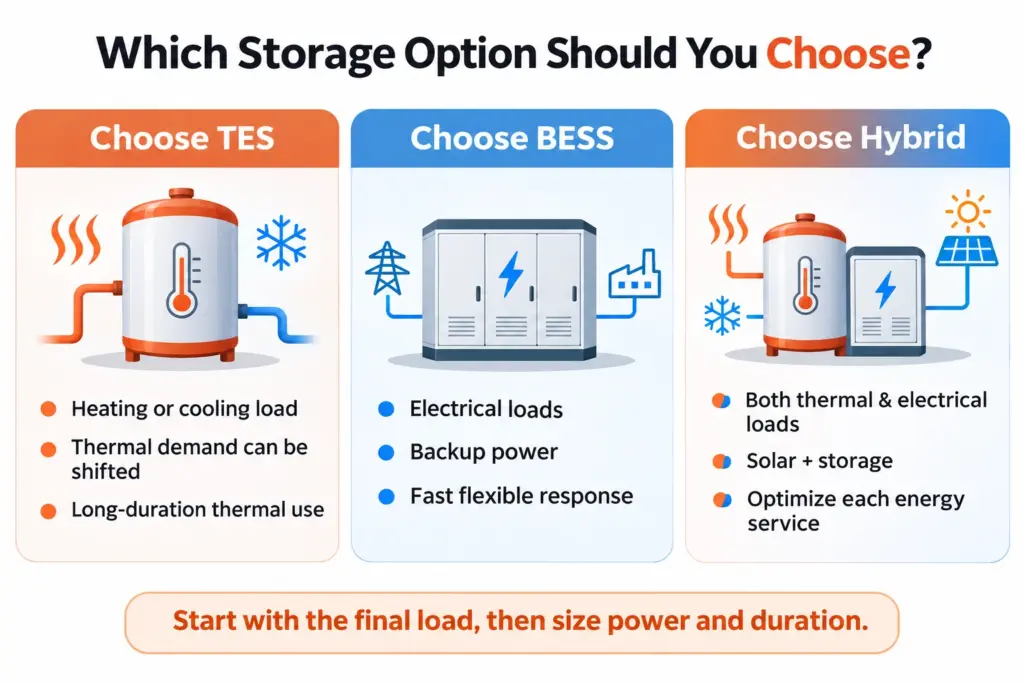
Choose BESS when the stored energy must ultimately be delivered as electricity.
Battery storage is particularly suitable when:
- electrical backup is required;
- solar electricity must be stored for nighttime use;
- peak electrical demand must be reduced;
- multiple electrical loads need energy;
- fast control is important;
- grid interaction is required;
- installation space is limited;
- the project uses a microgrid.
For commercial and industrial projects, both kW and kWh must be specified.
For example:
500 kW × 1 hour = 500 kWh
and
100 kW × 5 hours = 500 kWh
represent the same amount of energy but require very different PCS power and system configurations.
This is why nominal battery capacity alone is not enough to select a BESS.
When Should You Choose Thermal Energy Storage?
Choose TES when heating or cooling represents a large and predictable part of the site’s energy demand and that load can be shifted in time.
TES deserves evaluation when:
- cooling creates a large afternoon peak;
- hot-water demand is predictable;
- industrial waste heat is available;
- process heat is required for several hours;
- the facility already uses chilled-water infrastructure;
- central heating is available;
- sufficient storage space exists;
- long-duration thermal storage is required.
TES may be less attractive when:
- thermal loads are small;
- demand changes unpredictably;
- the site lacks space;
- required temperatures are difficult to maintain;
- thermal energy cannot be used regularly.
The system must deliver both:
kWh_th — total thermal energy
and
kW_th — required thermal power
at the required operating temperature.
When Does a Hybrid TES + BESS System Make More Sense?
A hybrid system can make sense when a facility has both major thermal demand and important electrical loads.
Instead of using a large BESS for every load, the project can potentially separate them:
TES → heating or cooling
BESS → electrical equipment and backup
Consider a facility with:
- large daytime cooling demand;
- solar generation;
- production machinery;
- critical electrical equipment;
- expensive peak electricity;
- backup requirements.
An all-battery solution could store electricity for the entire facility.
A hybrid configuration could instead use thermal storage for cooling and reserve battery capacity for electrical demand.
Whether this is financially better depends on the actual load profile, tariff structure and equipment cost.
Hybrid does not automatically mean lower cost.
It means each technology is assigned to the type of energy service it is designed to provide.
How Does Avepower Fit Into a TES vs BESS Project?
Avepower’s publicly documented project portfolio focuses on LiFePO4 battery energy storage systems rather than thermal energy storage.
Avepower is therefore relevant when the project requires:
- standalone battery storage;
- commercial or industrial BESS;
- solar-plus-storage;
- electrical backup;
- the battery portion of a hybrid TES + BESS system.
One documented Germany C&I project uses:
- 215.04 kWh nominal capacity;
- 100 kW rated power;
- 768 V nominal battery voltage;
- LFP chemistry;
- liquid cooling;
- integrated BMS, PCS and EMS;
- RS485, Ethernet and CAN communication.
View the Germany 215kWh C&I project
Avepower also documents a larger high-voltage project in Lithuania using:
- 522.496 kWh total energy;
- 832 V nominal DC voltage;
- four 42U battery cabinets;
- two battery clusters in parallel;
- CAN and RS485 communication.
View the Lithuania 522kWh high-voltage ESS project
These examples illustrate why real BESS selection requires more than choosing a nominal capacity.
Voltage, PCS rating, communication, BMS architecture, cabinet design, cooling and the actual load profile all affect the final configuration.
Need Help Sizing the Battery Storage Portion of Your Project?
If your project requires electrical storage, Avepower can support preliminary BESS configuration for commercial, industrial, solar-plus-storage and hybrid energy projects.
For an initial assessment, provide:
project country + hourly load profile + peak kW + required backup duration or usable kWh + system voltage + renewable generation capacity + critical loads + installation environment + communication requirements.
These inputs allow the battery capacity, PCS power, voltage architecture and cabinet configuration to be evaluated against the actual project rather than selecting a system based only on nominal kWh.
FAQ
Neither is universally better. Thermal energy storage is generally more suitable when the final load is heating or cooling, while battery storage is more suitable when electricity must be stored and later supplied to electrical equipment.
It can be cheaper in suitable thermal applications, but the result depends on the complete system design. TES is commonly measured in kWh_th while batteries are measured in kWh_e, so direct headline cost-per-kWh comparisons can be misleading.
TES can maintain stored heating or cooling, but it cannot directly power general electrical loads such as lights, computers, motors or production equipment. Electrical backup requires a BESS, generator or another electrical power source.
A hybrid system deserves evaluation when a facility has a large shiftable thermal load plus important electrical loads. TES can serve heating or cooling demand while BESS supports electrical loads, renewable energy shifting and backup requirements.