
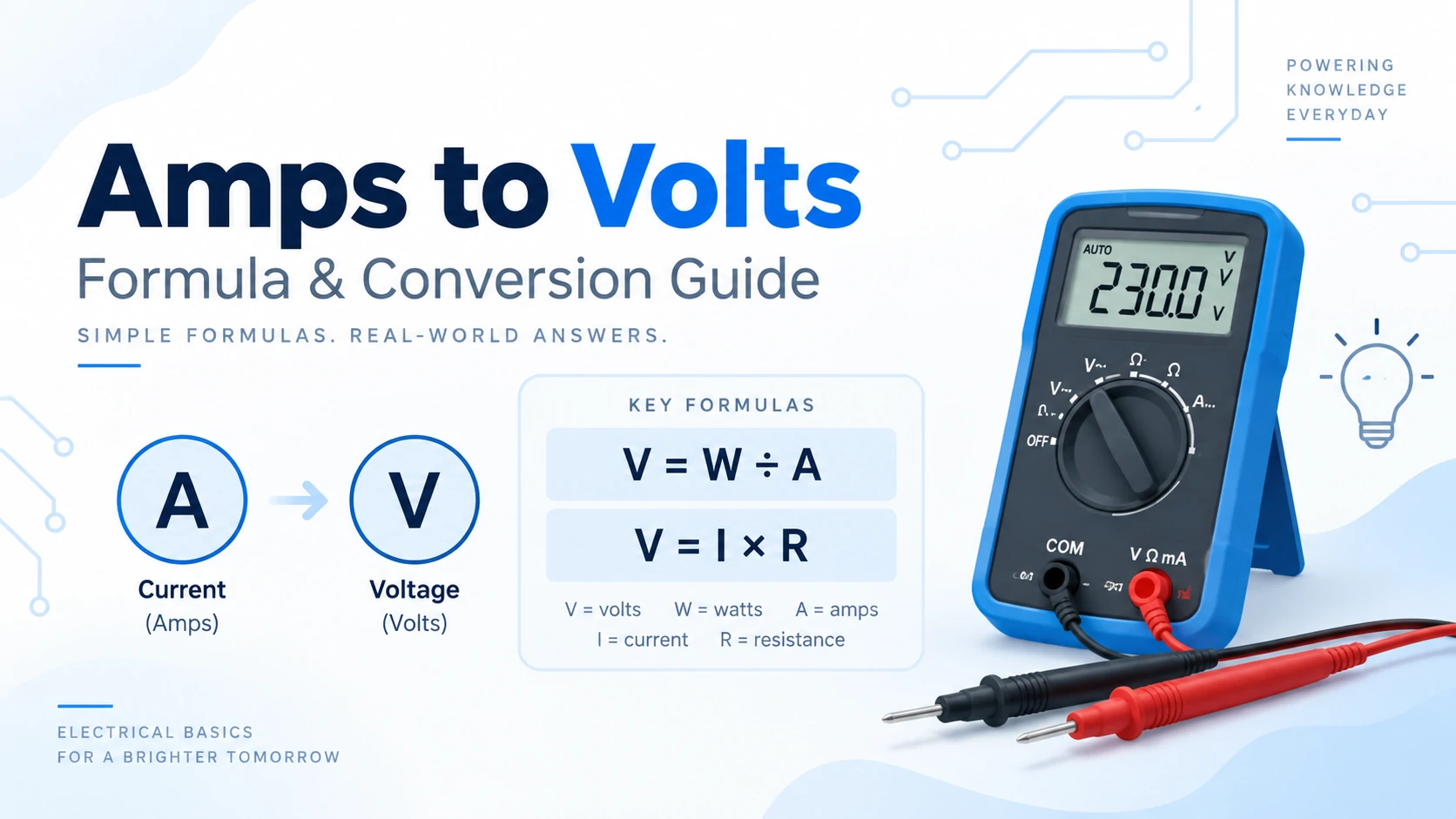
You cannot directly convert amps to volts because amperes measure electrical current while volts measure electrical potential difference. To calculate voltage from amps, you need at least one additional value—usually power in watts or resistance in ohms. For AC systems, you may also need power factor and phase information.
The two most common amps-to-volts formulas are:
Using power:
Voltage (V) = Power (W) ÷ Current (A)
Using resistance:
Voltage (V) = Current (A) × Resistance (Ω)
For example, if a DC load consumes 1,200W while drawing 10A:
1,200W ÷ 10A = 120V
If instead 10A flows through a 12Ω resistive load:
10A × 12Ω = 120V
You can use an Amps to Volts Calculator to calculate the result.
Amps to Volts Calculator
Enter amps and watts or resistance to calculate voltage.
Amps to Volts Conversion Table
Using Watts (Power)
| Current (Amps) | Example Power | Calculation Formula | Voltage (Volts) |
|---|---|---|---|
| 1 A | 1000 W | 1000 W ÷ 1 A | 1000 V |
| 2 A | 1000 W | 1000 W ÷ 2 A | 500 V |
| 3 A | 1000 W | 1000 W ÷ 3 A | 333.33 V |
| 4 A | 1000 W | 1000 W ÷ 4 A | 250 V |
| 5 A | 1000 W | 1000 W ÷ 5 A | 200 V |
| 6 A | 1000 W | 1000 W ÷ 6 A | 166.67 V |
| 8 A | 1000 W | 1000 W ÷ 8 A | 125 V |
| 10 A | 1000 W | 1000 W ÷ 10 A | 100 V |
| 12 A | 1000 W | 1000 W ÷ 12 A | 83.33 V |
| 13 A | 1000 W | 1000 W ÷ 13 A | 76.92 V |
| 15 A | 1000 W | 1000 W ÷ 15 A | 66.67 V |
| 16 A | 1000 W | 1000 W ÷ 16 A | 62.50 V |
| 20 A | 1000 W | 1000 W ÷ 20 A | 50 V |
| 25 A | 1000 W | 1000 W ÷ 25 A | 40 V |
| 30 A | 1000 W | 1000 W ÷ 30 A | 33.33 V |
| 40 A | 1000 W | 1000 W ÷ 40 A | 25 V |
| 50 A | 1000 W | 1000 W ÷ 50 A | 20 V |
| 60 A | 1000 W | 1000 W ÷ 60 A | 16.67 V |
| 80 A | 1000 W | 1000 W ÷ 80 A | 12.50 V |
| 100 A | 1000 W | 1000 W ÷ 100 A | 10 V |
Calculation Formula
Voltage (V) = Power (W) ÷ Current (A)
Example:
10 A at 1000 W = 1000 W ÷ 10 A = 100 V
AUsing Ohms (Resistance)
| Current (Amps) | Example Resistance | Calculation | Voltage (Volts) |
|---|---|---|---|
| 1 A | 10 Ω | 1 A × 10 Ω | 10 V |
| 2 A | 10 Ω | 2 A × 10 Ω | 20 V |
| 3 A | 10 Ω | 3 A × 10 Ω | 30 V |
| 4 A | 10 Ω | 4 A × 10 Ω | 40 V |
| 5 A | 10 Ω | 5 A × 10 Ω | 50 V |
| 6 A | 10 Ω | 6 A × 10 Ω | 60 V |
| 8 A | 10 Ω | 8 A × 10 Ω | 80 V |
| 10 A | 10 Ω | 10 A × 10 Ω | 100 V |
| 12 A | 10 Ω | 12 A × 10 Ω | 120 V |
| 13 A | 10 Ω | 13 A × 10 Ω | 130 V |
| 15 A | 10 Ω | 15 A × 10 Ω | 150 V |
| 16 A | 10 Ω | 16 A × 10 Ω | 160 V |
| 20 A | 10 Ω | 20 A × 10 Ω | 200 V |
| 25 A | 10 Ω | 25 A × 10 Ω | 250 V |
| 30 A | 10 Ω | 30 A × 10 Ω | 300 V |
| 40 A | 10 Ω | 40 A × 10 Ω | 400 V |
| 50 A | 10 Ω | 50 A × 10 Ω | 500 V |
| 60 A | 10 Ω | 60 A × 10 Ω | 600 V |
| 80 A | 10 Ω | 80 A × 10 Ω | 800 V |
| 100 A | 10 Ω | 100 A × 10 Ω | 1000 V |
Ohm's Law Formula
Voltage (V) = Current (A) × Resistance (Ω)
Example:
10 A × 10 Ω = 100 V
What Formula Converts Amps to Volts?
DC and resistive circuits can often use V=P/I or V=I×R, while AC calculations may require power factor and phase configuration.
Use this table before choosing a formula:
| What You Know | Circuit | Formula for Voltage | Best Use |
|---|---|---|---|
| Amps + Watts | DC | V = P ÷ I | Batteries, DC loads |
| Amps + Ohms | Ohmic load | V = I × R | Resistors, simple circuits |
| Amps + Watts + PF | Single-phase AC | V = P ÷ (I × PF) | AC appliances, inverter output |
| Amps + Watts + PF | 3-phase AC, line-to-line | V = P ÷ (√3 × I × PF) | Commercial/industrial systems |
| Amps + VA | Single-phase AC | V = VA ÷ I | Apparent-power calculations |
| Amps + VA | 3-phase AC | V = VA ÷ (√3 × I) | 3-phase apparent power |
The basic relationships V = IR and P = VI are established electrical formulas. However, Ohm's Law should not be treated as a universal fixed-resistance model for every electronic device or nonlinear load.
This distinction becomes important with inverters, motors, LED drivers, switch-mode power supplies and other electronically controlled equipment.
For more background on power calculations, see Avepower’s power rating guide.
How Do You Convert Amps to Volts Using Watts?
When current and real electrical power are known in a DC circuit, calculate volts by dividing watts by amps: V=P÷I.
Formula
V = P ÷ I
Where:
V= voltage in voltsP= power in wattsI= current in amps
Example: 1,200 Watts and 10 Amps
Known values:
P = 1,200W
I = 10A
Calculate:
V = 1,200 ÷ 10
V = 120V
Therefore, a 1,200W DC or unity-power-factor resistive load drawing 10A operates at 120V.
Example: 5,120 Watts and 100 Amps
5,120W ÷ 100A = 51.2V
This calculation is especially relevant to battery systems because 51.2V is a common nominal voltage for 16-cell LiFePO4 battery packs.
How Do You Convert Amps to Volts Using Ohms?
If current and resistance are known for an ohmic load, use Ohm's Law: voltage equals current multiplied by resistance.
Formula
V = I × R
Where:
V= voltageI= currentR= resistance
Example: 5 Amps Through 8 Ohms
5A × 8Ω = 40V
The voltage across the resistance is:
40V
Another Example
If 12A flows through a 10Ω resistance:
12A × 10Ω = 120V
According to Ohm's Law, the required voltage is 120V.
Why Does Higher Voltage Require Fewer Amps for the Same Power?
When power stays approximately constant, increasing voltage reduces the required current because I=P÷V.
Consider a 5,000W DC load before efficiency losses:
| System Voltage | Approx. Current |
|---|---|
| 12V | 416.7A |
| 24V | 208.3A |
| 48V | 104.2A |
| 51.2V | 97.7A |
| 100V | 50A |
| 400V | 12.5A |
The load is still 5kW.
What changes dramatically is current.
This is one reason residential energy storage commonly moves away from 12V architectures as power requirements increase.
Avepower explains this relationship further in its ampere and milliampere guide.
Can You Convert Amps to Volts Directly?
No. Amps and volts measure different electrical quantities, so there is no universal conversion such as “1 amp = X volts.” You must know another electrical value—typically watts, resistance, impedance, or other circuit information—before voltage can be calculated accurately.
An ampere measures electric current, while a volt measures electrical potential difference.
For a deeper explanation of this relationship, see Avepower’s voltage vs current guide and its introduction to what voltage means.
Amps vs Volts vs Watts vs Ohms
| Quantity | Symbol | Unit | What It Measures |
|---|---|---|---|
| Voltage | V | Volt (V) | Electrical potential difference |
| Current | I | Ampere (A) | Rate of electric charge flow |
| Power | P | Watt (W) | Rate of electrical energy transfer |
| Resistance | R | Ohm (Ω) | Opposition to current flow |
Conclusion
Amps cannot be directly converted to volts without additional electrical information. For DC systems, use V=P÷I when watts are known or V=I×R for an appropriate resistive load. For AC systems, confirm power factor and whether the circuit is single-phase or three-phase before calculating voltage.
Need Help Matching Battery Voltage, Current and Inverter Power?
Avepower provides LiFePO4 energy storage solutions for solar installers, distributors, wholesalers and project developers. Send us your inverter model, required kWh, load power, target battery voltage and project application, and our engineering team can help evaluate the battery capacity, discharge current, inverter compatibility and system configuration required for your project.
FAQ
No. Amps measure current and volts measure electrical potential difference. You need another value such as watts or resistance to calculate voltage.
There is no fixed answer. At 1Ω resistance, 1A produces a 1V drop. If a DC load consumes 120W while drawing 1A, the calculated voltage is 120V.
It depends on power or resistance. A 1,200W DC or resistive load drawing 10A operates at 120V, while a 2,300W unity-power-factor load drawing 10A operates at 230V.
Twenty amps can correspond to many voltages. A 2,400W resistive load at 20A equals 120V, while a 4,800W load at 20A equals 240V.
Yes, if another relevant electrical value is known. For an ohmic load with known resistance, use V=I×R. For AC systems, impedance or apparent power may provide another calculation path.
Amps alone cannot determine battery voltage. If instantaneous DC power is known, use V=P÷I. For example, 5,120W at 100A equals 51.2V. Actual battery terminal voltage may still vary with SOC, temperature and load.
Not always. For DC, V=P÷I is commonly used. AC real-power calculations can also require power factor, and three-phase systems add a phase factor such as √3 when line-to-line voltage is used.