
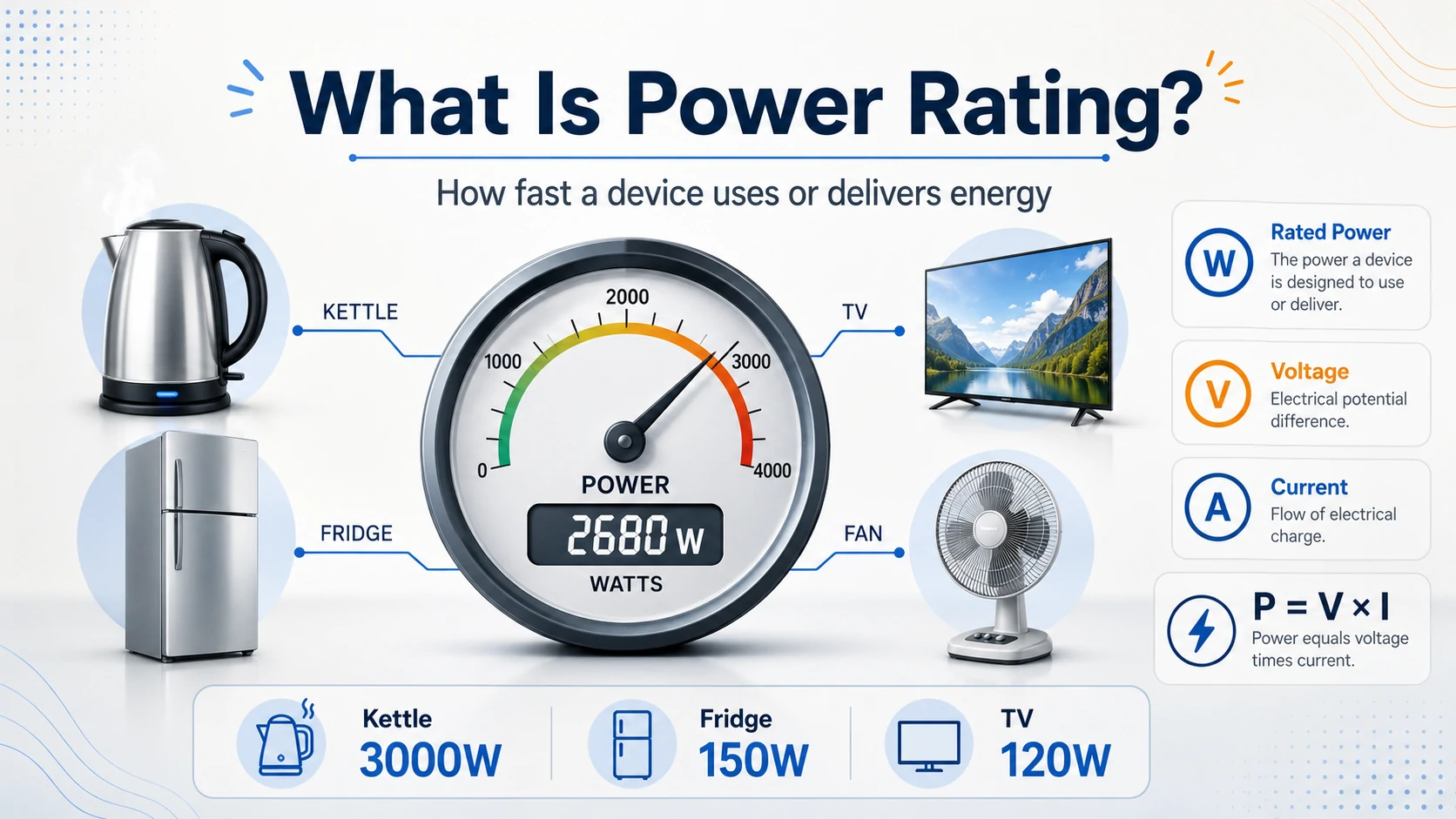
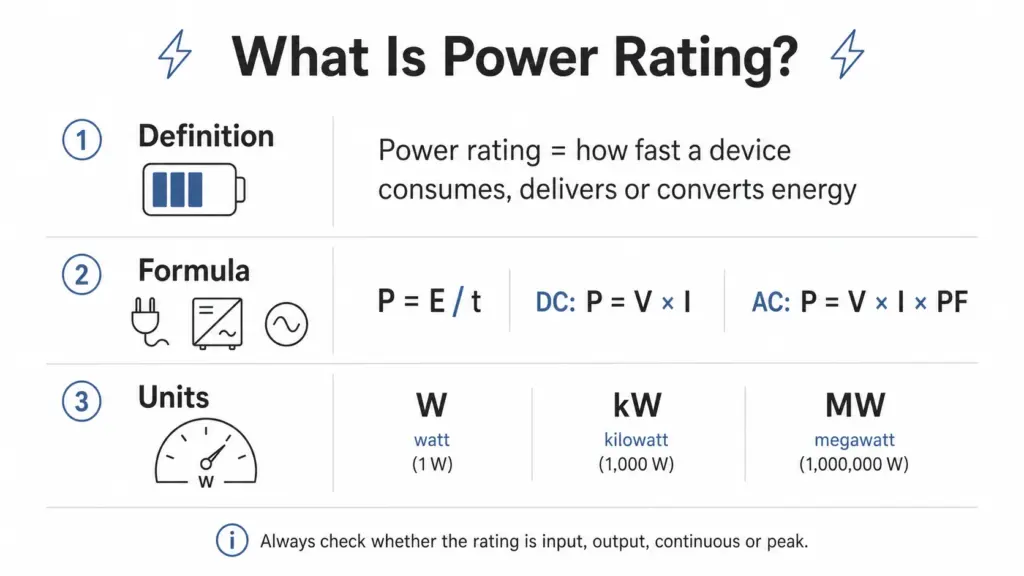
Power rating is the amount of electrical power a device is designed to consume, deliver or safely handle under specified conditions. It is usually expressed in watts (W) or kilowatts (kW).
For DC circuits and simple resistive loads, power can be calculated with:
Power (W) = Voltage (V) × Current (A)
For example, a 12V device drawing 5A has a calculated power of:
12V × 5A = 60W
For AC equipment, power factor and phase configuration may also need to be included.
Rated Power vs Peak Power: Quick Comparison
| Power Rating | What It Means | How Long? | Example |
|---|---|---|---|
| Rated / Continuous Power | Power a device can normally sustain under specified conditions | Continuous operation | 5kW inverter output |
| Peak / Surge Power | Higher power available temporarily for startup or sudden loads | Seconds or less, depending on the product | 10kW surge for 5 seconds |
The key difference: rated power tells you what a device can sustain during normal operation, while peak or surge power tells you how much it can handle temporarily.
Quick Power Rating Formulas
| Application | Formula |
|---|---|
| DC / Resistive Load | P = V × I |
| Single-Phase AC | P = V × I × PF |
| Three-Phase AC | P = √3 × V × I × PF |
| From Energy and Time | P = E ÷ t |
Where P = power, V = voltage, I = current, and PF = power factor.
What Is Power Rating?
Power rating is the specified rate at which electrical energy is consumed, delivered, converted or dissipated by equipment under defined conditions. It is normally shown in watts or kilowatts, but it should not automatically be interpreted as the device’s constant real-world consumption or an unlimited maximum output.
Power is the rate at which energy is transferred.
1 watt = 1 joule per second
| Equipment Type | What the Power Rating Usually Describes |
|---|---|
| Appliance | Nominal or maximum electrical input |
| Inverter | Continuous or short-duration AC output |
| Power supply | Maximum output available to connected loads |
| Battery system | Maximum charge or discharge power |
| Motor | Electrical input or mechanical shaft output |
| Resistor or component | Maximum heat it can dissipate safely |
| Solar panel | Output under specified test conditions |
How Is Power Rating Calculated?
Electrical power is calculated from the rate of energy transfer or from voltage, current and the characteristics of the circuit. The familiar formula P = V × I works directly for DC and simple resistive loads, while AC systems may also require power factor and phase configuration.
Basic Power Formula
The fundamental relationship is:
Power = Energy ÷ Time
Where:
- Power is measured in watts
- Energy is measured in joules
- Time is measured in seconds
DC Power Formula
For a DC circuit:
P = V × I
Where:
P= power in wattsV= voltage in voltsI= current in amperes
Example:
A 12V device drawing 5A requires:
12V × 5A = 60W
Its calculated input power is 60 watts.
Single-Phase AC Power Formula
For a single-phase AC load:
P = V × I × PF
Where PF is the power factor.
A 230V load drawing 10A at a power factor of 0.90 uses:
230V × 10A × 0.90 = 2,070W
The real power is approximately 2.07kW.
Balanced Three-Phase Power Formula
For a balanced three-phase system using line-to-line voltage:
P = √3 × V × I × PF
A 400V three-phase load drawing 20A at a power factor of 0.90 uses approximately:
1.732 × 400V × 20A × 0.90 = 12,470W
The real power is approximately 12.47kW.
Resistive Load Formulas
Where resistance is known, power may also be calculated as:
P = I² × R
or:
P = V² ÷ R
These formulas are most directly applicable to DC circuits and simple resistive loads. Motors, compressors, switch-mode power supplies and variable-speed equipment require additional consideration of power factor, efficiency, harmonics and operating state.
Not Sure What Power Rating Your System Needs?
Send us your load list, inverter model and required backup time. Avepower will help verify the appropriate battery capacity, continuous power and communication setup for your project.
What Is the Difference Between Rated Power and Peak Power?
Continuous power is the output equipment can maintain under stated conditions, while peak or surge power is available only for a limited period. Continuous power determines the normal load capacity; surge power determines whether motors, compressors, pumps and other high-starting-current equipment can start successfully.
| Rating | Typical Meaning | What Must Be Verified |
|---|---|---|
| Continuous power | Sustainable operating output | Temperature and voltage conditions |
| Rated power | Usually the normal design value | Whether it is continuous input or output |
| Maximum power | Highest permitted value | Duration and cooling requirements |
| Peak power | Short-duration maximum | Exact time limit |
| Surge power | Temporary startup support | Load type, duration and repetition |
| Overload power | Output above continuous rating | Percentage, duration and recovery time |
Consider two inverters:
- Inverter A: 5kW continuous, 10kW for five seconds
- Inverter B: 5kW rated, 10kW peak
These products cannot be assumed to have equal surge capability. Inverter B has not stated how long its peak lasts, the permitted voltage drop, how frequently the surge can repeat or the conditions under which it is available.
Motor loads require particular attention because the highest demand can occur during startup rather than normal operation.
Avepower’s inverter size chart recommends checking total simultaneous running watts, the largest additional startup surge and appropriate design headroom instead of selecting an inverter from running watts alone.
Match the Right Battery to Your Inverter and Loads
Avoid undersizing, overload shutdowns and compatibility issues. Share your project specifications with Avepower for battery, inverter and power-rating verification.
Where Can You Find the Power Rating of a Device?
The most reliable power rating is normally found on the equipment nameplate, technical datasheet or manufacturer’s installation manual. Read the full label rather than taking the largest wattage number, because a device may list input power, output power, standby power, maximum power and several voltage-specific ratings.
Check the following sources in order:
- Product nameplate
- Technical datasheet
- Installation or operating manual
- Manufacturer’s official product page
- Certification or approved-equipment database
- Measured data from a suitable power meter
A typical appliance label may include:
- Rated voltage
- Rated frequency
- Rated current
- Input power
- Output power
- Efficiency class
- Duty cycle
- Protection class
A battery inverter may additionally list:
- Maximum continuous output power
- Apparent power in VA or kVA
- Surge power and duration
- PV input power
- Battery voltage range
- Maximum battery current
- Grid voltage and frequency
- Operating temperature
- Derating conditions
The California Energy Commission Solar Equipment Lists, for example, provide fields such as model number, maximum continuous inverter output, nominal voltage and weighted efficiency. The Commission also warns users to verify the exact functionality and limitations in the manufacturer’s documentation.
Do not rely only on a marketplace title or promotional image. A large “10,000W” claim may represent momentary peak power rather than continuous output.
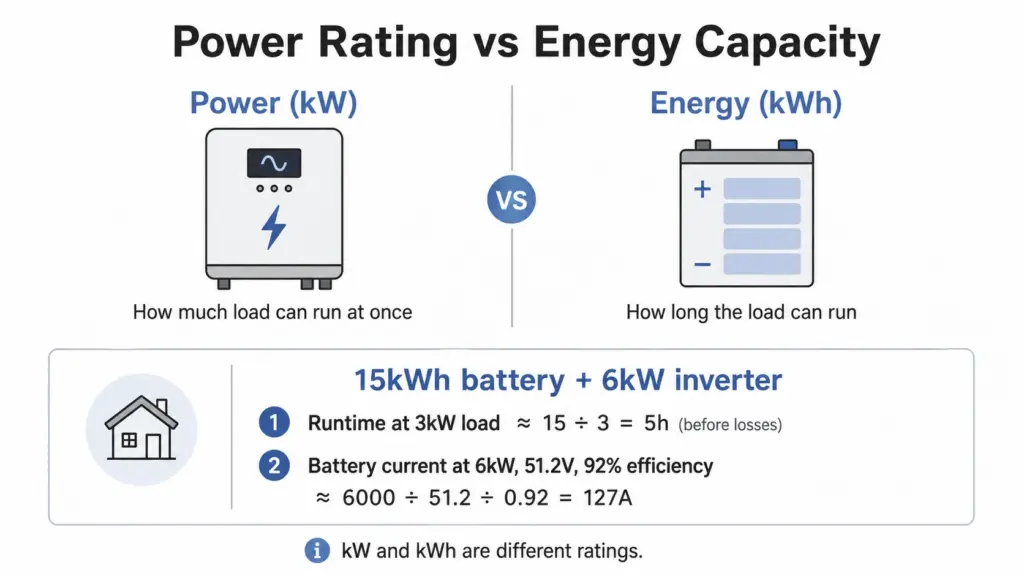
Power Rating vs Energy Capacity: kW vs kWh
Power rating measures how quickly energy can be used or delivered, while energy capacity measures the total amount available over time. Power is expressed in W or kW; electrical energy is commonly expressed in Wh or kWh. Both numbers are required when sizing a battery system.
The relationship is:
Energy = Power × Time
| Measurement | Power | Energy |
|---|---|---|
| Common units | W, kW, MW | Wh, kWh, MWh |
| Describes | Rate of energy transfer | Total energy transferred or stored |
| Main question | How much can run at once? | How long can it run? |
| Battery example | 5kW discharge power | 10kWh stored energy |
| Appliance example | 2kW heater | 6kWh used in three hours |
A 2kW heater operating continuously for three hours uses:
2kW × 3 hours = 6kWh
Similarly, a battery with 10kWh of usable energy and a 5kW output limit could theoretically support a 5kW load for approximately two hours.
In practice, runtime may be shorter because of:
- Inverter conversion losses
- Battery reserve settings
- Depth-of-discharge limits
- Temperature
- Battery ageing
- Standby consumption
- Voltage-dependent current limits
See Avepower’s detailed explanation of kW vs kWh for additional battery and solar examples.
Why Can Two Devices With the Same Wattage Behave Differently?
Two devices with the same watt rating may place very different demands on a power system because of power factor, efficiency, startup current, waveform, duty cycle and control method. Wattage alone therefore cannot confirm inverter compatibility, conductor size or whether a source can start the load.
Real Power Versus Apparent Power
Watts and kilowatts describe real power that performs useful work. VA and kVA describe apparent power, which is based on RMS voltage and current.
Power factor is:
PF = kW ÷ kVA
According to Fluke’s power factor guide, lower power factor requires more current to deliver the same amount of real power and can require larger conductors and equipment. Power factor should not be confused with the conversion efficiency of an inverter or appliance.
For example, a 5kW single-phase load at a power factor of 0.80 requires:
5kW ÷ 0.80 = 6.25kVA
At 230V, the current is approximately:
6,250VA ÷ 230V = 27.2A
At a power factor of 1.0, a 5kW load would draw approximately:
5,000W ÷ 230V = 21.7A
Both loads use 5kW of real power, but the lower-power-factor load requires considerably more current.
Input Power Versus Output Power
A microwave may show electrical input power and microwave output power. A motor may list electrical input and mechanical shaft output. An inverter has both DC input and AC output.
Because no conversion process is perfectly efficient:
Input power > useful output power
Always compare like with like. Do not compare an appliance’s input wattage directly with a motor’s mechanical output or an inverter’s peak VA rating.
Operating Temperature and Derating
Some equipment can deliver its full rating only within a specified temperature or voltage range. As internal temperature rises, an inverter or power supply may reduce output to prevent damage.
This means a system that supports 5kW in a laboratory or at 25°C may deliver less in:
- A hot equipment room
- Direct sunlight
- Restricted ventilation
- High altitude
- Low battery voltage
- Repeated overload operation
The relevant datasheet derating curve takes priority over the headline wattage.
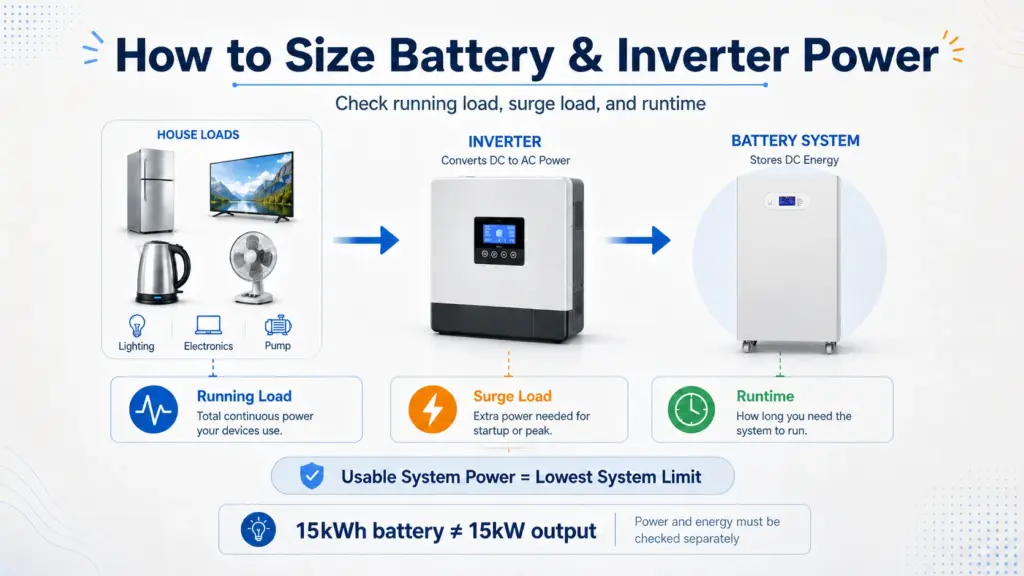
How Do You Use Power Ratings to Size an Inverter and Battery?
Size an inverter by combining simultaneous running loads, startup demand and design margin, then confirm that the battery, BMS, cables, protection devices and thermal limits can supply the required DC current. Size battery energy separately according to the required operating time and usable depth of discharge.
Step 1: Identify Simultaneous Loads
Do not add every appliance in the building unless all of them may run together.
Create separate load groups for:
- Essential backup loads
- Normal household loads
- High-power discretionary loads
- Motor and compressor loads
- Three-phase equipment
- Loads that cannot operate simultaneously
Step 2: Record Running and Startup Power
Use the nameplate or manufacturer’s data. Where the load varies, obtain measured operating data.
The following is an illustrative project dataset rather than a universal appliance table:
| Example Load | Running Power | Startup Power |
|---|---|---|
| Refrigerator | 180W | 900W |
| Lighting circuits | 240W | 240W |
| Router and security system | 80W | 80W |
| Water pump | 750W | 2,250W |
| Office equipment | 600W | 800W |
| Running total | 1,850W | — |
The largest additional startup demand is the pump surge above its existing running load:
2,250W − 750W = 1,500W
Estimated short-duration requirement:
1,850W + 1,500W = 3,350W
Using 25% planning headroom:
3,350W × 1.25 = 4,187.5W
A 5kW inverter with documented surge capability may therefore be a more appropriate preliminary selection than a 3kW model.
This is only a screening calculation. Final selection must use the actual nameplates, measured startup behavior, inverter overload curve and local electrical design requirements.
Step 3: Check Battery Discharge Power
For a battery system:
Approximate DC power = Battery voltage × Allowed discharge current
Approximate AC output is:
AC power ≈ Battery voltage × Current × Inverter efficiency
A 51.2V battery limited to 100A can provide approximately:
51.2V × 100A = 5.12kW DC
At an assumed 92% inverter efficiency:
5.12kW × 0.92 = 4.71kW AC
A 6kW inverter connected to this battery would not necessarily deliver 6kW continuously. The battery or BMS could become the limiting component.
In practical storage design, available power is determined by the lowest applicable limit among:
- Inverter continuous output
- Battery discharge current
- BMS current limit
- Battery voltage
- Cable and connector rating
- Fuse or breaker rating
- PCS limit
- Temperature-dependent derating
- Control or communication limits
Avepower’s battery storage design guide explains the wider design process, while its guide to the power conversion system in energy storage covers the conversion and control path between the battery and AC system.
Step 4: Calculate Required Energy
After confirming power, calculate runtime:
Required battery energy = Load power × Required hours ÷ System efficiency
Then adjust for:
- Usable depth of discharge
- Battery reserve
- Temperature
- Ageing allowance
- Future load growth
- Backup priorities
A system may pass the power test but fail the runtime test, or have enough stored energy but insufficient instantaneous discharge power.

What Does an Avepower 15kWh Battery Example Show?
The Avepower example shows why kWh, inverter output, peak VA and battery current must be checked together. Its nominal energy indicates potential runtime, while the inverter and battery-current specifications determine how much load can operate simultaneously and whether full output remains available as battery voltage changes.
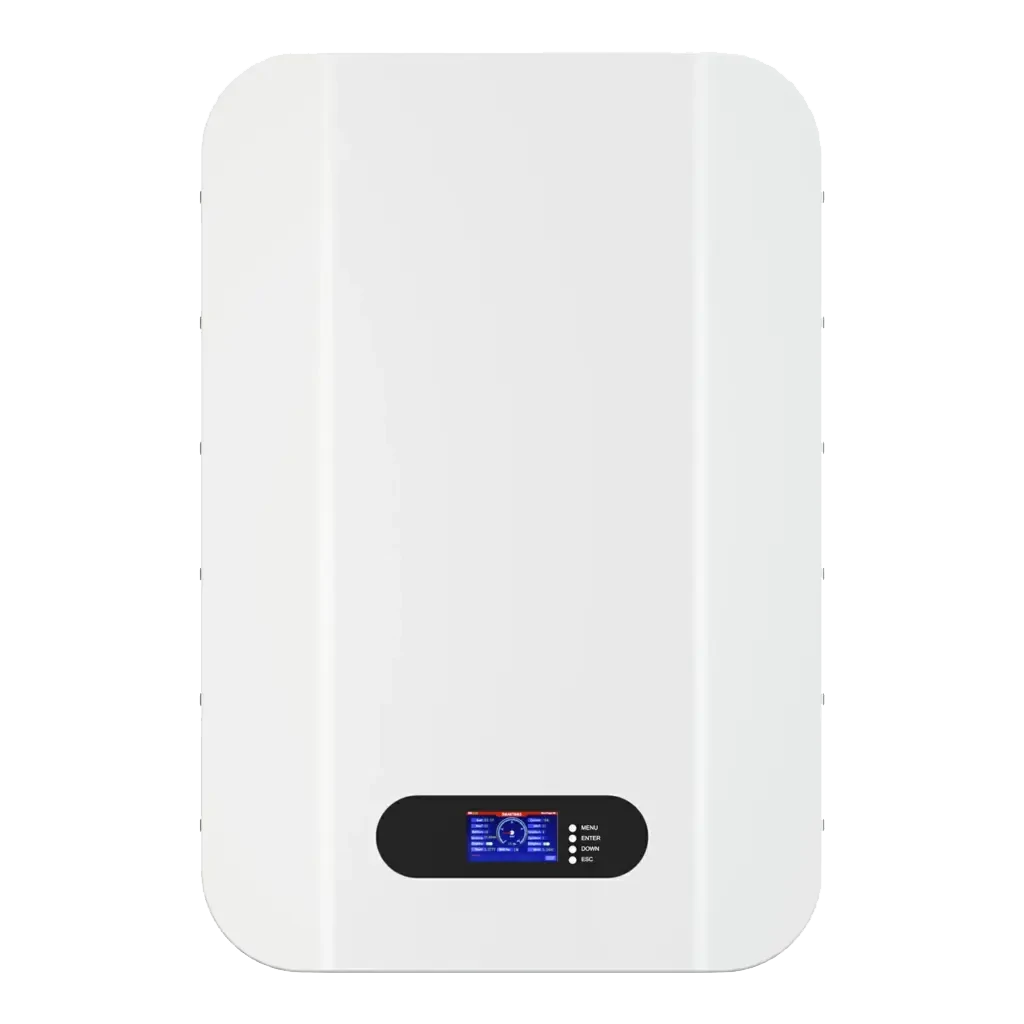
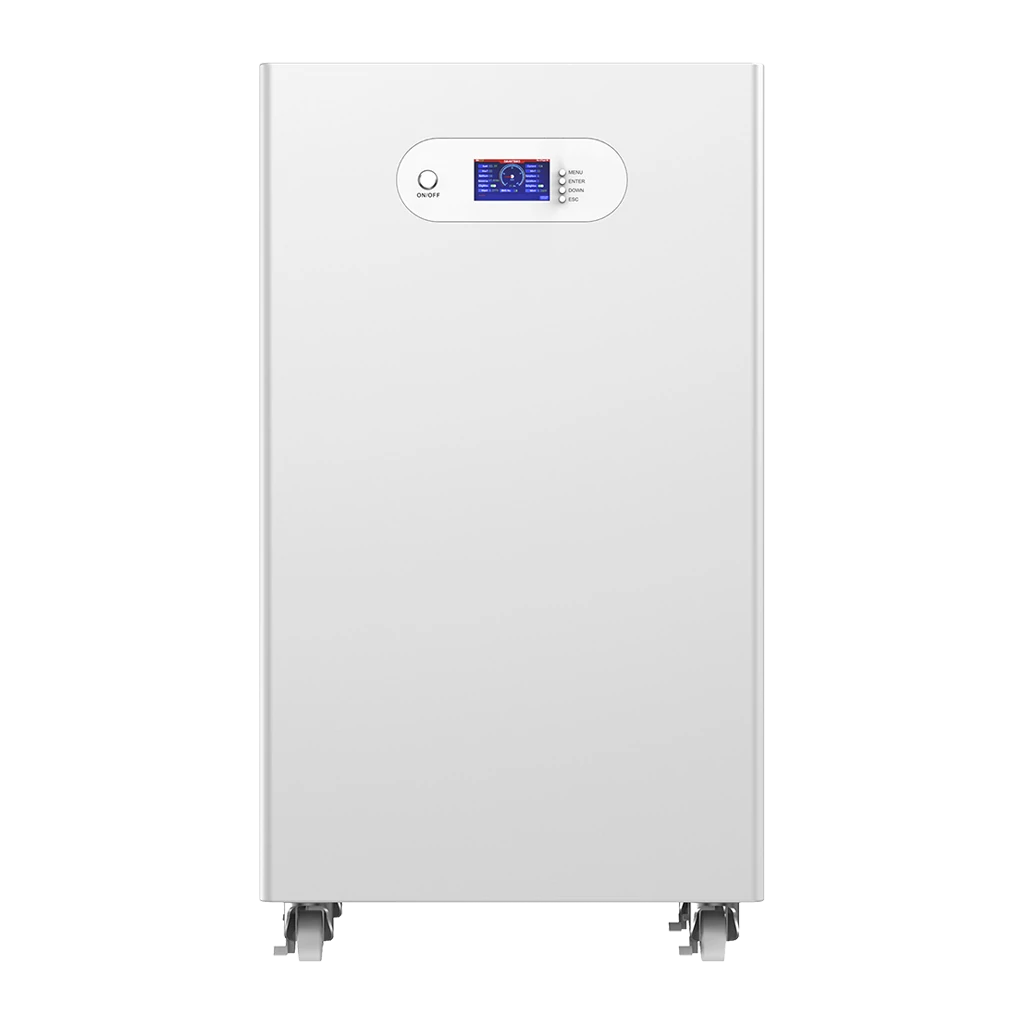
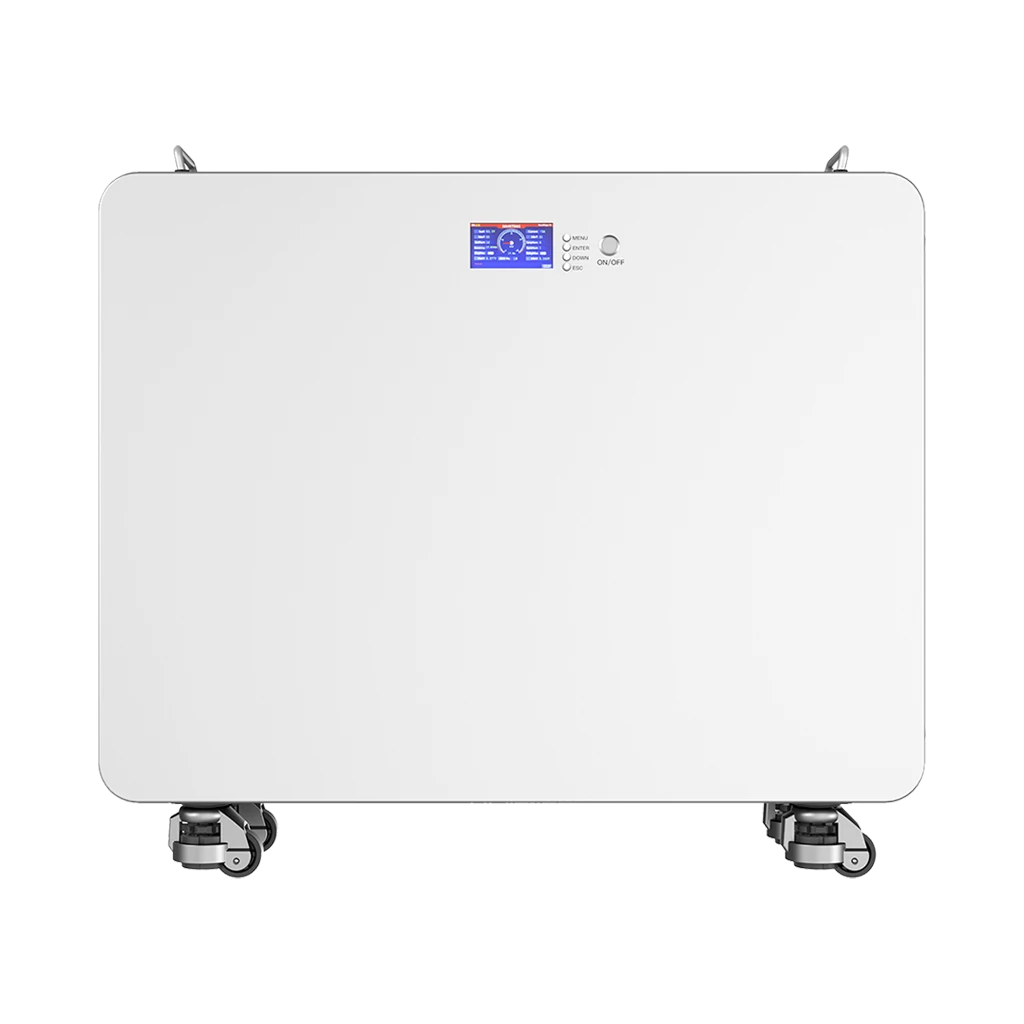
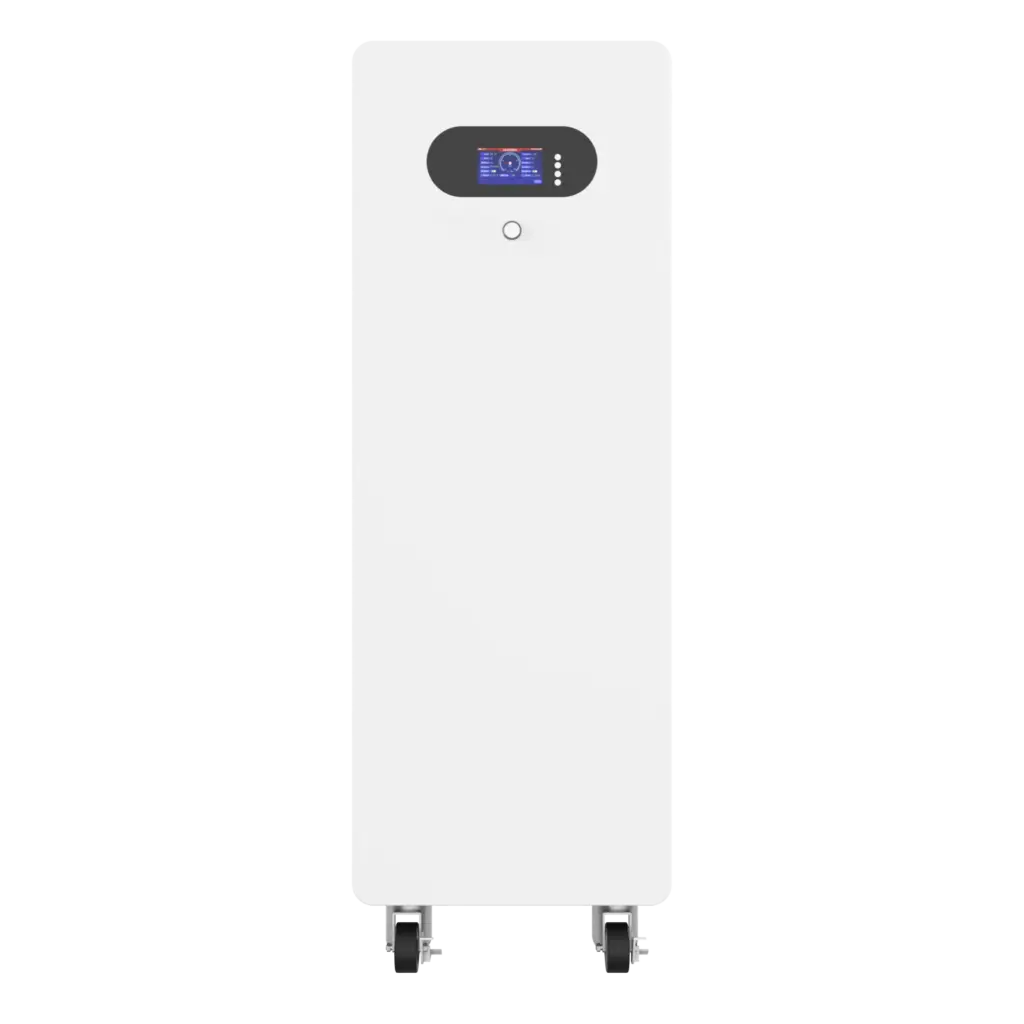
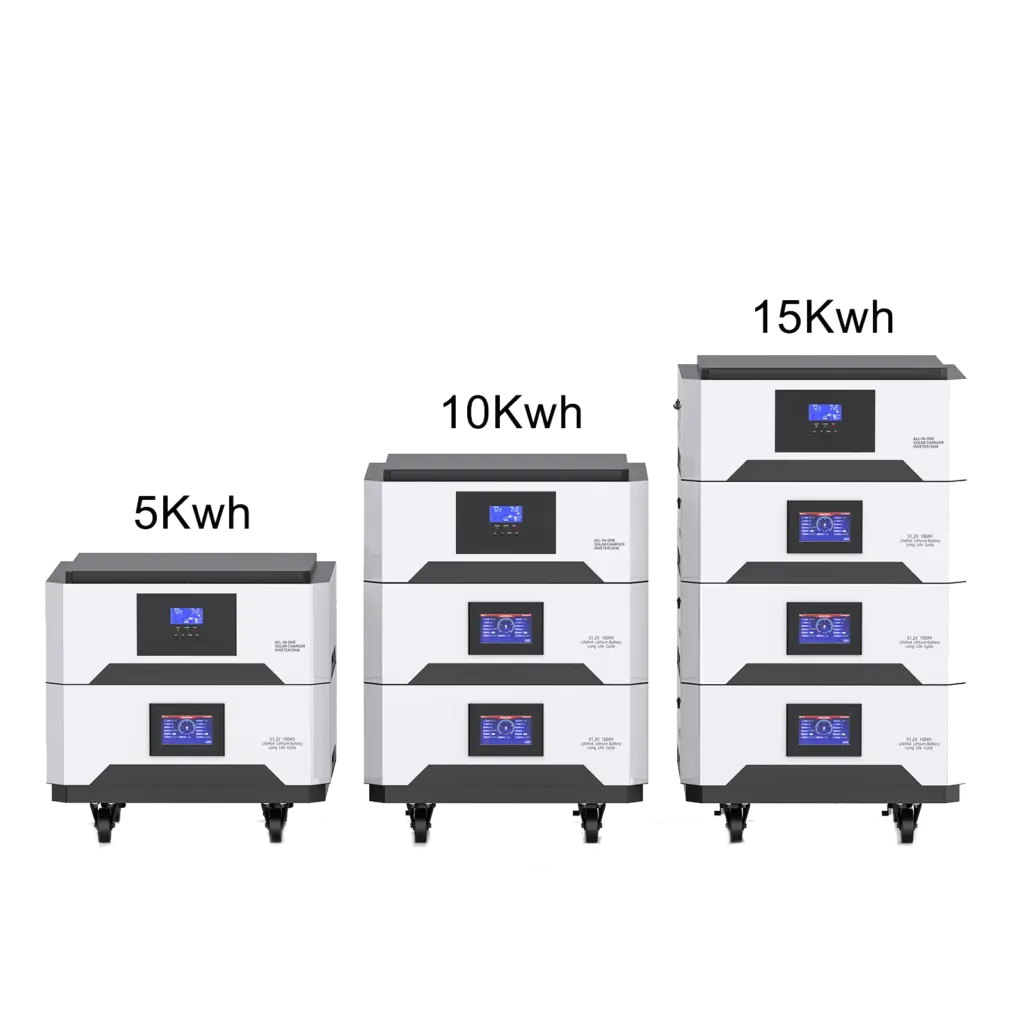
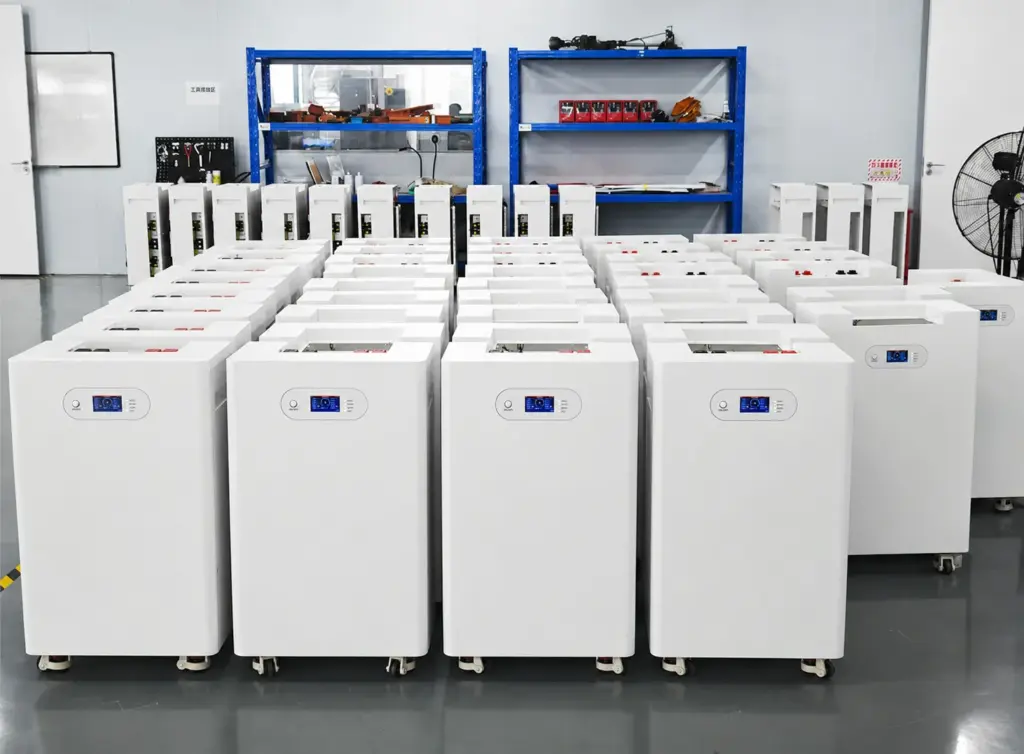
The Avepower 15kWh all-in-one solar battery with a 6kW inverter lists the following relevant specifications:
| Specification | Published Value |
|---|---|
| Nominal battery voltage | 51.2V |
| Nominal battery energy | 15kWh |
| Rated AC output | 6,200W |
| Peak apparent power | 12,400VA |
| Battery discharge current | 140A |
| Battery chemistry | LiFePO4 |
| Communication | CAN, RS485 and RS232 |
The product integrates the battery, pure sine wave inverter and MPPT charger in one cabinet.
Current Calculation
Using the published 6,200W output and an illustrative inverter-efficiency assumption of 92%:
Required current = 6,200W ÷ (51.2V × 0.92)
Required current ≈ 131.7A
This is below the listed 140A discharge-current value at nominal voltage.
However, battery voltage does not remain fixed. At a hypothetical operating voltage of 48V:
6,200W ÷ (48V × 0.92) ≈ 140.4A
The calculated current is now slightly above 140A.
This does not establish how the product will behave at that exact point. It demonstrates why installers must verify:
- The complete battery operating-voltage range
- Whether 140A is continuous or condition-dependent
- Inverter efficiency at the relevant load
- Low-voltage derating behavior
- BMS current control
- Cable and protection limits
- Manufacturer-approved operating settings
A headline power rating should never replace the complete performance curve.
Illustrative Runtime Calculation
Assume, only for preliminary planning:
- 15kWh nominal energy
- 80% usable energy window
- 92% conversion efficiency
Estimated usable AC energy:
15kWh × 0.80 × 0.92 = 11.04kWh
| Average AC Load | Illustrative Runtime |
|---|---|
| 1kW | 11.0 hours |
| 2kW | 5.5 hours |
| 4kW | 2.8 hours |
| 6kW | 1.8 hours |
These figures are not guaranteed product runtimes. Actual results depend on operating voltage, reserve settings, temperature, battery condition, efficiency curve, standby demand and load behavior.
The decision value is clear:
- 15kWh answers approximately how long loads may operate.
- 6.2kW answers how much AC load may operate simultaneously.
- 12.4kVA indicates short-duration capability, subject to its specified conditions.
- 140A helps determine whether the battery side can sustain the requested output.
Installers should also confirm the inverter model and communication protocol through Avepower’s inverter compatibility support before final system configuration.
Do not select a storage system from kWh or inverter wattage alone. Send Avepower your simultaneous load list, startup requirements, required runtime and inverter model to evaluate battery energy, discharge current, communication and expansion requirements before ordering.
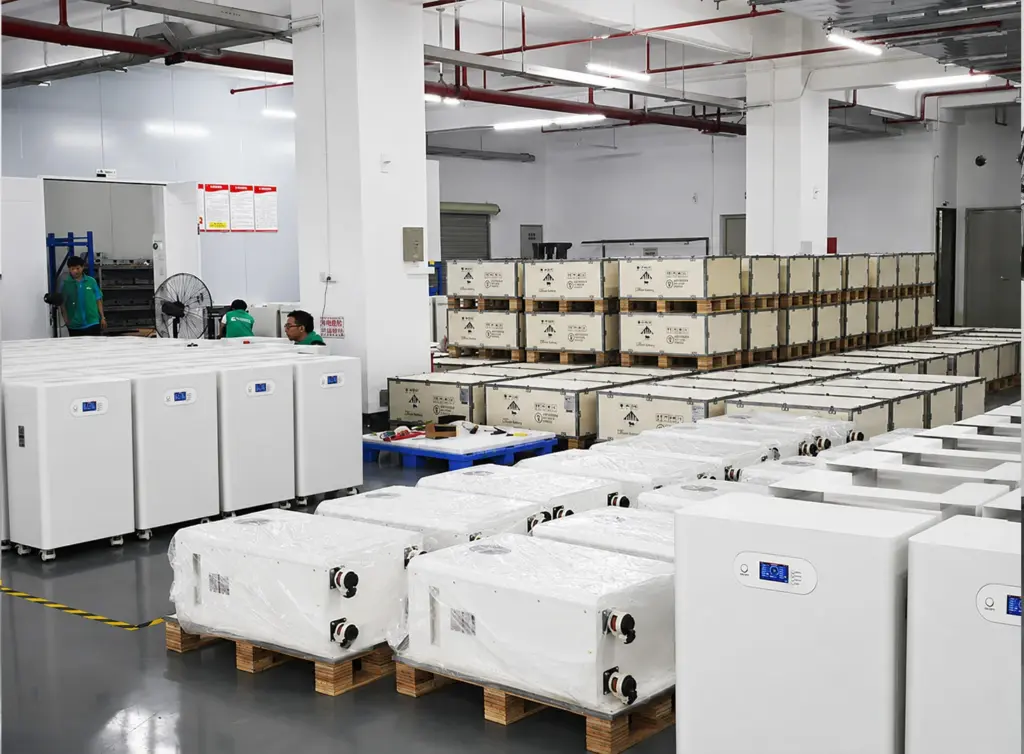
Build a Battery System Around Your Market Requirements
Avepower supports custom capacity, power output, enclosure design, communication protocols and branding for distributors, installers and energy storage companies.
What Happens If You Exceed a Power Rating?
Exceeding a power rating can cause voltage drop, overheating, output distortion, protective shutdown, accelerated ageing or permanent component damage. The exact result depends on the equipment and protection design; a properly protected inverter may trip safely, while an underrated cable or unprotected component may continue heating.
Possible outcomes include:
For an Appliance
An appliance supplied with incorrect voltage or inadequate source power may:
- Fail to start
- Operate intermittently
- Draw excessive current
- Overheat
- Shut down
- Deliver reduced performance
For an Inverter or Power Supply
An overloaded source may:
- Enter current limiting
- Reduce its output voltage
- Activate overload protection
- Shut down and restart
- Generate an alarm
- Reduce power because of temperature
For a Battery System
Excessive requested power may cause:
- BMS overcurrent protection
- Rapid voltage sag
- Inverter low-voltage shutdown
- Connector or cable heating
- Fuse or breaker operation
- Accelerated cell stress
- Reduced available capacity at high current
For an Electronic Component
A resistor, transistor or converter operating above its thermal power rating may exceed its safe junction temperature even when the system voltage appears acceptable.
Protection should be treated as a final safeguard, not as permission to operate continuously above the rating.
Match Battery Power With Your Real Project Loads
Avepower supplies LiFePO4 battery systems for residential, commercial, installer, distributor and OEM/ODM projects. Installers, distributors and project developers can submit their load profile, inverter model, voltage platform, target runtime and expected order quantity through Avepower’s custom battery system service to verify power, capacity, communication and configuration requirements before procurement.
Conclusion
A useful power rating must identify more than a wattage number. Confirm whether it describes input, output, continuous capacity or peak capability, and then check voltage, current, VA, power factor, duration and environmental limits. For battery systems, evaluate power capability and stored energy as two separate requirements.
FAQ
Power rating is the rate at which a device is designed to use, deliver or safely handle energy. It is normally expressed in watts or kilowatts and must be interpreted under the conditions stated by the manufacturer.
No. A higher rating provides more potential output or load capacity, but it may increase cost, physical size and standby losses. The correct choice is a rating that supports the verified continuous load, startup demand, operating conditions and reasonable expansion.
It uses 1kWh in one hour only when it continuously draws 1,000W for the entire hour. Thermostatically controlled or variable-speed equipment may have a lower average consumption.
No. Rated power is a declared operating value, while actual power changes with load, control mode, temperature and operating cycle. Measurement is more reliable when exact consumption is required.
Only when the manufacturer specifies an approved temporary overload or surge capability. Exceeding a continuous rating without such approval may cause overheating, shutdown, accelerated wear or permanent damage.
A battery power rating describes how quickly it can charge or discharge, normally in kW. It depends on voltage, current, chemistry, BMS settings, temperature, state of charge and the permitted duration.
Voltage rating identifies the electrical potential the equipment is designed to use or withstand. Power rating describes the rate of energy transfer. Two devices can have the same wattage but incompatible voltage requirements.
For DC or a nearly resistive load, multiply volts by amps. For an AC load, also consider power factor. The result may represent apparent power rather than real power when power factor is unknown.