
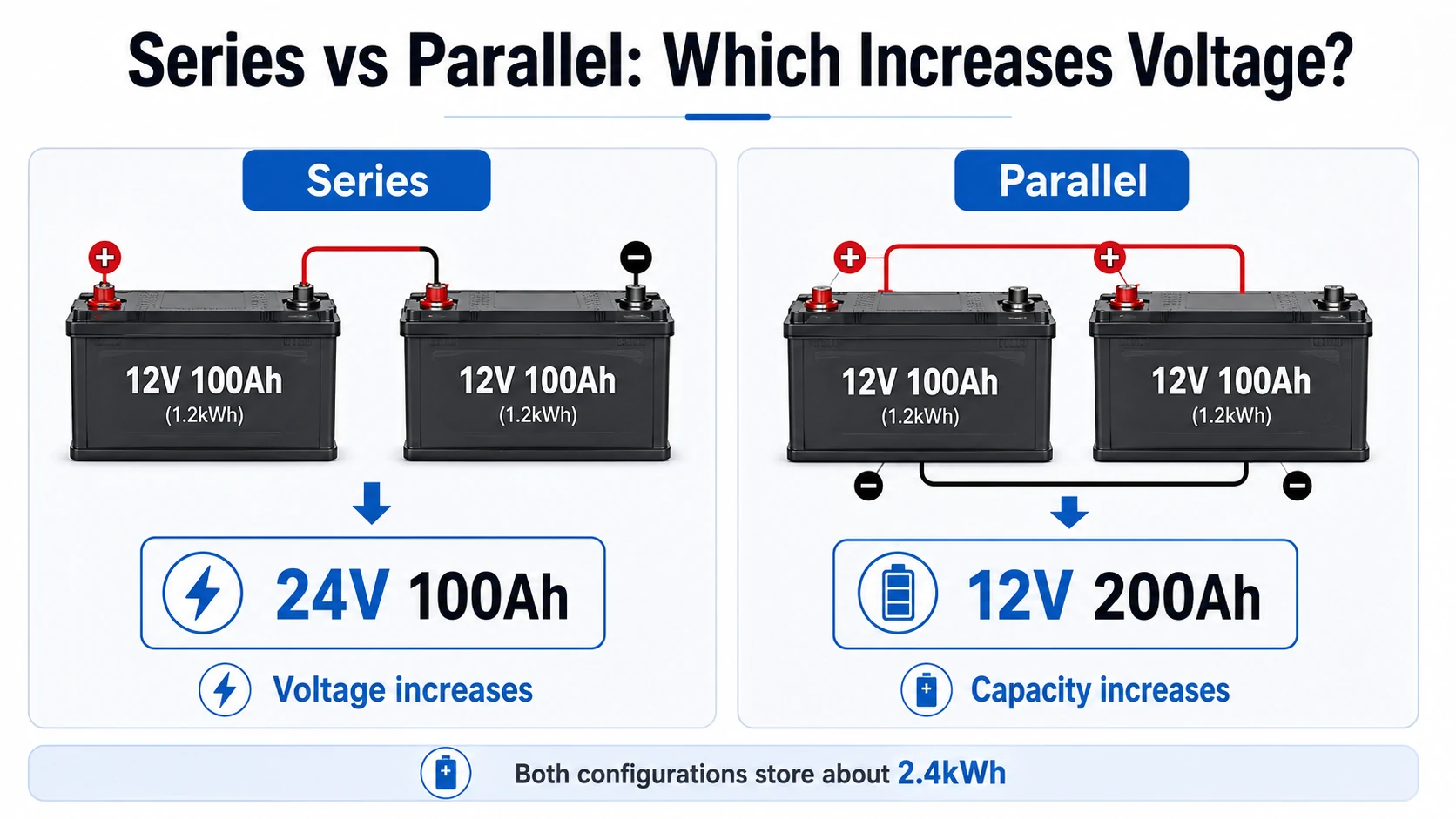
Series increases voltage; parallel does not. With identical batteries, a series connection adds the individual battery voltages while amp-hour capacity remains equal to one battery. A parallel connection keeps the original voltage but adds amp-hour capacity and available current. The correct configuration depends on inverter voltage, runtime, cable current, BMS limits and installation requirements.
For example, two 12V 100Ah batteries connected in series create a 24V 100Ah bank. The same batteries connected in parallel create a 12V 200Ah bank. Both arrangements store approximately 2.4kWh of nominal energy:
- Series: 24V × 100Ah = 2,400Wh
- Parallel: 12V × 200Ah = 2,400Wh
This guide focuses on batteries and DC energy storage systems. Other electrical components, such as resistors and capacitors, follow different series and parallel calculation rules.
Does Series or Parallel Increase Voltage?
A series battery connection increases voltage because each battery’s voltage is added along one current path, while a parallel connection keeps every battery connected across the same positive and negative points. Therefore, parallel batteries must operate at the same voltage, but their capacities and potential current contribution can be combined.
The basic rules are:
Series voltage: Vtotal = V1 + V2 + V3 + …
Parallel voltage: Vtotal = voltage of one battery
Series connections increase voltage, parallel connections increase capacity, and series-parallel configurations can increase both.
A quick example using three identical 12V 100Ah batteries shows the difference:
- Three in series: 36V 100Ah
- Three in parallel: 12V 300Ah
For the physical wiring sequence, see Avepower’s guides on connecting three batteries in series and connecting three batteries in parallel.
What Changes When Batteries Are Connected in Series or Parallel?
Series changes the battery bank’s voltage but not its amp-hour rating, whereas parallel changes the total amp-hour rating while keeping voltage constant. Both configurations can combine the energy of multiple batteries, but they deliver that energy through different voltage and current relationships.
| Specification | Series Connection | Parallel Connection | Series-Parallel |
|---|---|---|---|
| Total voltage | Voltages add | Same as one battery | Increases by batteries per string |
| Total amp-hours | Same as one battery | Amp-hours add | Increases by number of parallel strings |
| Total watt-hours | Energy of all batteries combined | Energy of all batteries combined | Energy of all batteries combined |
| Current path | Same current passes through every battery | Current divides between battery branches | Shared between parallel series strings |
| Typical purpose | Reach 24V, 48V or higher | Increase runtime and storage capacity | Increase voltage and capacity |
| Main design concern | Voltage imbalance and BMS limits | Unequal current sharing and fault current | Both balancing and current-sharing complexity |
The terms amps and amp-hours should not be treated as the same measurement:
- Amps, or A, measure instantaneous current.
- Amp-hours, or Ah, represent charge capacity.
- Watts, or W, measure power.
- Watt-hours, or Wh, represent stored or consumed energy.
Parallel batteries increase total Ah. They may also increase the bank’s permitted continuous discharge current when each battery and BMS is designed to share the load, but the actual current drawn is still determined by the connected equipment.
Not Sure Whether to Choose Series or Parallel?
Share your inverter voltage, load power and required battery capacity. Avepower can help you evaluate the right battery configuration for your residential or commercial energy storage project.
How Do You Calculate Battery Voltage, Amp-Hours and Energy?
Calculate voltage by adding batteries in each series string, calculate amp-hours by adding equal parallel strings, and calculate nominal energy by multiplying total voltage by total amp-hours. For a balanced bank of identical batteries, the total watt-hours should equal the sum of the individual battery energies regardless of the final topology.
Use these formulas:
Batteries in Series
- Total voltage = battery voltage × number of batteries in series
- Total Ah = Ah rating of one battery
- Total Wh = total voltage × total Ah
Batteries in Parallel
- Total voltage = voltage of one battery
- Total Ah = battery Ah × number of parallel batteries
- Total Wh = total voltage × total Ah
Series-Parallel Batteries
- Total voltage = battery voltage × batteries per series string
- Total Ah = battery Ah × number of parallel strings
- Total Wh = total voltage × total Ah
Avepower’s battery amp-hour calculation guide provides additional examples for converting between watts, watt-hours, voltage and amp-hours.
Calculation: Four 12V 100Ah Batteries
| Configuration | Bank Voltage | Bank Capacity | Nominal Energy |
|---|---|---|---|
| 4 batteries in series | 48V | 100Ah | 4,800Wh |
| 4 batteries in parallel | 12V | 400Ah | 4,800Wh |
| 2S2P arrangement | 24V | 200Ah | 4,800Wh |
The calculation shows that the connection method does not create additional stored energy. It changes the electrical form in which the same nominal energy is delivered.
Actual usable energy will be lower than the simple nominal calculation after accounting for permitted depth of discharge, inverter efficiency, cable losses, temperature, BMS reserve settings and battery condition.
Does Series or Parallel Provide More Power?
Neither connection inherently creates more stored energy when the same number of identical batteries is used. Series provides higher voltage at lower current for a compatible constant-power load, while parallel provides higher Ah capacity and potential current capability at the original voltage.
Consider four 12.8V 100Ah batteries:
| Configuration | Voltage | Capacity | Nominal Energy |
|---|---|---|---|
| One battery | 12.8V | 100Ah | 1.28kWh |
| Four in series | 51.2V | 100Ah | 5.12kWh |
| Four in parallel | 12.8V | 400Ah | 5.12kWh |
The stored nominal energy is the same because:
- Series: 51.2V × 100Ah = 5,120Wh
- Parallel: 12.8V × 400Ah = 5,120Wh
Real usable energy can differ because of inverter efficiency, cable losses, BMS cutoffs, temperature, battery imbalance and the load’s operating-voltage requirements.
Why Does a Higher-Voltage Series Bank Need Less Current?
A higher-voltage battery bank requires less current to deliver the same power, which can reduce cable voltage drop, conductor heating and resistive loss when the comparison uses the same load power and equivalent conductor resistance. This is one reason higher-voltage architectures are used in larger inverters and commercial energy storage systems.
Consider an ideal 5kW DC load:
| Nominal Battery Voltage | Ideal Current at 5kW |
|---|---|
| 12V | 416.7A |
| 24V | 208.3A |
| 48V | 104.2A |
| 51.2V | 97.7A |
| 345.6V | 14.5A |
These values exclude inverter losses, voltage sag and operating-voltage variation, but they demonstrate the relationship.
Cable heating is related to:
- Cable loss = Current² × Resistance
- Ploss = I²R
When voltage is doubled for the same power, current is approximately halved. With the same resistance, the theoretical resistive loss becomes approximately one-quarter.
This does not mean installers can automatically use small cables in every higher-voltage system. Cable size must still be selected according to actual current, allowable voltage drop, conductor temperature rating, installation method, fault current, protection coordination and local electrical requirements.
Planning a Larger Battery Storage Project?
Tell us your required voltage, usable capacity, installation environment and expected quantity. Get a project-specific battery recommendation and wholesale quotation from Avepower.
Is Series or Parallel Better for Solar Battery Storage?
Parallel is usually the practical expansion method when a residential solar inverter already matches the voltage of a complete 48V or 51.2V battery module, while series is used when the inverter or PCS specifically requires a higher DC voltage platform. The inverter operating range—not a general preference—should determine the connection method.
A modern low-voltage residential system often uses complete 51.2V LiFePO4 modules. Connecting approved modules in parallel can increase storage capacity while maintaining the inverter’s required battery voltage.
For example:
- One 51.2V 100Ah battery: approximately 5.12kWh
- Two approved units in parallel: 51.2V 200Ah, approximately 10.24kWh
- Four approved units in parallel: 51.2V 400Ah, approximately 20.48kWh
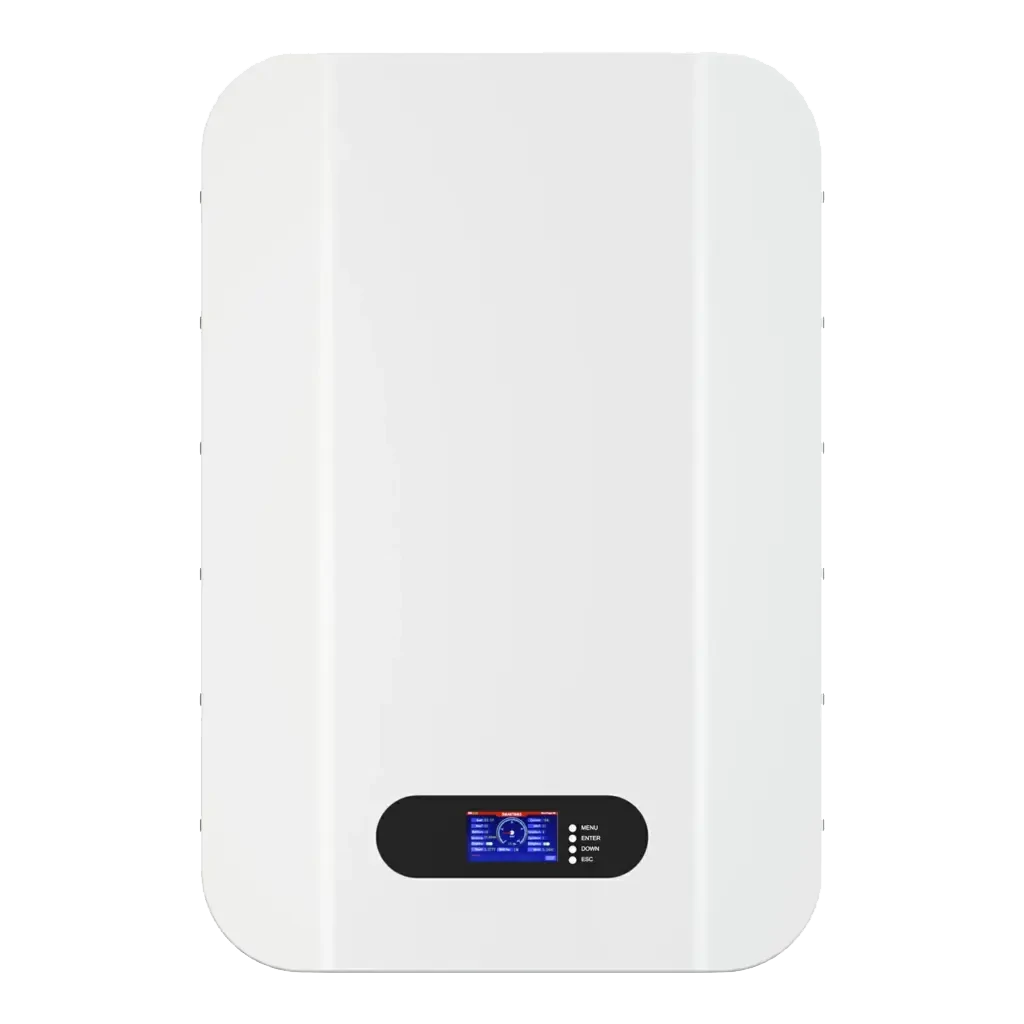
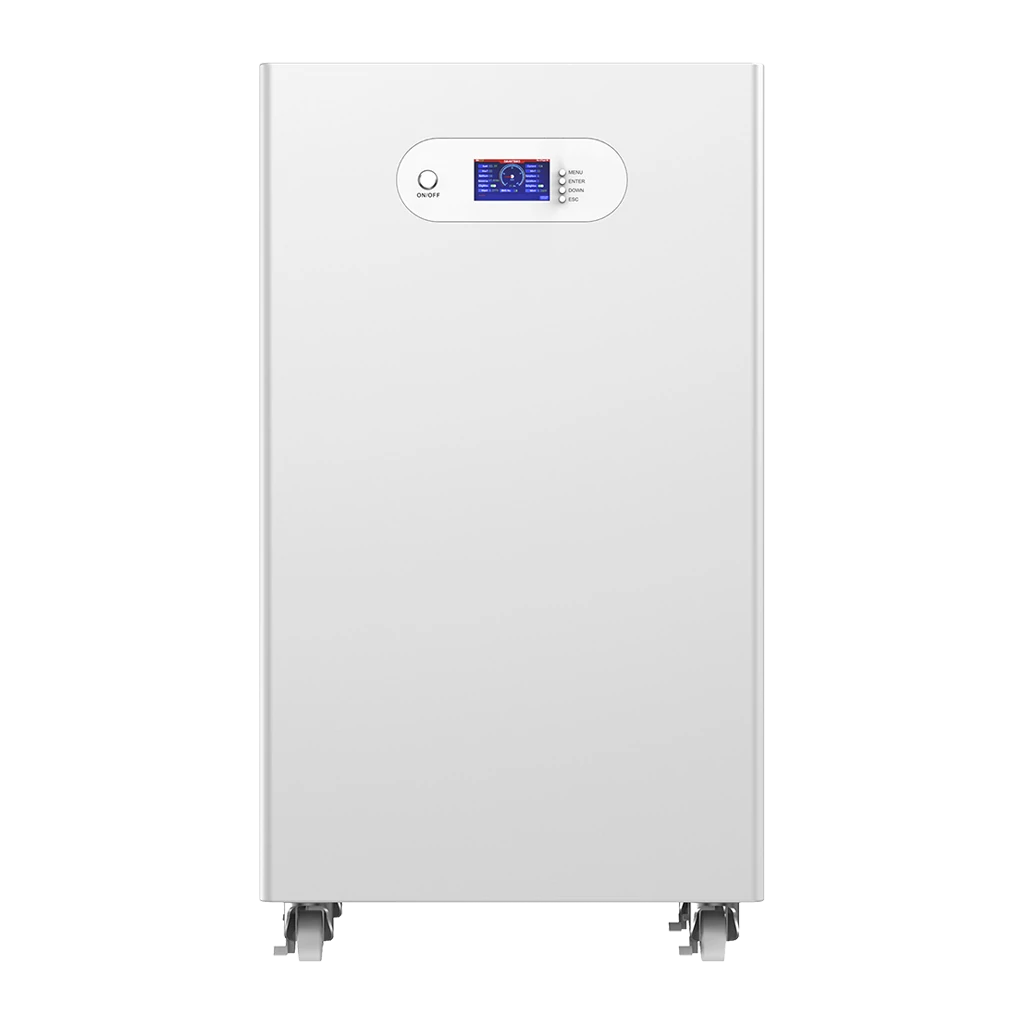
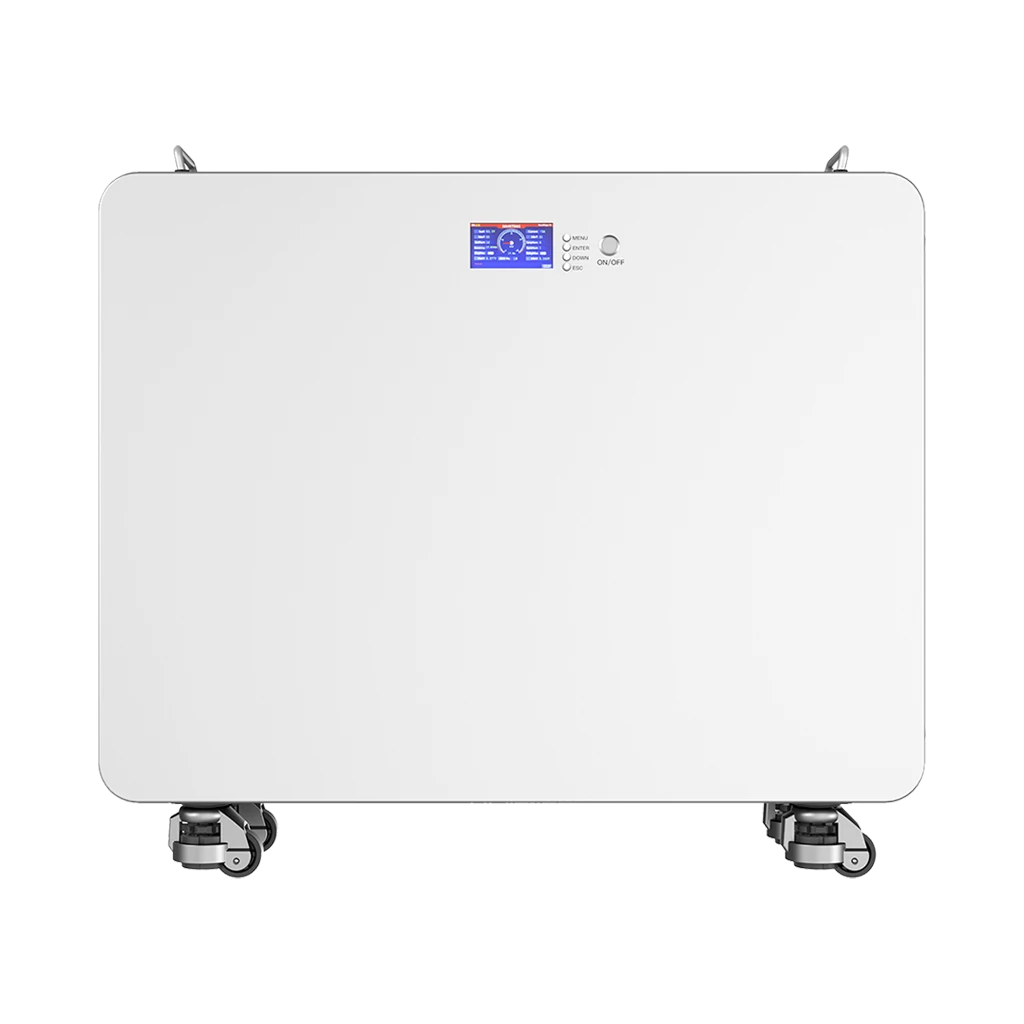
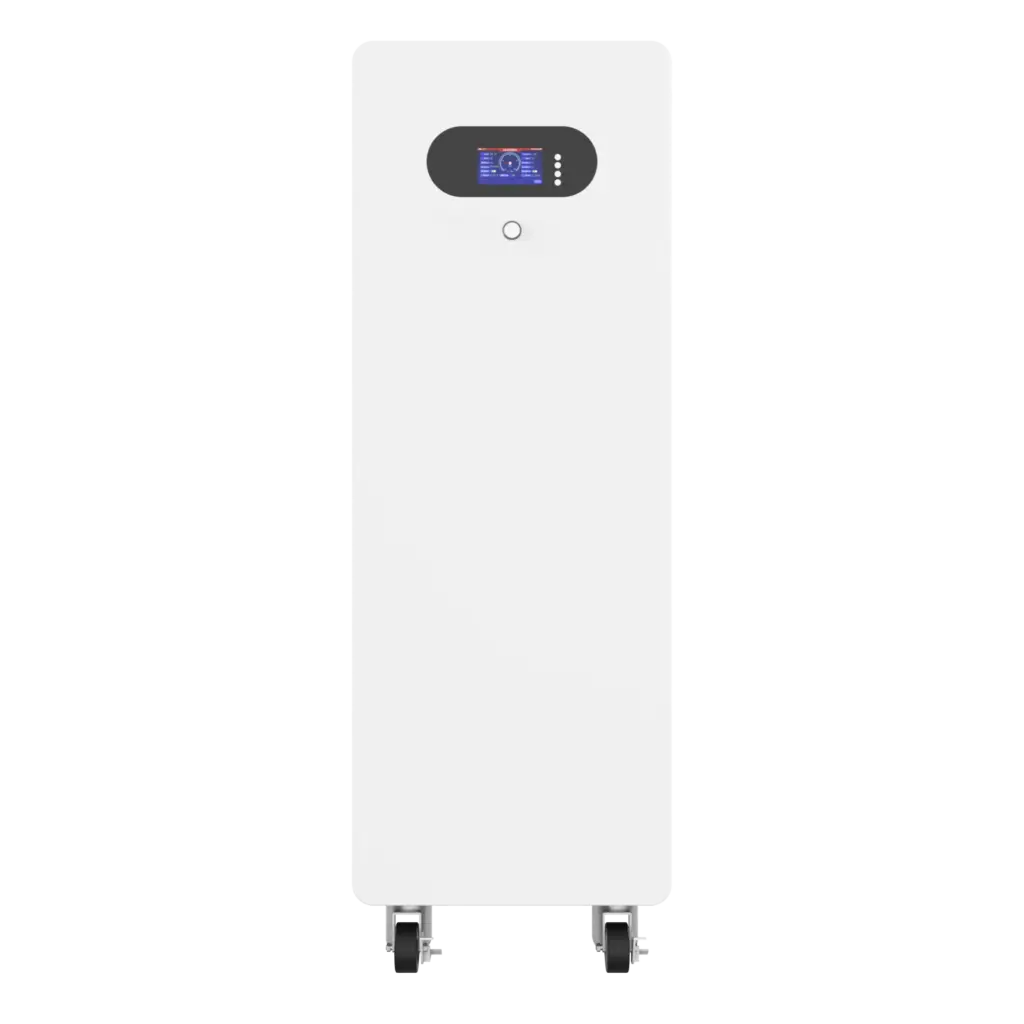
Avepower’s wall-mounted LiFePO4 battery range includes modular low-voltage systems designed for capacity expansion. However, the permitted number of parallel units, communication addresses, master-battery settings and total current limits must be confirmed for the exact model.
A high-voltage solar or C&I system is different. It may use purpose-built modules connected in series under coordinated BMU and BCU control. Installers should not create a high-voltage lithium bank by simply connecting ordinary residential batteries in series unless the manufacturer specifically approves that configuration.
Before selecting a battery topology, confirm the inverter’s:
- Battery voltage range
- Maximum charge and discharge current
- Maximum battery power
- Required communication protocol
- Supported battery models
- Pre-charge and contactor requirements
- Grounding and insulation-monitoring requirements
Avepower publishes an inverter compatibility list covering communication methods and supported protocol options, but compatibility should still be verified using the exact inverter model and firmware.
Which Configuration Should You Choose for a 12V, 24V or 48V System?
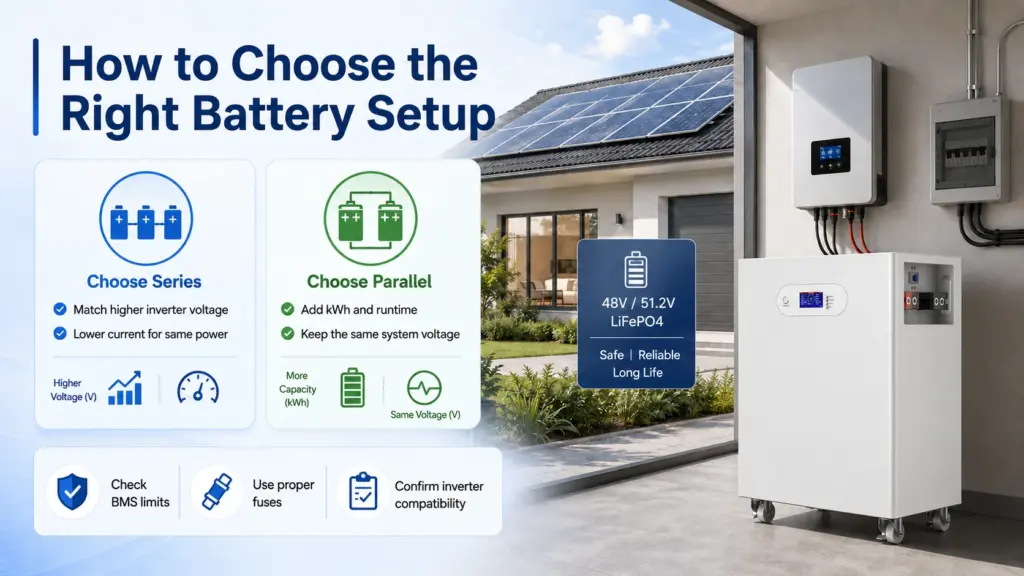
Choose the configuration by matching the battery bank to the inverter or DC load’s approved voltage range first, and then add enough Ah or kWh to meet runtime requirements. Never select series or parallel solely because one arrangement appears to provide more voltage, amps or power.
| Required System | Common Configuration | Appropriate When |
|---|---|---|
| 12V equipment | One 12V battery or matched 12V batteries in parallel | Voltage is already correct and more runtime is needed |
| 24V equipment | Two approved 12V batteries in series or one 24V battery | Inverter or load requires a 24V input |
| 36V equipment | Three approved 12V batteries in series | Motor, cart or industrial equipment requires 36V |
| 48V-class inverter | Four approved 12V batteries in series or a purpose-built 48V/51.2V battery | Higher-power solar and backup applications |
| Larger 48V storage | Multiple compatible 48V or 51.2V modules in parallel | More kWh is required without changing inverter voltage |
| High-voltage ESS | Manufacturer-engineered HV modules and control equipment | Commercial systems requiring a specified high-voltage DC range |
For residential storage, a purpose-built 48V or 51.2V battery can be simpler than field-connecting multiple 12V lithium batteries in series. It reduces the number of inter-module power links and can provide integrated inverter communication, monitoring and system-level BMS control.
Avepower’s guide to high-voltage versus low-voltage batteries provides additional selection criteria for residential and commercial energy storage.
When Should Batteries Be Connected in Series?
Use a series connection when the equipment requires a higher DC operating voltage than one approved battery can provide and the batteries are specifically designed for series operation. Common examples include 24V or 48V equipment built from lower-voltage batteries and engineered high-voltage battery clusters for commercial inverters or PCS equipment.
Typical series applications include:
- Two approved 12V batteries for a 24V load
- Four approved 12V batteries for a 48V inverter
- Individual LiFePO4 cells connected internally to create a 51.2V module
- High-voltage packs connected into a 300V–800V battery cluster
- Equipment that requires lower current over longer DC cable runs
Series wiring is appropriate only when all batteries or modules have compatible:
- Nominal voltage
- Amp-hour capacity
- Chemistry
- BMS design
- Charge and discharge limits
- State of charge
- Age and operating condition
- Communication and balancing strategy
The current passing through a series string is the same through every battery. The entire string is therefore constrained by the battery or BMS with the lowest permitted current or usable capacity.
Series-connected batteries can also drift apart in voltage because no two batteries have exactly identical internal resistance and capacity.
When Should Batteries Be Connected in Parallel?
Use parallel wiring when the required system voltage is already correct but the project needs more storage capacity, longer runtime or a higher approved current capability. Parallel expansion is common in 12V mobile systems, 24V battery banks and 48V or 51.2V residential energy storage systems.
Parallel batteries are connected:
- Positive terminal to a common positive busbar
- Negative terminal to a common negative busbar
The bank voltage remains equal to one battery, while the Ah values add.
Parallel connection is useful for:
- Increasing solar battery capacity
- Extending backup runtime
- Expanding a modular battery system
- Sharing load current across approved battery modules
- Providing serviceable battery branches
- Adding redundancy in a properly designed architecture
However, parallel batteries do not automatically share current equally. A branch with shorter cables, cleaner terminals or lower internal resistance may carry more current than another branch.
When Do You Need a Series-Parallel Battery Bank?
A series-parallel configuration is required when the project needs both a higher voltage and more amp-hour capacity than one series string can provide. The batteries are first grouped into identical series strings, and those equal-voltage strings are then connected in parallel through a balanced distribution system.
For four 12V 100Ah batteries arranged as 2S2P:
- Connect two batteries in series to create a 24V 100Ah string.
- Build a second identical 24V 100Ah string.
- Confirm both strings are at closely matched voltages.
- Connect the strings in parallel.
- The result is a 24V 200Ah, 4.8kWh bank.
Every parallel string must contain the same number and type of batteries. A three-battery string should not be paralleled with a two-battery string because their voltages are different.
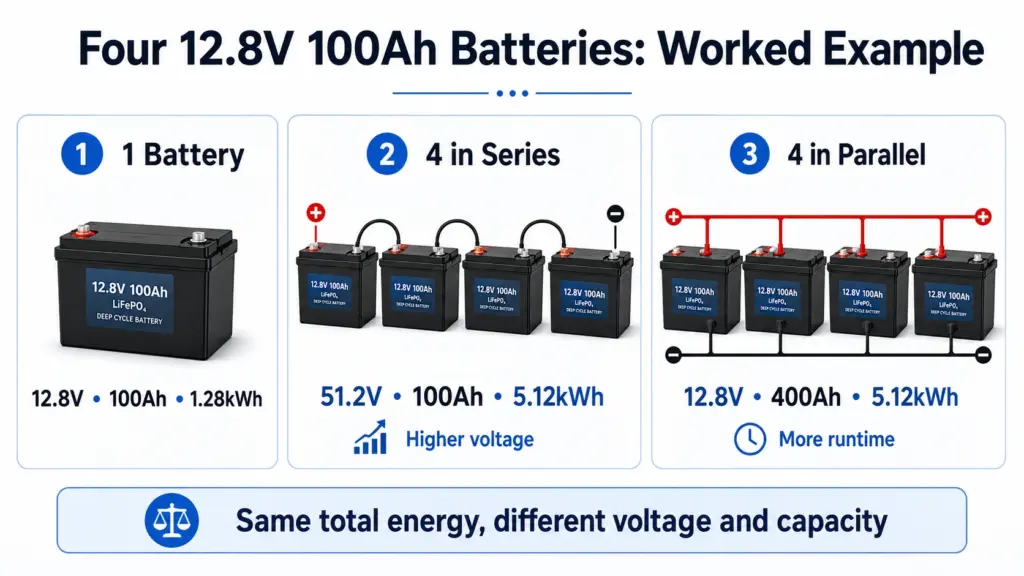
Worked Example: How Do Four 12.8V 100Ah Batteries Change in Each Configuration?
Four matched 12.8V 100Ah batteries can form either a 51.2V 100Ah series string or a 12.8V 400Ah parallel bank. Both arrangements store 5.12kWh nominally, but they require different inverters, chargers, protection devices and cable designs.
Four Batteries in Series
- 4 × 12.8V = 51.2V
- Capacity = 100Ah
- Energy = 51.2V × 100Ah = 5.12kWh
Use this arrangement only when:
- All four batteries permit four-unit series operation;
- The inverter accepts the complete working-voltage range;
- The charger is suitable for the full series bank;
- No 12V load is connected across only one battery;
- Battery-level voltage and balance can be monitored.
Four Batteries in Parallel
- Voltage = 12.8V
- Capacity = 4 × 100Ah = 400Ah
- Energy = 12.8V × 400Ah = 5.12kWh
Use this arrangement only when:
- The batteries are approved for parallel operation;
- Terminal voltages and state of charge are within the required matching range;
- Each branch has suitable overcurrent protection;
- Branch cables provide equal or engineered resistance;
- The common busbars and main disconnect can carry total bank current.
Eight Batteries in a 4S2P Configuration
Two identical four-battery series strings can be connected in parallel:
- Voltage = 4 × 12.8V = 51.2V
- Capacity = 2 × 100Ah = 200Ah
- Energy = 51.2V × 200Ah = 10.24kWh
A balanced 4S2P configuration requires eight batteries. Four batteries cannot simultaneously produce 51.2V and 200Ah when each individual battery is 12.8V 100Ah.
How Do Real Avepower Projects Use Series and Parallel Connections?
Avepower project data demonstrates that parallel low-voltage modules are practical for increasing residential storage capacity, while engineered series strings are used to reach the higher DC voltage required by commercial energy storage systems. The two projects use the same electrical principles at very different voltage and energy scales.
Parallel Case: 64kWh Residential Storage in France
The France 64kWh solar battery project uses four 16kWh Avepower LiFePO4 batteries installed in parallel.
| Project Item | Specification |
|---|---|
| Battery quantity | 4 |
| Capacity per battery | 16kWh |
| Total system energy | 64kWh |
| Nominal system voltage | 51.2V |
| Connection method | Parallel |
| Application | Residential solar storage and backup |
The project increased total energy capacity while keeping the system on a 51.2V low-voltage platform. It also retained a modular structure that supports transportation, maintenance and future system planning.
Series Case: 108.5kWh High-Voltage ESS in the Netherlands
The Netherlands 108.5kWh high-voltage ESS project uses six 57.6V, 314Ah battery packs connected in series.
| Project Item | Specification |
|---|---|
| Battery packs | 6 |
| Voltage per pack | 57.6V |
| Capacity per pack | 314Ah |
| Pack energy | 18.0864kWh |
| Final voltage | 345.6V |
| Final capacity | 314Ah |
| Total energy | 108.5184kWh |
| Architecture | 1P108S |
The voltage calculation is:
57.6V × 6 = 345.6V
The amp-hour capacity remains 314Ah because the packs are connected in series:
345.6V × 314Ah = 108,518.4Wh
This system uses coordinated BMU and BCU monitoring, CAN communication and high-voltage protection rather than treating the modules as independent consumer batteries.
These cases demonstrate the central rule:
- Parallel increased the capacity of the 51.2V residential bank.
- Series increased the voltage of the commercial battery cluster.
- Neither arrangement created energy beyond the combined energy of its battery modules.
Build the Correct Battery Architecture With Avepower
The right battery configuration must match the project’s voltage, energy, power, inverter communication and protection requirements—not simply the desired number of batteries. Residential systems may need approved 51.2V parallel expansion, while commercial projects may require a purpose-built high-voltage series cluster with coordinated BMU, BCU and PCS integration.
Avepower supports installers, distributors, EPC companies, project developers and OEM/ODM partners with:
- Low-voltage and high-voltage LiFePO4 battery systems
- Series, parallel and modular capacity planning
- Battery and inverter compatibility verification
- CAN, RS485 and project-specific protocol matching
- BMS, BMU and BCU configuration
- Cable, cabinet and system-layout support
- OEM/ODM voltage and capacity customization
- Technical documentation for project integration
Avepower operates a 20,000m² manufacturing base with more than 50 R&D and engineering staff and supports standard battery products as well as project-specific high-voltage architectures.
Share your inverter model, required kWh, target kW, battery voltage range, communication protocol and project application through Avepower’s custom battery solution service. The engineering team can recommend whether a low-voltage parallel system, high-voltage series cluster or balanced series-parallel architecture is appropriate for the project.
Take Control of Your Energy with Avepower!
Reliable home solar battery solutions with OEM/ODM customization and in-house manufacturing, tailored to the needs of distributors, installers, and energy partners.
Conclusion: Does Series or Parallel Increase Voltage?
Series increases voltage; parallel does not. Series adds individual battery voltages while retaining one battery’s Ah rating. Parallel retains one battery’s voltage while adding Ah capacity and potentially increasing available current capability. A series-parallel bank can increase both voltage and capacity when enough matched batteries are used.
The best configuration is not determined by voltage alone. Inverter range, usable kWh, load power, BMS limits, communication, branch protection, cable resistance, charging equipment and local safety requirements must all be verified before installation.
FAQ
A purpose-built 48V or 51.2V battery is often the simplest solution. Multiple compatible 48V-class modules can then be paralleled when more kWh is required.
Yes, four matched and series-approved 12V batteries can form a 48V-class bank. The inverter, charger, BMS and every connected device must support the full working and charging-voltage range.
Both can be safe when engineered correctly, but their hazards differ. Series raises shock and insulation risk through higher voltage, while parallel increases available current and potential fault energy.
Equal-length, equal-size cables help each branch present similar resistance. Unequal resistance can make one battery carry more current and age faster than the others.
Their voltages would add electrically, but mixing dissimilar batteries is normally unsuitable and may cause imbalance or damage. Use matched batteries and a manufacturer-approved design.
No. The Ah rating of a matched series string remains equal to one battery. Four 12V 100Ah batteries in series form a 48V 100Ah bank.
Parallel batteries can increase available current capability and Ah capacity, but they do not automatically make a load draw more current. Actual current depends on load demand and all applicable system limits.