
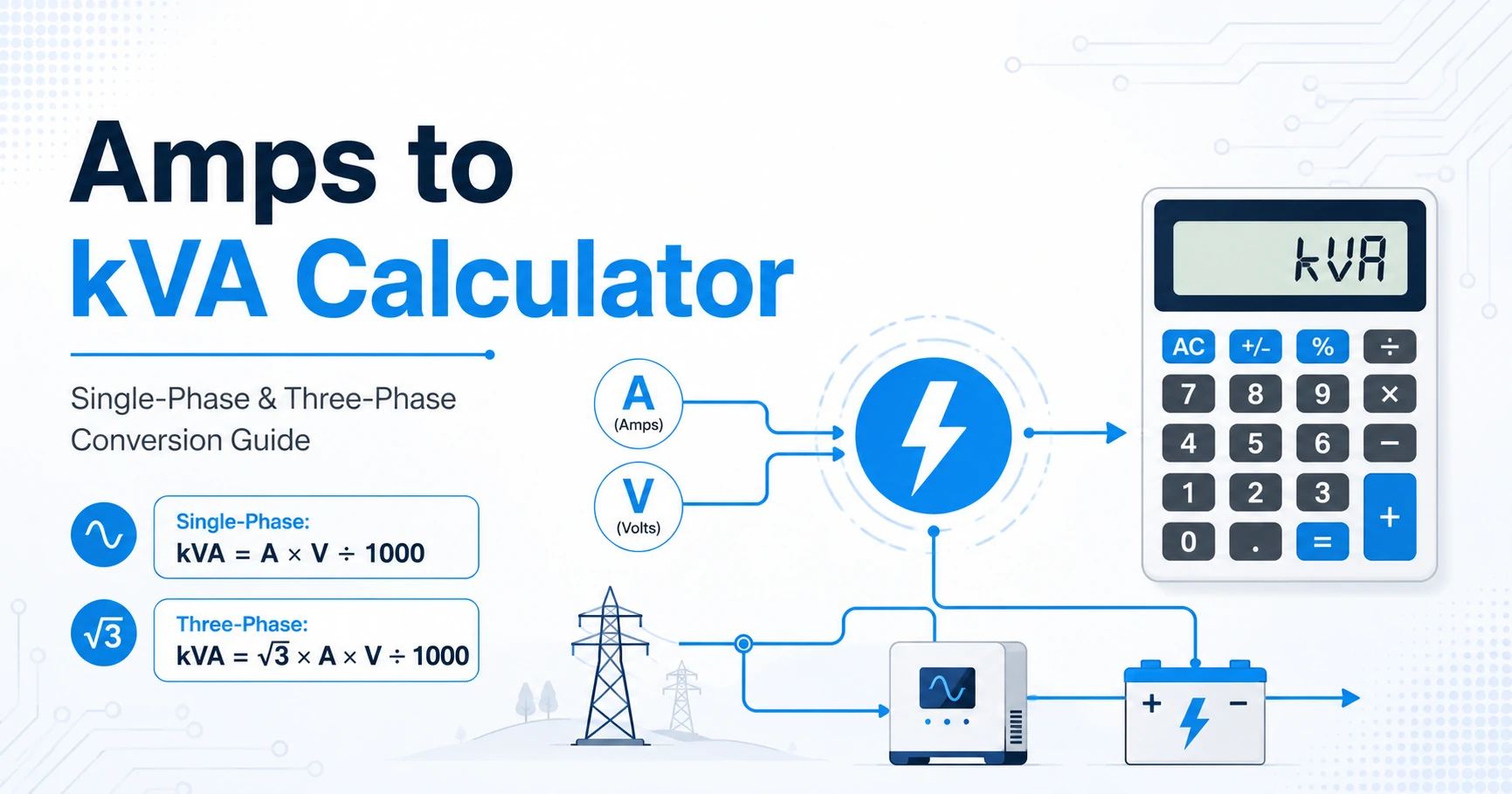
To convert amps to kVA, you need the current in amps, the RMS voltage, and the electrical phase configuration. For single-phase AC, use kVA = Amps × Volts ÷ 1000. For balanced three-phase power using line-to-line voltage, use kVA = √3 × Amps × Volts ÷ 1000.
Quick answer:
| Electrical System | Amps to kVA Formula |
|---|---|
| Single-phase AC | kVA = A × V ÷ 1000 |
| Three-phase AC, line-to-line | kVA = √3 × A × VLL ÷ 1000 |
| Three-phase AC, line-to-neutral | kVA = 3 × A × VLN ÷ 1000 |
For example:
- 100A at 400V three-phase = 69.28 kVA
- 30A at 230V single-phase = 6.9 kVA
- 30A at 400V three-phase = 20.78 kVA
If you first need to understand how voltage and current differ, see Avepower’s Voltage vs Current guide or its explanation of amperes and milliamperes.
Amps to kVA Calculator
Enter the current, voltage, and phase type to convert amps to kVA.
What Do You Need to Convert Amps to kVA?
To calculate kVA from amps correctly, you need the RMS current, the applicable AC voltage, and whether the circuit is single-phase or three-phase. For three-phase systems, you must also know whether the stated voltage is measured line-to-line or line-to-neutral before choosing the formula.
| Input | Why It Matters |
|---|---|
| Current, A | Represents the RMS line current used in the power calculation |
| Voltage, V | Amps alone do not define electrical power |
| Phase type | Single-phase and three-phase systems use different formulas |
| Voltage reference | Three-phase line-to-line and line-to-neutral values require different formula forms |
| Power factor | Needed for kW calculations, but not for basic V × A → kVA conversion |
For example, saying that a circuit carries 100 amps is not enough to determine its kVA.
At 240 V single phase:
240 × 100 ÷ 1,000 = 24 kVA
At 480 V three phase:
1.732 × 480 × 100 ÷ 1,000 ≈ 83.14 kVA
The same 100 A therefore represents very different apparent power depending on voltage and phase configuration.
What Is the Amps to kVA Formula for Single-Phase AC?
For a single-phase AC circuit, calculate apparent power by multiplying RMS voltage by RMS current and dividing the result by 1,000. No √3 factor is used, and power factor should not be inserted when the goal is specifically to calculate kVA from measured volts and amps.
The formula is:
kVA = V × A ÷ 1,000
Where:
- V = RMS voltage in volts
- A = RMS current in amps
- 1,000 converts volt-amperes to kilovolt-amperes
Example 1: 30 Amps at 230 V
kVA = 230 × 30 ÷ 1,000
kVA = 6.90
So a 230 V single-phase circuit carrying 30 A represents approximately 6.9 kVA of apparent power.
Example 2: 100 Amps at 240 V
kVA = 240 × 100 ÷ 1,000
kVA = 24
The apparent power is 24 kVA.
Example 3: 50 Amps at 120 V
kVA = 120 × 50 ÷ 1,000 = 6 kVA
How Do You Convert Amps to kVA in a Three-Phase System?
For a balanced three-phase system, use √3 × line-to-line voltage × line current ÷ 1,000. If your voltage is line-to-neutral instead, use 3 × line-to-neutral voltage × line current ÷ 1,000.
Using Line-to-Line Voltage
The most common three-phase formula is:
kVA = √3 × VLL × I ÷ 1,000
where √3 is approximately 1.732.
Schneider Electric likewise defines three-phase apparent power using the √3 × line-voltage × line-current relationship for balanced systems.
Example: 100 Amps at 415 V Three Phase
kVA = 1.732 × 415 × 100 ÷ 1,000
kVA ≈ 71.88
So 100 A at 415 V three phase is approximately 71.88 kVA.
Example: 100 Amps at 480 V Three Phase
kVA = 1.732 × 480 × 100 ÷ 1,000
kVA ≈ 83.14
Therefore, 100 A at 480 V three phase is approximately 83.14 kVA.
Using Line-to-Neutral Voltage
If the available measurement is line-to-neutral voltage:
kVA = 3 × VLN × I ÷ 1,000
Do not use a line-to-neutral voltage in the √3 × VLL formula unless you first convert it to the corresponding line-to-line voltage.
For a balanced wye system:
VLL ≈ √3 × VLN
For additional context on phase configuration in energy-storage applications, see Avepower's Single Phase vs 3 Phase Battery guide.
Amps to kVA Conversion Table
Single-Phase Amps to kVA
| Amps | 120V | 230V | 240V |
|---|---|---|---|
| 10A | 1.20 kVA | 2.30 kVA | 2.40 kVA |
| 20A | 2.40 kVA | 4.60 kVA | 4.80 kVA |
| 30A | 3.60 kVA | 6.90 kVA | 7.20 kVA |
| 50A | 6.00 kVA | 11.50 kVA | 12.00 kVA |
| 100A | 12.00 kVA | 23.00 kVA | 24.00 kVA |
Three-Phase Amps to kVA — Line-to-Line Voltage
| Amps | 208V | 400V | 415V | 480V |
|---|---|---|---|---|
| 10A | 3.60 kVA | 6.93 kVA | 7.19 kVA | 8.31 kVA |
| 20A | 7.21 kVA | 13.86 kVA | 14.38 kVA | 16.63 kVA |
| 30A | 10.81 kVA | 20.78 kVA | 21.56 kVA | 24.94 kVA |
| 50A | 18.01 kVA | 34.64 kVA | 35.94 kVA | 41.57 kVA |
| 100A | 36.03 kVA | 69.28 kVA | 71.88 kVA | 83.14 kVA |
Which Amps to kVA Formula Should You Use for Single Phase and Three Phase?
Use the single-phase formula when one AC phase supplies the load. Use the √3 three-phase formula when a balanced three-phase load is supplied and your voltage is measured line-to-line. If your three-phase voltage value is line-to-neutral, use the three-times-per-phase relationship instead.
| Situation | Correct Formula | Example Voltage |
|---|---|---|
| 120V single phase | A × 120 ÷ 1000 | North American branch loads |
| 230V single phase | A × 230 ÷ 1000 | Residential / small commercial |
| 240V single phase | A × 240 ÷ 1000 | Residential / split-phase load calculation |
| 208V three phase | 1.732 × A × 208 ÷ 1000 | Commercial systems |
| 400V three phase | 1.732 × A × 400 ÷ 1000 | Common international system |
| 415V three phase | 1.732 × A × 415 ÷ 1000 | Commercial / industrial |
| 480V three phase | 1.732 × A × 480 ÷ 1000 | Industrial systems |
Why Does Three-Phase Use √3?
The √3 factor appears because the line-to-line voltage of a balanced three-phase system is related geometrically to its phase voltage.
In a balanced wye system:
VLL = √3 × VLN
How Does Amps to kVA Apply to Real Battery and Energy Storage Projects?
In battery energy storage, the amps-to-kVA calculation is most useful on the AC side of an inverter or power conversion system. On the DC battery side, voltage × current is normally expressed as watts or kilowatts, so engineers should not mix battery-side DC current with AC-side kVA calculations.
Case 1: 15 kWh All-in-One Battery With an Integrated Inverter
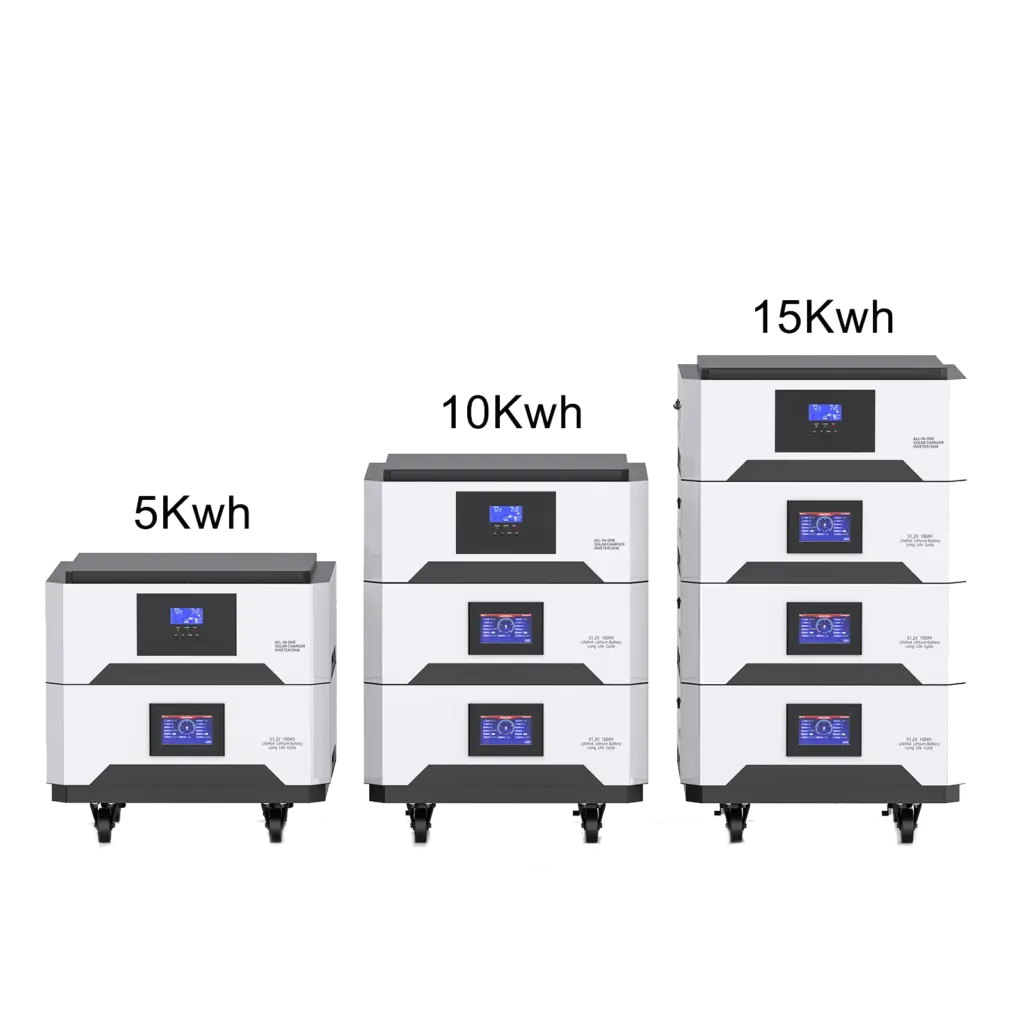
Avepower's 15 kWh all-in-one solar battery with integrated inverter combines a 51.2 V, 314 Ah battery with a 6.2 kW pure sine wave inverter and 220/230/240 V AC output.
If 6.2 kW were delivered at 230 V with PF = 1, the screening calculation would be:
Current ≈ 6,200 ÷ 230 ≈ 26.96 A
At PF = 1:
Apparent power ≈ 6.2 kVA
Case 2: 215 kWh Commercial Energy Storage Project in Germany
Avepower's 215 kWh Germany commercial energy-storage case study specifies a 100 kW rated system, a 110 kW maximum power value and a 400 V rated grid connection.
For an illustrative balanced three-phase calculation, if the system operated at 100 kW and PF = 1:
kVA = 100 kVA
Current ≈ 100,000 ÷ (1.732 × 400)
Current ≈ 144.3 A
If the same 100 kW real-power requirement operated at PF = 0.90:
kVA = 100 ÷ 0.90 ≈ 111.11 kVA
Current ≈ 111,111 ÷ (1.732 × 400)
Current ≈ 160.4 A
Conclusion
The correct amps-to-kVA calculation always starts by identifying voltage and phase. Use A × V ÷ 1000 for single-phase AC and √3 × A × VLL ÷ 1000 for balanced three-phase AC. Do not include power factor unless you are converting between kVA and real power in kW.
For quick reference:
- Single phase:
kVA = A × V ÷ 1000 - 3 phase, line-to-line:
kVA = 1.732 × A × V ÷ 1000 - 3 phase, line-to-neutral:
kVA = 3 × A × V ÷ 1000 - kW from kVA:
kW = kVA × PF
For simple conversions, these formulas are sufficient.
For battery-energy-storage applications, explore Avepower's commercial energy storage solutions or the company's vertical LiFePO4 battery systems to see how battery capacity, current, inverter power and AC system requirements are specified in practical systems.
FAQ
No. Amps measure current while kVA measures apparent power, so voltage is required to connect the two quantities. You also need the phase configuration because single-phase and three-phase systems use different formulas.
It depends on voltage and phase. At 230V single phase, 30A equals 6.9kVA. At 400V balanced three phase, 30A equals approximately 20.78kVA. Therefore, “30 amps to kVA” has no universal answer without additional electrical information.
At 230V single phase, 100A equals 23kVA. At 240V single phase it equals 24kVA, while at 400V balanced three phase it equals approximately 69.28kVA.
Power factor does not need to be multiplied into a direct RMS amps-and-volts kVA calculation. It affects the relationship between kVA and useful real power in kW: kW = kVA × PF.
Only when power factor equals 1.0. At PF 0.8, 10kVA represents 8kW of real power. This is why motors, transformers, generators, UPS systems and inverters may carry both kVA and kW-related specifications.
1.732 is an approximation of √3. It comes from the 120-degree phase relationship in a balanced three-phase system and connects line-to-line voltage with phase voltage.
For DC systems, power is normally expressed in watts or kilowatts rather than kVA because there is no AC phase relationship or conventional power factor. The basic DC relationship is P = V × I, so DC power in kW is V × A ÷ 1000.