
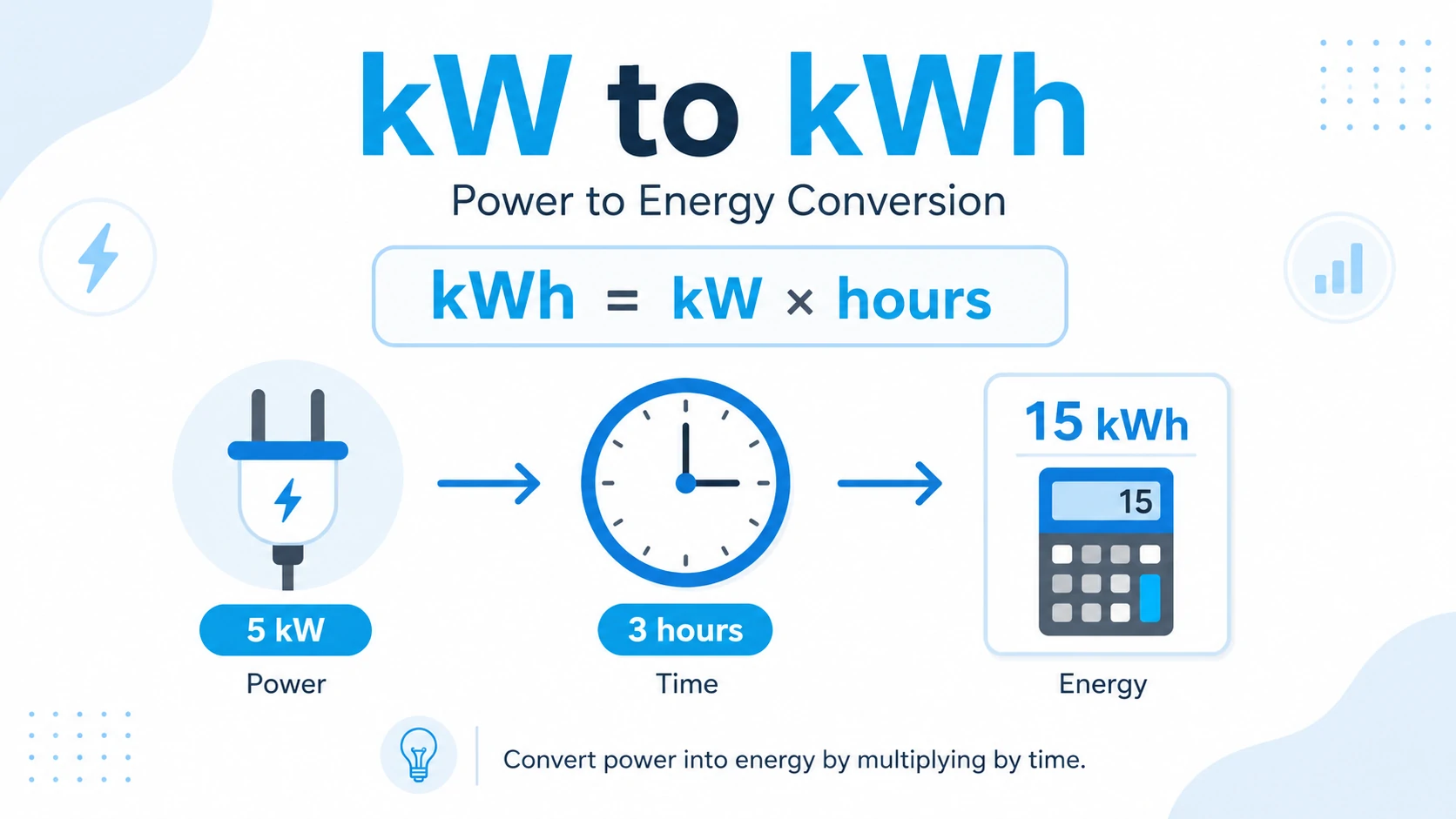
You cannot convert kW to kWh without knowing time. Kilowatts (kW) measure power, while kilowatt-hours (kWh) measure energy used or produced over time. To convert kW to kWh, multiply the power in kilowatts by the operating time in hours.
kWh = kW × hours
For example:
5 kW × 3 hours = 15 kWh
So, a 5kW load operating continuously for three hours uses 15kWh of electrical energy.
Calculating kW to kWh is simple. Just enter the power in kilowatts (kW) and the operating time into Avepower’s free online kW to kWh calculator, and it will instantly calculate the total energy consumption in kilowatt-hours (kWh) for you.
How Do You Convert kW to kWh?
To convert kW to kWh, multiply the equipment's actual or average power in kilowatts by the number of hours it operates.
The basic formula is:
Energy (kWh) = Power (kW) × Time (hours)
Where:
- kW = electrical power
- hours = operating duration
- kWh = total electrical energy
Example: 3 kW for 4 Hours
A 3kW heater operates for four hours:
3 kW × 4 h = 12 kWh
The heater therefore consumes 12kWh of energy.
Can You Convert kW to kWh Without Time?
No. A kW value alone cannot be converted into kWh because power and energy are different physical quantities. You must know how long the power is being used, produced or delivered before the total amount of energy can be calculated.
Consider a 5kW load:
| Power | Operating Time | Energy |
|---|---|---|
| 5kW | 15 min | 1.25kWh |
| 5kW | 30 min | 2.5kWh |
| 5kW | 1 hour | 5kWh |
| 5kW | 2 hours | 10kWh |
| 5kW | 4 hours | 20kWh |
| 5kW | 8 hours | 40kWh |
| 5kW | 24 hours | 120kWh |
The power remains 5kW in every example.
Only the operating time changes, yet total energy ranges from 1.25kWh to 120kWh.
What Is the Difference Between kW and kWh?
kW tells you how fast electrical energy is being used or delivered at one moment, while kWh tells you how much total energy has been consumed, generated or stored. In battery systems, kW mainly relates to power capability and kWh mainly relates to energy capacity and runtime.
| Measurement | kW | kWh |
|---|---|---|
| Full name | Kilowatt | Kilowatt-hour |
| Measures | Power | Energy |
| Main question | How much power right now? | How much energy over time? |
| Appliance example | 2kW heater | 6kWh consumed |
| Solar example | 10kW PV array | 40kWh generated per day |
| Inverter example | 6kW output | Not an energy rating |
| Battery example | 10kW discharge capability | 20kWh stored energy |
| Utility relevance | Peak demand | Energy consumption |
For battery systems, Avepower's battery capacity guide covering Ah, Wh and kWh provides a deeper explanation of why energy capacity and power rating should be evaluated separately.
kW to kWh Conversion Chart
| Power | 1 Hour | 2 Hours | 4 Hours | 8 Hours | 24 Hours |
|---|---|---|---|---|---|
| 0.5kW | 0.5kWh | 1kWh | 2kWh | 4kWh | 12kWh |
| 1kW | 1kWh | 2kWh | 4kWh | 8kWh | 24kWh |
| 2kW | 2kWh | 4kWh | 8kWh | 16kWh | 48kWh |
| 3kW | 3kWh | 6kWh | 12kWh | 24kWh | 72kWh |
| 5kW | 5kWh | 10kWh | 20kWh | 40kWh | 120kWh |
| 6kW | 6kWh | 12kWh | 24kWh | 48kWh | 144kWh |
| 10kW | 10kWh | 20kWh | 40kWh | 80kWh | 240kWh |
| 20kW | 20kWh | 40kWh | 80kWh | 160kWh | 480kWh |
| 50kW | 50kWh | 100kWh | 200kWh | 400kWh | 1,200kWh |
| 100kW | 100kWh | 200kWh | 400kWh | 800kWh | 2,400kWh |
How Many kWh Does 1 kW Use?
A constant 1kW load uses 1kWh in one hour, 8kWh in eight hours and 24kWh in twenty-four hours.
Examples:
1kW × 1h = 1kWh
1kW × 8h = 8kWh
1kW × 24h = 24kWh
For 30 days at continuous 1kW operation:
1 × 24 × 30 = 720kWh
How Many kWh Is 5 kW?
A 5kW load uses 5kWh per hour when it operates continuously at exactly 5kW. It therefore uses 10kWh in two hours, 20kWh in four hours and 40kWh in eight hours.
For example:
5kW × 4h = 20kWh
How Many kWh Is 10 kW?
A constant 10kW load consumes 10kWh in one hour, 20kWh in two hours and 100kWh in ten hours.
For example:
10kW × 3h = 30kWh
But suppose a machine is rated at 10kW and averages only 6.5kW during operation.
Its three-hour energy use becomes:
6.5kW × 3h = 19.5kWh
How Do You Convert kW to kWh When Time Is in Minutes?
When runtime is given in minutes, divide the minutes by 60 to convert them into hours, then multiply by kW. You can also calculate the result directly with kWh = kW × minutes ÷ 60.
The formula is:
kWh = kW × minutes ÷ 60
Example: 4kW for 30 Minutes
30 minutes equals:
30 ÷ 60 = 0.5 hours
Therefore:
4kW × 0.5h = 2kWh
Example: 7.2kW EV Charger for 45 Minutes
45 minutes equals:
45 ÷ 60 = 0.75 hours
Therefore:
7.2 × 0.75 = 5.4kWh
How Do You Calculate Daily and Monthly kWh From kW?
Calculate daily kWh by multiplying average operating kW by daily runtime, then multiply that daily energy figure by the number of operating days to estimate monthly consumption. Use actual duty cycles whenever equipment does not run continuously.
Suppose a 2.5kW load operates for six hours per day.
Daily consumption:
2.5 × 6 = 15kWh/day
For 30 days:
15 × 30 = 450kWh/month
If electricity costs $0.20/kWh:
450 × $0.20 = $90/month
This produces the general electricity-cost formula:
Electricity Cost = kWh × Electricity Rate
How Do You Convert Solar System kW to kWh?
Estimate solar kWh by multiplying the array's kW rating by equivalent peak-sun hours, then adjust for real system losses. A solar array rated at 5kW does not continuously produce 5kW throughout every daylight hour.
A simplified formula is:
Solar Energy ≈ Solar kW × Peak Sun Hours
For example:
5kW system × 4.5 peak-sun-hours:
5 × 4.5 = 22.5kWh/day
This is an idealized energy figure.
A more useful planning estimate can include a performance factor:
Solar kWh ≈ kW × Peak Sun Hours × Performance Factor
Assuming an illustrative 80% performance factor:
5 × 4.5 × 0.80 = 18kWh/day
How Do You Calculate Battery Runtime From kWh and kW?
To estimate battery runtime, divide usable battery energy in kWh by the average load in kW.
The simplest formula is:
Runtime (hours) = Battery Energy (kWh) ÷ Load (kW)
Example:
A 15kWh battery supplying a constant 3kW load:
15 ÷ 3 = 5 hours
This is the theoretical result.
Suppose only 90% of the battery energy is usable:
15 × 0.90 = 13.5kWh
At a 3kW load:
13.5 ÷ 3 = 4.5 hours
How Do You Convert kWh Back to kW?
To convert kWh back to average kW, divide the total energy by the number of hours over which that energy was consumed or delivered.
The formula is:
Average kW = kWh ÷ hours
Example:
A building consumes 120kWh over eight hours:
120 ÷ 8 = 15kW average
Conclusion: kW to kWh Formula
The correct way to convert kW to kWh is to multiply power by time: kWh = kW × hours. There is no fixed kW-to-kWh conversion because kW measures power while kWh measures accumulated energy.
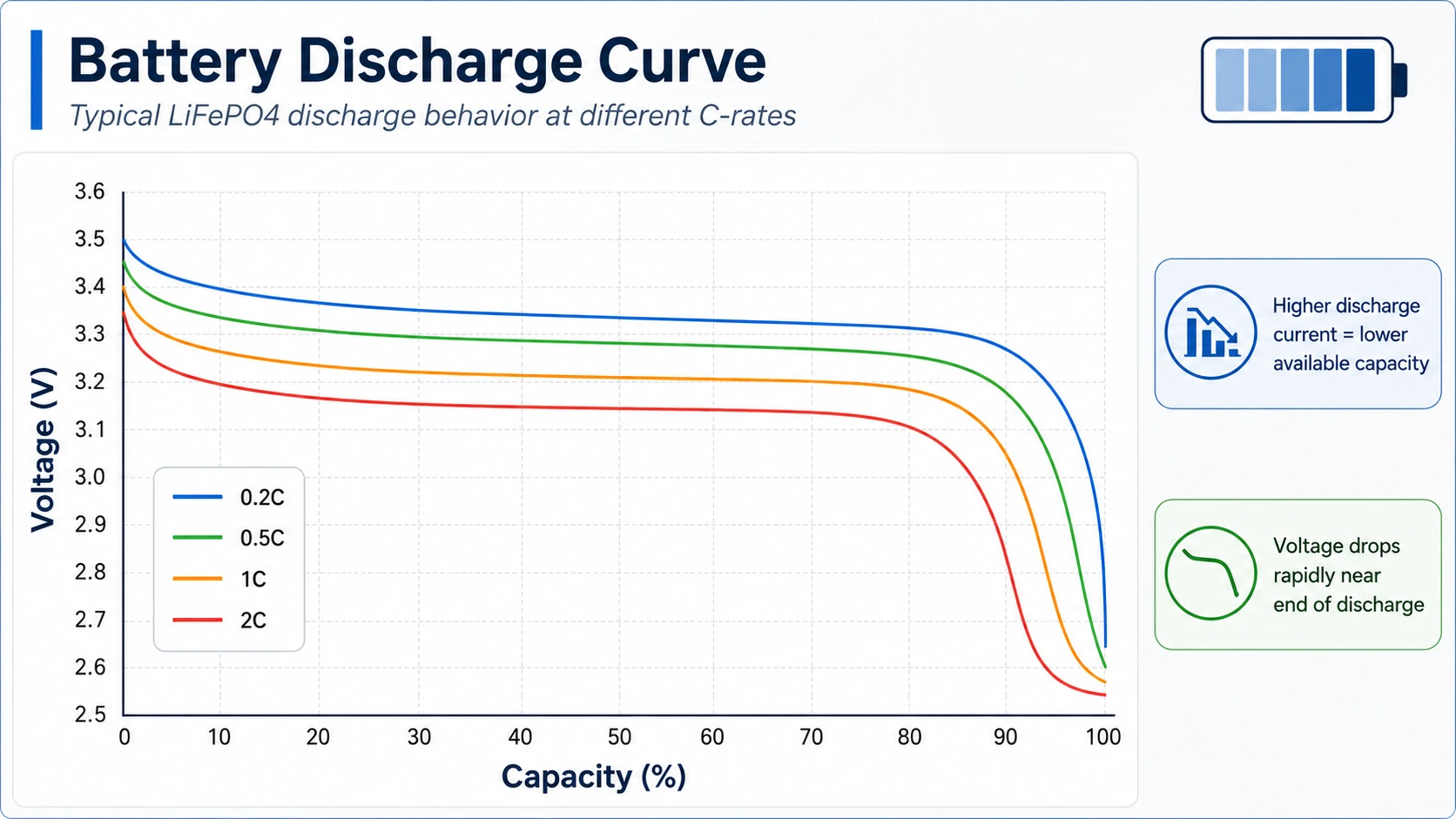
For solar systems, batteries and commercial energy storage, also consider variable power, usable energy, efficiency, discharge current and the load profile.
If you are sizing a residential project, Avepower's residential battery energy storage solutions provide scalable LiFePO4 configurations for solar storage and backup applications.
For higher-power projects, Avepower's commercial and industrial energy storage solutions combine battery kWh capacity with appropriate PCS power, BMS/EMS integration and project-specific configuration.
FAQ
1kW operating for one hour equals 1kWh. This follows directly from kWh = kW × hours.
A constant 1kW load operating for 24 hours uses 24kWh.
A constant 5kW load operating for eight hours consumes: 5 × 8 = 40kWh
A constant 10kW load operating for five hours uses: 10 × 5 = 50kWh
A constant 100kW load operating for two hours uses: 100 × 2 = 200kWh
Only after one hour of continuous operation at exactly 1kW. After two hours, 1kW equals 2kWh of accumulated energy; after eight hours, it equals 8kWh.
A rough estimate is solar kW multiplied by equivalent peak-sun hours and then adjusted for system performance. At 4.5 peak-sun-hours, the ideal result is 22.5kWh before losses.