
Battery systems are widely used in renewable energy, backup power, electric vehicles, marine applications, and off-grid power systems. Many of these systems require higher voltages than a single battery can provide.
If you have four 12-volt batteries and want to build a 48-volt battery bank, connecting them in series is the correct method. This configuration is commonly used in solar energy storage systems, UPS backup power, telecom equipment, and home energy storage solutions.
In this guide, we will explain how to connect 4 batteries in series, why series wiring increases voltage, what equipment you need, and the safety practices required to build a reliable 48V battery system.
What Does It Mean to Connect 4 Batteries in Series?
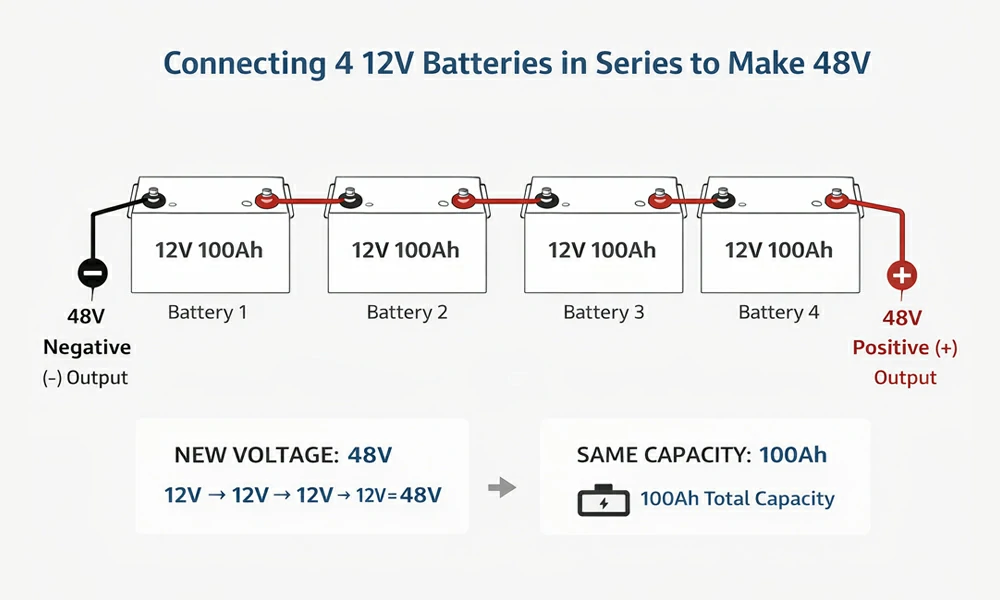
Connecting 4 batteries in series means joining the batteries in a chain so that the positive terminal of one battery connects to the negative terminal of the next battery. In a series connection, voltage adds up, while the amp-hour capacity stays the same as that of a single battery.
This setup is particularly advantageous for home energy storage or solar systems where higher voltage is required. Higher voltage systems are beneficial because they reduce the current needed for the same power output. Lower current reduces energy losses in cables, heat generation, and the required cable thickness, making the system more efficient and safer.
Example: 4 × 12V Battery Configuration
Each battery specification:
- Voltage: 12V
- Capacity: 100Ah
- Energy: 1.2 kWh
Calculation: Energy = Voltage × Capacity
So: 12V × 100Ah = 1200Wh (1.2kWh)
For four batteries in series:
| Parameter | Value |
|---|---|
| Voltage | 48V |
| Capacity | 100Ah |
| Energy | 4.8kWh |
The final system becomes: 48V 100Ah battery bank (4.8 kWh).
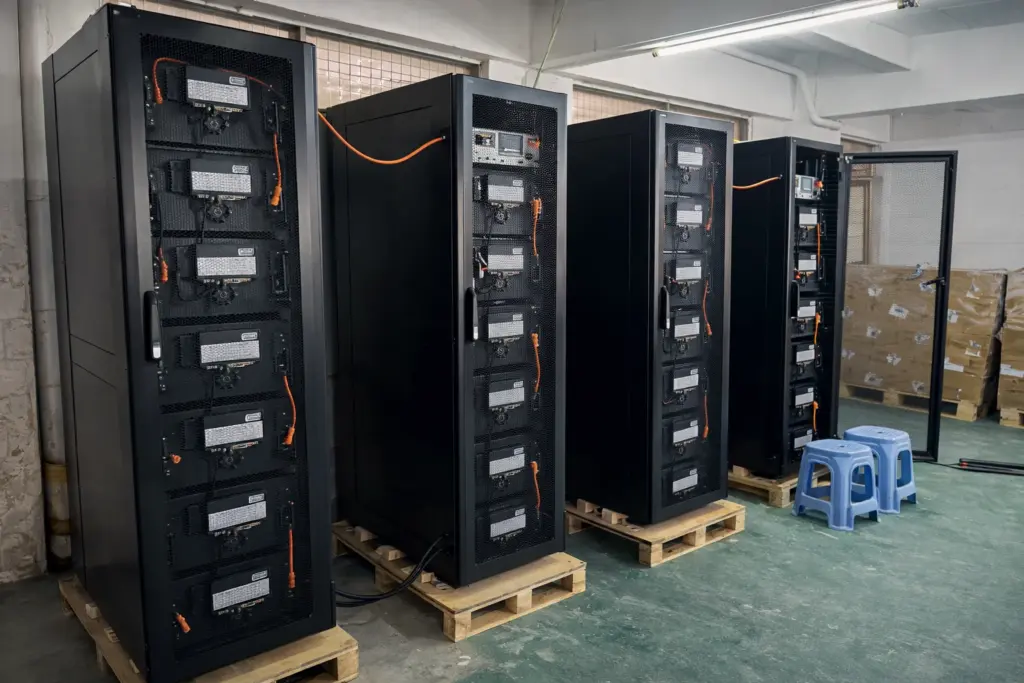
Avepower 832 V High-Voltage Battery Energy Storage System Case Study
Avepower partnered with a Lithuanian installer to deploy a 522.5 kWh high-voltage energy storage system. The 832 V DC, 628 Ah setup uses MB31 cells in integrated packs with smart BMS and IP20 cabinets.
Why Use 4 12V Batteries to Make 48V?
There are several reasons why users choose 4 batteries in series instead of buying one single 48V battery.
1. Flexibility
Twelve-volt batteries are widely available and easy to source in most markets. By connecting four 12V batteries in series, users can conveniently build a 48V battery bank without needing specialized high-voltage battery modules.
2. Easy Replacement
If one battery fails, it may be possible to replace the faulty unit instead of replacing an entire high-voltage pack, although all replacement decisions must be made carefully to maintain balance.
3. Suitable for 48V Systems
Many inverters, solar charge controllers, telecom devices, and energy storage systems are designed around 48V architecture. A 48V system offers lower current than a 12V system for the same power level, which helps reduce cable size and energy loss.
4. Higher Efficiency
Higher voltage systems require less current to deliver the same power. Lower current helps reduce cable energy loss, minimize heat generation, and allows the use of thinner cables.
| System Voltage | Current Required for 3000W |
|---|---|
| 12V | 250A |
| 24V | 125A |
| 48V | 62.5A |
5. Practical for Solar and Backup Power
In off-grid and hybrid solar applications, 48V battery banks are often preferred because they are more efficient than lower-voltage battery setups, especially when powering larger loads.
How Series Wiring Works in Simple Terms
To understand series wiring, imagine the batteries as steps in a staircase. Each battery raises the voltage level by another 12V. When connected correctly, the electrical potential increases from one end of the battery bank to the other.
Here is the basic logic:
- Start at the negative terminal of Battery 1
- Connect the positive terminal of Battery 1 to the negative terminal of Battery 2
- Connect the positive terminal of Battery 2 to the negative terminal of Battery 3
- Connect the positive terminal of Battery 3 to the negative terminal of Battery 4
- The remaining open terminals become the output:
- System negative = negative terminal of Battery 1
- System positive = positive terminal of Battery 4
At that point, the total voltage measured across the two free end terminals should be about 48V nominal.
In a fully charged state, the actual voltage may be higher than 48V depending on battery chemistry. For example, lead-acid and lithium batteries have different charging ranges and resting voltages. Still, the nominal system is called 48V because four 12V batteries are connected in series.
What You Need Before Connecting 4 Batteries in Series
Before starting, make sure the batteries are appropriate for series connection and that all components are compatible with a 48V system.
1. Four Identical 12V Batteries
All batteries in the series should be identical. They should have:
- The same brand
- The same capacity
- The same battery chemistry
- The same age and usage condition
Using mismatched batteries can lead to uneven charging and discharging, which may reduce system efficiency and shorten battery lifespan. In severe cases, it can also cause overheating or premature battery failure.
2. Battery Cables
Use high-quality copper battery cables with proper insulation. Copper provides low electrical resistance and improves current flow between batteries.
The cable size should match the system current. A general guideline is shown below:
| Current | Recommended Cable Size |
|---|---|
| < 100A | 16 mm² |
| 100–200A | 25 mm² |
| > 200A | 35 mm² or larger |
Choosing the correct cable size reduces voltage drop, heat generation, and energy loss.
3. Battery Terminals or Busbars
Battery terminals or busbars are used to create secure and stable connections between batteries. Proper connectors ensure low resistance and prevent loose contacts that could lead to overheating.
4. Fuse or Circuit Breaker
A fuse or circuit breaker is essential for system protection. It helps prevent damage caused by:
- Short circuits
- Overcurrent conditions
- Wiring faults
Installing a fuse near the battery bank is a common safety practice in battery systems.
5. Insulated Tools
Always use insulated tools when working with batteries. This helps prevent accidental short circuits and reduces the risk of electric shock or equipment damage during installation.
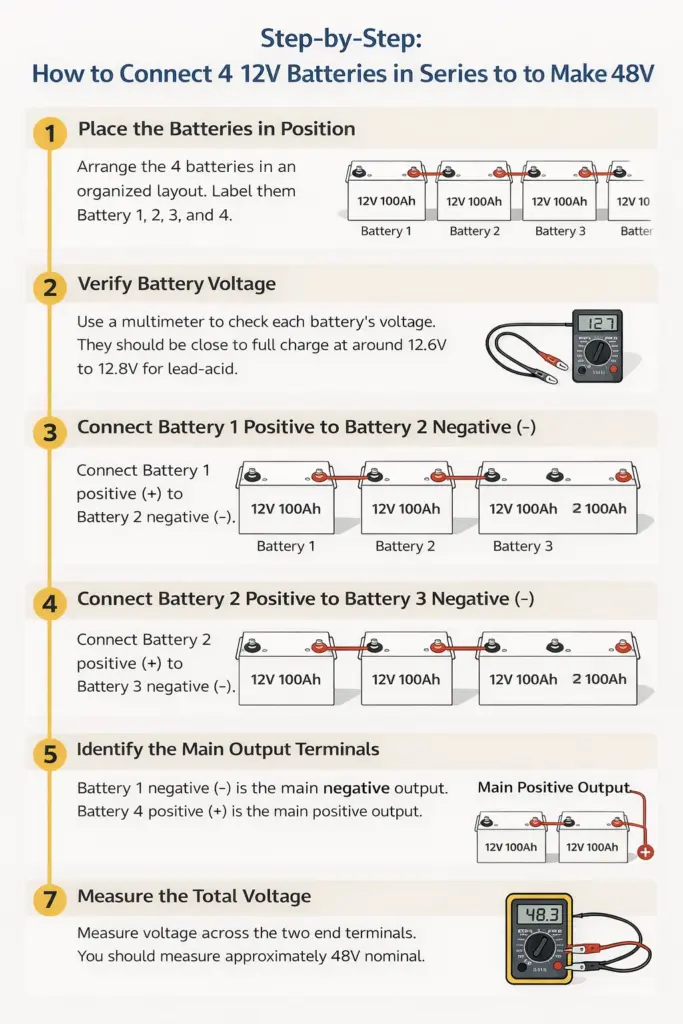
Step-by-Step: How to Connect 4 12V Batteries in Series to Make 48V
Step 1: Place the Batteries in Position
Arrange the four 12V batteries close enough that the interconnect cables can reach comfortably, but not so tightly packed that heat dissipation becomes a problem.
Label them mentally or physically as:
- Battery 1
- Battery 2
- Battery 3
- Battery 4
Keeping the layout organized helps avoid polarity mistakes.
Step 2: Verify Battery Voltage
Before making any connections, use a multimeter to check the voltage of each battery.
For example, if they are nominal 12V batteries, each one may read:
- Around 12.6V to 12.8V if fully charged lead-acid
- Around 13.2V to 13.6V for some lithium 12V batteries depending on chemistry and state of charge
The key point is not the exact reading, but that all four batteries should be very close in voltage. Large differences indicate unequal charge levels and may cause stress after connection.
Step 3: Connect Battery 1 Positive to Battery 2 Negative
Take the first interconnect cable and connect:
- Battery 1 positive (+) to Battery 2 negative (-)
Tighten the terminals to the manufacturer’s torque recommendation. Do not overtighten.
Step 4: Connect Battery 2 Positive to Battery 3 Negative
Take the second interconnect cable and connect:
- Battery 2 positive (+) to Battery 3 negative (-)
At this stage, the chain continues to build voltage.
Step 5: Connect Battery 3 Positive to Battery 4 Negative
Take the third interconnect cable and connect:
- Battery 3 positive (+) to Battery 4 negative (-)
Now the four batteries are linked in series.
Step 6: Identify the Main Output Terminals
At the end of the chain, two free terminals remain:
- Battery 1 negative (-) becomes the main negative output
- Battery 4 positive (+) becomes the main positive output
These are the only two terminals you use to connect the battery bank to a 48V inverter, charger, controller, or load.
Step 7: Measure the Total Voltage
Use a multimeter across the two free end terminals:
- Black probe on Battery 1 negative
- Red probe on Battery 4 positive
You should measure approximately 48V nominal.
Depending on battery chemistry and charge level, the reading might be:
- Around 50V to 54V in some resting or partially charged states
- Higher during charging
- Lower when discharged
But if the reading is close to zero, 12V, 24V, or 36V, the wiring is incorrect and should be checked before connecting any equipment.
Simple Wiring Diagram for 4 Batteries in Series
Here is a basic text diagram:
System Negative
(-) Battery 1 (+) — (-) Battery 2 (+) — (-) Battery 3 (+) — (-) Battery 4 (+)
System Positive
Or more explicitly:
- Battery 1 negative = system negative
- Battery 1 positive to Battery 2 negative
- Battery 2 positive to Battery 3 negative
- Battery 3 positive to Battery 4 negative
- Battery 4 positive = system positive
That is the standard arrangement for 4 batteries in series.
Charging a 48V Battery Bank
Once four batteries are connected in series, they must be charged with a 48V compatible charger.
Typical charging voltages:
| Battery Type | Charge Voltage |
|---|---|
| Lead Acid | ~56–58V |
| LiFePO4 | ~54–56V |
Using an incorrect charger may damage the batteries.
How to Check If the Connection Is Correct
After wiring the batteries, you should verify the voltage before connecting any inverter, charger, or load.
Use a Multimeter
Set the multimeter to measure DC voltage.
Place:
- The black probe on Battery A negative
- The red probe on Battery D positive
If the batteries are healthy and properly charged, you should measure approximately 48V nominal, though the real reading may vary depending on battery chemistry and state of charge.
For example:
- Around 50–54V may be seen in some charged lead-acid systems
- Around 51–53.6V or more may be seen in lithium systems depending on charging level and chemistry
The key point is that the voltage should be roughly the combined total of the four 12V batteries.
Also Check Each Battery Individually
Measure each battery one by one:
- Battery A
- Battery B
- Battery C
- Battery D
They should all be close in voltage. A large difference may indicate a weak battery, poor connection, or uneven charge level.
4 Batteries in Series vs Parallel
- Series connection increases voltage
- Parallel connection increases amp-hour capacity (Ah)
So when people say 4 batteries in series and parallel, they often mean arranging four batteries into a mixed configuration, not all in one straight series string and not all in one parallel group.
| Number of Batteries | Wiring Method | Single Battery Rating | Connection Type | Final Output |
|---|---|---|---|---|
| 4 | Connect all 4 batteries end to end | 12V 100Ah | Series | 48V 100Ah |
| 4 | Connect all positive terminals together and all negative terminals together | 12V 100Ah | Parallel | 12V 400Ah |
| 4 | Connect 2 batteries in series per string, then connect the 2 strings in parallel | 12V 100Ah | Series-Parallel | 24V 200Ah |
Related articles: 4 batteries in parallel
When a 48V System Makes More Sense Than 12V or 24V
Many small systems start at 12V because it is simple and familiar. But as system size increases, 48V becomes more attractive.
A 48V battery bank built from 4 batteries in series is usually a better choice when:
- Load power is moderate to high
- Cable runs are longer
- Inverter size is 3000W or above
- Efficiency matters
- Heat and current need to be reduced
- The system is part of a solar storage application
In short, 48V systems are often the next step when a project grows beyond the practical limits of 12V.
Need a Higher-Voltage Energy Storage Solution?
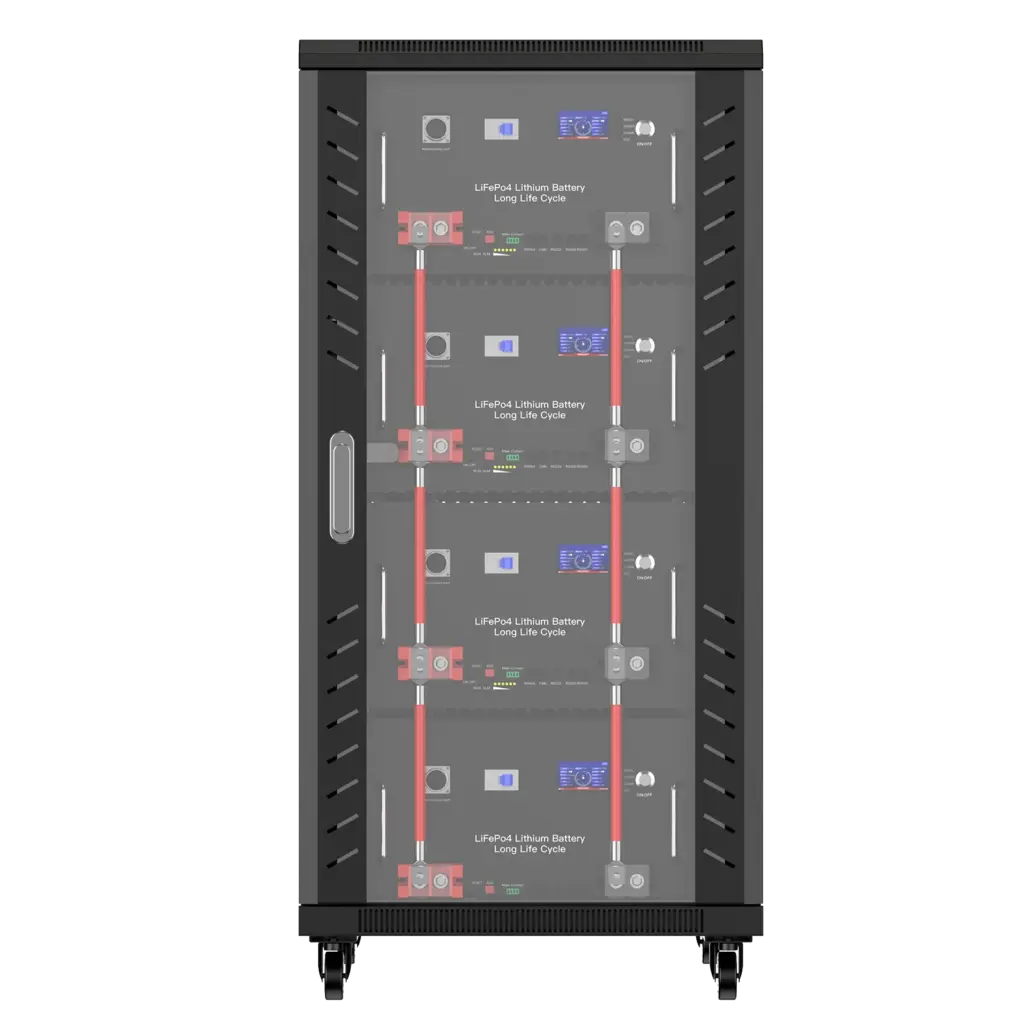
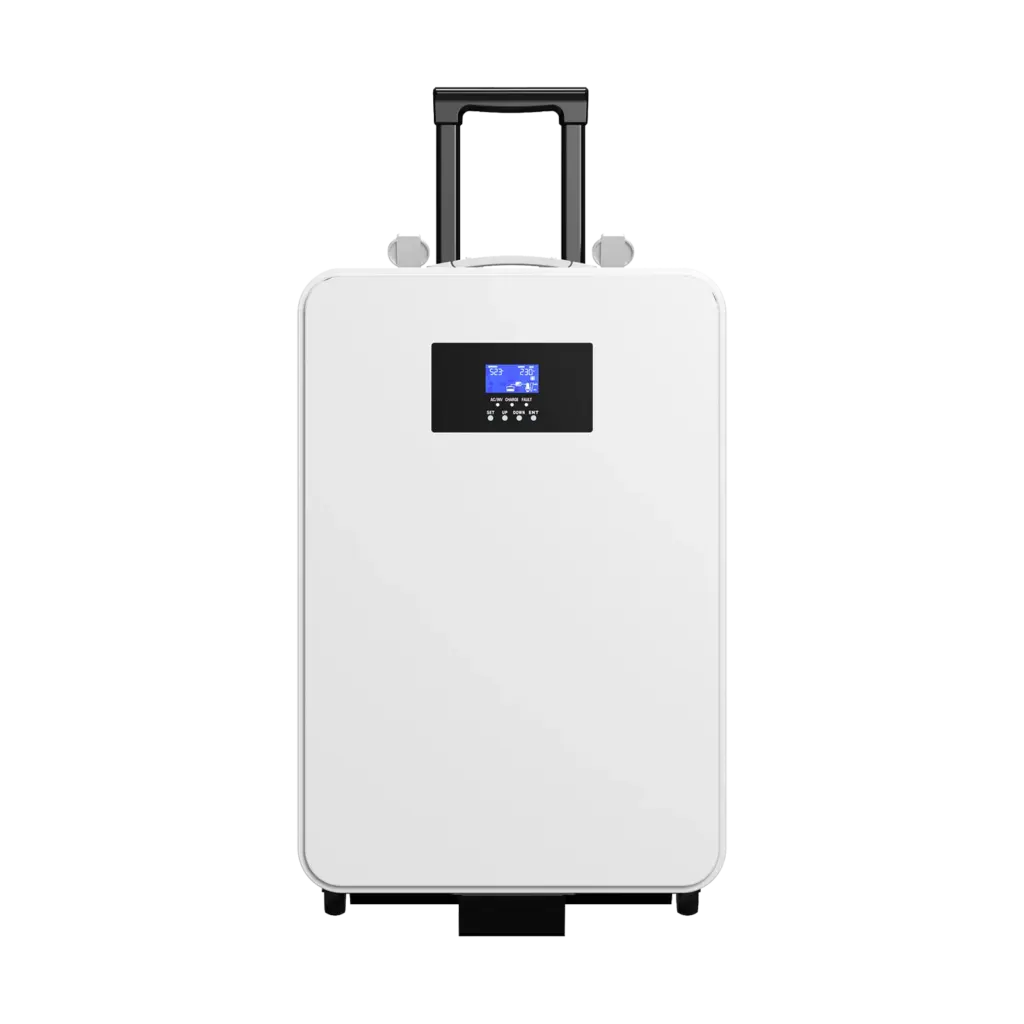
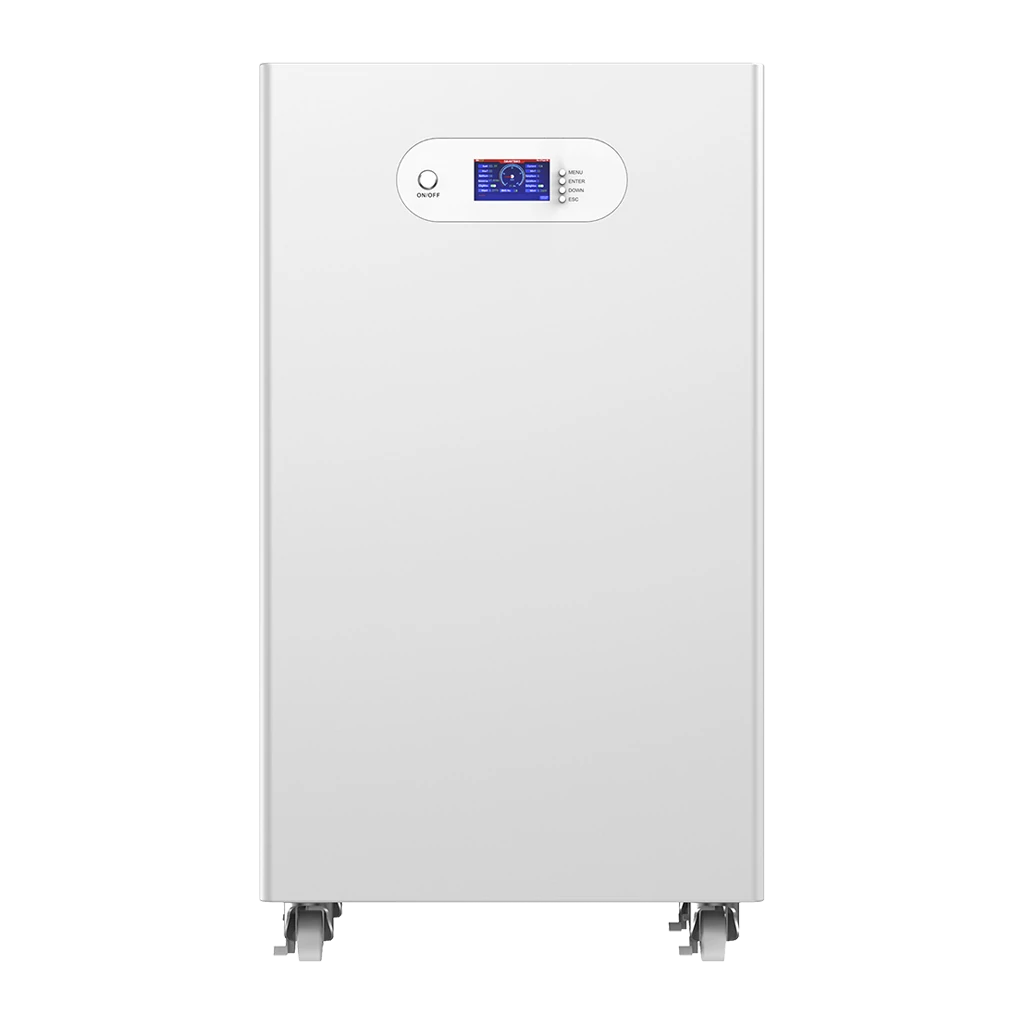
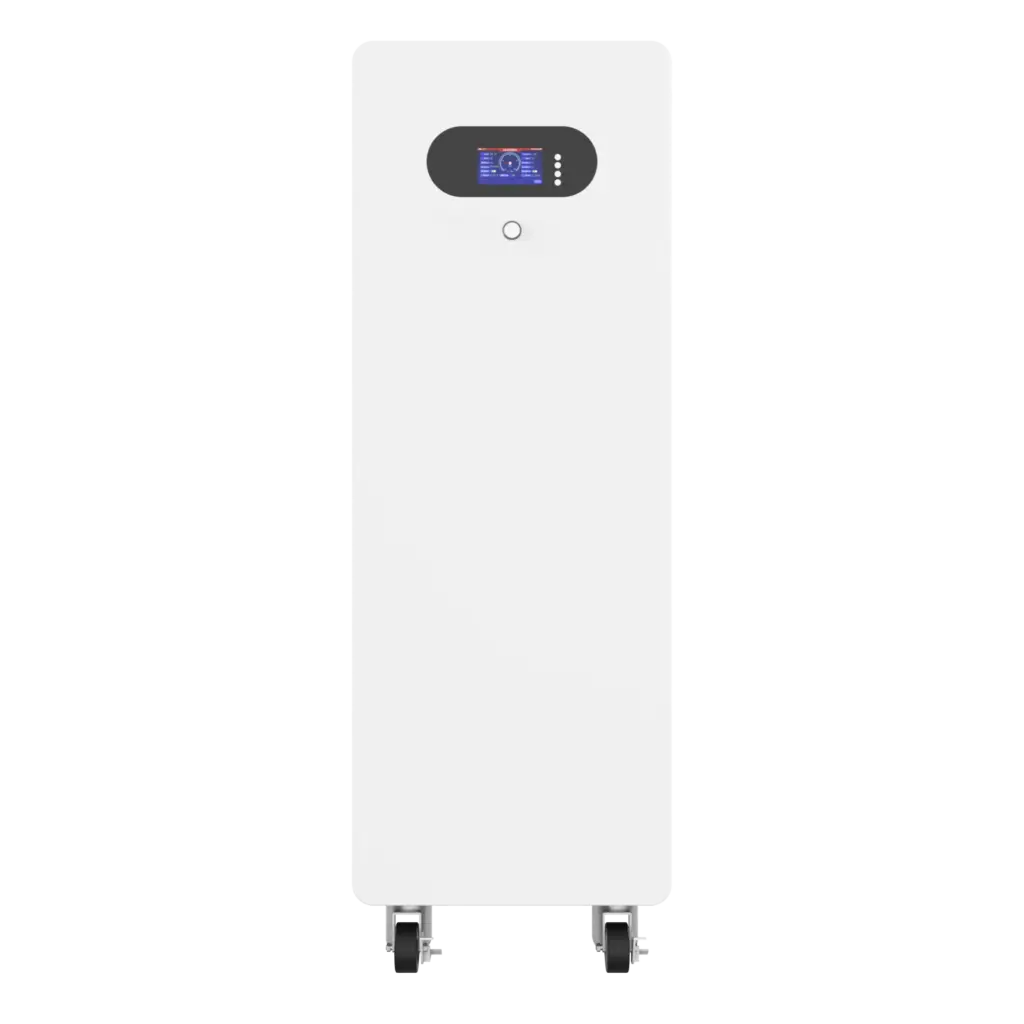
If you need a higher-voltage battery system for residential ESS, commercial backup, or solar storage projects, choosing the right battery configuration is critical for safety, efficiency, and long-term performance. Avepower offers professional high-voltage energy storage solutions with reliable LiFePO4 technology, and flexible system customization to match different application needs.
Avepower has already supported a 522.496kWh high-voltage ESS project in Lithuania, built around a nominal 832V DC architecture for commercial and industrial grid support and renewable integration. The system was configured as a compact four-cabinet solution, with two clusters connected in parallel, demonstrating strong capability in high-voltage system design, integration, and delivery.
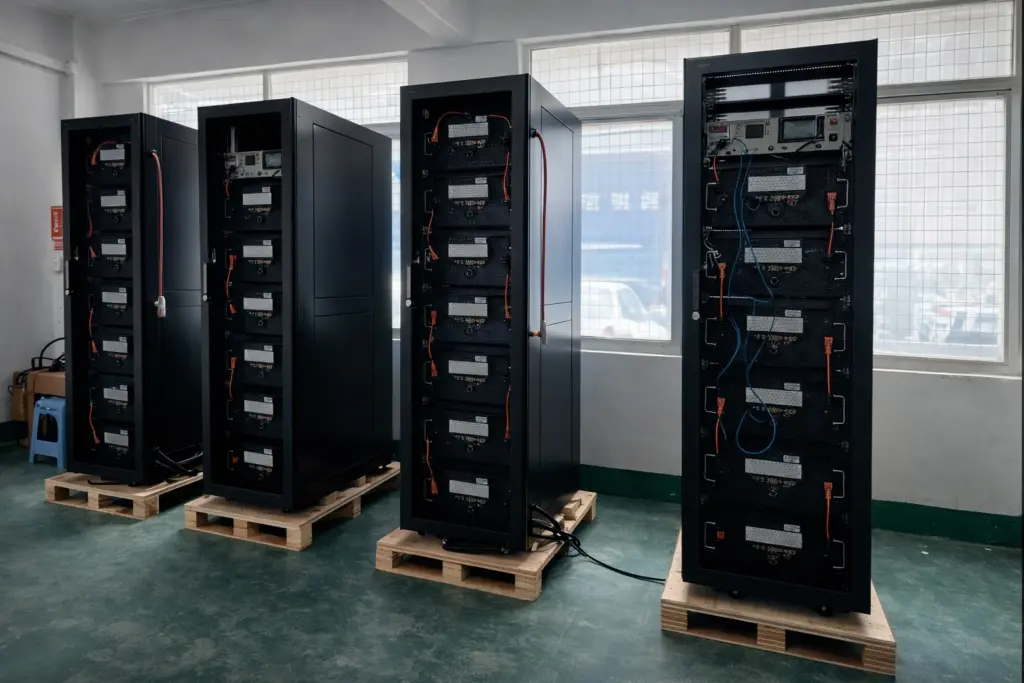
High-Voltage Energy Storage Solutions with Avepower
Contact Avepower today to discuss your voltage range, target capacity, and project requirements.
FAQ
To connect 4 batteries in series and make 48V, connect the positive terminal of the first 12V battery to the negative terminal of the second, then continue the same pattern across all four batteries. The remaining free negative terminal on the first battery and the free positive terminal on the fourth battery become the 48V output terminals.
If you use four 12V batteries, the total nominal voltage will be: 12V + 12V + 12V + 12V = 48V. So, 4 batteries in series produce 48V, provided all batteries are correctly connected and in good condition.
No. When 4 batteries are connected in series, the voltage increases, but the amp-hour capacity stays the same as one battery.
If you connect 4 x 12V 100Ah batteries in series, you get a 48V 100Ah battery bank.
No. A battery bank made from 4 batteries in series becomes a 48V system, so it requires a 48V charger that matches the battery chemistry. A 12V charger is not suitable for charging a 48V battery bank.
Pulling 12V power from one battery in a 4 batteries in series bank can cause uneven discharge and battery imbalance. Over time, this may damage the battery bank and reduce overall lifespan.