
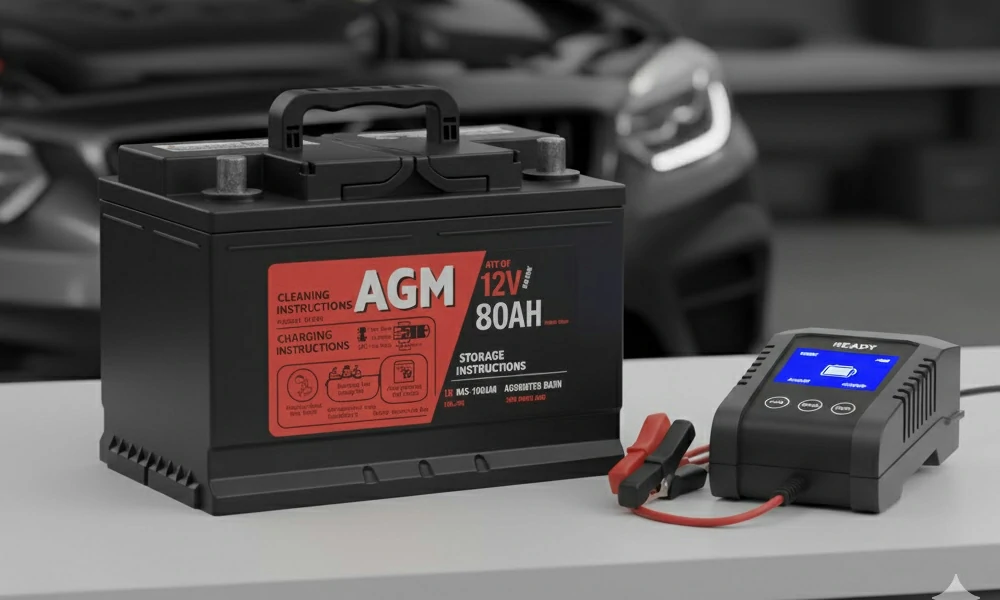
AGM (absorbed glass mat) batteries show up everywhere now — in start-stop cars, boats, RVs, backup power systems and even some small off-grid setups. Many people like them because they start engines easily, they can work as deep-cycle batteries, and they need very little maintenance.
But there is one area where AGM batteries are not forgiving: charging.
If you use the wrong charger, you can quietly destroy an AGM battery long before its time.
This guide will explain why AGM batteries need a special charger and how to safely power them up, ensuring you get the most life and performance from your investment.
What Is An AGM Battery?
AGM stands for Absorbed Glass Mat. Inside the battery, you still have lead plates and an acid solution like a normal lead-acid battery. The main difference is the separator between the plates.
AGM batteries use a glass fiber mat that soaks up the acid like a sponge. This design gives a few important features:
- The liquid does not slosh around, so the battery can handle vibration well.
- The battery case stays sealed, so you normally do not add water.
- The battery can sit for longer periods with less self-discharge.
Because the acid stays trapped in the mat, the battery can move and tilt without spilling. This design is one reason car makers use AGM batteries in tighter spaces and in modern vehicles with many electronic features.
Key Differences from Standard Lead-Acid Batteries
AGM batteries outperform standard batteries in several ways, but these differences are also why their charging needs are specific:
| Feature | AGM Battery | Standard Flooded Battery |
| Internal Resistance | Very Low | Higher |
| Charge Acceptance (Amps) | Very High (Can accept 30-50+ Amps) | Low (Needs slow, low-amp charging) |
| Max Safe Charging Voltage | Critical, must be below 15 Volts | Can tolerate up to 17 Volts |
| Lifespan | Generally Longer | Shorter |
| Performance | Provides high bursts of power; resistant to sulfation | Requires more maintenance; susceptible to sulfation |
Can You Use A Regular Charger On An AGM Battery?
Most of the time, the safe answer is no.
You should not use a basic, older “dumb” charger that does not have an AGM mode or at least a 12 V smart mode with fixed voltage limits.
A regular charger can:
- Push the voltage too high
- Overheat the battery
- Open the valve and dry out the plates
- Shorten the life of the battery by a large margin
Why AGM Batteries Need A Special Charger
A regular flooded battery has more internal resistance.
Because of this, a regular battery needs a bit more voltage to drive current in.
It cannot safely accept very high current for a long time.
An AGM battery has lower internal resistance.
Because of this, the AGM battery:
- can accept higher current (more amps) without stress,
- can charge faster,
- does not need very high voltage.
If you push the voltage too high on an AGM battery, you can:
- overheat the battery,
- build too much gas and pressure,
- open the safety valve,
- let gas and moisture escape,
- dry out the glass mat.
Once the inside dries out, the battery usually cannot recover.
Safe Use Of A Regular Charger In An Emergency
Most of the time, you should avoid regular chargers with AGM batteries. However, you may face an emergency where you only have an old charger and a dead battery. In that case, you can reduce risk, but you still need to be very careful.
If you ever must use a regular charger on an AGM battery, you should:
- Check the actual output voltage with a multimeter while the charger runs. You should stop if the voltage pushes above about 14.8 V for a 12 V AGM battery.
- Use the lowest current setting on the charger to limit heat.
- Disconnect all loads from the battery so the charger only sees the battery, not other devices.
- Watch temperature closely by touching the side of the battery case. If the case feels hot, you should stop charging and let the battery cool.
- Avoid leaving the charger unattended for long periods.
These steps do not make the regular charger safe in the long term. They only reduce damage when you have no better option.
Recommended Voltage And Current Range
Every AGM battery brand gives its own exact numbers, but many 12-volt AGM batteries use a similar charging window.
Most AGM batteries:
- Prefer a charging voltage of about 13.5 V to 14.8 V during normal charging.
- Tolerate short equalization or high-voltage stages only if the manufacturer clearly allows it.
The safe current (amps) depends on battery size. In many cases:
- Many makers suggest a charging current of up to 0.2C to 0.3C (20–30% of the Ah rating).
- A 100 Ah AGM battery may safely handle 20–30 A with the right charger and settings.
You should still check your specific battery label or manual, because each model may use slightly different targets.
Risks Of Using A Regular Charger On An AGM Battery
Many older or very basic chargers only know one trick: they push current until the voltage is quite high, and they hold it there without much control. That style may be okay for some old flooded batteries, but it is dangerous for AGM batteries.
What Happens When Voltage Is Too High
When a regular charger pushes 15–17 V into a 12 V AGM battery for too long, several things happen inside:
- The plates heat up because the reactions move too fast.
- The electrolyte loses water as gas.
- The internal pressure climbs until the safety valve opens.
When the valve opens, gas and moisture escape. Because you cannot refill an AGM battery in normal use, the plates start to dry out. After enough drying, the battery loses capacity and may fail very early.
In the worst case, a very high voltage can also warp plates or damage separators. This damage reduces capacity and can cause shorted cells.
What Happens When Voltage Is Too Low
A regular charger can also be too weak or poorly controlled in the other direction. If the charger never reaches the proper absorption voltage or does not hold it long enough, the battery never fully charges.
When a lead-acid battery stays partially charged most of the time:
- Hard sulfate crystals can build up on the plates.
- The effective capacity becomes lower.
- The voltage drops faster under load.
People often call this problem sulfation. Once sulfation becomes severe, you usually cannot reverse it fully, so the battery loses useful life.
How Wrong Charging Shortens Battery Life
You can think of wrong charging like a slow leak in a tire. The tire looks okay for a while, but every bad drive takes a bit of life away.
- High voltage makes the AGM battery lose water and dry out.
- Low voltage makes the AGM battery build sulfate and lose capacity.
- Too much current makes the AGM battery heat up and stress internal parts.
Each problem by itself shortens life. When you mix them, the battery may fail far earlier than its rated cycle life.
How Long Does It Take To Charge An AGM Battery?
Charge time depends mainly on:
- Battery capacity (Ah)
- Charger output (A)
- Depth of discharge
You can estimate charging time with a simple rule.
Charging Time (hours) ≈ Battery Ah ÷ Charger Amps
For example:
- If your AGM battery has 70 Ah, and your AGM charger can give 5 A, then:
- Charging Time ≈ 70 ÷ 5 = 14 hours.
- If you use a 20 A AGM-compatible charger on the same 70 Ah battery:
- Charging Time ≈ 70 ÷ 20 = 3.5 hours.
You can add 10–20% to this time as a buffer because the absorption and float stages slow down near the end.
Or, you can use the calculator provided by Avepower to estimate your actual charging time.
AGM Battery Charging Time Calculator
Charge Times For AGM Batteries
| Battery Capacity (Ah) | Charger Current (A) | Approximate Time From Near Empty To Full |
|---|---|---|
| 35 Ah | 5 A | About 7–8 hours |
| 70 Ah | 5 A | About 14–16 hours |
| 70 Ah | 10 A | About 7–8 hours |
| 70 Ah | 20 A | About 3.5–4.5 hours |
| 100 Ah | 10 A | About 10–12 hours |
| 100 Ah | 20 A | About 5–6 hours |
AGM batteries can safely accept higher current than many flooded batteries, so 20 A charging is often acceptable if the charger is designed for AGM use and if the battery manufacturer allows it.
How To Know If Your Charger Supports AGM Batteries
Your charger is usually safe for AGM batteries if you see one or more of these:
- The front panel has a mode labeled “AGM” or “AGM / Absorbed”.
- The manual lists AGM batteries as supported, not just “lead-acid” in general.
- The charger mentions voltage ranges close to 14.4–14.7 V for the main charge and 13.5–13.8 V for float when used with AGM batteries.
- The charger calls itself a smart charger or multi-stage charger and clearly describes bulk, absorption, and float stages for AGM.
If you do not find any of this, you should treat the charger as not AGM-safe unless the manufacturer clearly says otherwise.
Signs You Should Avoid Using The Charger
You should avoid using the charger on an AGM battery if:
- The charger is an old, heavy “taper charger” with only an on/off switch and no smart modes.
- The charger has an equalize mode only with very high voltage and no way to disable it.
- The charger’s manual never mentions AGM or sealed batteries.
In these cases, the safest choice is to buy or borrow a modern smart charger that supports AGM.
Extra Protections In A Good AGM Charger
A good AGM-compatible charger often includes extra safety and performance features. For example:
- The charger often has a specific AGM mode or AGM button.
- The charger often monitors battery voltage and adjusts the current.
- Some chargers include temperature sensors and reduce voltage when the battery gets warm.
- Many smart chargers stop charging or switch to float mode on their own.
These functions create a controlled environment for the battery. The charger does more than just “turn on and off.” The charger actively protects the battery during each stage.
The Right Charging Profile For An AGM Battery
Most AGM-compatible chargers use a multi-stage charging process.
| Stage | What The Charger Does | What Happens Inside The Battery |
|---|---|---|
| Bulk | Sends as much current as the charger allows, up to a set voltage | Battery fills quickly from low state of charge |
| Absorption | Holds voltage at a set level, current slowly falls | Battery tops off the last 15–20% of capacity |
| Float | Drops to a lower “maintenance” voltage | Battery stays full without overcharging |
1. Bulk Stage
- The charger pushes a steady current until the battery voltage rises to the target level (for example, 14.4 V).
- This stage fills the battery quickly, often up to around 80–85%.
2. Absorption Stage
- The charger holds the voltage at the absorption level (for example, 14.4–14.7 V).
- The current slowly tapers down as the battery fills the last part of its capacity.
- This stage is important for reaching a true full charge.
3. Float Stage
- The charger drops to a lower voltage, often around 13.5–13.8 V.
- At this stage, the charger does not try to keep forcing energy in.
- It just keeps the battery full and offsets natural self-discharge.
A good AGM charger moves through these stages automatically. A regular “dumb” charger may not; it may keep pushing higher voltage or current for too long.
Better Charging Options For AGM Batteries
You have several safe ways to charge AGM batteries today.
Dedicated AGM Battery Chargers
A dedicated AGM charger is usually the simplest and safest choice.
- The charger uses a charging profile that fits AGM chemistry.
- The charger limits voltage strictly to the right range.
- The charger switches to float automatically when the battery is full.
Many of these chargers are also smart, which means they watch voltage, current, and sometimes temperature to decide when to move between stages.
Smart And Multi Chemistry Chargers
Some newer chargers can handle several battery types. They may have settings such as:
- Flooded
- AGM
- Gel
- Sometimes even lithium
When you use such a charger, you need to:
- Select the AGM setting before you connect or start charging.
- Check that the display or LED really shows AGM mode.
If the charger can auto-detect chemistry, you should still read the manual and confirm that the maker supports AGM auto-detection. If you feel unsure, you should choose AGM mode by hand.
Vehicle Alternators And Solar Chargers
Your AGM battery does not live on a bench all the time. People often charge AGM batteries through:
- The vehicle alternator when the engine is running.
- A DC-DC charger between the alternator and a house AGM battery in RVs or boats.
- A solar charge controller between panels and an AGM house bank.
You should make sure that these devices also support AGM batteries and have a programmable or AGM-friendly voltage profile. Many modern DC-DC chargers and MPPT solar controllers can be set to match the AGM voltage ranges from your battery data sheet.
Conclusion
For AGM battery users, the best recommendation is always to invest in a quality AGM-specific smart charger. These devices manage the voltage and current perfectly, ensuring your battery lasts as long as possible.
However, if you are planning your next power upgrade for your RV, boat, or auxiliary power needs, we invite you to explore the high-performance and hassle-free charging benefits of Avepower’s LiFePO4 battery solutions. It could be the simple, powerful solution you are searching for.
Would you like to learn more about how Avepower’s LiFePO4 batteries compare to AGM batteries for your specific application, such as an RV or a high-performance vehicle? Please send an email to: info@avepower.com

Power That Lasts
If you want a battery you can just install and forget, go with an Avepower LiFePO4.
You get 4000+ cycles, around 10 years of use, a built-in BMS, and capacity you can expand later as your needs grow—just talk to Avepower for easy sizing advice and a no-pressure quote.
FAQ
In most cases, you should not use a basic regular charger on an AGM battery. Many old-style chargers push the voltage too high (often above 15 V), do not control the charging stages, and can overheat or dry out the AGM plates.
For RV or boat house batteries, people often add a DC-DC charger between the alternator and the AGM bank. This device gives a cleaner AGM charging profile and protects both the alternator and the batteries.