
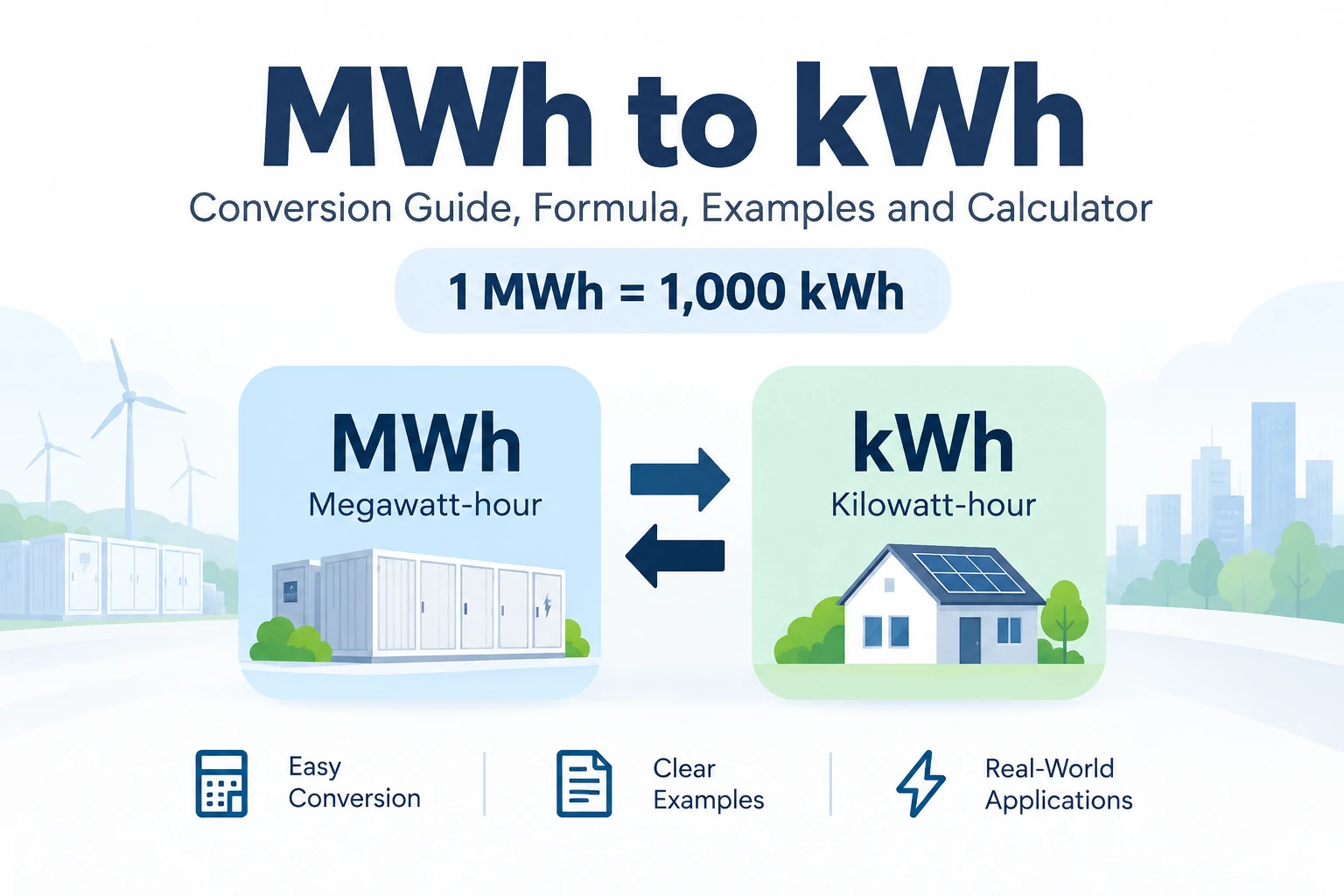
1 MWh equals exactly 1,000 kWh, so converting MWh to kWh is simple: multiply the number of megawatt-hours by 1,000; for example, 2.5 MWh equals 2,500 kWh, while converting in the opposite direction requires dividing the kWh value by 1,000.
The basic formula is:
kWh = MWh × 1,000
So:
- 1 MWh = 1,000 kWh
- 0.5 MWh = 500 kWh
- 2 MWh = 2,000 kWh
- 10 MWh = 10,000 kWh
If you are working with batteries, solar projects or electricity bills, Avepower’s guide explaining what kWh means in electricity and battery storage provides additional context on how the unit is used in real energy systems.
MWh to kWh Calculator
Convert megawatt-hours (MWh) to kilowatt-hours (kWh) instantly.
How Do You Convert MWh to kWh?
To convert MWh to kWh, multiply the megawatt-hour value by 1,000 because the difference between the SI prefixes mega and kilo is a factor of 1,000; no information about voltage, current, system efficiency or operating time is required for this unit conversion.
Use:
Energy (kWh) = Energy (MWh) × 1,000
Example 1: Convert 1 MWh to kWh
Start with:
1 MWh
Multiply by 1,000:
1 × 1,000 = 1,000
Result: 1 MWh = 1,000 kWh
Example 2: Convert 2.5 MWh to kWh
2.5 × 1,000 = 2,500
Result: 2.5 MWh = 2,500 kWh
Example 3: Convert 12.75 MWh to kWh
12.75 × 1,000 = 12,750
Result: 12.75 MWh = 12,750 kWh
The same multiplication factor works for integers, decimals and very large utility-scale energy values.
MWh to kWh Conversion Chart
| Megawatt-hours (MWh) | Kilowatt-hours (kWh) |
|---|---|
| 0.001 MWh | 1 kWh |
| 0.01 MWh | 10 kWh |
| 0.1 MWh | 100 kWh |
| 0.2 MWh | 200 kWh |
| 0.25 MWh | 250 kWh |
| 0.5 MWh | 500 kWh |
| 1 MWh | 1,000 kWh |
| 2 MWh | 2,000 kWh |
| 2.5 MWh | 2,500 kWh |
| 5 MWh | 5,000 kWh |
| 10 MWh | 10,000 kWh |
| 20 MWh | 20,000 kWh |
| 50 MWh | 50,000 kWh |
| 100 MWh | 100,000 kWh |
For the reverse conversion:
MWh = kWh ÷ 1,000
Therefore, 500 kWh equals 0.5 MWh, while 5,000 kWh equals 5 MWh.
Why Does 1 MWh Equal 1,000 kWh?
One MWh equals 1,000 kWh because mega represents 10⁶ while kilo represents 10³, creating a difference of 10³ or 1,000; the “hour” portion remains unchanged, so the conversion depends entirely on the relationship between megawatts and kilowatts.
The prefix relationship is:
mega = 1,000,000
kilo = 1,000
Therefore:
1,000,000 ÷ 1,000 = 1,000
This gives:
1 MW = 1,000 kW
When both power values operate for the same one-hour period:
1 MWh = 1,000 kWh
What Is the Difference Between MWh and kWh?
MWh and kWh measure the same physical quantity—energy—but at different scales: kWh is convenient for homes, small solar systems and individual battery products, whereas MWh is more practical for commercial, industrial, grid-scale and other large energy-storage or electricity-generation applications.
A useful way to compare them is:
| Unit | Full Name | Equivalent | Typical Use |
|---|---|---|---|
| Wh | Watt-hour | 1 Wh | Small electronics |
| kWh | Kilowatt-hour | 1,000 Wh | Homes, solar, batteries |
| MWh | Megawatt-hour | 1,000 kWh | C&I BESS, microgrids, utilities |
| GWh | Gigawatt-hour | 1,000 MWh | Large grids and generation |
For battery applications, battery capacity may be expressed in Ah, Wh, kWh or MWh depending on system scale.
A 10 kWh residential battery, for instance, could also be described as 0.01 MWh, but kWh is easier to read at that scale.
A 5 MWh commercial energy storage system could technically be described as 5,000 kWh, although MWh is usually more convenient in project specifications.
Is MWh the Same as MW?
MWh and MW are not interchangeable: MW measures power—the rate at which electricity is generated, delivered or consumed—while MWh measures energy accumulated over time, so converting MW directly into MWh requires knowing how long the stated power level is maintained.
Use:
Energy = Power × Time
For example:
2 MW × 3 hours = 6 MWh
Then:
6 MWh × 1,000 = 6,000 kWh
A battery described as 2 MW / 4 MWh therefore has two different ratings:
| Specification | Meaning |
|---|---|
| 2 MW | Maximum or specified power output |
| 4 MWh | Stored energy capacity |
| 2-hour duration | 4 MWh ÷ 2 MW |
How Is MWh to kWh Conversion Used in Battery Storage?
MWh-to-kWh conversion is especially useful in battery storage because utility or tender documents often specify total project capacity in MWh, while individual battery cabinets, modules and performance calculations are commonly expressed in kWh, requiring both units to be placed on the same scale before sizing equipment.
Suppose a project requires:
2.5 MWh
Convert it first:
2.5 × 1,000 = 2,500 kWh
If each battery cabinet provides 250 kWh of nominal energy:
2,500 ÷ 250 = 10 cabinets
Avepower explains this distinction further in its guide to nominal battery energy and usable kWh and its technical overview of battery efficiency and round-trip losses.
Real Battery Storage Examples: Converting kWh Projects to MWh
Systems below about one megawatt-hour are often presented in kWh for precision, but converting them to MWh makes comparisons with larger commercial and grid-scale specifications easier while leaving the underlying stored-energy quantity unchanged.
Case 1: 522.496 kWh High-Voltage ESS
Avepower’s Lithuanian high-voltage project is rated at 522.496 kWh with an 832 V nominal DC architecture.
Convert kWh to MWh:
522.496 ÷ 1,000 = 0.522496 MWh
See the 522.496 kWh high-voltage ESS case study for the complete system configuration.
Case 2: 640 kWh Hotel Solar BESS
A hotel solar-storage project uses 640 kWh of battery capacity across 20 × 32 kWh battery units.
640 ÷ 1,000 = 0.64 MWh
The project illustrates how commercial batteries can combine solar storage, backup power and peak management. See the 640 kWh hotel solar BESS project.
Case 3: 215 kWh Commercial Energy Storage
A 215 kWh battery system converts to:
215 ÷ 1,000 = 0.215 MWh
Avepower also documents a 215 kWh liquid-cooled C&I energy storage project.
Case 4: 693.312 kWh High-Voltage ESS
693.312 ÷ 1,000 = 0.693312 MWh
For a larger high-voltage example, see Avepower’s 693 kWh high-voltage ESS case study.
These examples demonstrate that kWh can provide convenient project-level precision even when the same systems are approaching the MWh scale.
Quick Reference: MWh to kWh Formulas
Multiply MWh by 1,000 to obtain kWh and divide kWh by 1,000 to obtain MWh.
| Calculation | Formula |
|---|---|
| MWh to kWh | kWh = MWh × 1,000 |
| kWh to MWh | MWh = kWh ÷ 1,000 |
| MW to MWh | MWh = MW × hours |
| kW to kWh | kWh = kW × hours |
Key answer: 1 MWh = 1,000 kWh.
Converting MWh to kWh for Your Energy Storage Project
The mathematical conversion is simple—1 MWh always equals 1,000 kWh—but choosing a battery system requires additional engineering around usable capacity, required kW output, backup duration, voltage, PCS configuration, battery efficiency, communications, safety requirements and future expansion.
Avepower develops LiFePO4 energy storage solutions for residential, commercial, industrial and custom high-voltage applications, with project configurations ranging from individual kWh-scale batteries to larger high-voltage ESS installations. Its public project portfolio includes systems such as 215 kWh, 522.496 kWh, 640 kWh and 693.312 kWh.
If you already know your target capacity in MWh, convert it to kWh first, then combine that figure with your load profile, required power, backup duration, solar generation, inverter or PCS requirements and expected operating conditions.
Planning a commercial or high-voltage battery project? Explore Avepower’s custom battery and OEM/ODM engineering services or contact the Avepower team with your required MWh/kWh capacity, load data, system voltage and application requirements to receive a project-specific storage configuration.
FAQ
There are exactly 1,000 kWh in 1 MWh.
2 × 1,000 = 2,000 kWh.
5 × 1,000 = 5,000 kWh.
10 × 1,000 = 10,000 kWh.
Divide the kWh value by 1,000. For example: 2,500 kWh ÷ 1,000 = 2.5 MWh.
No. MWh means megawatt-hour, whereas mWh technically means milliwatt-hour. SI prefix capitalization matters.
Yes in nominal energy capacity: both describe the same amount of stored energy. However, actual usable or delivered energy can be lower depending on operating limits and system losses.