
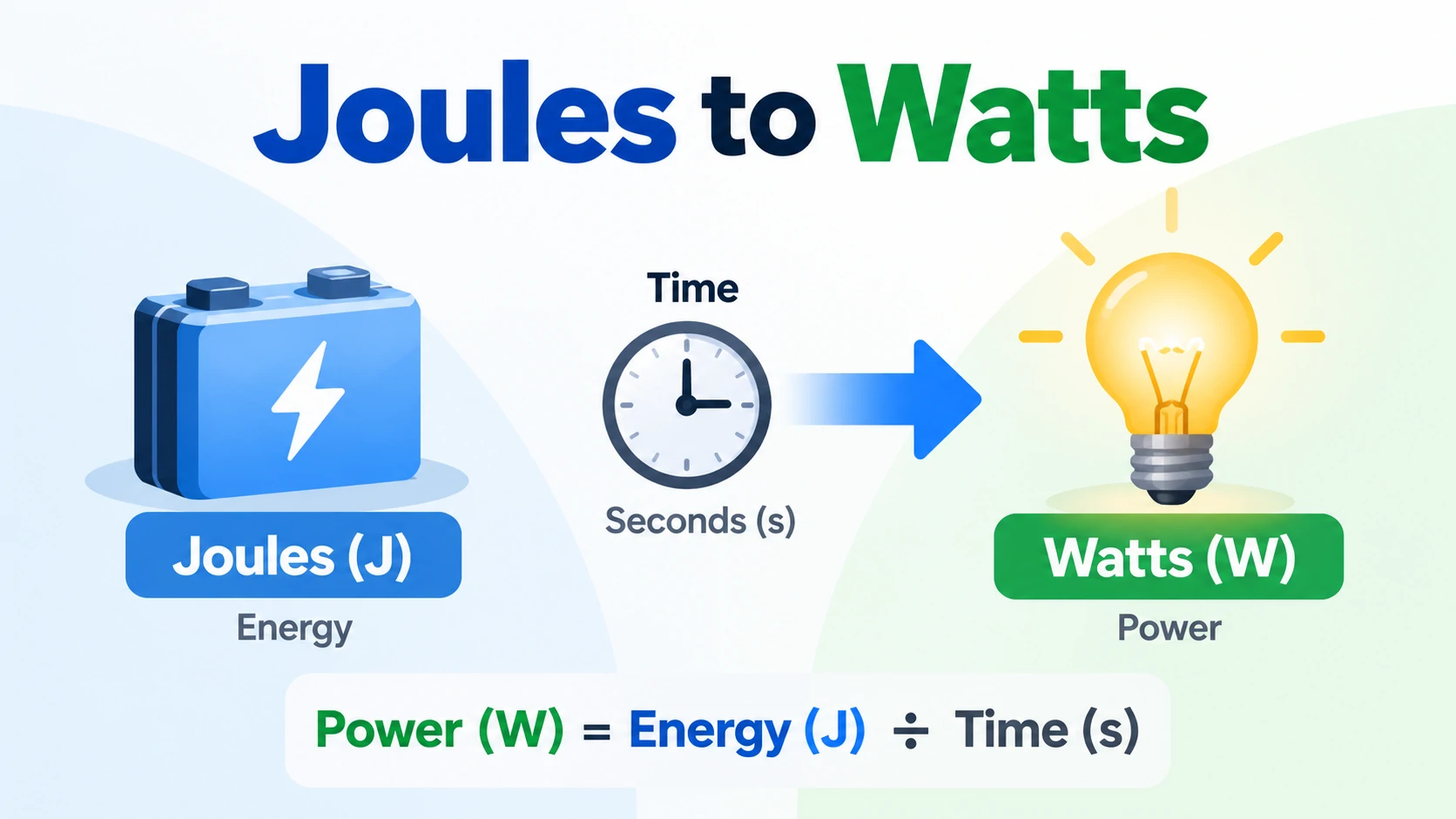
To convert joules to watts, you must know how long the energy is transferred or used. Divide energy in joules by time in seconds:
Power (W) = Energy (J) ÷ Time (s)
For example, 1,000 joules delivered over 10 seconds equals 100 watts. There is no single watt value for 1,000 joules unless the time interval is known, because joules measure energy while watts measure the rate of energy transfer.
Joules to Watts Calculator
Enter energy in joules and the time over which the energy is transferred to calculate power in watts.
How Do You Convert Joules to Watts?
Convert joules to watts by dividing the total energy by the elapsed time in seconds. The result is the average power over that time interval, not necessarily the maximum or instantaneous power reached during the event.
Formula:
P = E ÷ t
Where:
| Symbol | Meaning | Unit |
|---|---|---|
| P | Average power | watts (W) |
| E | Energy transferred or consumed | joules (J) |
| t | Time interval | seconds (s) |
Example:
1,500 J ÷ 5 s = 300 W
So if 1,500 joules of energy are transferred over five seconds, the average power is 300 watts.
Joules to Watts Conversion Table: 200 J to 4,000 J
Assuming the energy is transferred in 1 second: Watts = Joules ÷ 1 second.
| Joules | Time | Watts |
|---|---|---|
| 200 J | 1 second | 200 W |
| 360 J | 1 second | 360 W |
| 500 J | 1 second | 500 W |
| 600 J | 1 second | 600 W |
| 900 J | 1 second | 900 W |
| 1,000 J | 1 second | 1,000 W |
| 1,080 J | 1 second | 1,080 W |
| 1,200 J | 1 second | 1,200 W |
| 1,500 J | 1 second | 1,500 W |
| 1,800 J | 1 second | 1,800 W |
| 2,100 J | 1 second | 2,100 W |
| 2,400 J | 1 second | 2,400 W |
| 2,700 J | 1 second | 2,700 W |
| 3,000 J | 1 second | 3,000 W |
| 4,000 J | 1 second | 4,000 W |
Why Can't You Convert Joules to Watts Without Time?
You cannot convert joules directly to watts because the two units measure different physical quantities. A joule measures a quantity of energy; a watt measures how quickly energy is transferred, generated or consumed.
Consider the same 1,000 joules:
| Energy | Time | Average Power |
|---|---|---|
| 1,000 J | 0.1 s | 10,000 W |
| 1,000 J | 1 s | 1,000 W |
| 1,000 J | 10 s | 100 W |
| 1,000 J | 60 s | 16.67 W |
| 1,000 J | 3,600 s | 0.278 W |
Nothing about the amount of energy changed. Only the delivery time changed.
Is One Joule Equal to One Watt?
One joule is not generally equal to one watt. One joule transferred in exactly one second corresponds to an average power of one watt.
The correct relationship is:
1 W = 1 J/s
and:
1 J = 1 W·s
Joules to Watts Conversion Examples
The correct watt value always depends on both energy and time. Before calculating, convert milliseconds, minutes or hours into seconds so that the units remain consistent.
| Example | Calculation | Average Power |
|---|---|---|
| 100 J in 1 second | 100 ÷ 1 | 100 W |
| 500 J in 5 seconds | 500 ÷ 5 | 100 W |
| 1,000 J in 10 seconds | 1,000 ÷ 10 | 100 W |
| 3,600 J in 60 seconds | 3,600 ÷ 60 | 60 W |
| 36,000 J in 60 seconds | 36,000 ÷ 60 | 600 W |
| 3,600 J in 1 hour | 3,600 ÷ 3,600 | 1 W |
| 3.6 MJ in 1 hour | 3,600,000 ÷ 3,600 | 1,000 W |
Does Joules ÷ Seconds Give Average or Peak Power?
Dividing total joules by total seconds gives average power across the selected interval. It does not automatically tell you the instantaneous maximum power, startup surge or short-duration peak power.
For a time interval:
Average Power = ΔE ÷ Δt
For a continuously changing process, instantaneous power is expressed conceptually as:
P(t) = dE/dt
This matters whenever energy is not transferred at a constant rate.
For example, a motor may have a moderate average power requirement but draw substantially more power during startup. Likewise, a pulse event may release most of its energy during only a small fraction of the measurement window.
What Is the Difference Between Joules, Watts, Watt-Hours and kWh?
Joules, watt-hours and kilowatt-hours measure energy, while watts and kilowatts measure power. Separating those two categories prevents many battery, solar and electrical sizing errors.
| Unit | Measures | Meaning | Typical Use |
|---|---|---|---|
| Joule (J) | Energy | Quantity of transferred energy | Physics, engineering, pulse energy |
| Watt (W) | Power | Joules transferred per second | Appliances, electrical loads |
| Watt-hour (Wh) | Energy | One watt sustained for one hour | Small batteries |
| Kilowatt (kW) | Power | 1,000 watts | Inverters, motors, larger loads |
| Kilowatt-hour (kWh) | Energy | 1,000 Wh | Batteries, solar production, electricity use |
For battery and solar applications, Avepower's kW vs kWh guide explains this distinction in more detail.
How Do You Convert Joules to Watt-Hours?
Convert joules to watt-hours by dividing by 3,600 because one hour contains 3,600 seconds and one watt equals one joule per second.
Wh = J ÷ 3,600
Therefore:
1 Wh = 3,600 J
Examples:
| Joules | Watt-Hours |
|---|---|
| 3,600 J | 1 Wh |
| 36,000 J | 10 Wh |
| 360,000 J | 100 Wh |
| 3,600,000 J | 1,000 Wh = 1 kWh |
| 36,000,000 J | 10 kWh |
For battery calculations, see Avepower's battery watt-hour calculation guide.
How Do You Convert Joules to Kilowatt-Hours?
Convert joules to kilowatt-hours by dividing by 3,600,000.
kWh = J ÷ 3,600,000
The reverse calculation is:
J = kWh × 3,600,000
For example:
36,000,000 J ÷ 3,600,000 = 10 kWh
How Does Joules-to-Watts Math Apply to Batteries?
For batteries, joules or kWh tell you how much energy is available, while watts or kW tell you how quickly the system can deliver that energy. A correct battery specification therefore needs both an energy rating and a power capability.
Consider an idealized 10 kWh battery:
10 kWh = 36,000,000 J
If it delivered that energy evenly over five hours:
36,000,000 J ÷ 18,000 s = 2,000 W
The resulting average power is 2 kW.
Avepower explains the distinction between nominal and usable battery energy in its nominal energy guide.
When Is a Joules-to-Watts Conversion Not Enough?
A joules-to-watts conversion is not enough whenever equipment selection depends on something other than average energy-transfer rate. This is especially important for batteries, inverters, motors, compressors, industrial loads and power electronics.
Check the following before making an equipment decision:
- Continuous power: the power that must be supplied for normal operation.
- Peak or surge power: short-duration demand during startup or rapid load changes.
- Usable energy: the portion of battery energy available within permitted operating limits.
- Voltage range: both the battery and inverter must operate within compatible voltage limits.
- Current limits: the BMS, cells, cables and protection equipment must support the required current.
- Conversion efficiency: energy lost in the battery, inverter, PCS, wiring and other equipment reduces usable output.
- Load variation: average power can hide large changes during a real operating cycle.
- AC power factor: for some AC loads, voltage × current alone does not equal real power unless power factor and waveform conditions are considered.
For high-voltage or commercial systems, use measured interval load data and manufacturer engineering limits rather than designing the system from a simple average-power calculation alone.
Conclusion
The correct relationship is simple:
Watts = Joules ÷ Seconds
But the practical meaning is more important than the arithmetic. Joules measure energy; watts measure the rate at which that energy is transferred. The calculation gives average power over the selected time interval, so it should not automatically be interpreted as instantaneous or peak power.
For battery and energy-storage decisions, use Wh or kWh for energy capacity and W or kW for power capability, then verify usable energy, peak demand, voltage, current, inverter or PCS limits and system efficiency.
If you are sizing a residential, commercial or industrial energy-storage system, Avepower can review your load profile, maximum kW, daily kWh, required backup time, PV capacity, inverter or PCS model, system voltage, application and project country before recommending a configuration. You can also review Avepower's energy-storage case studies and certification documentation, or submit your project requirements for a project-specific assessment.
FAQ
Yes. In SI units, one joule per second equals one watt. Therefore, a process transferring 250 joules every second has a power level of 250 watts.
Five minutes equals 300 seconds, so: 1,000 J ÷ 300 s = 3.33 W
Not from the joule rating alone. A joule rating describes an energy quantity, while watts require a defined time interval. Surge-protection performance also depends on parameters such as test waveform, clamping behavior, voltage conditions and applicable product specifications, so dividing joules by an assumed duration is not a substitute for the manufacturer's tested ratings.
Wh and kWh are energy units that map conveniently to electrical power and runtime. Because appliances are normally rated in watts or kilowatts, using Wh or kWh makes calculations such as runtime ≈ usable energy ÷ load power easier to interpret. One Wh still represents exactly 3,600 joules.
No. A 10 kWh rating tells you about stored energy, not maximum output power. You must separately check continuous discharge power, peak power, current limits, BMS limits, voltage and inverter compatibility.
Not by average watts alone. The inverter must support the expected continuous load and any relevant short-duration startup or surge load. Equipment such as pumps, motors, compressors and HVAC systems may require substantially different peak and average power levels.