
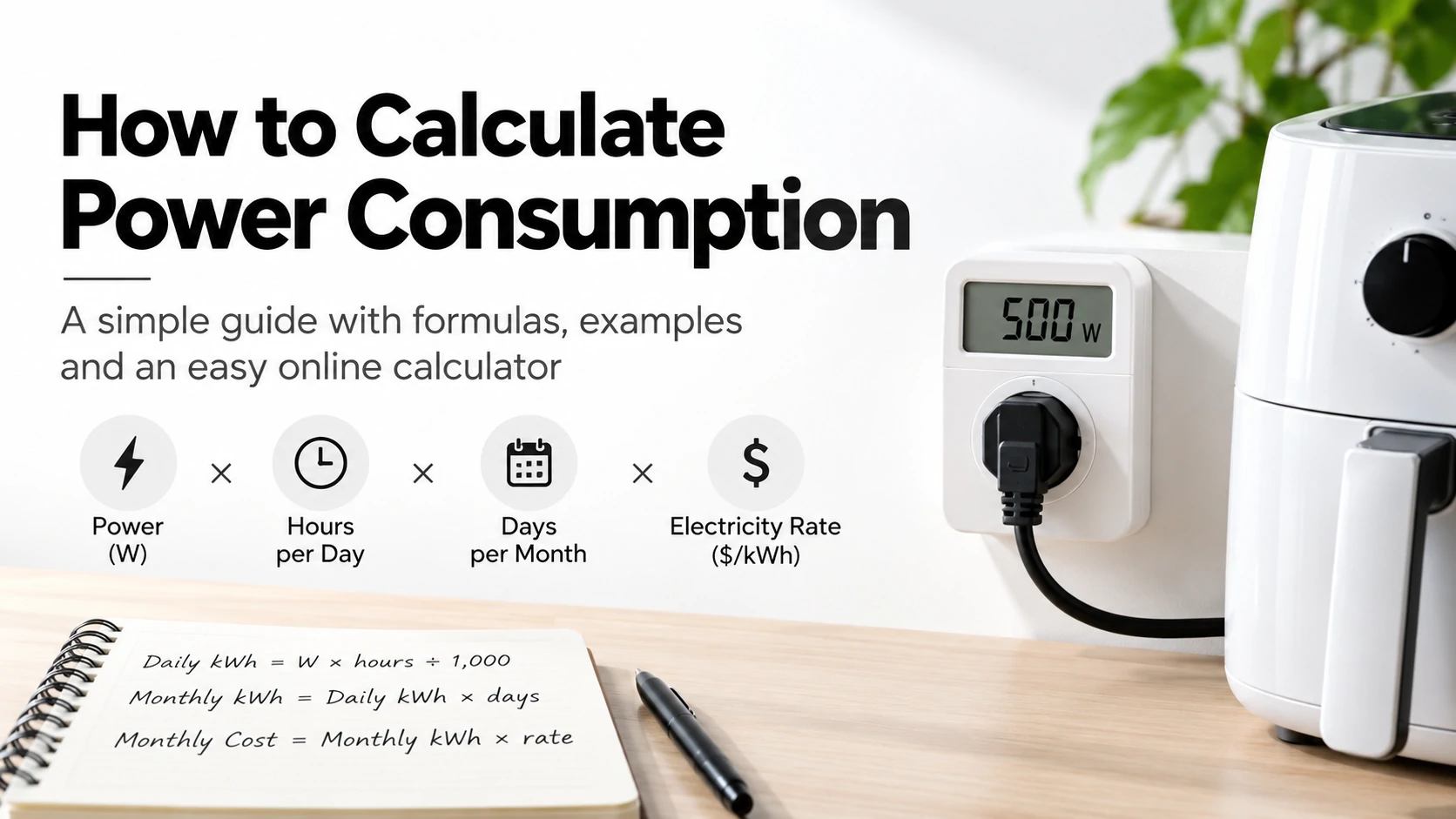
To calculate power consumption, multiply a device’s power in watts (W) by the number of hours it operates, then divide by 1,000 to get kilowatt-hours (kWh). For example, a 500W device running for 4 hours consumes 2kWh. Multiply the result by your electricity rate to estimate the energy cost. For appliances with changing power levels, use their average measured power or calculate each operating period separately.
Power consumption formula:
Energy (kWh) = Power (W) × Operating Time (hours) ÷ 1,000
You can use this calculation to estimate appliance electricity usage, understand energy bills, compare equipment efficiency and determine how much battery storage or inverter capacity a home or business may need.
What Is Power Consumption and How Is It Measured?
Power consumption describes the rate at which an electrical device uses energy, usually measured in watts (W) or kilowatts (kW). The total electricity consumed over time is measured in watt-hours (Wh) or kilowatt-hours (kWh). Power tells you how much electricity a device needs at a given moment; energy tells you how much it uses over a period.
| Unit | Meaning | Example |
|---|---|---|
| Watt (W) | Rate of electrical power | A 100W television |
| Kilowatt (kW) | 1,000 watts | A 2kW electric heater |
| Watt-hour (Wh) | Energy consumed over time | 100W used for 1 hour = 100Wh |
| Kilowatt-hour (kWh) | 1,000 watt-hours | 1kW used for 1 hour = 1kWh |
| Kilowatt-hour per day (kWh/day) | Daily energy consumption | 10kWh consumed in one day |
A high-power appliance does not necessarily use more electricity overall than a low-power device.
For example:
- A 2,000W heater running for 30 minutes consumes 1kWh.
- A 100W device running for 10 hours also consumes 1kWh.
Both consume the same energy, although their instantaneous power requirements are very different.
How Do You Calculate Power Consumption in kWh?
To calculate electricity consumption in kWh, identify the device’s actual or estimated power, multiply it by the operating hours and divide by 1,000. For monthly or yearly estimates, multiply the daily energy consumption by the number of operating days. This method is most accurate when power remains relatively constant.
Step 1: Find the appliance wattage
Check the appliance nameplate, instruction manual, manufacturer specifications or an appropriate power meter.
For example, assume an appliance consumes a steady 1,200W while operating.
Step 2: Record the operating time
Suppose the appliance runs for 3 hours per day.
Its daily energy use is:
1,200W × 3 hours ÷ 1,000 = 3.6kWh/day
Step 3: Calculate monthly consumption
If the appliance operates for 30 days:
3.6kWh × 30 = 108kWh/month
Step 4: Calculate yearly consumption
If the same operating pattern continues for 365 days:
3.6kWh × 365 = 1,314kWh/year
The results can be summarized as follows:
| Period | Formula | Energy |
|---|---|---|
| 1 hour | 1,200 × 1 ÷ 1,000 | 1.2kWh |
| 3 hours | 1,200 × 3 ÷ 1,000 | 3.6kWh |
| 30 days, 3h/day | 3.6 × 30 | 108kWh |
| 365 days, 3h/day | 3.6 × 365 | 1,314kWh |
These values assume continuous 1,200W power during every stated operating hour. If the device changes power levels, its actual consumption will differ.
How Can You Find an Appliance’s Actual Power Consumption?
The most reliable way to find an appliance’s actual energy consumption is to measure its accumulated kWh over a representative operating period. A manufacturer’s wattage label provides a useful starting point, but rated or maximum input power may differ substantially from average operating power, especially for refrigerators, air conditioners and variable-speed equipment.
There are three practical methods.
Method 1: Read the appliance label
Most electrical appliances display a rated input power or electrical rating.
For example:
- Input power: 800W
- Rated voltage: 230V
- Rated current: 4A
Use a clearly stated power-input rating when available. If only voltage and current are given, the correct power calculation depends on whether the equipment operates on DC or AC and, for AC, its power factor.
Also distinguish between power input and power output. A charger rated to deliver 100W of DC output may draw more than 100W from the AC outlet because energy is lost during conversion.
Method 2: Use an electricity meter
A compatible plug-in energy meter can measure the energy consumed by appliances connected through a standard outlet.
For equipment with changing loads, record energy over an entire operating cycle or another representative period.
For example, if an appliance consumes 1.8kWh over 24 hours:
Average power = 1.8 × 1,000 ÷ 24 = 75W
This does not mean the appliance continuously draws 75W. It means its average consumption over the measurement period was equivalent to 75W.
For hardwired equipment, use appropriately installed circuit-level monitoring, equipment data or utility meter records. Electrical panel measurements should be performed using suitable equipment and qualified personnel.
Method 3: Check standardized energy labels
Some appliances have standardized labels showing estimated annual energy consumption.
For example, if a refrigerator’s verified energy label states 365kWh/year:
365 ÷ 365 = 1kWh/day
This can be more useful than multiplying compressor-rated power by 24 hours, because refrigerators cycle between operating states.
How Do You Calculate Power Consumption When Wattage Changes?
When an appliance’s power changes during operation, calculate the energy used in each operating period and add the results, or use a meter that records total kWh. Multiplying maximum rated watts by every hour of operation can considerably overestimate consumption for equipment that cycles, runs at partial load or enters standby mode.
The general calculation is:
Total Energy (kWh) = Σ [Power (W) × Time (h)] ÷ 1,000
For example, assume an air-conditioning unit operates over an eight-hour period as follows:
| Operating mode | Power | Duration | Energy |
|---|---|---|---|
| Active cooling | 1,500W | 3 hours | 4.50kWh |
| Low-power/idle mode | 60W | 5 hours | 0.30kWh |
| Total | — | 8 hours | 4.80kWh |
Using 1,500W continuously for eight hours would produce an estimate of 12kWh.
However, the assumed operating pattern gives:
4.5 + 0.3 = 4.8kWh
How Do You Calculate Total Household Power Consumption?
To estimate household electricity consumption, calculate the daily kWh used by each appliance and add the results. Include device quantities, operating time and realistic average power. The result can help identify major electricity users, estimate monthly energy costs and establish an initial energy budget for solar or home battery storage.
Example: Daily electricity consumption of selected household appliances
The following is a hypothetical household load worksheet. All power values and usage times are assumptions for calculation purposes, not measured national averages.
| Appliance | Quantity | Assumed average power | Hours/day | Daily energy |
|---|---|---|---|---|
| LED lights | 6 | 10W each | 5 | 0.300kWh |
| Laptop | 1 | 65W | 6 | 0.390kWh |
| Television | 1 | 100W | 4 | 0.400kWh |
| Refrigerator | 1 | 50W average | 24 | 1.200kWh |
| Wi-Fi router | 1 | 12W | 24 | 0.288kWh |
| Electric fans | 2 | 70W each | 6 | 0.840kWh |
| Total | 3.418kWh |
Daily electricity use
Total energy = 3.418kWh/day
Monthly electricity use
Assuming the same use for 30 days:
3.418 × 30 = 102.54kWh/month
Monthly electricity cost
At an illustrative electricity rate of $0.20/kWh:
102.54 × $0.20 = $20.51 per month
How Do You Calculate Electricity Cost from Power Consumption?
Electricity energy cost is calculated by multiplying consumption in kWh by the applicable electricity rate per kWh. For a fixed-price tariff, the calculation is straightforward. For time-of-use, tiered or commercial tariffs, costs must be calculated using the relevant billing periods and pricing conditions.
Electricity energy cost = Energy consumed (kWh) × Energy rate ($/kWh)
For example, a 1,200W appliance operating three hours daily consumes:
1.2 × 3 = 3.6kWh/day
At an assumed rate of $0.20/kWh:
3.6 × $0.20 = $0.72/day
For 30 days:
$0.72 × 30 = $21.60/month
How do time-of-use electricity rates affect cost?
With time-of-use pricing, electricity consumed during peak periods may cost more than electricity consumed off-peak.
Calculate each period separately:
Total energy cost = Σ (kWh consumed in each tariff period × applicable rate)
For example, moving an appliance’s operation to a cheaper period may reduce cost without changing its total energy consumption.
However, not every appliance can be shifted without affecting comfort, operations or other constraints.
How much can a lower-power appliance save?
Suppose an existing device consumes 1,200W while operating three hours per day, and a replacement consumes 800W for the same three hours while providing the required service.
Daily energy saved:
(1,200 − 800) × 3 ÷ 1,000 = 1.2kWh
Monthly energy saved over 30 days:
1.2 × 30 = 36kWh
At $0.20/kWh:
36 × $0.20 = $7.20 per month
How Do You Calculate Power Consumption for a Business or Factory?
Commercial electricity analysis requires both total energy consumption in kWh and peak power demand in kW. Energy consumption helps estimate usage charges, while peak demand may affect utility demand charges and electrical equipment sizing. A business should use interval meter data where possible instead of relying only on connected equipment nameplate ratings.
Example: A one-hour commercial load profile
Assume a facility has the following average demand in four consecutive 15-minute intervals:
| Interval | Average demand | Duration | Energy consumed |
|---|---|---|---|
| 00–15 minutes | 10kW | 0.25h | 2.50kWh |
| 15–30 minutes | 30kW | 0.25h | 7.50kWh |
| 30–45 minutes | 20kW | 0.25h | 5.00kWh |
| 45–60 minutes | 40kW | 0.25h | 10.00kWh |
| Total | 1 hour | 25.00kWh |
Total energy consumption during the hour is:
2.5 + 7.5 + 5 + 10 = 25kWh
Average power over the hour is:
25kWh ÷ 1 hour = 25kW
The highest 15-minute average demand is:
40kW
These three values describe different things:
- 25kWh: energy consumed during the hour
- 25kW: average power over the hour
- 40kW: highest 15-minute average demand in this example
How can battery storage reduce peak power demand?
An energy storage system can discharge during high-load intervals to reduce electricity imported from the grid, provided its power capacity, state of charge and controls are sufficient.
Using the previous example, suppose the facility wants to limit grid demand to 25kW.
The battery would need to provide:
| Original load | Target grid demand | Battery output | Duration | Energy delivered |
|---|---|---|---|---|
| 30kW | 25kW | 5kW | 15 minutes | 1.25kWh |
| 40kW | 25kW | 15kW | 15 minutes | 3.75kWh |
| Total | 5.00kWh |
For these intervals, the battery must deliver 5kWh of AC energy, with a maximum required discharge power of 15kW.
What Are the Most Common Power Consumption Calculation Mistakes?
The most common mistakes are confusing watts with kilowatt-hours, treating maximum input wattage as constant operating power, overlooking equipment duty cycles and calculating storage capacity without checking output power. These errors can lead to incorrect electricity cost forecasts, oversized systems or battery and inverter combinations that cannot support the intended loads.
| Mistake | Why it matters | Better approach |
|---|---|---|
| Confusing kW with kWh | Power and energy answer different questions | Calculate power requirements and energy separately |
| Using maximum wattage for every hour | Can overestimate variable-load consumption | Use measured average power or operating intervals |
| Ignoring appliance quantity | Underestimates total consumption | Multiply energy by the number of devices |
| Treating V × A as AC real power | Ignores power factor | Apply the correct AC formula or measure real watts |
| Using the wrong electricity rate | Produces misleading operating costs | Use actual applicable tariff information |
| Ignoring inverter losses | Underestimates battery capacity | Include supported discharge efficiency assumptions |
| Ignoring simultaneous loads | Can undersize inverter output | Calculate realistic maximum concurrent demand |
| Ignoring battery operating limits | A high kWh rating may not deliver sufficient kW | Verify voltage, current and BMS limits |
How Can Avepower Help You Select the Right Energy Storage System?
After calculating power consumption, you can use your daily kWh, maximum kW and required backup duration to develop an initial battery storage specification. Avepower provides LiFePO4 battery systems and OEM/ODM energy storage configuration support for residential, commercial and industrial projects, subject to model-specific engineering and system compatibility checks.
For commercial projects, Avepower’s Commercial and Industrial Energy Storage Solutions include published battery and power configurations that can serve as starting points for technical evaluation.
To request a project-specific configuration, provide:
- Project country and application
- Recent electricity bills or interval load data
- Daily or monthly electricity consumption in kWh
- Maximum demand and critical-load power in kW
- Required backup duration
- Solar PV capacity, if applicable
- Existing inverter or PCS model
- Installation environment and expected project quantity
Contact Avepower for an Energy Storage Configuration
The final design should be confirmed against measured electrical demand, operating conditions, model-specific specifications, applicable regulations and project economics before purchasing equipment.
FAQ
A 1,000W appliance uses 24kWh if it draws 1,000W continuously for 24 hours. If its operating power changes or it runs for only part of the day, actual electricity consumption will be lower or different. Use measured kWh for equipment that cycles or varies its power.
Yes. Divide the billed kWh by the number of days to estimate average daily consumption. To calculate average power in kW for the full billing period, divide total kWh by the number of hours. This provides an average, not the highest instantaneous or billing-interval demand.
Use a compatible electricity meter to measure the device’s kWh over a representative period, or check its documentation and applicable energy label. If only voltage and current are available, calculate power using the appropriate DC or AC formula, including power factor where necessary.
No. A daily consumption of 10kWh describes the total electrical energy used in 24 hours. A 10kW load describes power at a particular time. A facility could consume 10kWh at many different power levels and operating durations, which is why energy capacity and inverter power must be evaluated independently.