
To convert mAh to Wh, multiply the battery capacity in milliamp-hours by its nominal voltage, then divide by 1,000. For example, a 10,000mAh battery rated at 3.7V stores approximately 37Wh. You cannot accurately convert mAh to Wh unless you also know the battery voltage.
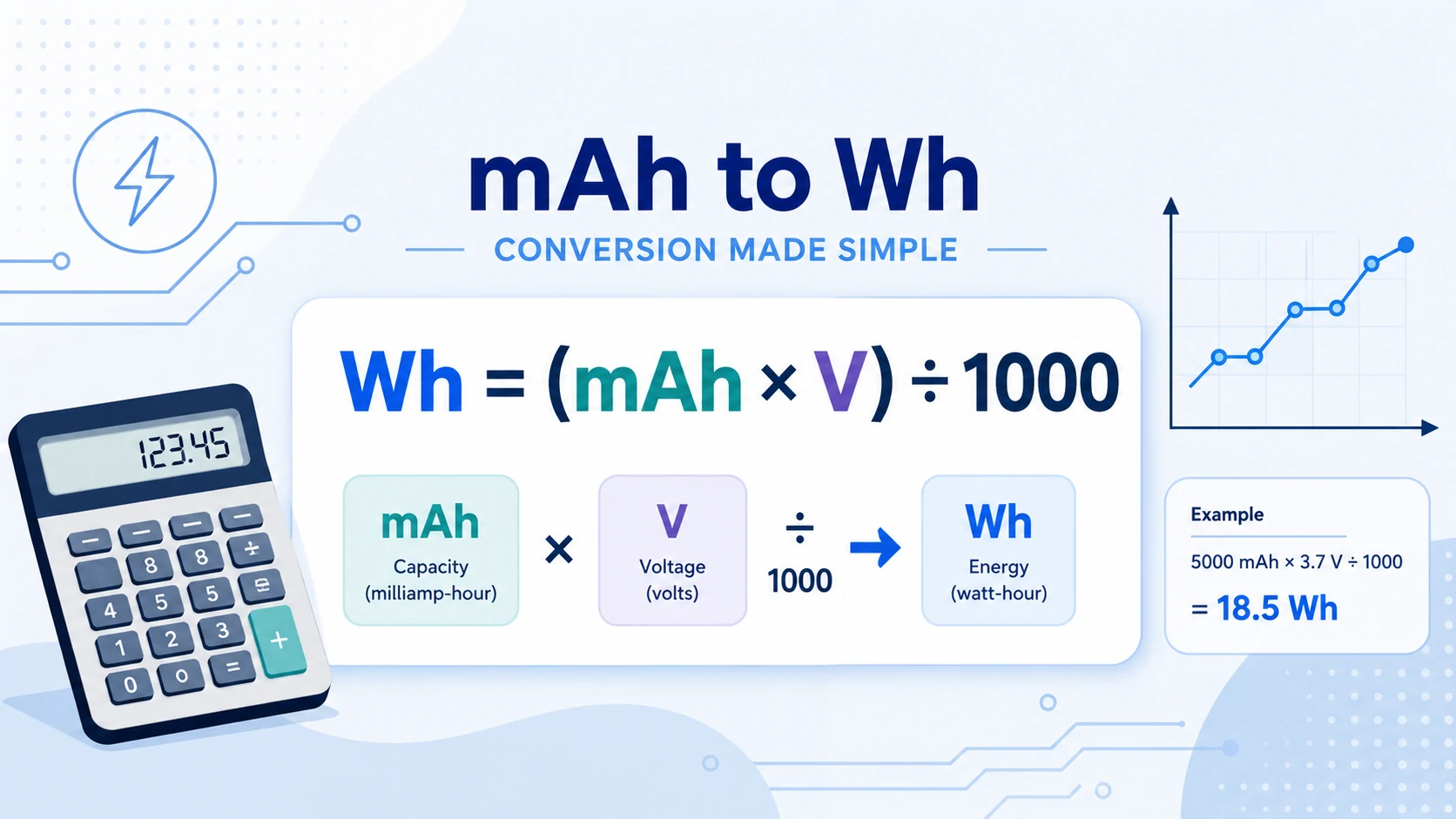
mAh to Wh formula:
Wh = (mAh × V) ÷ 1,000
Example:
10,000mAh × 3.7V ÷ 1,000 = 37Wh
The calculation itself is simple. You can use our free online mAh to Wh converter to calculate it.
This guide explains how to calculate watt-hours correctly, which voltage to use for lithium-ion and LiFePO4 batteries, how common capacities compare, and why nominal Wh is not always the same as usable energy.
How Do You Convert mAh to Wh?
To convert mAh to Wh correctly, first identify the battery’s rated milliamp-hour capacity and nominal voltage. Multiply those two values and divide by 1,000; the result represents the battery’s approximate nominal stored energy in watt-hours.
The formula is:
Wh = mAh × Voltage ÷ 1,000
Where:
- mAh = milliamp-hours, a measure of electric charge
- V = battery nominal voltage in volts
- Wh = watt-hours, a measure of electrical energy
- 1,000 = conversion factor between mAh and Ah
A second way to understand the calculation is:
mAh ÷ 1,000 = Ah
Then:
Ah × V = Wh
So a 5,000mAh, 3.7V battery becomes:
5,000mAh ÷ 1,000 = 5Ah
5Ah × 3.7V = 18.5Wh
For a deeper explanation of Ah and battery charge capacity, see Avepower’s guide to ampere-hours (Ah).
Why Do You Need Voltage to Convert mAh to Wh?
You need voltage because mAh measures electric charge while Wh measures energy, so two batteries with exactly the same mAh rating can contain very different amounts of usable energy when their operating voltages are different.
Consider two 10,000mAh batteries:
| Battery | Capacity | Nominal Voltage | Nominal Energy |
|---|---|---|---|
| Battery A | 10,000mAh | 3.2V | 32Wh |
| Battery B | 10,000mAh | 3.7V | 37Wh |
| Battery C | 10,000mAh | 12V | 120Wh |
All three batteries have the same charge capacity in mAh, but Battery C stores almost four times as much nominal energy as Battery A.
For broader battery comparisons, Wh or kWh is normally more meaningful. Avepower’s battery capacity guide covering Ah, Wh and kWh explains this relationship in more detail.
mAh to Wh Conversion Chart
| Capacity | At 3.2V | At 3.7V | At 5V |
|---|---|---|---|
| 1,000mAh | 3.2Wh | 3.7Wh | 5Wh |
| 2,000mAh | 6.4Wh | 7.4Wh | 10Wh |
| 5,000mAh | 16Wh | 18.5Wh | 25Wh |
| 10,000mAh | 32Wh | 37Wh | 50Wh |
| 20,000mAh | 64Wh | 74Wh | 100Wh |
| 26,800mAh | 85.76Wh | 99.16Wh | 134Wh |
| 27,000mAh | 86.4Wh | 99.9Wh | 135Wh |
| 30,000mAh | 96Wh | 111Wh | 150Wh |
| 50,000mAh | 160Wh | 185Wh | 250Wh |
How Many Wh Is 10,000mAh?
A 10,000mAh battery equals 37Wh at 3.7V, 32Wh at 3.2V, or 50Wh at 5V.
For a typical 3.7V lithium-ion rating:
10,000 × 3.7 ÷ 1,000 = 37Wh
How Many Wh Is 20,000mAh?
A 20,000mAh battery rated at 3.7V contains approximately 74Wh of nominal energy, while the same 20,000mAh rating at 3.2V would equal 64Wh and at a true 5V rating would equal 100Wh.
At 3.7V:
20,000 × 3.7 ÷ 1,000 = 74Wh
How Many Wh Is 27,000mAh?
A 27,000mAh lithium-ion battery rated at 3.7V converts to 99.9Wh.
Calculation:
27,000 × 3.7 ÷ 1,000 = 99.9Wh
What Is the Difference Between mAh, Ah, Wh and kWh?
| Unit | Measures | Common Uses |
|---|---|---|
| mAh | Electric charge | Phones, small cells, power banks |
| Ah | Electric charge | RV, marine, LiFePO4 batteries |
| Wh | Electrical energy | Laptops, power banks, portable batteries |
| kWh | Electrical energy | Home batteries, solar storage, BESS |
| W | Power | Device consumption or battery output rate |
| kW | Power | Inverters, large loads, ESS output |
Useful conversions include:
1Ah = 1,000mAh
1kWh = 1,000Wh
Wh = Ah × V
kWh = Ah × V ÷ 1,000
Avepower also provides a detailed nominal battery energy guide covering the difference between energy, capacity and power.
Can You Convert Wh Back to mAh?
Yes. To convert Wh back to mAh, multiply the watt-hours by 1,000 and divide by the battery voltage; as with the forward conversion, a voltage value is required.
The reverse formula is:
mAh = Wh × 1,000 ÷ V
Example:
A 74Wh battery at 3.7V:
74 × 1,000 ÷ 3.7 = 20,000mAh
For example, 100Wh equals:
- 31,250mAh at 3.2V
- About 27,027mAh at 3.7V
- 20,000mAh at 5V
- 7,812.5mAh at 12.8V
Conclusion: mAh to Wh in One Formula
The reliable way to convert mAh to Wh is Wh = mAh × nominal voltage ÷ 1,000.
For battery engineering, system sizing or product comparison, also distinguish nominal energy from usable energy, confirm the battery's voltage architecture, and account for BMS and conversion losses.
For LiFePO4 battery projects, Avepower offers LiFePO4 battery solutions covering 12V, 24V and larger energy-storage applications, while its technical library provides supporting guides on battery capacity, voltage, efficiency and system configuration.
FAQ
At 3.7V, 1,000mAh equals 3.7Wh. At 3.2V it equals 3.2Wh, and at 5V it equals 5Wh. The battery voltage must therefore be specified.
A 5,000mAh battery at 3.7V equals 18.5Wh because 5,000 × 3.7 ÷ 1,000 = 18.5. A 5,000mAh battery at another voltage will have a different Wh value.
10,000mAh at 3.7V equals 37Wh. Divide 10,000mAh by 1,000 to obtain 10Ah, then multiply 10Ah by 3.7V.
20,000mAh at 3.7V equals 74Wh. This is a common nominal energy figure for large portable power banks.
At exactly 3.7V, 27,000mAh equals 99.9Wh. Do not assume that every 27,000mAh battery is 99.9Wh, however, because the answer changes with the rated voltage.
No. Wh and mAh measure different quantities. At 1V, 1Wh corresponds mathematically to 1,000mAh, but at 3.7V it corresponds to about 270mAh. Voltage must be included.