
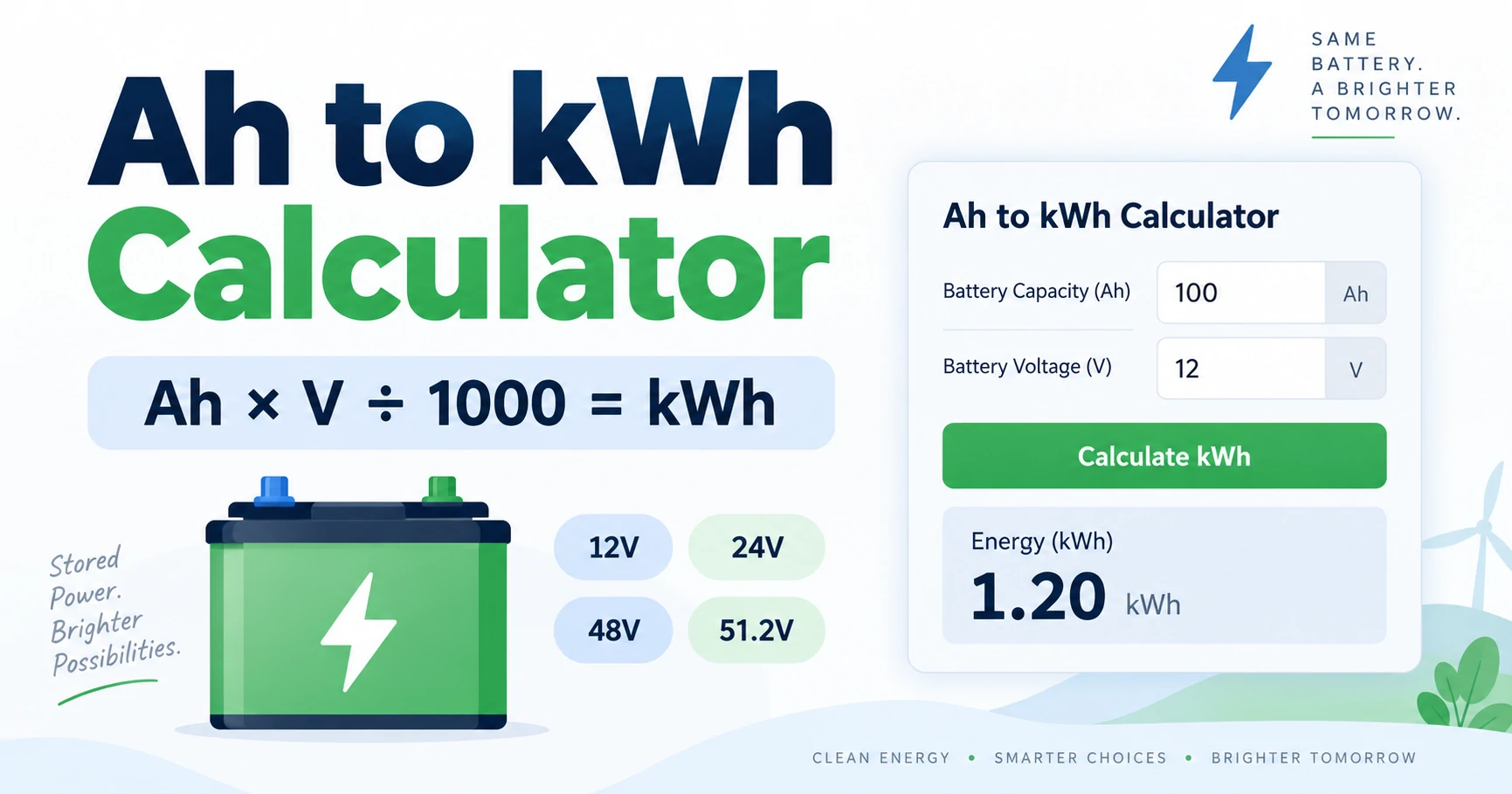
To convert amp hours (Ah) to kilowatt-hours (kWh), multiply the battery capacity in Ah by its nominal voltage, then divide by 1,000. A 100Ah battery stores about 1.2kWh at 12V, 4.8kWh at 48V, or 5.12kWh at 51.2V.
Ah to kWh formula:
kWh = Ah × V ÷ 1,000
For example:
100Ah × 51.2V ÷ 1,000 = 5.12kWh
You can also use our free online Ah to kWh calculator to quickly convert amp-hours (Ah) into kilowatt-hours (kWh).
Ah to kWh Calculator
kWh = Ah × V ÷ 1000
How Do You Convert Ah to kWh?
Convert Ah to kWh by multiplying the battery's amp-hour capacity by its nominal voltage and dividing by 1,000. Always use the voltage associated with the same battery or battery bank whose Ah rating you are converting.
The calculation is:
Energy (kWh) = Capacity (Ah) × Nominal Voltage (V) ÷ 1,000
The logic comes from two unit conversions:
Ah × V = Wh
and:
Wh ÷ 1,000 = kWh
Therefore:
Ah × V ÷ 1,000 = kWh
Example: 100Ah 12V Battery
100Ah × 12V = 1,200Wh
1,200Wh ÷ 1,000 = 1.2kWh
Example: 100Ah 48V Battery
100Ah × 48V = 4,800Wh
4,800Wh ÷ 1,000 = 4.8kWh
Example: 100Ah 51.2V LiFePO4 Battery
100Ah × 51.2V = 5,120Wh
5,120Wh ÷ 1,000 = 5.12kWh
For a deeper explanation of what an amp-hour actually measures, see Avepower's Ampere-Hours (Ah) battery guide.
Ah to kWh Conversion Chart
| Battery Capacity | 12V | 24V | 48V | 51.2V |
|---|---|---|---|---|
| 5Ah | 0.06kWh | 0.12kWh | 0.24kWh | 0.26kWh |
| 10Ah | 0.12kWh | 0.24kWh | 0.48kWh | 0.51kWh |
| 20Ah | 0.24kWh | 0.48kWh | 0.96kWh | 1.02kWh |
| 30Ah | 0.36kWh | 0.72kWh | 1.44kWh | 1.54kWh |
| 40Ah | 0.48kWh | 0.96kWh | 1.92kWh | 2.05kWh |
| 50Ah | 0.60kWh | 1.20kWh | 2.40kWh | 2.56kWh |
| 60Ah | 0.72kWh | 1.44kWh | 2.88kWh | 3.07kWh |
| 80Ah | 0.96kWh | 1.92kWh | 3.84kWh | 4.10kWh |
| 100Ah | 1.20kWh | 2.40kWh | 4.80kWh | 5.12kWh |
| 120Ah | 1.44kWh | 2.88kWh | 5.76kWh | 6.14kWh |
| 150Ah | 1.80kWh | 3.60kWh | 7.20kWh | 7.68kWh |
| 200Ah | 2.40kWh | 4.80kWh | 9.60kWh | 10.24kWh |
| 250Ah | 3.00kWh | 6.00kWh | 12.00kWh | 12.80kWh |
| 280Ah | 3.36kWh | 6.72kWh | 13.44kWh | 14.34kWh |
| 300Ah | 3.60kWh | 7.20kWh | 14.40kWh | 15.36kWh |
| 314Ah | 3.77kWh | 7.54kWh | 15.07kWh | 16.08kWh |
| 324Ah | 3.89kWh | 7.78kWh | 15.55kWh | 16.59kWh |
| 400Ah | 4.80kWh | 9.60kWh | 19.20kWh | 20.48kWh |
| 500Ah | 6.00kWh | 12.00kWh | 24.00kWh | 25.60kWh |
| 1000Ah | 12.00kWh | 24.00kWh | 48.00kWh | 51.20kWh |
Why Do You Need Voltage to Convert Ah to kWh?
This is because amp-hours (Ah) measure a battery’s charge capacity rather than the actual amount of energy it stores. Multiplying the battery capacity in Ah by its voltage in volts (V) converts the charge capacity into energy in watt-hours (Wh), which can then be converted to kilowatt-hours (kWh).
Consider two batteries:
| Battery | Capacity | Nominal Voltage | Nominal Energy |
|---|---|---|---|
| Battery A | 100Ah | 12V | 1.20kWh |
| Battery B | 100Ah | 51.2V | 5.12kWh |
Both batteries are rated at 100Ah, but Battery B represents more than four times the nominal energy.
Avepower explains the relationship between voltage, Ah and nominal battery energy in its nominal energy guide. The guide also notes an important engineering limitation: multiplying nominal voltage by Ah provides a useful nominal-energy estimate, but actual battery voltage changes during discharge, so precise energy testing integrates voltage and current through the discharge period.
Is the Calculated kWh the Same as Usable Battery Energy?
No. Ah × voltage gives a nominal or theoretical energy figure, while usable energy depends on the battery's permitted operating window, BMS limits, depth of discharge and manufacturer specifications.
For example, suppose a battery has:
Nominal energy = 10kWh
Selected operating window = 90%
The simplified usable-energy estimate becomes:
10kWh × 0.90 = 9kWh
However, if the manufacturer already gives an official usable-energy specification, use that figure instead of applying another DoD reduction.
Otherwise, you may accidentally reduce the capacity twice.
| Metric | What It Tells You | Best Use |
|---|---|---|
| Ah | Electrical charge capacity | Comparing batteries at the same voltage |
| Nominal kWh | Rated/reference stored energy | Battery-size comparison |
| Usable kWh | Energy available inside allowed operating limits | Runtime and system sizing |
| kW | How quickly energy can be delivered | Load and inverter sizing |
| AC delivered energy | Approximate energy reaching AC loads | Backup/runtime planning |
For a detailed explanation, see Avepower's nominal vs usable battery capacity guide.
How Do You Estimate Real AC Energy From Battery Ah?
A simplified planning equation is:
Approximate AC Energy = Ah × V ÷ 1,000 × Usable Fraction × Conversion Efficiency
Assume a 51.2V 314Ah battery is operated across an 80% planning window with 93% one-way DC-to-AC efficiency.
Step 1 — Nominal energy:
314Ah × 51.2V ÷ 1,000 = 16.0768kWh
Step 2 — Energy inside the selected 80% operating window:
16.0768 × 0.80 = 12.861kWh
Step 3 — Approximate energy after 93% conversion efficiency:
12.861 × 0.93 ≈ 11.96kWh
Example: How Many kWh Is a 51.2V 314Ah Battery?
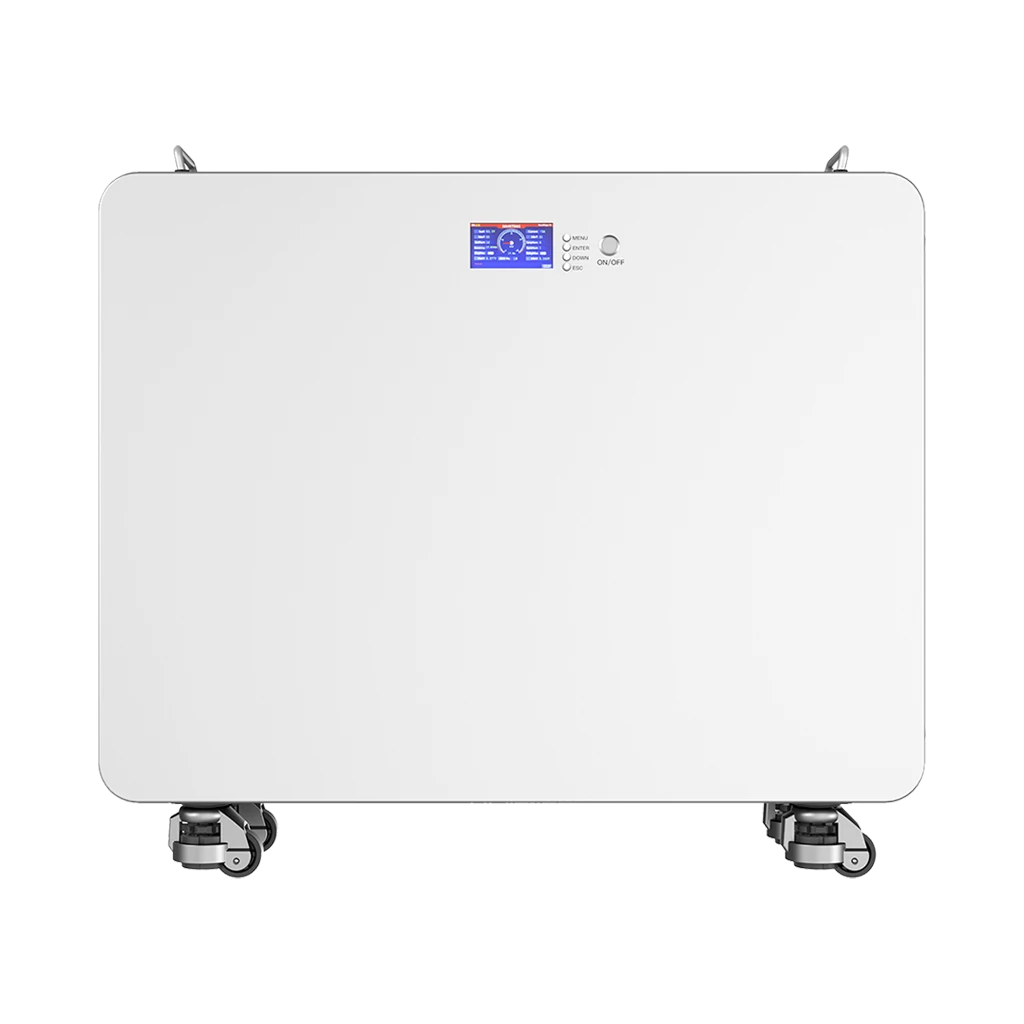
A 51.2V 314Ah battery has a nominal energy capacity of approximately 16.08 kWh. For example, Avepower’s 51.2V 314Ah vertical LiFePO4 battery provides approximately 16.08 kWh of nominal energy storage capacity.
Calculation:
51.2V × 314Ah = 16,076.8Wh
Therefore:
16,076.8Wh ÷ 1,000 = 16.0768kWh
or approximately:
16.08kWh
Avepower's 51.2V 314Ah 16kWh LiFePO4 battery lists 314Ah capacity, 16kWh nominal energy, a 200A discharge rating and support for up to 16 units in parallel.
This example illustrates an important purchasing rule: use Ah-to-kWh conversion to verify whether battery capacity, nominal voltage and stated energy are reasonably consistent, then evaluate discharge current, BMS limits, inverter compatibility, cycle conditions and usable capacity separately.
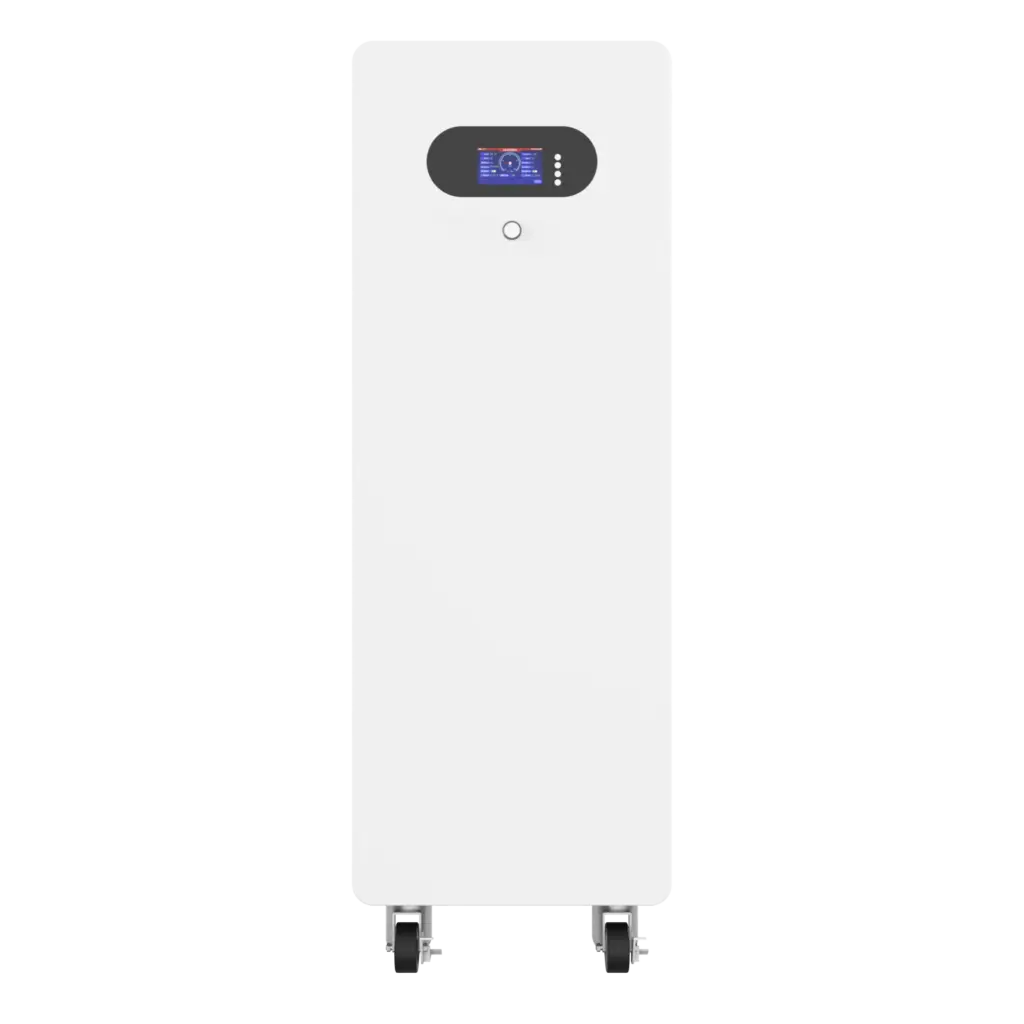
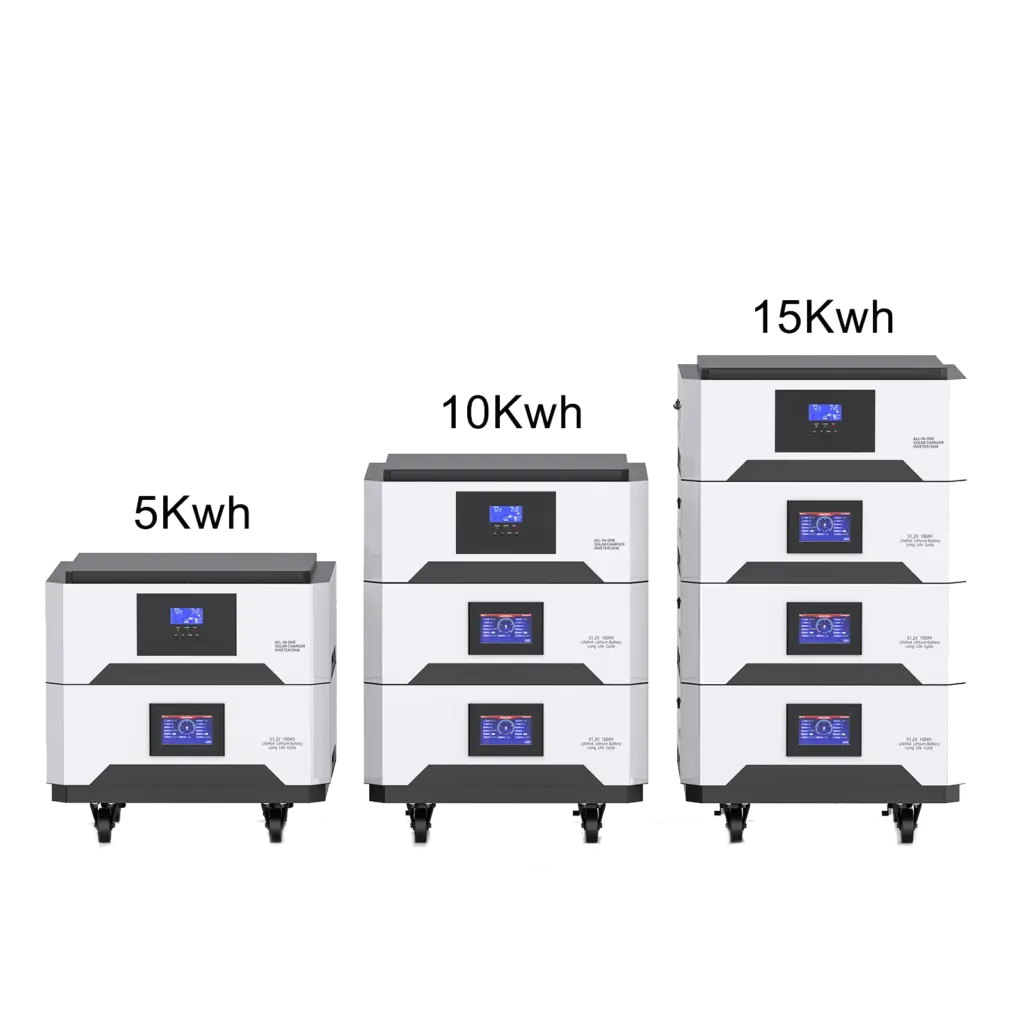
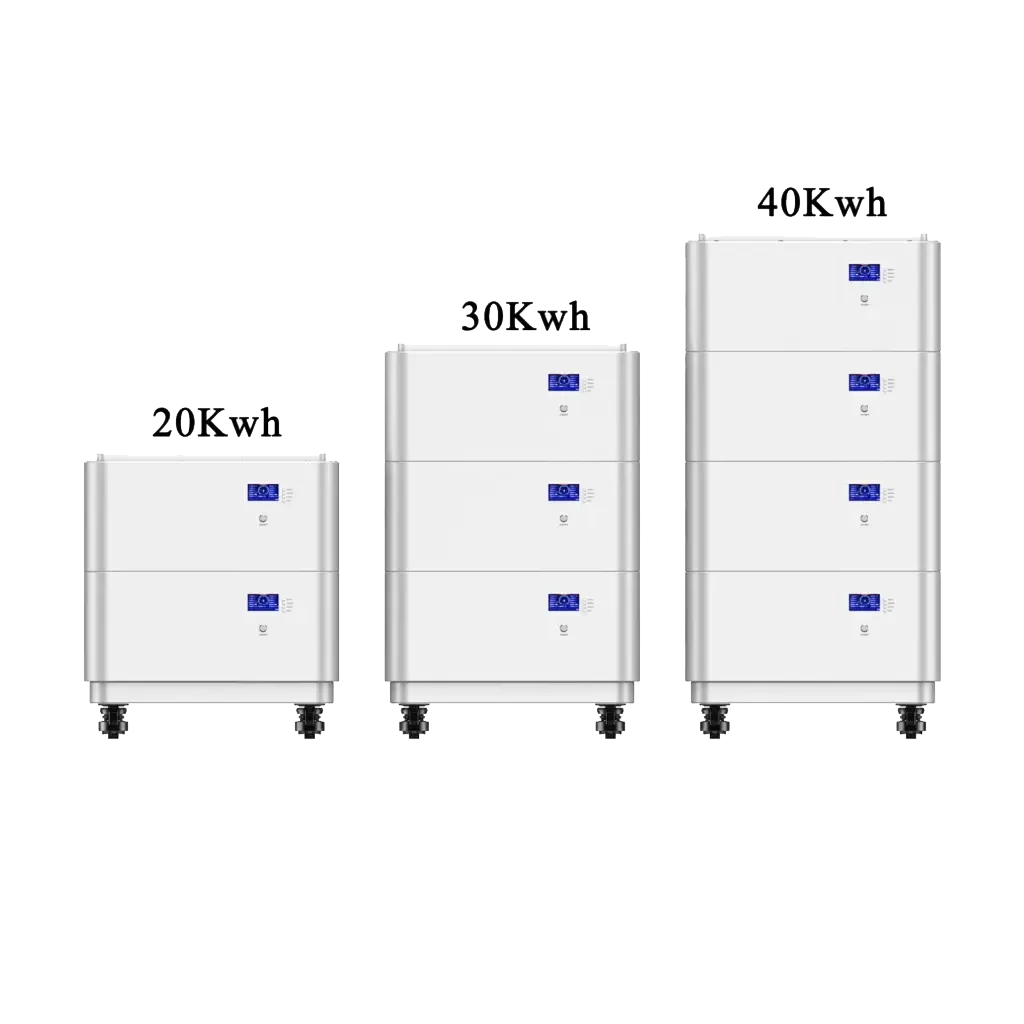
For larger residential projects, Avepower's vertical LiFePO4 battery range includes 8kWh, 15kWh, 16kWh, 30kWh and 50kWh classes with modular expansion options.
How Do You Convert kWh Back to Ah?
To convert kWh back to Ah, multiply the required kilowatt-hours by 1,000 and divide by battery voltage. This is useful when you know your required energy storage but need to estimate the necessary battery Ah capacity.
The reverse formula is:
Ah = kWh × 1,000 ÷ V
Example: How Many Ah Is 10kWh at 51.2V?
10 × 1,000 ÷ 51.2 = 195.31Ah
The theoretical capacity is therefore approximately:
195Ah
Ah, Wh, kWh and kW: What Is the Difference?
Ah measures electrical charge, Wh and kWh measure energy, and kW measures power.
| Unit | Measures | Typical Question |
|---|---|---|
| Ah | Charge capacity | How much charge can the battery store? |
| Wh | Energy | How much energy is in a small battery? |
| kWh | Energy | How much energy can a home or ESS battery store? |
| W | Power | How much power is a device using now? |
| kW | Power | How much power can an inverter or battery deliver? |
For smaller batteries rated in milliamp-hours, use Avepower's mAh to kWh calculator guide.
Need Help Turning Ah and kWh Into a Real Battery Configuration?
Avepower manufactures LiFePO4 energy-storage systems for residential, commercial and high-voltage applications and supports OEM/ODM projects for installers, distributors, EPC companies and energy-storage brands.
Manufacturing capabilities include a 20,000m² production facility, 15+ production lines and 50+ technical engineers, while its product portfolio covers wall-mounted, rack-mounted, vertical, stackable and custom high-voltage systems.
If you already know your required usable kWh, inverter model, peak load, project country and backup duration, Avepower can use those inputs to help determine the appropriate battery voltage, Ah capacity, BMS configuration and system architecture.

Take Control of Your Energy with Avepower!
Reliable home solar battery solutions with OEM/ODM customization and in-house manufacturing, tailored to the needs of distributors, installers, and energy partners.
FAQ
It depends on voltage. A 100Ah battery is approximately 1.2kWh at 12V, 2.4kWh at 24V, 4.8kWh at 48V and 5.12kWh at 51.2V.
A 100Ah 12V battery contains approximately 1.2kWh of nominal energy: 100 × 12 ÷ 1,000 = 1.2kWh
A 100Ah 48V battery contains approximately 4.8kWh: 100 × 48 ÷ 1,000 = 4.8kWh
Voltage determines the answer. A 200Ah battery is about 2.4kWh at 12V, 4.8kWh at 24V, 9.6kWh at 48V and 10.24kWh at 51.2V.
No. Ah measures charge, so voltage is required to calculate energy. Without voltage, the kWh value cannot be determined.
No. One Ah represents different amounts of energy at different voltages. For example, 1Ah at 12V equals 0.012kWh, while 1Ah at 48V equals 0.048kWh.
Use the nominal voltage given on the relevant battery specification. If a LiFePO4 battery is rated at 12.8V, using 12.8V gives a more accurate nominal-energy result than using the generic 12V system class.
Yes, if additional identical batteries are added. Parallel connection keeps voltage approximately constant while increasing total Ah, so total kWh increases in proportion to the number of batteries.