
We live in a world that is always on. From the devices we hold in our hands to the lights that brighten our cities, everything needs power. When we talk about how much electricity a big project uses, or how much a power plant can generate, we often see a term like “megawatt,” or its abbreviation, MW. But what does that really mean? This article will explain what a megawatt is, how it relates to our everyday lives, and how it’s different from a megawatt-hour.
Quick Answer: What Is 1 MW?
1 megawatt (MW) equals 1,000 kilowatts (kW) or 1,000,000 watts (W).
MW measures power—the rate at which electricity is produced or consumed—while MWh measures the amount of energy delivered or stored over time.
| Conversion | Equivalent |
|---|---|
| 1 MW | 1,000 kW |
| 1 MW | 1,000,000 W |
| 1 MWh | 1,000 kWh |
A 1 MW solar system, generator or battery inverter can deliver up to 1 megawatt of power under the right conditions.
How Many kW Are in 1 MW?
You’re probably more familiar with a kilowatt (kW), which is 1,000 watts. Since a megawatt is a million watts, it’s 1,000 times larger than a kilowatt.
1 MW = 1,000 kW = 1,000,000 W
| Megawatts | Kilowatts |
|---|---|
| 0.1 MW | 100 kW |
| 0.5 MW | 500 kW |
| 1 MW | 1,000 kW |
| 2 MW | 2,000 kW |
| 5 MW | 5,000 kW |
| 10 MW | 10,000 kW |
Power Unit Converter
Convert between W, kW, MW and GW. Use quick modes, custom unit selectors, or the swap button.
How “Strong” is 1 MW in Real Life?
1 MW is enough power, at a given moment, to supply roughly 1,000 typical homes — this is a common rule of thumb used in the U.S., but the exact number depends on how much each home is using at that time.
Put another way, 1 MW can run one average U.S. home for about 1.2 months, keep a swimming pool pump running for around five months, or even toast nearly 90,000 slices of bread — all of these examples are just ways to show how large 1 MW is when converted to everyday uses. Because of this, megawatts are normally used to describe the output of a power plant or the power needs of something big (a data center, a factory, even a small city area).
1 MW to kW: Quick Conversion Table
1 MW = 1,000 kW.
This is one of the most common conversions users search for. Kilowatts are more familiar in homes and small commercial projects, while megawatts are used for larger energy systems.
For example, a residential solar system may be 5 kW, 10 kW or 15 kW. A commercial solar project may be 500 kW. A utility-scale solar farm may be 5 MW, 20 MW or 100 MW.
That means:
| Megawatts | Kilowatts | Watts |
|---|---|---|
| 0.1 MW | 100 kW | 100,000 W |
| 0.5 MW | 500 kW | 500,000 W |
| 1 MW | 1,000 kW | 1,000,000 W |
| 5 MW | 5,000 kW | 5,000,000 W |
| 10 MW | 10,000 kW | 10,000,000 W |
For solar and battery storage projects, this conversion helps buyers compare system size, inverter output, peak load demand and grid connection capacity.
MW vs MWh: What’s the Difference?
This is where many people get confused.
MW measures power. MWh measures energy.
Think of MW like the speed of electricity delivery. Think of MWh like the total amount of electricity delivered over time.
| Term | What It Measures | Simple Meaning |
|---|---|---|
| MW | Power | How much electricity can be delivered right now |
| MWh | Energy | How much electricity is delivered over time |
The basic formula is:
Energy = Power × Time
So:
| Power Output | Running Time | Energy Produced |
|---|---|---|
| 1 MW | 1 hour | 1 MWh |
| 1 MW | 2 hours | 2 MWh |
| 0.5 MW | 4 hours | 2 MWh |
| 2 MW | 1 hour | 2 MWh |
This is especially important for battery storage. A battery system described as 1 MW / 2 MWh can deliver 1 MW of power for about 2 hours. A 1 MW / 4 MWh system can deliver 1 MW for about 4 hours.
How Many Homes Can 1 MW Power?
A simple way to estimate it is to divide 1,000 kW by the average power demand per home. If a home averages around 1 kW to 2 kW at a given moment, then 1 MW may support roughly 500 to 1,000 homes at that moment. But this is only a rule-of-thumb estimate.
For energy over a full day, it is better to use MWh or kWh. For example, if one home uses about 30 kWh per day, then 1 MWh, which equals 1,000 kWh, could theoretically cover about 33 homes for one day.
Capacity Factor: Why 1 MW Is Not 1 MW All Day Long
Many power sources do not run at full output all the time. The term capacity factor describes the difference between nameplate rating and real-world average output.
For example, USGS explains that modern wind turbines often operate with capacity factors in the 40% range, and uses that concept to translate turbine output into “homes powered.”
This is why a “1 MW” generator or solar plant does not automatically mean “1 MW all day.” The actual energy delivered depends on the resource (sun/wind), equipment, and operating strategy.
How Many MW to Power a City?
Let’s take a city of 100,000 people. That’s about 50,000 households. If each household uses roughly 1 MWh per month (12 MWh per year), the city needs around 600,000 MWh of electricity each year to cover that demand. That doesn’t mean the city needs 600 MW all the time — because MW is instantaneous and demand goes up and down — but it shows the scale of annual energy needed.
How Many kWh is 1 MW?
When you convert power to energy, you add time.
- 1 MW for 1 hour = 1 MWh
- 1 MWh = 1,000 kWh
This is because “mega” means million and “kilo” means thousand, so 1 megawatt (MW) is 1,000 times larger than 1 kilowatt (kW). To convert MWh to kWh, you multiply by 1,000.
What Does 1 MW Mean for Solar Power?
Solar energy has become one of the fastest-growing sources of electricity worldwide. But how does one measure solar power in megawatts?
How Many Solar Panels Do You Need to Produce 1 MW?
The number of solar panels required to produce 1 MW depends on their capacity and efficiency. Standard solar panels generate between 250 and 440 watts each. To reach a 1 MW output:
- Using 400-watt panels: ~2,500 panels
- Using 440-watt panels: ~2,200 panels
Panels rarely operate at full capacity due to weather, shading, and seasonal sunlight variation. Therefore, a solar farm may need extra panels to ensure reliable energy production. In today’s market, 500 W high-efficiency modules are also common. If you use 500 W panels, you would need about 2,000 of them to reach 1 MW (because 2,000 × 500 W = 1,000,000 W = 1 MW). The higher the panel wattage, the fewer panels you need — but the panels are usually physically larger.
How Big is a 1 MW Solar Farm?
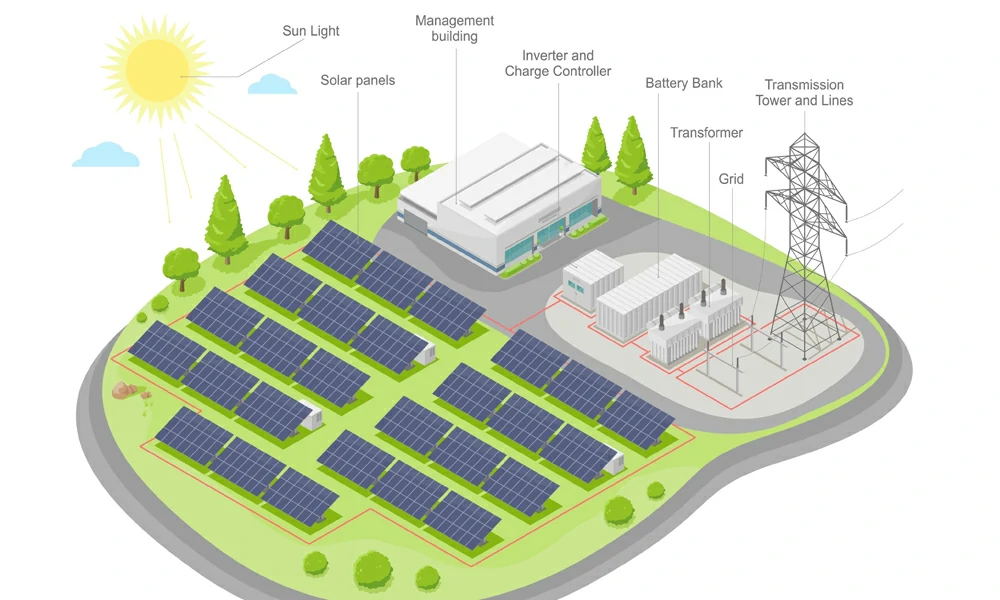
A 1 MW solar farm generally covers 4 to 5 acres, or around 16,000 to 20,000 square meters. The exact size depends on the panel layout, spacing, and efficiency. Such a farm can provide electricity for small communities, commercial buildings, or industrial sites.
Factors like terrain, sunlight exposure, and panel orientation influence how much electricity the farm can produce. For example, south-facing panels or solar trackers that follow the sun can increase energy capture by 20–25%.
Solar Energy and Megawatts: MWdc vs MWac
Solar projects often use two related ratings:
- MWdc: the DC rating of the solar panels (nameplate panel power)
- MWac: the AC rating after the inverter (what the grid “sees”)
It is common to build more DC panel capacity than inverter AC capacity. NREL’s Annual Technology Baseline (ATB) uses a DC-to-AC ratio (also called ILR) around 1.34 for a representative utility-scale PV system. [3]
Why this matters:
If someone says “a 100 MW solar plant,” you should check whether that is MWdc or MWac, because it changes how you interpret equipment size and energy output.
What Does 1 MW Mean for Battery Energy Storage?
While megawatts measure power at a specific moment, megawatt-hours (MWh) measure the total amount of energy produced or consumed over time.
For example:
- A 1 MW solar array running at full capacity for one hour produces 1 MWh of electricity.
- A battery storage system rated at 1 MWh can store enough energy to supply that 1 MW of power for one hour.
Large-scale battery systems, known as Battery Energy Storage Systems (BESS), are often used to store solar or wind energy for later use. A 1 MWh BESS can power several homes during a blackout or provide backup energy during peak demand hours.
For commercial and industrial projects, the required battery capacity depends on load profile, discharge duration, solar generation, operating strategy and grid requirements.
Looking for a battery storage solution for a 100 kW, 500 kW or 1 MW project? Avepower provides customizable C&I energy storage systems for installers, distributors and project developers.
Fuel-to-Power Example: How Much Coal for 1 MWh?
If electricity is generated from coal, a common estimate is that it takes about 1,100 pounds (around 500 kg) of coal to generate 1 MWh of electricity. This shows why improving efficiency and using renewables/storage can significantly reduce fuel use and emissions.
Megawatt vs. Megawatt-Hour: Power vs. Energy
This is a common point of confusion, but the difference is actually quite simple. If a megawatt (MW) is the rate of power, a megawatt-hour (MWh) is the total amount of energy used or produced over a period of time.
So, whenever you see MW, think “How fast is electricity being delivered right now?” and whenever you see MWh, think “How much electricity was delivered over time?”
You can watch the following video to learn more:
The table below summarizes the main differences between these two important units.
| Feature | Megawatt (MW) | Megawatt-hour (MWh) |
|---|---|---|
| What it measures | Power or capacity (the rate of energy) | Energy or consumption (the total amount of energy) |
| Time element | Measures an instantaneous moment | Includes a time component (e.g., one hour) |
| Common Use | Rating a power plant’s capacity | Billing customers on their energy usage |
Comparing MW and GW
In electricity terminology, a gigawatt (GW) is larger than a megawatt. Specifically, 1 GW equals 1,000 MW or 1,000,000,000 watts.
Gigawatts are typically used to describe massive power plants or national electricity grids, while megawatts are more practical for regional or smaller-scale power facilities. For instance, a single wind farm might produce 50 MW, while a country’s entire power grid can handle tens of gigawatts.
| Unit | Value (in Watts) | Use Case |
|---|---|---|
| Kilowatt (kW) | 1,000 | Home appliances, small-scale systems |
| Megawatt (MW) | 1,000,000 | Power plants, wind farms |
| Gigawatt (GW) | 1,000,000,000 | National grid, large-scale projects |
Common Mistakes to Avoid
- Mixing up MW and MWh
MW is instantaneous. MWh includes time. - Ignoring peak vs average
“Homes powered” changes dramatically if you use average demand vs peak demand. - Forgetting MWdc vs MWac in solar
A “100 MWdc” solar array is not the same as “100 MWac” delivered through the inverter.
Megawatts in Commercial and Industrial Energy Storage
For residential battery systems, users usually talk about kW and kWh. For commercial, industrial and grid-scale projects, MW and MWh become more common.
A shopping mall, factory, farm, telecom site, EV charging hub or industrial park may need hundreds of kilowatts or several megawatts of power capacity. In these projects, battery storage can help reduce peak demand, improve solar energy use, provide backup power and support more stable energy management.
Avepower provides commercial and industrial battery energy storage solutions. For larger projects, the key is not just choosing a battery capacity, but matching the battery system with load demand, inverter power, communication protocol, grid requirements and installation conditions.
Conclusion
A megawatt is a large unit of power. 1 MW equals 1,000 kW or 1,000,000 watts. It is commonly used for solar farms, power plants, commercial facilities, industrial loads and battery energy storage systems.
The most important point is the difference between MW and MWh. MW tells you how much power can be delivered at one moment. MWh tells you how much energy is delivered over time.
For solar and battery projects, both numbers matter. MW helps define power output. MWh helps define runtime and stored energy. Understanding both makes it easier to compare systems, estimate backup duration and choose the right energy storage solution.
If you are planning a commercial solar storage project, backup power system or scalable battery energy storage solution, Avepower can help evaluate your required power, energy capacity, communication needs and system configuration.
FAQ
1 MW equals 1,000 kW. It also equals 1,000,000 watts.
MW measures power at a specific moment. MWh measures energy produced or consumed over time. For example, 1 MW running for 1 hour produces 1 MWh of energy.
1 MWh equals 1,000 kilowatt-hours and can power hundreds to thousands of homes for one hour, depending on their average energy use.
One megawatt is 1 million watts. It is commonly used to describe the output of large electricity generators like power plants, solar farms, and wind turbines.
Yes. 1 MW is a large amount of power, usually used to describe commercial solar systems, utility-scale solar farms, power plants, industrial loads and battery energy storage systems.
In solar, 1 MW means the solar system has a rated power capacity of 1 megawatt under standard conditions. Actual output depends on sunlight, weather, system design and inverter capacity.
In battery storage, MW refers to charge or discharge power. MWh refers to stored energy. A 1 MW / 2 MWh battery can theoretically discharge at 1 MW for about 2 hours.