
In energy storage systems, the concept of C-rate plays a crucial role in determining battery performance, lifespan, and suitability for specific applications. Despite its importance, C-rate is often misunderstood or oversimplified. This article will explore the definition of battery C-rate, how to calculate it, its impact on lithium-ion batteries, and how to choose the right C-rate based on your specific needs.
What Is C-Rate in a Battery?
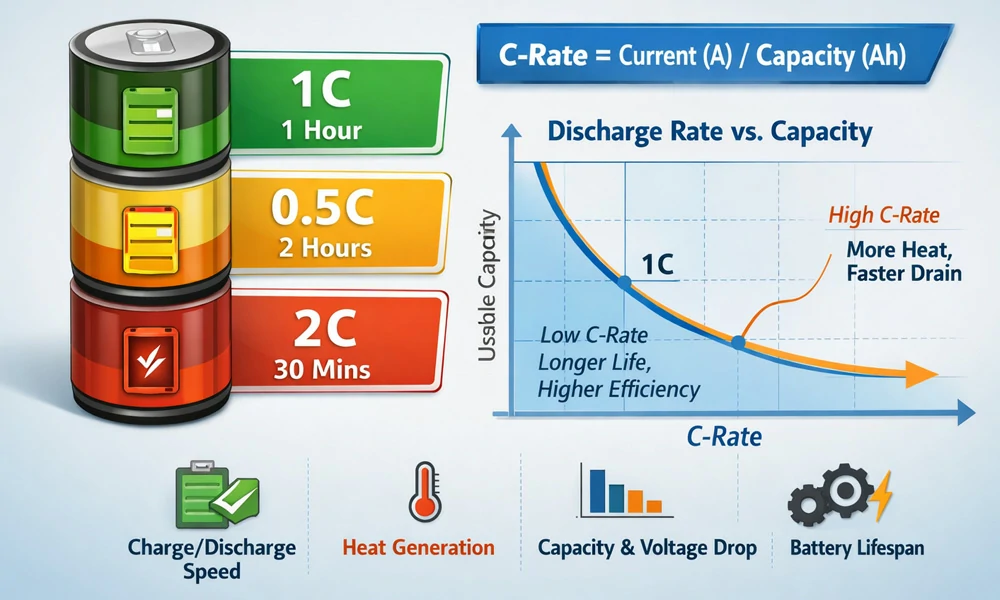
The C-rate of a battery is a measure of how fast it is charged or discharged relative to its total capacity. It standardizes the rate of energy flow so you can understand how quickly a battery can safely deliver or accept power.
In simple terms, the C-rate tells you how fast you can safely use or charge a battery without damaging it.
How Is Battery C-Rate Expressed?
Battery C-rate is usually written in one of these forms:
- 0.2C
- 0.5C
- 1C
- 2C
- 3C
- 10C
You may also see it written as:
- C/5 instead of 0.2C
- C/2 instead of 0.5C
- 2C continuous
- 3C peak for 10 seconds
The meaning is always relative to the battery’s rated capacity.
For example, if a battery pack is 100Ah:
- C/10 = 10A
- 0.5C = 50A
- 1C = 100A
The reason manufacturers use C-rate instead of only amps is that it scales across different battery sizes. A 10A load is very small for a 280Ah cell, but very large for a 5Ah cell. Using C-rate makes the stress level easier to compare.
How to Calculate C-Rate of a Battery?
When calculating the C-rate of a battery, there are two key values you need to know:
- Battery Capacity
- Current
For any battery, the C-rate shows how fast it is being charged or discharged relative to its rated capacity. In simple terms, it tells you whether the battery is working gently, moderately, or very aggressively.
A 100Ah battery means the battery can ideally deliver:
- 100A for 1 hour, or
- 50A for 2 hours, or
- 20A for 5 hours
under ideal conditions.
Equation
C-rate (h⁻¹) = Current (A) / Battery Capacity (Ah)
Battery Capacity (Ah) = Current (A) × Time (h)
Make sure all units are consistent.
If capacity is written in Ah, current should be in A.
If capacity is written in mAh, current should be in mA.
To estimate charging or discharging time:
Time (h) = Battery Capacity (Ah) / Current (A)
Keep in mind that this is an ideal calculation. In real applications, actual charging time may be slightly longer because of efficiency losses, voltage limits, and the final constant-voltage charging stage.
Charge Rate Calculations
To calculate the charging C-rate of a battery, you need the applied charging current and the battery capacity.
For a 100Ah battery receiving a charging current of 20A, the C-rate is:
C-rate (h⁻¹) = 20A / 100Ah = 0.2C
This means the battery is being charged at 0.2C.
If you want to charge the same 100Ah battery at 0.5C, the required current is:
Current (A) = Battery Capacity (Ah) × C-rate (h⁻¹)
Current (A) = 100Ah × 0.5C
Current (A) = 50A
So, a 100Ah battery charged at 0.5C requires 50A of charging current.
Discharge Rate Calculations
To calculate the discharge rate of a battery, you also use battery capacity and C-rate.
If you have a 100Ah lithium battery, the discharge current and theoretical runtime at different C-rates can be calculated as follows:
| C-rating | 1C | 2C | 0.2C |
|---|---|---|---|
| Calculation | 1C = 100Ah × 1C = 100A discharge current available | 2C = 100Ah × 2C = 200A discharge current available | 0.2C = 100Ah × 0.2C = 20A discharge current available |
| 100Ah / 100A = 1 hour discharge time | 100Ah / 200A = 0.5 hour (30 minutes) discharge time | 100Ah / 20A = 5 hours discharge time | |
| Answer | The battery can run for 1 hour with a 100A load | The battery can run for 30 minutes with a 200A load | The battery can run for 5 hours with a 20A load |
Battery C-Rate Time Conversion Table
The relationship between C-rate and discharge time is inverse and predictable. As the C-rate increases, the discharge time decreases proportionally.
Here is a standard reference table:
Example for a 100Ah battery
| C-Rate | Time | Example (100Ah Battery) |
|---|---|---|
| 0.05C (C/20) | 20 hours | 5 A |
| 0.1C (C/10) | 10 hours | 10 A |
| 0.2C (C/5) | 5 hours | 20 A |
| 0.5C (C/2) | 2 hours | 50 A |
| 1C | 1 hour | 100 A |
| 2C | 30 minutes | 200 A |
| 5C | 12 minutes | 500 A |
| 10C | 6 minutes | 1000 A |
| 20C | 3 minutes | 2000 A |
| 30C | 2 minutes | 3000 A |
Example for a 280Ah Battery
| C-Rate | Time | Example (280Ah Battery) |
|---|---|---|
| 0.1C | 10 hours | 28 A |
| 0.2C | 5 hours | 56 A |
| 0.5C | 2 hours | 140 A |
| 1C | 1 hour | 280 A |
| 2C | 30 minutes | 560 A |
How Do I Find the C Rating of My Battery?
If you want to determine a battery’s C-rate, you usually need to refer to its specification sheet or datasheet, because the C-rate is rarely printed directly on the battery. Instead, it is calculated based on the battery’s capacity and current parameters.
On the datasheet, look for the following fields:
- Nominal capacity (Ah)
- Charge current (A)
- Discharge current (A)
- Maximum continuous charge current
- Maximum continuous discharge current
- Peak or pulse discharge current
- Capacity test conditions
Then use the formula:
C-rate = current ÷ capacity
Example: Avepower 280Ah Battery
Specifications:
- Nominal capacity: 280 Ah
- Charge current: 100 A
- Discharge current: 200 A
Then the C-rate can be calculated as:
- Charge C-rate = 100 A ÷ 280 Ah ≈ 0.36C
- Discharge C-rate = 200 A ÷ 280 Ah ≈ 0.71C
This means that for this Avepower battery:
- Charging at 100 A corresponds to approximately 0.36C
- Discharging at 200 A corresponds to approximately 0.71C
Many battery datasheets do not explicitly state “this is a 0.5C battery” or “this is a 1C battery.” Instead, they provide the capacity and current values so you can determine the C-rate yourself.
Additionally, you should pay attention to the difference between standard/recommended values and maximum values. Typically, the charge and discharge currents listed in a datasheet represent recommended or typical operating conditions, while the maximum continuous charge/discharge current indicates the upper limit the battery can tolerate. This does not mean it is advisable to operate continuously at that high C-rate.
How to Determine the C-Rate for Capacity and Performance Testing?
To accurately measure battery capacity, the test current cannot be chosen arbitrarily. Capacity testing should follow the manufacturer’s specified methods or widely accepted testing standards.
Taking the Avepower 48V 280Ah 15kWh battery as an example, the datasheet indicates a nominal capacity of 280Ah, a charge current of 100A, and a discharge current of 200A, with a CC-CV (constant current–constant voltage) charging method.
Based on the C-rate formula—C-rate = Current ÷ Capacity—we can calculate the typical operating rates of this battery: the charging rate is approximately 0.36C (100A ÷ 280Ah), and the discharging rate is about 0.71C (200A ÷ 280Ah).
At the same time, Avepower batteries can achieve over 8,000 cycles (at 25°C and 80% depth of discharge, or DOD). This highlights that test results are not determined by C-rate alone. Factors such as ambient temperature, depth of discharge, charging method, and a consistent testing procedure all have a direct impact on the final measured capacity.
However, it is important to note that the operating C-rate is not the same as the capacity testing C-rate. If your goal is to verify battery capacity, the most reliable approach is still to follow the manufacturer’s official testing specifications or full datasheet guidelines.
On the other hand, if your goal is comparative performance testing, all samples must be tested under identical conditions—including C-rate, temperature, rest time, and cutoff parameters—to ensure the results are valid and comparable.
If you would like more detailed technical guidance, customized battery solutions, or full testing specifications, feel free to contact Avepower. Our team can provide professional support for system design, performance evaluation, and product selection to help you get the most accurate and reliable results from your energy storage system.
How C-Rate Affects Lithium-Ion Batteries
Lithium-ion batteries are highly sensitive to C-rate. Charging or discharging too quickly can have several effects:
- Heat Generation: High C-rates increase internal resistance, generating heat. Excess heat can accelerate battery degradation or, in extreme cases, cause thermal runaway.
- Cycle Life Reduction: Frequent operation at high C-rates reduces the total number of charge-discharge cycles a battery can achieve.
- Reduced Effective Capacity: At high C-rates, the battery may deliver less energy than its nominal capacity due to voltage drops and inefficiencies.
- Safety Risks: Overcharging or rapid discharging beyond the recommended C-rate can compromise safety, especially in lithium-ion chemistry.
By contrast, operating at moderate C-rates ensures long-term stability and predictable performance.
Choosing the Right C-Rate for Your Needs
Selecting the appropriate C-rate depends on your application and battery type:
- Residential Solar Storage: Lower C-rates (0.2–0.5C) are common for long-term battery health.
- Power Tools: High C-rates (2–5C) are often required for rapid energy delivery.
- Electric Vehicles: Moderate to high C-rates (1–3C) balance performance with battery life.
- UPS or Backup Systems: Usually low C-rates to maximize efficiency and reduce stress on the battery.
Understanding your device’s energy requirements and duty cycle is key to selecting the proper C-rate.
Conclusion
The battery C-rate is a vital metric that determines how quickly a battery can safely charge and discharge. Proper understanding and application of C-rate ensures optimal performance, safety, and longevity of your battery system. Whether you are designing a home solar storage solution, selecting batteries for electric vehicles, or managing industrial energy storage, the C-rate guides your decision-making process.
By calculating your battery’s C-rate and understanding its implications, you can make informed choices about charging currents, system design, and operational safety, ensuring that your battery performs reliably for years to come.
FAQ
C-rate is the battery’s charge or discharge current expressed relative to its rated capacity. A 1C rate means the current is numerically equal to the battery’s Ah rating, so the battery would ideally charge or discharge in about one hour.
Check the datasheet for nominal capacity and current ratings, then divide current by capacity. Look for standard charge/discharge current and max continuous current.
It means the battery is being charged or discharged at half of its rated Ah value in amps. A 100Ah battery at 0.5C is operating at 50A.
Higher C-rate generally increases heat, can reduce delivered capacity under load, and can accelerate degradation if combined with harsh conditions such as low-temperature charging or high-temperature cycling.