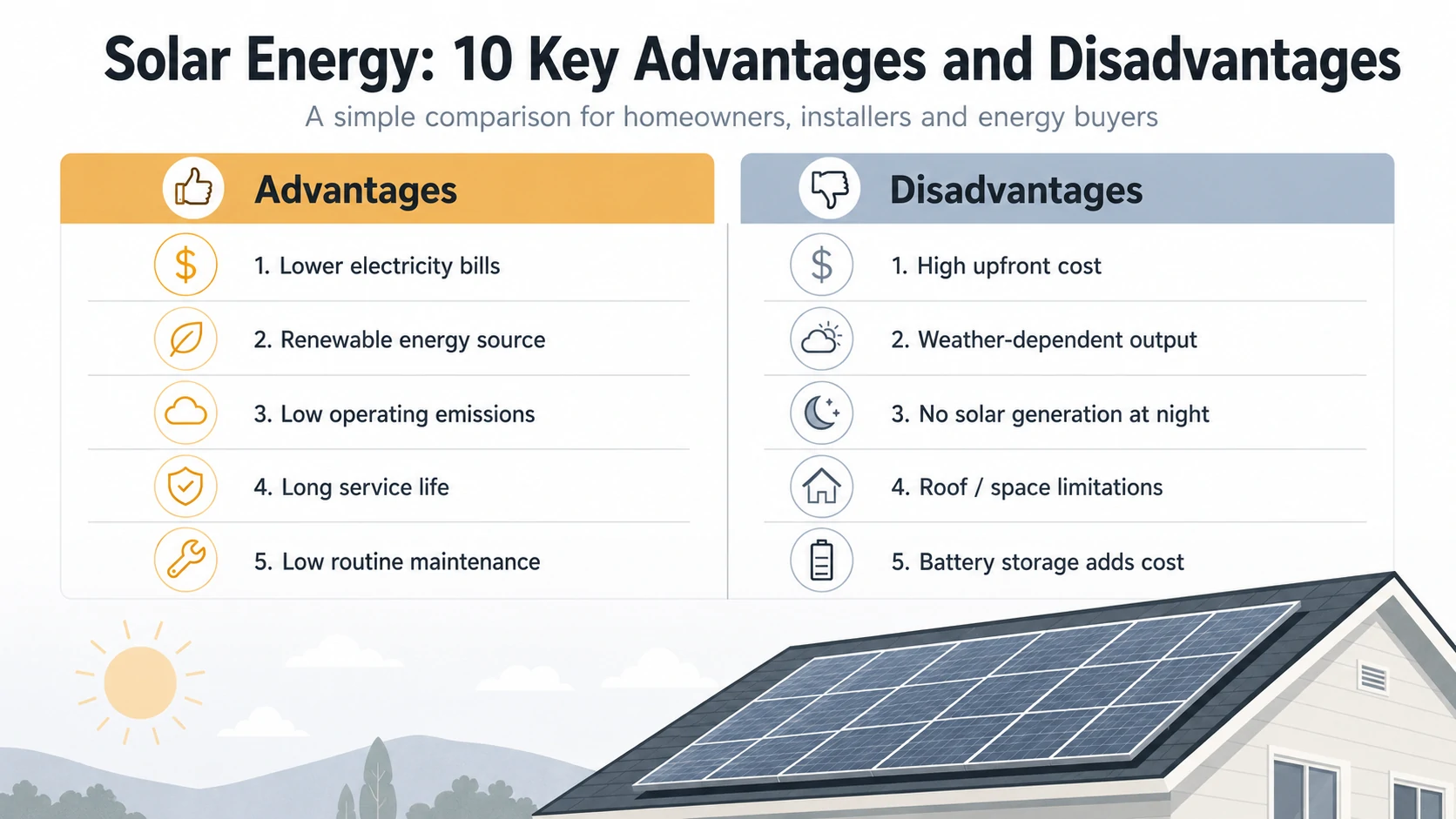
The main advantages of solar energy are lower grid electricity use, low lifecycle emissions, renewable generation, relatively low operating requirements and greater control over energy costs. Its main disadvantages are high upfront investment, variable daytime production, roof or land limitations, grid-policy dependence and additional cost when battery storage is required.
Here is the decision in one table.
| Solar Energy Advantages | Solar Energy Disadvantages |
|---|---|
| Renewable energy source | High initial investment |
| Can reduce electricity purchases | Output varies with sunlight |
| Low lifecycle carbon emissions | Does not generate PV electricity at night |
| Low routine maintenance | Not every roof or site is suitable |
| Long operating life | Financial value depends on electricity tariffs |
| Can improve solar self-consumption with batteries | Batteries increase system cost |
| Can increase energy independence | Grid-tied solar alone may stop during outages |
| Scalable from rooftops to utility projects | Manufacturing uses materials and energy |
| Can be paired with EVs and smart loads | End-of-life recycling still needs planning |
| Utility-scale solar is increasingly cost competitive | Large solar farms require suitable land |
What Are the Main Advantages of Solar Energy?
Solar energy’s strongest advantages are its renewable fuel source, low operational emissions, ability to reduce purchased electricity, long equipment life and flexibility across residential, commercial and utility applications. The actual financial advantage, however, depends on solar yield, system price, electricity rates, self-consumption and local export rules rather than sunlight alone.
The five most important advantages are:
- Renewable electricity generation
- Lower electricity purchases
- Low lifecycle greenhouse gas emissions
- Long equipment life and relatively low maintenance
- Greater energy control when combined with batteries and smart energy management
Each benefit needs to be considered in context.
Advantage 1: Is Solar Energy Really Renewable?
Yes. Solar PV converts sunlight into electricity without consuming a finite fuel during operation. Unlike coal or natural gas generation, a PV array does not require continuous fuel extraction and combustion, although energy and raw materials are still required to manufacture panels, inverters, mounting systems and electrical components.
The sunlight reaching a solar array is continually replenished.
Advantage 2: Can Solar Energy Lower Electricity Bills?
Yes, when solar electricity replaces electricity that would otherwise be purchased from the grid. Savings are usually strongest when retail electricity prices are high and a large share of solar production is consumed on-site. Exported electricity may be worth less, so system economics should separate self-consumed and exported solar.
The financial value of solar can be approximated using:
Annual Solar Value = Self-Consumed Solar × Import Price + Exported Solar × Export Price
For example, suppose an 8kW system produces:
11,200kWh/year
Assume:
- 60% is used directly by the property;
- 40% is exported;
- grid electricity costs $0.30/kWh;
- exported solar receives $0.08/kWh.
Self-consumed solar:
11,200 × 60% = 6,720kWh
Value:
6,720 × $0.30 = $2,016
Exported solar:
11,200 × 40% = 4,480kWh
Export value:
4,480 × $0.08 = $358.40
Approximate annual electricity value:
$2,374.40
If the net installed cost were hypothetically $18,000:
Simple Payback = $18,000 ÷ $2,374.40
≈ 7.6 years
Advantage 3: Does Solar Energy Reduce Carbon Emissions?
Yes. Solar PV has manufacturing-related emissions, but lifecycle studies consistently find substantially lower greenhouse gas emissions per kWh than fossil-fuel electricity. The exact carbon footprint depends on panel technology, manufacturing electricity mix, location, solar yield, lifetime and lifecycle-analysis methodology, so no single number applies everywhere.
Solar panels do not emit carbon dioxide while converting sunlight into electricity.
Emissions occur primarily during:
- raw-material processing;
- polysilicon production;
- wafer and cell manufacturing;
- glass and aluminum production;
- module assembly;
- transportation;
- installation;
- maintenance;
- and end-of-life treatment.
Advantage 4: How Long Do Solar Panels Last?
Modern PV systems are long-lived assets rather than short-term electronics. Typical project performance periods are often around 20–30 years, while current industry surveys indicate operational lifetimes can extend to roughly 25–35 years. Panels gradually lose output instead of suddenly stopping after their warranty period.
The U.S. Department of Energy says most PV systems still maintain at least:
80% of initial output after 25 years
Advantage 5: Does Solar Require a Lot of Maintenance?
Generally no. Solar PV has no fuel supply and conventional modules contain no moving mechanical parts, so routine maintenance requirements are relatively modest. Performance still needs monitoring because shading, dirt, electrical faults, inverter problems, vegetation or physical damage can reduce energy production without necessarily being obvious to the owner.
Typical maintenance may include:
- system monitoring;
- visual inspections;
- vegetation management;
- checking electrical components;
- removing unusual debris;
- and cleaning where local soiling justifies it.
Advantage 6: Can Solar Increase Energy Independence?
Solar reduces dependence on purchased grid electricity during periods when the PV array is producing enough power. True outage independence requires more than panels alone, however. For continuous electricity during grid failures or after sunset, a properly designed system normally needs compatible storage, inverter controls and safe grid-islanding capability.
Backup operation normally requires:
Solar + compatible inverter + storage + appropriate isolation/control equipment.
Solar therefore improves energy independence, but solar panels alone do not automatically deliver energy resilience.
What Are the Main Disadvantages of Solar Energy?
The most important disadvantages of solar energy are upfront capital cost, variable production, nighttime generation limits, location and roof constraints, dependence on electricity-market rules, additional storage costs and lifecycle impacts from manufacturing and disposal. These limitations are manageable in many projects, but some properties simply do not provide strong technical or financial conditions for solar.
The major disadvantages are:
- High initial cost
- Intermittent generation
- No PV production at night
- Roof, shading and space limitations
- Battery storage adds expense
- Grid and tariff policies affect returns
- Manufacturing has environmental impacts
- Recycling infrastructure is still developing
- Utility-scale projects can create land-use conflicts
Disadvantage 1: Why Is the Upfront Cost of Solar So High?
Solar has low fuel costs after installation but requires substantial investment before the first kWh is generated. Modules are only part of that cost: inverters, racking, wiring, engineering, permitting, labor, electrical upgrades, customer acquisition and interconnection can collectively represent a large portion of a finished residential system.
This is why comparing solar systems using panel prices alone is misleading.
Disadvantage 2: Is Solar Energy Unreliable Because the Sun Does Not Always Shine?
Solar generation is variable rather than continuously dispatchable: production changes with time of day, season, cloud cover, shading and weather. This does not make solar unusable, but it means solar supply and electricity demand do not automatically match, particularly when household demand peaks after sunset.
A typical home may have:
High solar generation: 10 a.m.–3 p.m.
but:
High household demand: 6 p.m.–10 p.m.
Without flexible loads or battery storage, much of the midday electricity may be exported while the household later buys electricity back from the grid.
The solution can involve:
- geographic grid diversity;
- flexible electricity demand;
- smart energy management;
- batteries;
- pumped storage;
- other generation sources;
- or stronger transmission.
Disadvantage 3: Do Solar Panels Work at Night?
Photovoltaic panels do not generate electricity from sunlight after the sun has set. A solar-powered property can still use electricity at night through the grid or a battery charged earlier in the day, but this stored or imported electricity should not be confused with nighttime PV generation.
This is one of the simplest disadvantages of solar energy.
PV generation follows sunlight.
Disadvantage 4: Does Every House Have a Suitable Roof for Solar?
No. A technically viable rooftop requires enough usable area, acceptable structural condition, manageable shading and an orientation and tilt that produce sufficient annual energy. A poor roof can still support solar in some cases, but higher installation complexity or lower generation may weaken project economics enough that another solution becomes preferable.
Common problems include:
- mature tree shading;
- nearby buildings;
- chimneys;
- skylights;
- limited roof area;
- complex roof geometry;
- aging roofing material;
- structural limitations.
If the roof needs replacement soon, replacing it before installing solar may avoid paying later to remove and reinstall the array.
Alternatives can include:
- carport solar;
- ground-mounted solar;
- community solar;
- building-integrated PV.
Roof direction alone should not be used as an automatic rejection rule.
East- and west-facing systems, for example, may still work well depending on tariff and load profile.
Disadvantage 5: Is Battery Storage Required for Solar Energy?
No. Grid-connected solar can reduce electricity purchases without a battery, and adding storage purely because a solar system exists may create unnecessary cost. A battery becomes more valuable when the project needs evening solar use, time-of-use optimization, export reduction, backup power or operation in an off-grid or weak-grid environment.
This is one of the most important financial decisions.
Solar Without Battery
Best suited when:
- daytime demand is high;
- grid reliability is good;
- export compensation is attractive;
- backup power is not required.
Solar + Battery
More relevant when:
- daytime exports are high;
- evening electricity is expensive;
- backup is important;
- exports are limited;
- the grid is unreliable.
For more detailed sizing, Avepower’s guide to solar electricity battery storage explains capacity, inverter architecture, usable energy and backup requirements.
Battery sizing should start from load data and solar surplus, not from whichever battery capacity happens to be advertised.
Disadvantage 6: Does Manufacturing Solar Panels Harm the Environment?
Solar manufacturing is not impact-free. Producing polysilicon, glass, aluminum, copper, cells and modules requires raw materials, industrial processing and electricity. Those upstream impacts create greenhouse gas emissions and other environmental burdens even though the installed PV module itself produces electricity without fuel combustion.
A proper comparison therefore uses:
lifecycle emissions
rather than simply operational emissions.
The IPCC emphasizes that solar’s environmental assessment should include:
- resource depletion;
- land use;
- ecotoxicity;
- acidification;
- particulate pollution;
- manufacturing;
- and end-of-life treatment.
Solar Energy With vs Without Battery Storage
Solar-only systems usually provide the simplest path to bill savings, while solar-plus-storage adds evening energy shifting and potential backup capability at a higher system cost. The better architecture depends on the project’s objective, so storage should be justified through load profile, tariffs and outage requirements rather than treated as mandatory solar equipment.
| Factor | Solar Only | Solar + Battery |
|---|---|---|
| Initial cost | Lower | Higher |
| Daytime electricity savings | Yes | Yes |
| Store midday surplus | No | Yes |
| Nighttime solar use | Grid/export-credit dependent | Yes, from stored energy |
| Outage backup | Usually no | Possible with correct architecture |
| Self-consumption | Moderate | Higher potential |
| System complexity | Lower | Higher |
| Inverter/BMS integration | Simple | More important |
| Battery replacement concern | None | Yes |
| Best for | Bill reduction | Bill reduction + storage/backup |
What Type of Solar Battery Can Be Used to Address Solar’s Limitations?
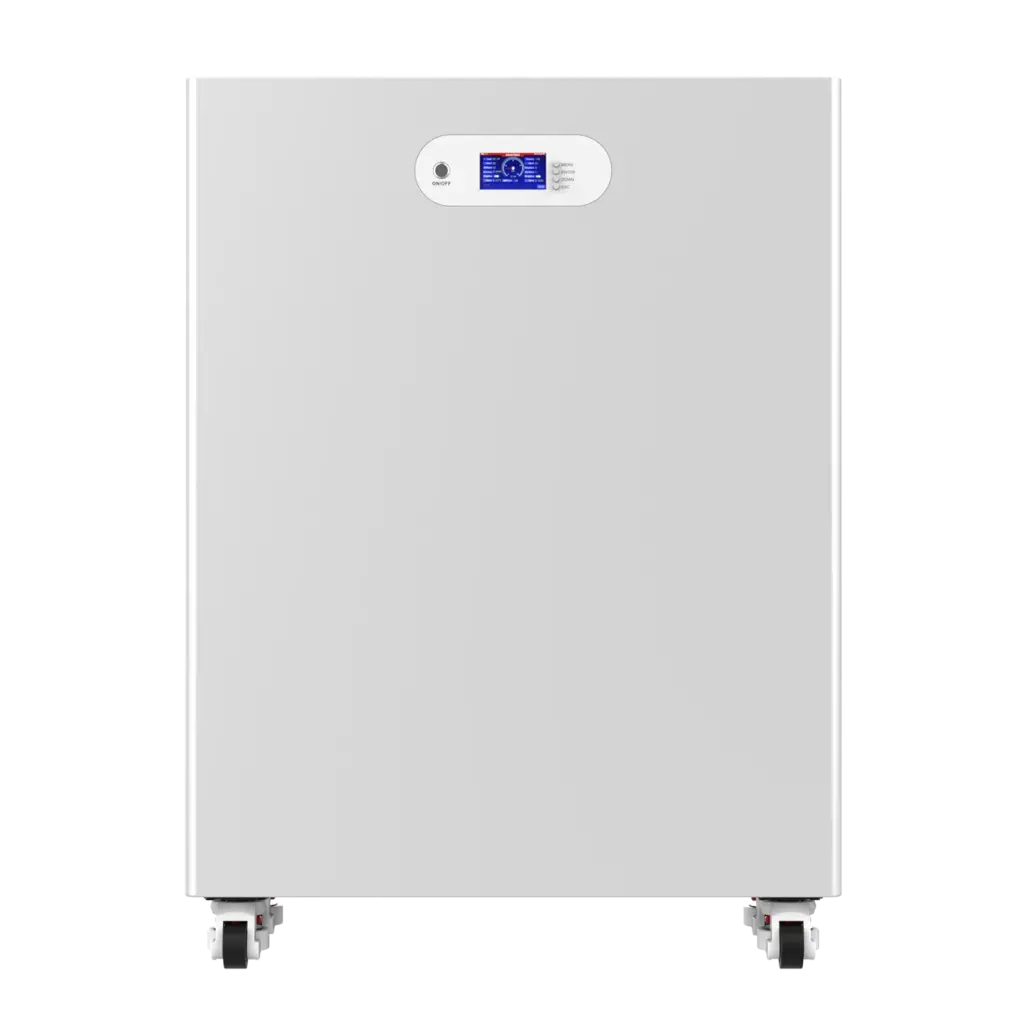
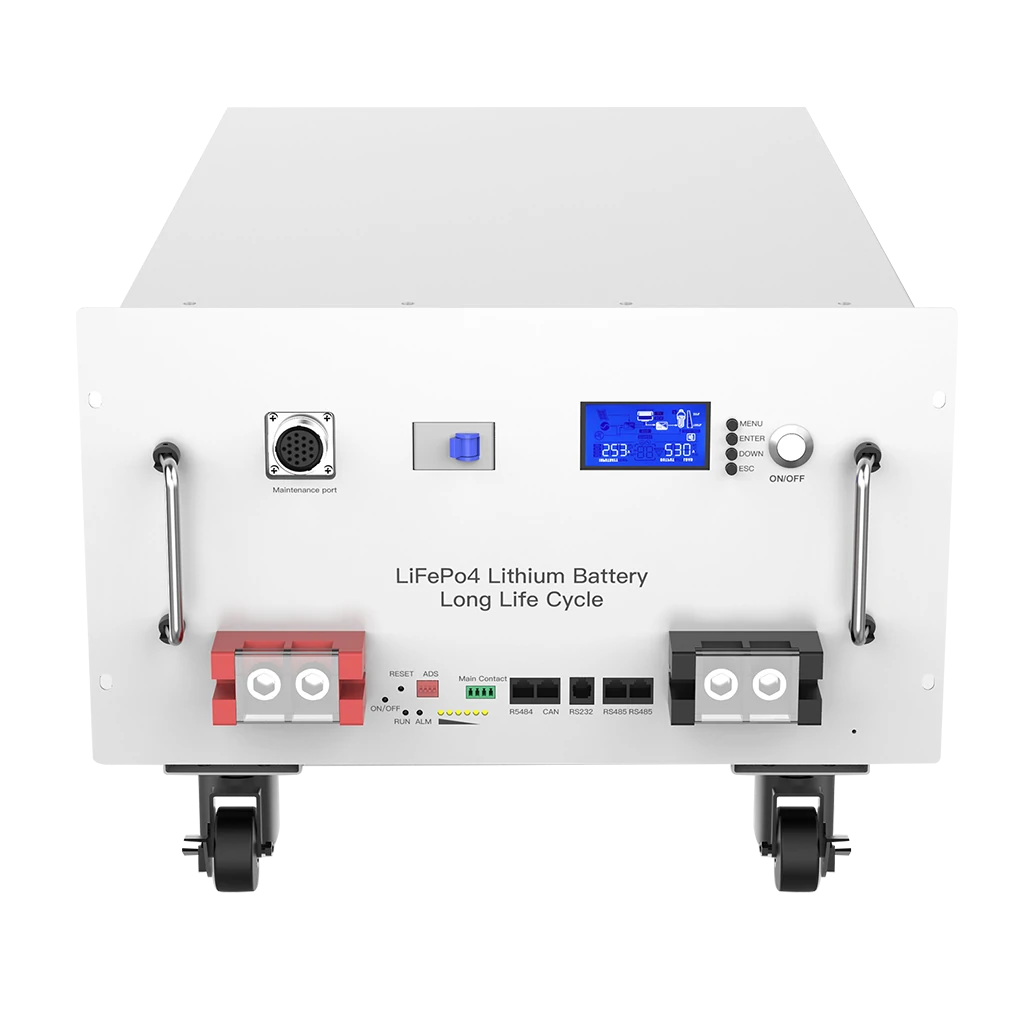
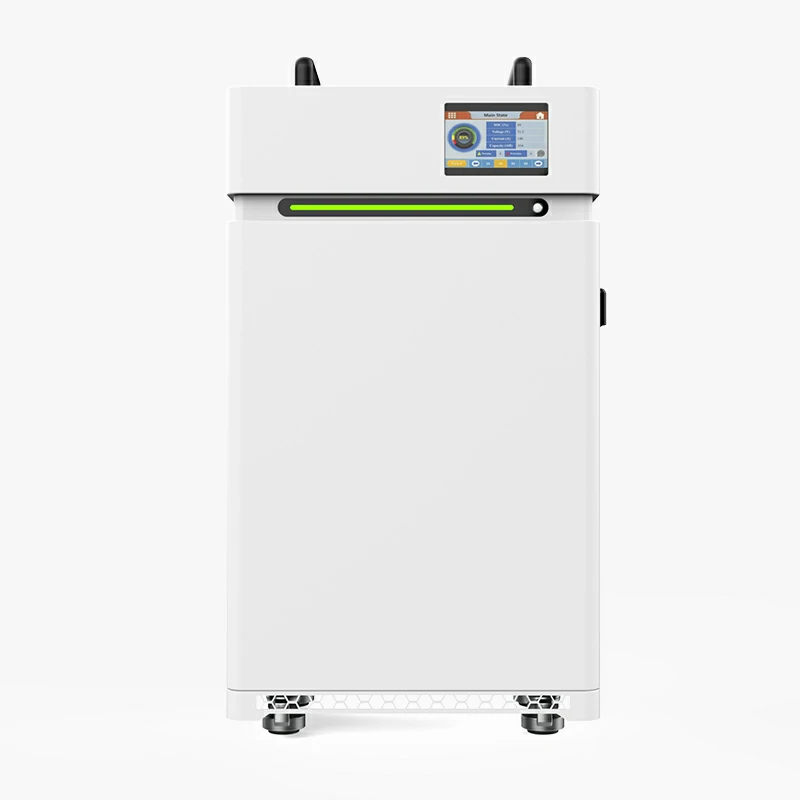
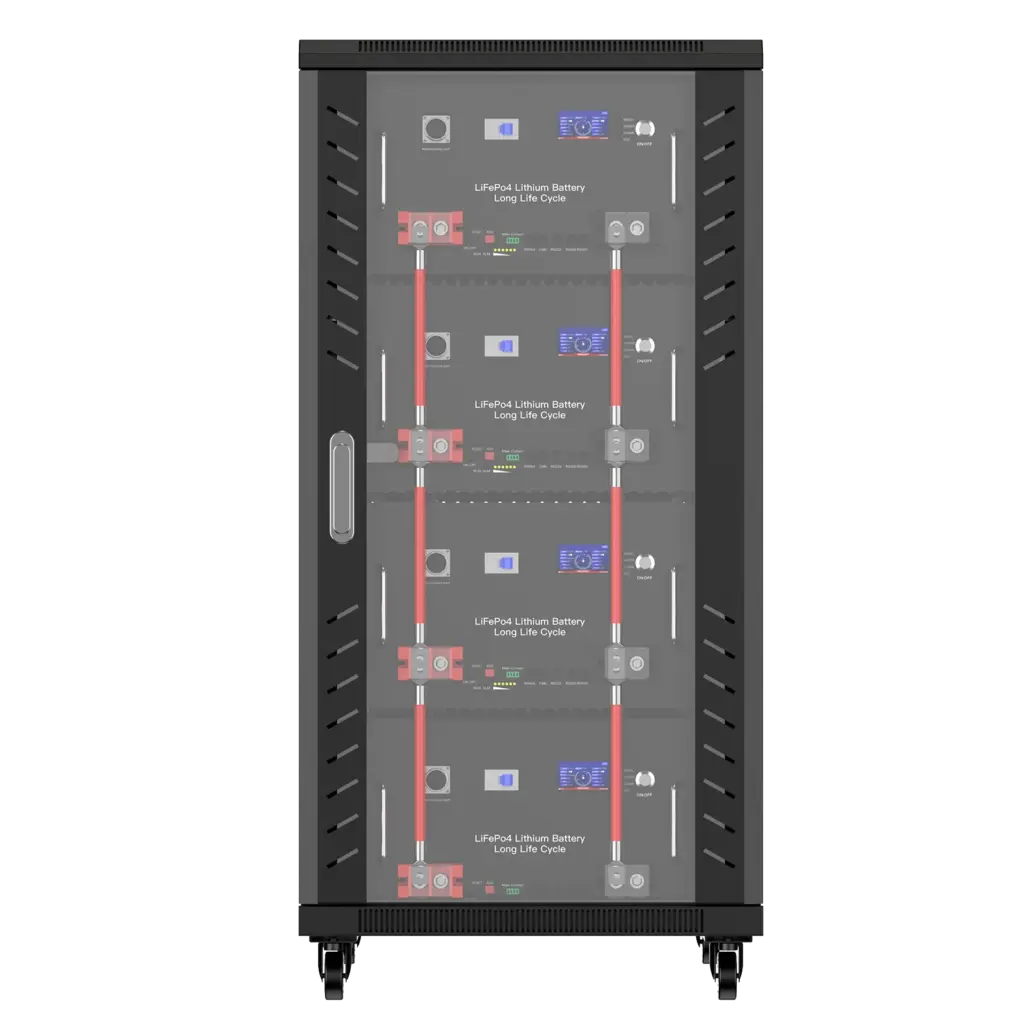
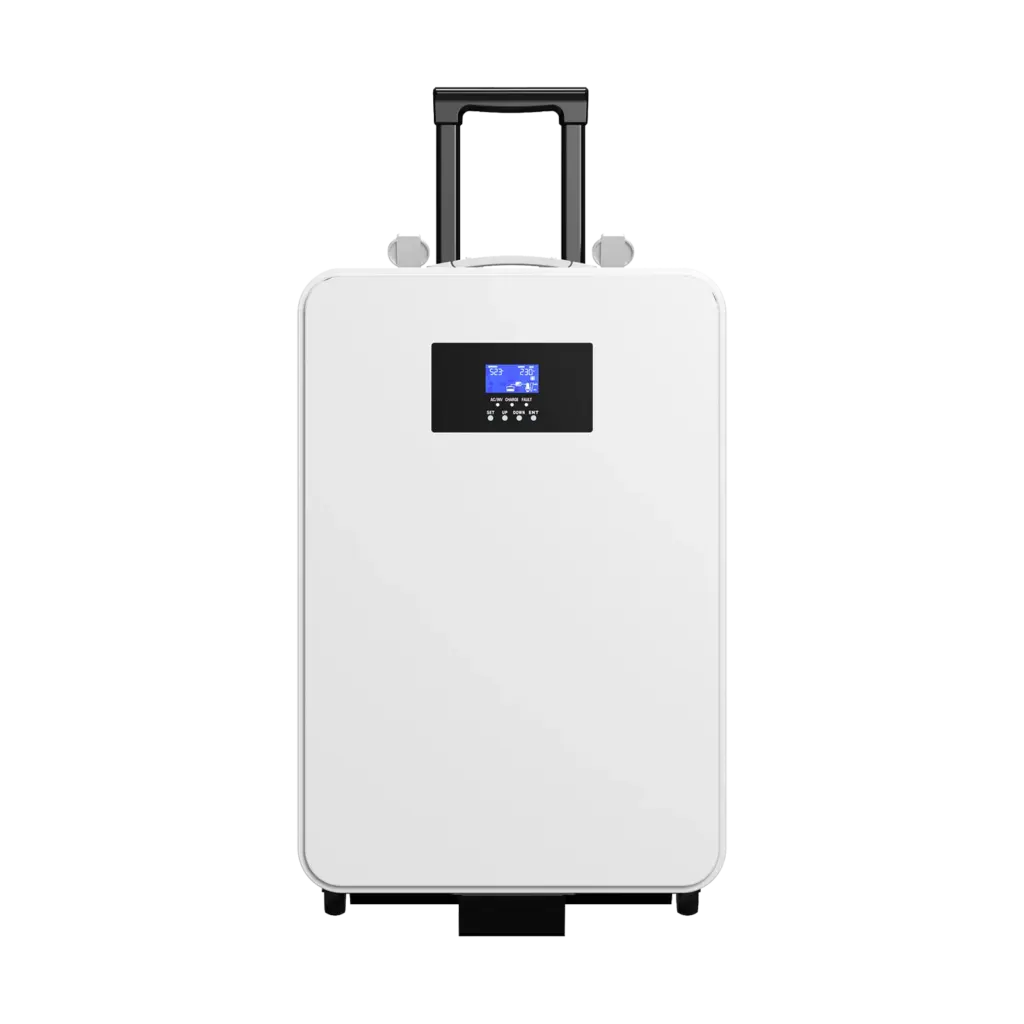
Lithium iron phosphate batteries are commonly used in modern stationary storage because they support repeated cycling, compact installations and integrated battery-management systems. Capacity alone should not determine selection: inverter voltage, current, usable energy, communication protocol, expansion needs and required certifications also have to match the project.
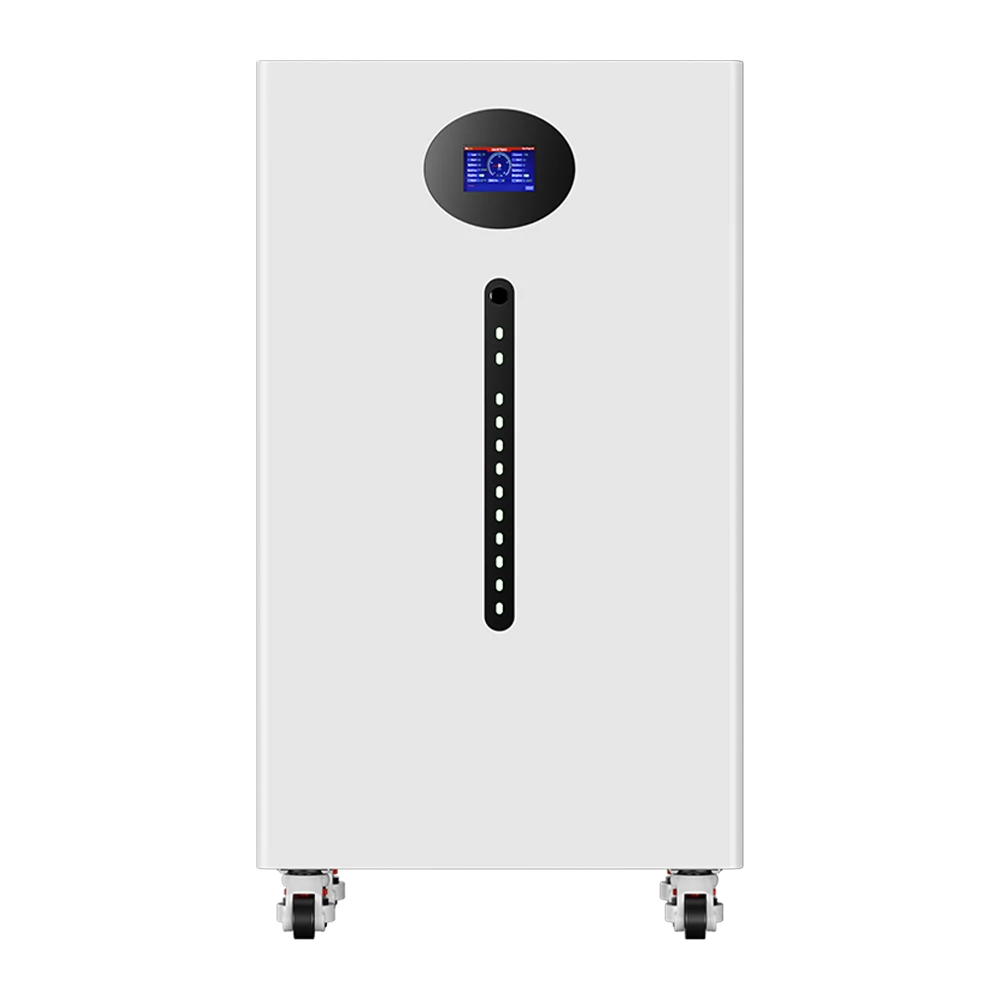
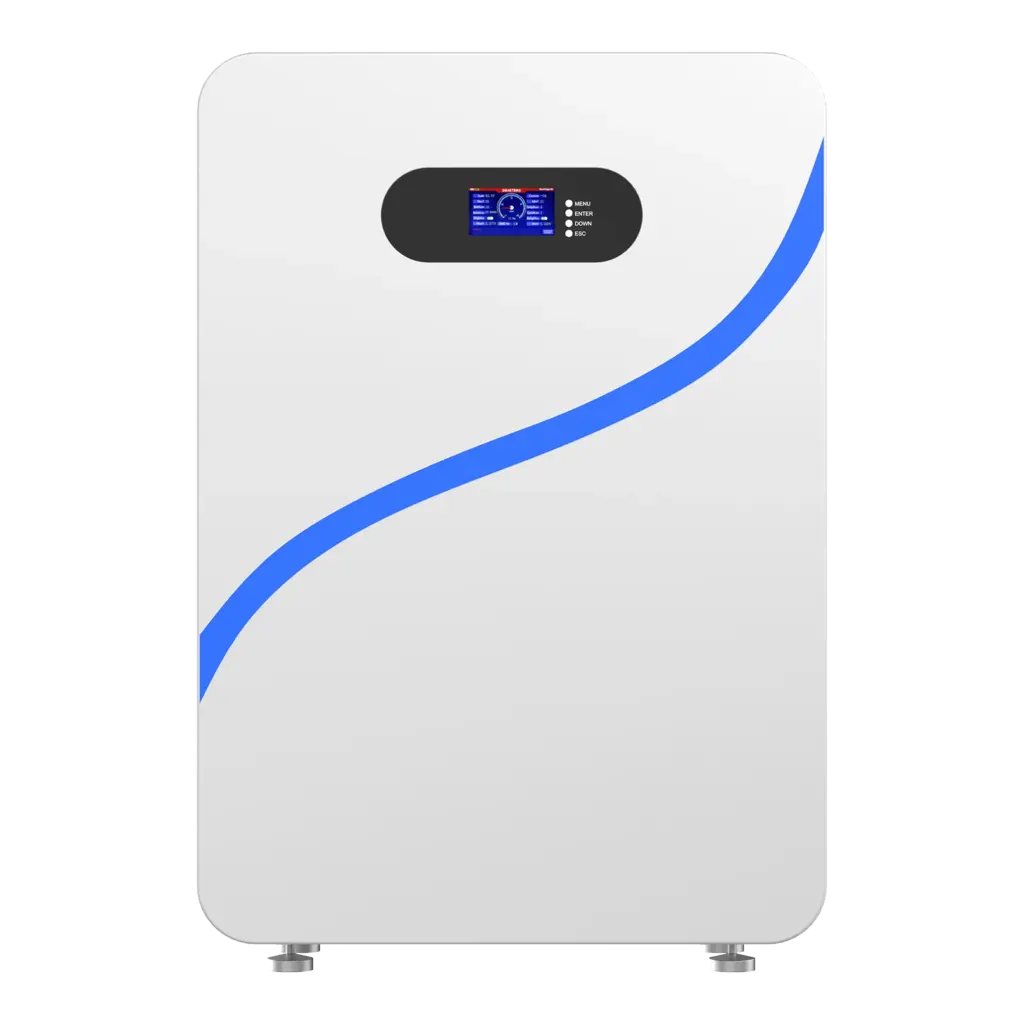
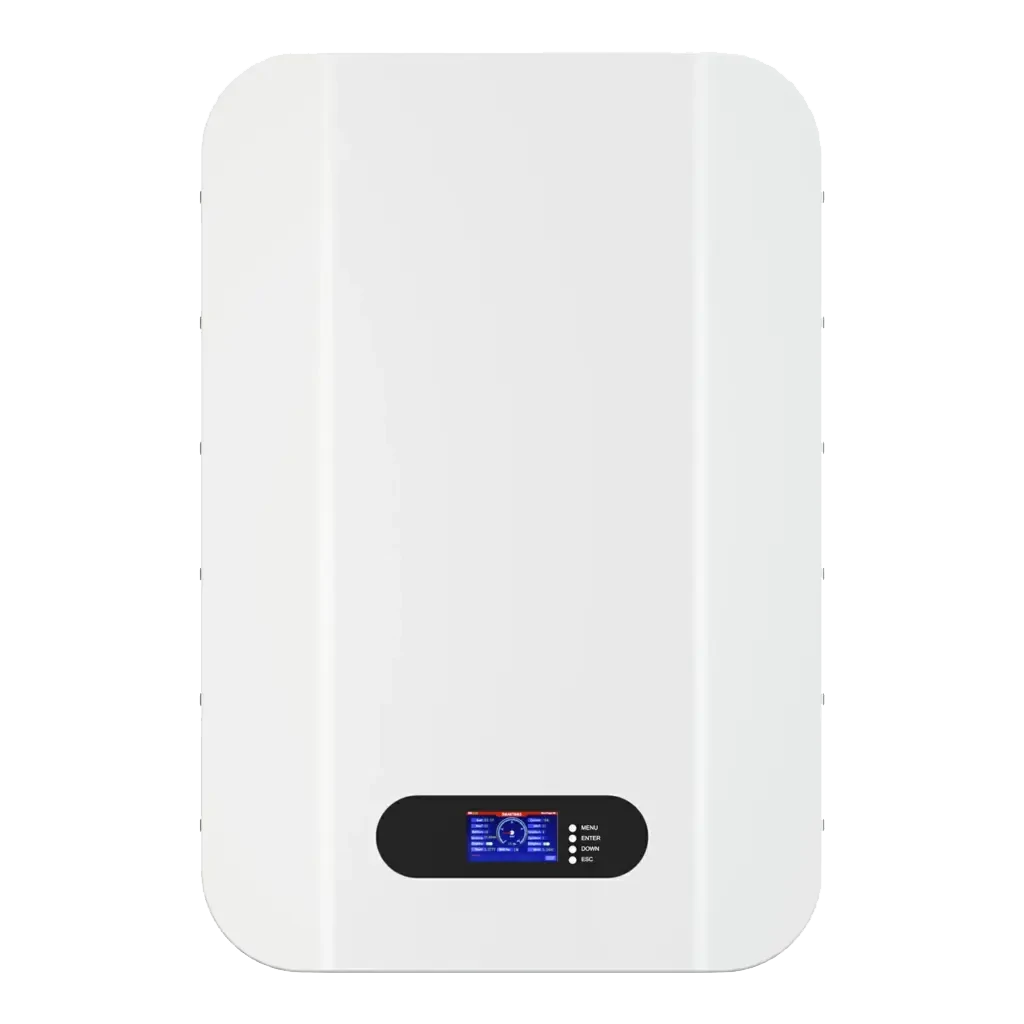
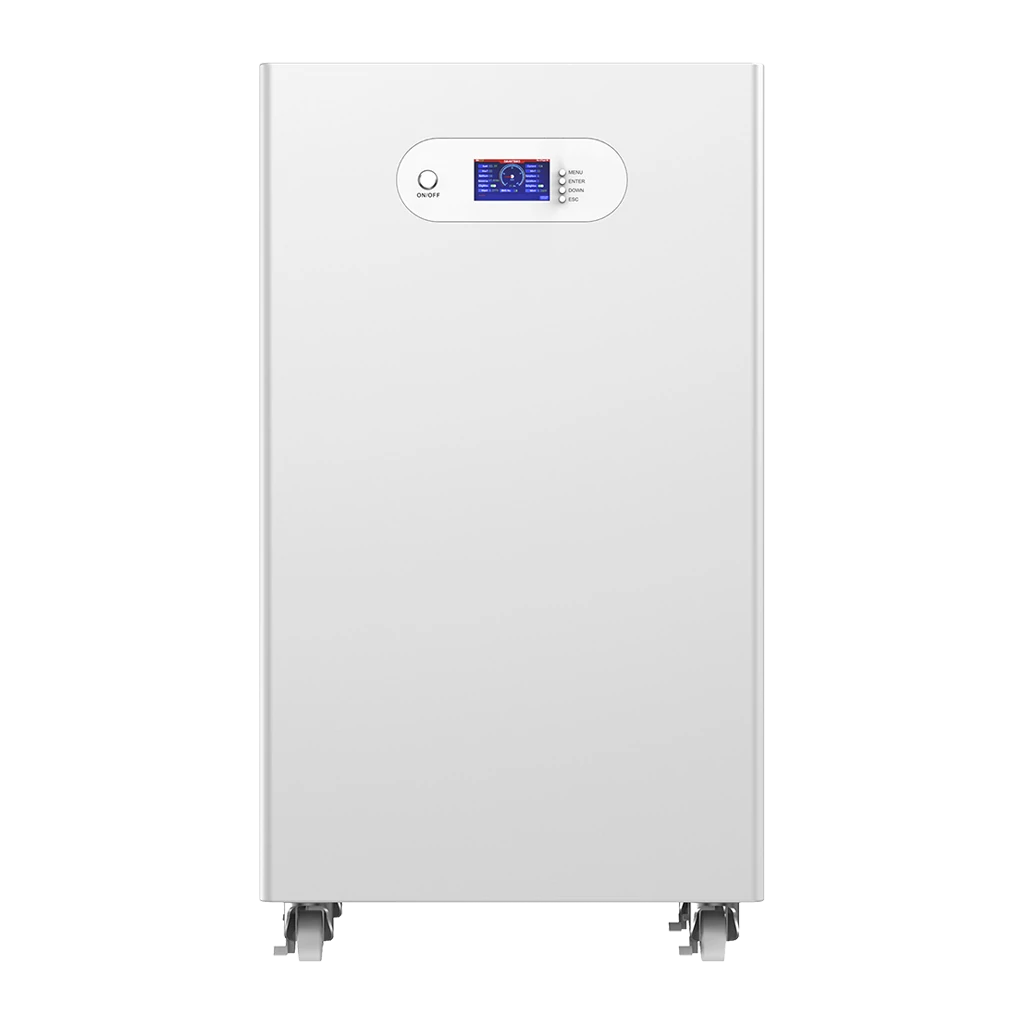
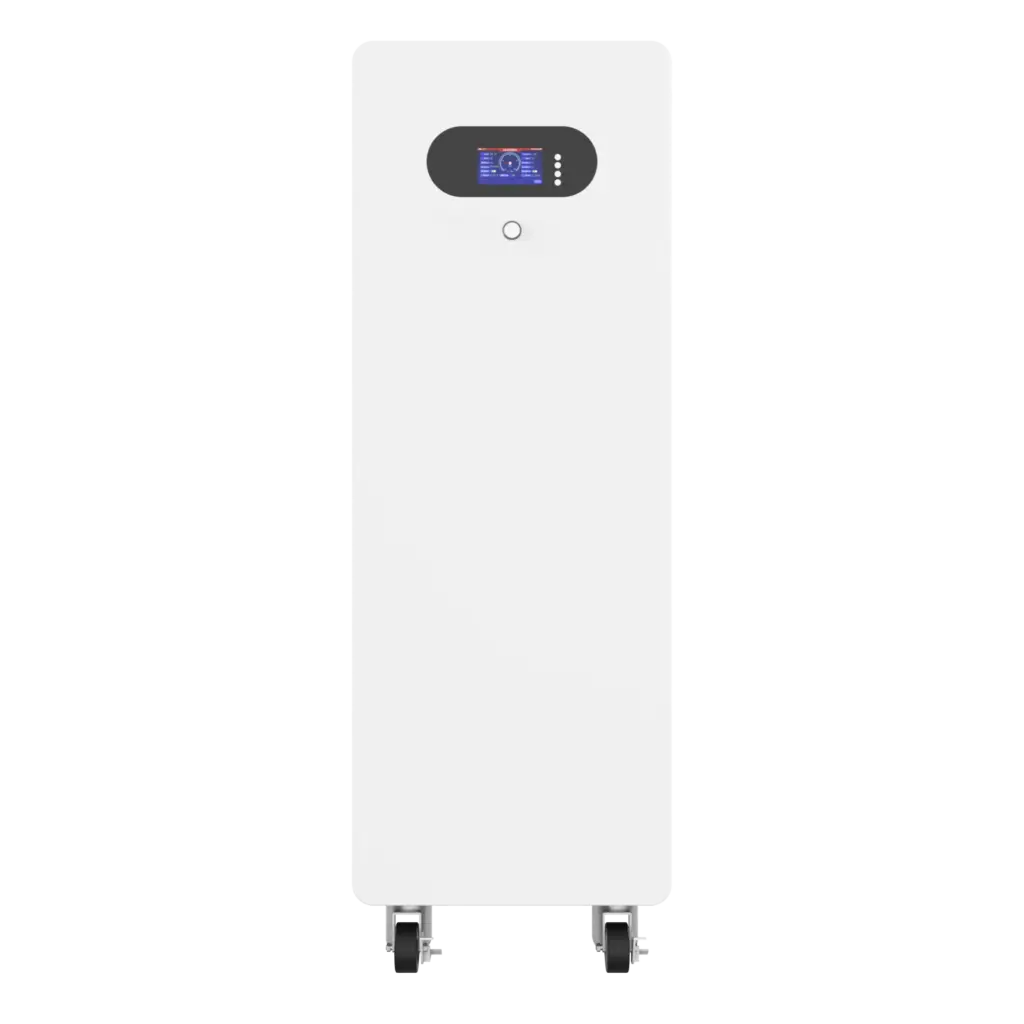
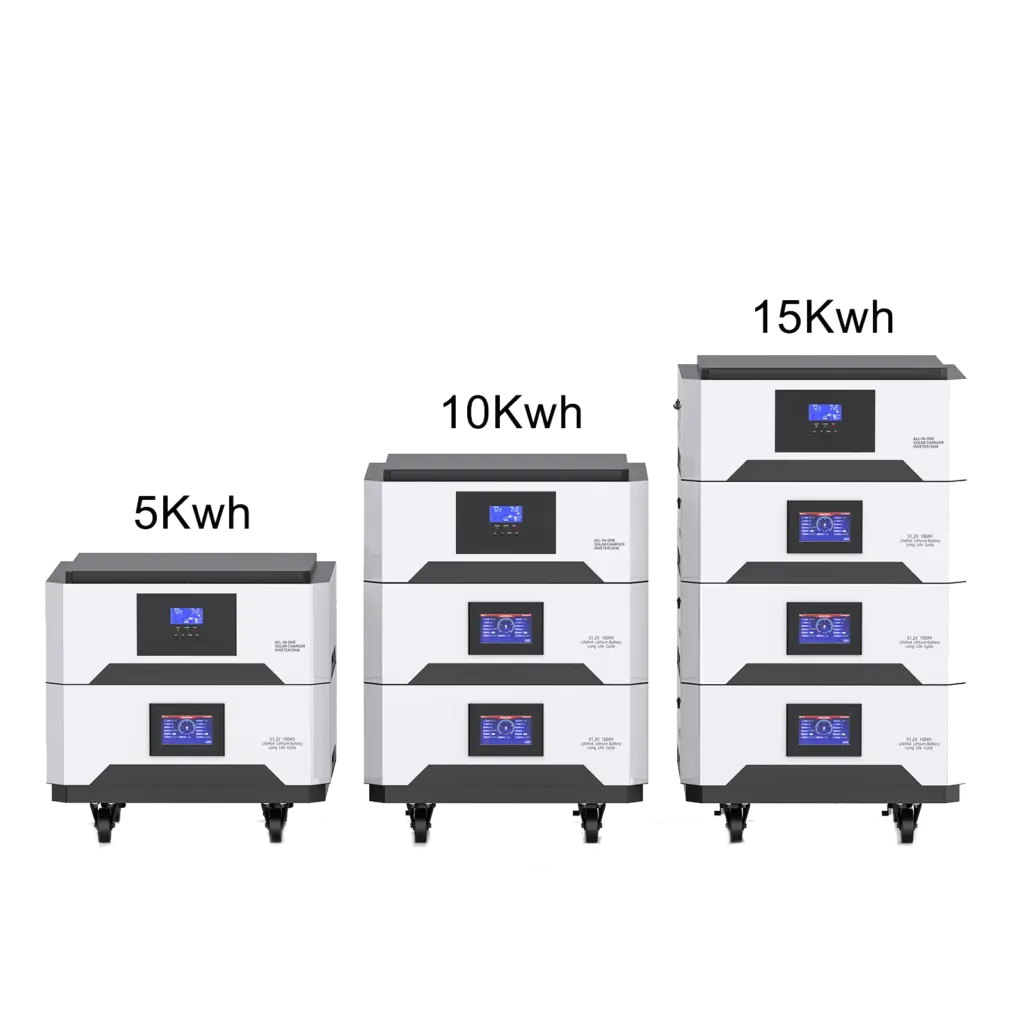
For example, Avepower’s 5kWh, 10kWh and 15kWh stackable solar battery system uses:
- 51.2V LiFePO4 architecture;
- 5kWh modules;
- CAN / RS485 / RS232;
- 4.3-inch display;
- up to 100A continuous discharge;
- modular 5/10/15kWh configurations;
- stated 8,000+ cycles at specified test conditions.
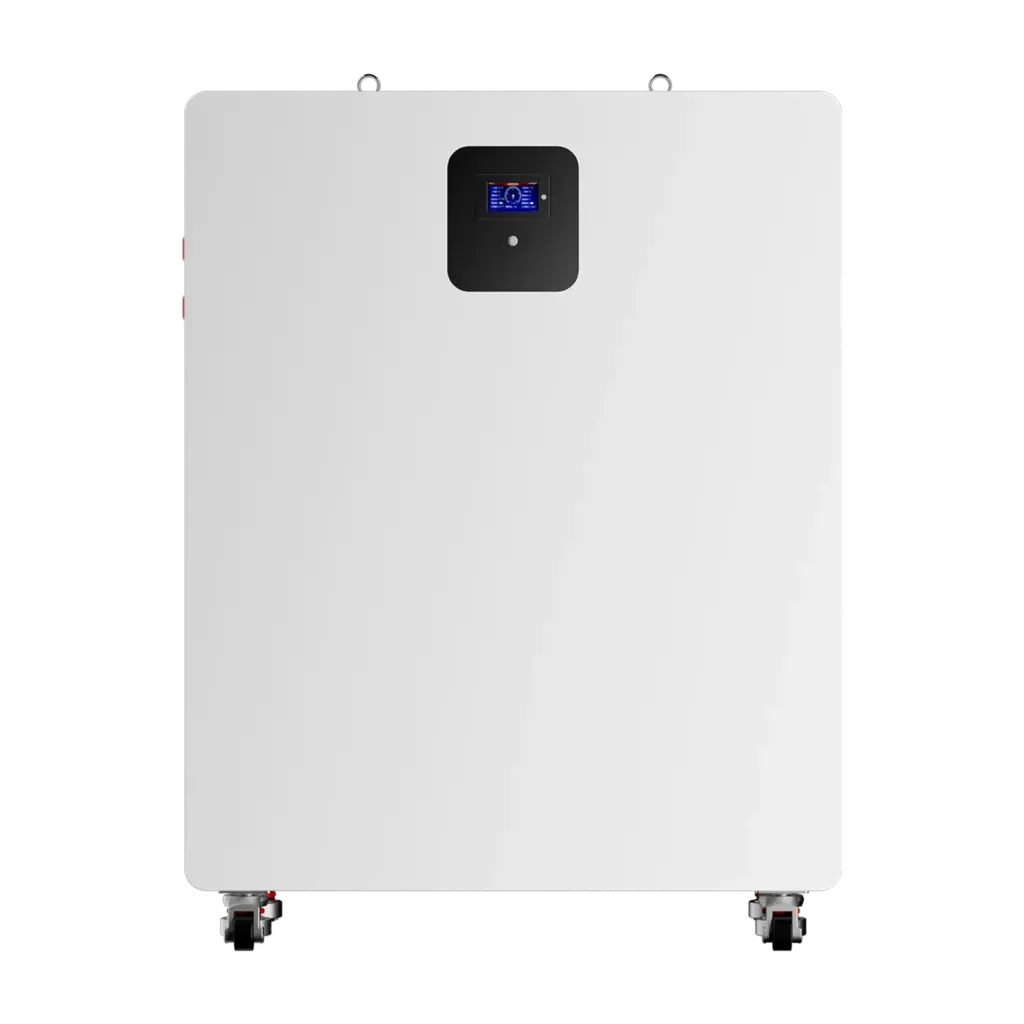
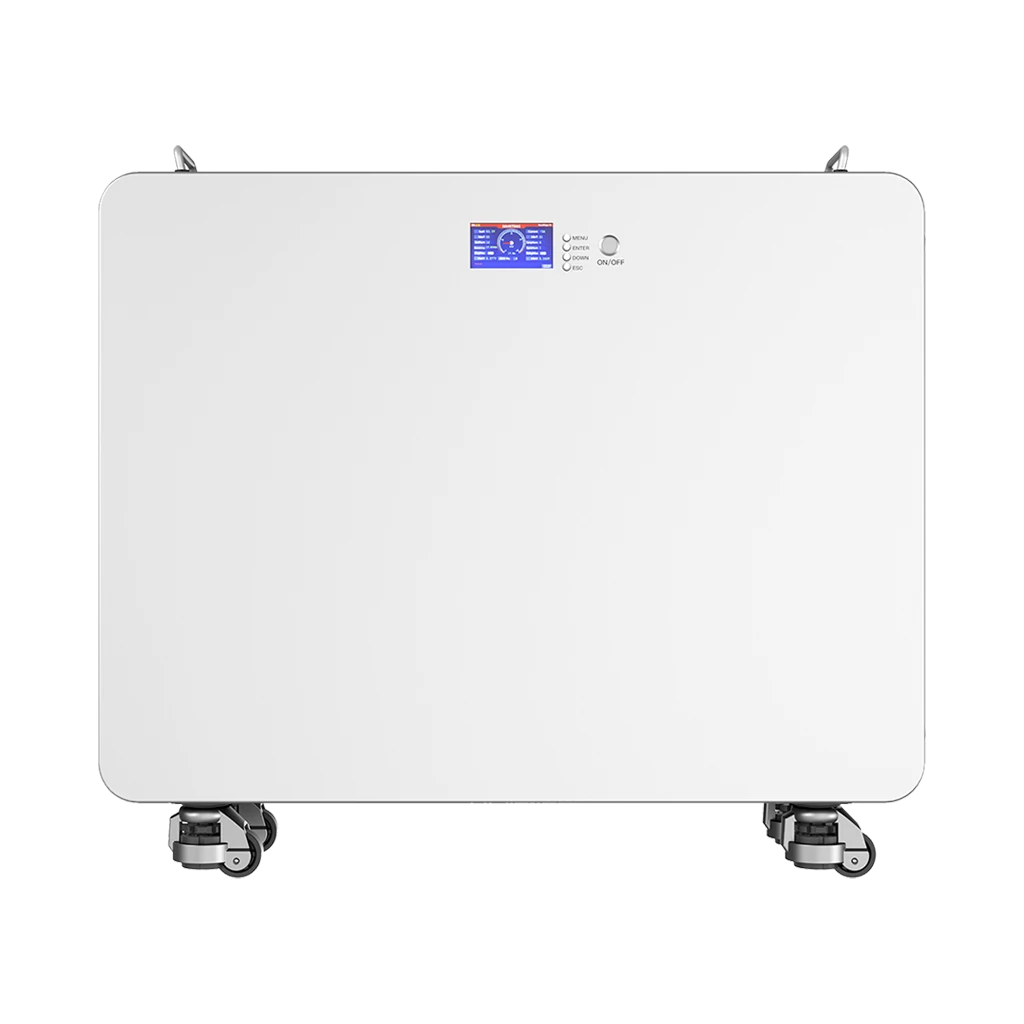
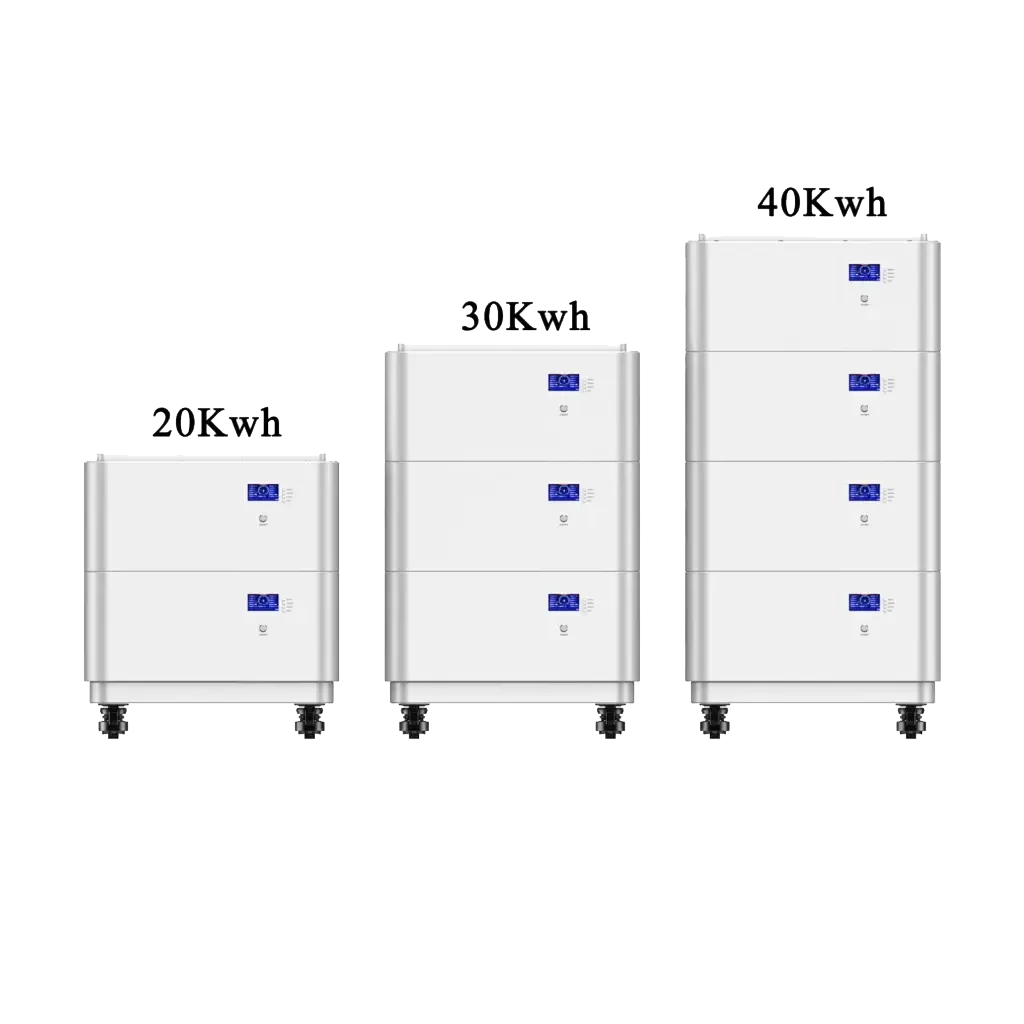
For larger residential loads, Avepower’s 16kWh 51.2V 314Ah LiFePO4 battery provides approximately 16kWh nominal energy and supports up to 200A discharge and CAN/RS485/RS232 communication.
These specifications have decision value only after the inverter and load requirements are known.
Conclusion: What Are the Advantages and Disadvantages of Solar Energy?
Solar energy’s biggest strengths are renewable generation, low lifecycle emissions, long equipment life and the ability to reduce electricity purchases. Its biggest weaknesses are upfront cost and the mismatch between solar production and electricity demand. Batteries can reduce that mismatch, but storage should be added only when its savings, backup or energy-control value justify its extra cost.
Before installing solar, evaluate:
Site → Solar Yield → Load → Tariff → Export Value → PV Size → Battery Need → Inverter → Certification → Lifecycle Cost
rather than selecting panels or batteries first.
Build a Solar + Storage System Around the Actual Project
For solar installers, distributors, EPC contractors and project developers, the advantage of battery storage depends on how well the system matches the solar array, inverter and real electricity load.
Avepower provides LiFePO4 residential battery systems ranging from modular home-storage configurations to higher-capacity solar-storage solutions, with CAN/RS485 communication, inverter-matching support and OEM/ODM options.
Send your: Project Country + PV Size + Inverter Model + Required Battery Capacity + Daily Load + Backup Requirement
to determine whether the project needs solar only, solar + battery, or a larger off-grid storage architecture.
Explore Residential Energy Storage Solutions
View Avepower Home Energy Storage Products
Review Real Energy Storage Case Studies
Take Control of Your Energy with Avepower!
Reliable home solar battery solutions with OEM/ODM customization and in-house manufacturing, tailored to the needs of distributors, installers, and energy partners.
FAQ
Five major advantages of solar energy are renewable electricity generation, lower grid electricity purchases, low lifecycle greenhouse gas emissions, long equipment life and relatively low routine maintenance. Solar can also support greater energy independence when combined with suitable battery storage and backup equipment.
Five major disadvantages are high upfront cost, variable generation, no normal PV production at night, roof or site limitations and the additional expense of battery storage when nighttime use or backup is required. Manufacturing and end-of-life management also create lifecycle environmental impacts.
For homeowners, the biggest practical disadvantage is often the initial investment, while technically the main limitation is that electricity production follows available sunlight rather than household demand. Which problem matters more depends on the site: grid-connected homes can tolerate variability more easily than off-grid systems.
A modern solar PV system is commonly designed around roughly 20–30 or more years of operation, while current industry assessments cited by DOE place expected panel operational life around 25–35 years. Panels normally degrade gradually rather than suddenly failing when they reach 25 years.
Panels do not automatically stop working after 25 years. Many continue producing electricity at reduced output. Owners can keep operating them, repower the site with newer modules, reuse suitable equipment or send end-of-life panels into available recycling and waste-management channels depending on local regulations.