
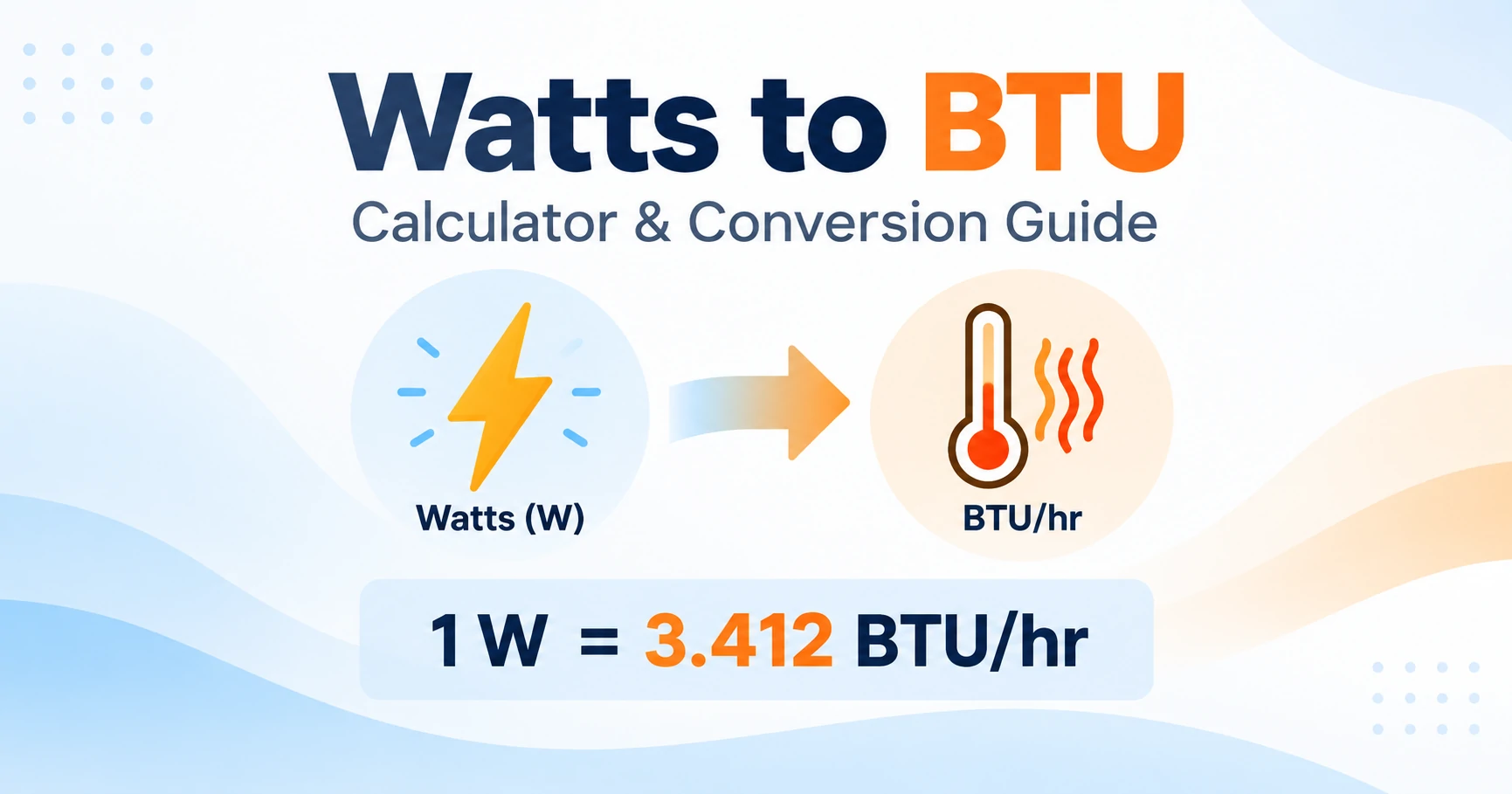
To convert watts to BTU per hour, multiply watts by 3.412142. Therefore, 1 watt equals approximately 3.412 BTU/hr, 1,000 watts equals 3,412 BTU/hr, and 1,500 watts equals about 5,118 BTU/hr.
Quick Watts to BTU Answer
- 1 W = 3.412142 BTU/hr
- 100 W = 341.21 BTU/hr
- 500 W = 1,706.07 BTU/hr
- 1,000 W = 3,412.14 BTU/hr
- 1,500 W = 5,118.21 BTU/hr
- 5,000 W = 17,060.71 BTU/hr
- 1 BTU/hr = 0.293071 W
For an instant calculation, use:
BTU/hr = Watts × 3.412142
To convert in the opposite direction:
Watts = BTU/hr × 0.293071
or:
Watts = BTU/hr ÷ 3.412142
Watts to BTU Calculator
Convert watts to BTU per hour or BTU/hr back to watts.
How Do You Convert Watts to BTU per Hour?
Watts convert to BTU per hour by multiplying the watt value by 3.412142. This conversion compares two units of power: watts measure energy transfer in joules per second, while BTU/hr expresses how much thermal energy is transferred each hour.
The formula is:
BTU/hr = Watts × 3.412142
Example: Convert 1,500 Watts to BTU/hr
1,500 × 3.412142 = 5,118.21 BTU/hr
So a 1,500W electrical load has a thermal-power equivalent of approximately:
5,118 BTU/hr
For a resistance heater, this is also a useful approximation of the heat delivered to the room because nearly all electrical energy ultimately becomes heat.
Watts to BTU/hr Conversion Table
| Watts | BTU/hr |
|---|---|
| 1 W | 3.41 BTU/hr |
| 10 W | 34.12 BTU/hr |
| 50 W | 170.61 BTU/hr |
| 100 W | 341.21 BTU/hr |
| 250 W | 853.04 BTU/hr |
| 500 W | 1,706.07 BTU/hr |
| 750 W | 2,559.11 BTU/hr |
| 1,000 W | 3,412.14 BTU/hr |
| 1,200 W | 4,094.57 BTU/hr |
| 1,500 W | 5,118.21 BTU/hr |
| 2,000 W | 6,824.28 BTU/hr |
| 3,000 W | 10,236.42 BTU/hr |
| 4,000 W | 13,648.57 BTU/hr |
| 5,000 W | 17,060.71 BTU/hr |
| 6,000 W | 20,472.85 BTU/hr |
| 7,000 W | 23,884.99 BTU/hr |
| 10,000 W | 34,121.42 BTU/hr |
For quick reference:
- 750 watts to BTU = 2,559.11 BTU/hr
- 1000 watts to BTU = 3,412.14 BTU/hr
- 1200 watts to BTU = 4,094.57 BTU/hr
- 1500 watts to BTU = 5,118.21 BTU/hr
- 2000 watts to BTU = 6,824.28 BTU/hr
- 4000 watts to BTU = 13,648.57 BTU/hr
- 5000 watts to BTU = 17,060.71 BTU/hr
- 6000 watts to BTU = 20,472.85 BTU/hr
- 7000 watts to BTU = 23,884.99 BTU/hr
- 10000 watts to BTU = 34,121.42 BTU/hr
How Do You Convert Watts to Total BTU Over Time?
To convert watts into total BTU rather than BTU/hr, multiply the wattage by operating time in hours and then multiply by 3.412142. Adding time changes the calculation from power to energy, which is essential for energy-use, battery-runtime and heating-energy calculations.
Use:
BTU = Watts × Hours × 3.412142
Example: 2,000W for 3 Hours
2,000 × 3 × 3.412142 = 20,472.85 BTU
So a constant 2,000W load operating for three hours represents:
approximately 20,473 BTU of total energy
The same load uses:
2,000W × 3h ÷ 1,000 = 6kWh
Therefore:
6kWh ≈ 20,473 BTU
When the objective is battery runtime or electricity consumption, it is usually clearer to calculate energy in Wh or kWh first. Use the Avepower watts to kWh calculator for that step.
How Do You Convert BTU/hr Back to Watts?
To convert BTU per hour back to watts, multiply BTU/hr by approximately 0.293071, or divide the BTU/hr value by 3.412142.
Use either formula:
Watts = BTU/hr × 0.293071
or:
Watts = BTU/hr ÷ 3.412142
Examples:
| BTU/hr | Thermal-Equivalent Watts |
|---|---|
| 5,000 BTU/hr | 1,465 W |
| 8,000 BTU/hr | 2,345 W |
| 10,000 BTU/hr | 2,931 W |
| 12,000 BTU/hr | 3,517 W |
| 18,000 BTU/hr | 5,275 W |
| 24,000 BTU/hr | 7,034 W |
What Is the Difference Between Watts, Watt-Hours, BTU and BTU/hr?
| Measurement | Type | What It Tells You | Typical Use |
|---|---|---|---|
| Watt (W) | Power | Instantaneous rate of energy use | Appliance electrical load |
| Kilowatt (kW) | Power | 1,000 watts | Inverters, HVAC input |
| BTU/hr | Power | Thermal energy rate | Heating/cooling capacity |
| Watt-hour (Wh) | Energy | Watts used over time | Small batteries |
| Kilowatt-hour (kWh) | Energy | Energy consumed or stored | Home batteries, electricity bills |
| BTU | Energy | Total thermal energy | Heating and fuel calculations |
What Are the Most Common Watts-to-BTU Mistakes?
Most conversion errors occur because users confuse energy with power or assume an HVAC unit’s cooling capacity and electrical consumption are the same thing, even though these specifications represent different physical quantities.
Watch for these common mistakes:
- Writing BTU instead of BTU/hr: Watts measure power, so the directly comparable unit is BTU per hour.
- Treating 1 W as 3.412 BTU: The correct power relationship is:1 W ≈ 3.412 BTU/hrFor energy:1 Wh ≈ 3.412 BTU.
- Using AC cooling capacity to estimate electrical consumption: A 12,000 BTU/hr AC is not automatically a 3,517W electrical appliance.
- Ignoring EER, CEER, SEER or COP: HVAC efficiency determines the relationship between electrical input and delivered heating or cooling.
- Using watts instead of watt-hours for battery runtime: Watts describe load power; Wh or kWh describe how much energy the battery must supply over time.
- Using nameplate maximum power as continuous real-world power: Some loads cycle, modulate or operate below rated maximum power.
- Ignoring startup surge: Compressors, pumps and motors can require substantially more power during startup than during normal operation.
Watts to BTU Formula Summary
For most practical calculations, remember two constants: multiply watts by 3.412 to obtain BTU/hr, and multiply BTU/hr by 0.293 to obtain the equivalent power in watts.
| Conversion | Formula |
|---|---|
| Watts → BTU/hr | BTU/hr = W × 3.412142 |
| kW → BTU/hr | BTU/hr = kW × 3,412.142 |
| BTU/hr → Watts | W = BTU/hr × 0.293071 |
| BTU/hr → kW | kW = BTU/hr × 0.000293071 |
| Wh → BTU | BTU = Wh × 3.412142 |
Need to Size a Battery or Inverter After Converting BTU to Watts?
A watts-to-BTU conversion is only the first step when the real goal is backup-power or energy-storage sizing. The final system should be selected from actual running watts, startup surge, operating hours, usable battery energy, inverter efficiency and the complete load profile.
For residential backup projects, start by documenting:
- Continuous appliance watts
- Motor or compressor startup requirements
- Required backup hours
- Daily energy consumption in kWh
- Usable battery capacity
- Inverter continuous and surge ratings
- Other simultaneous household loads
Avepower’s battery and inverter sizing calculator can take the calculation from appliance watts to estimated battery and inverter requirements, while its residential battery energy storage solutions provide examples of system configurations for home backup applications.
If you are planning a residential solar or backup-power project, Avepower can help evaluate the load profile, required runtime, inverter capacity, battery energy and system configuration together rather than selecting a battery from a BTU figure alone.
FAQ
One watt equals approximately 3.412142 BTU per hour. Multiply any watt value by 3.412142 to convert it to BTU/hr.
100 watts equals approximately 341.21 BTU/hr.
500 watts equals approximately 1,706.07 BTU/hr.
1,000 watts equals approximately 3,412.14 BTU/hr. Because 1,000 watts equals 1 kilowatt, you can also remember that 1kW is approximately 3,412 BTU/hr.
A 1,500W resistance heater is approximately 5,118 BTU/hr.
5,000 watts equals approximately 17,060.71 BTU/hr.
12,000 BTU/hr is thermally equivalent to approximately 3,517 watts.
One BTU per hour equals approximately 0.293071 watts.
One kilowatt equals approximately 3,412.14 BTU/hr.
No. BTU measures an amount of energy, while BTU/hr measures a rate of energy transfer. BTU is comparable with Wh or kWh; BTU/hr is comparable with W or kW.