
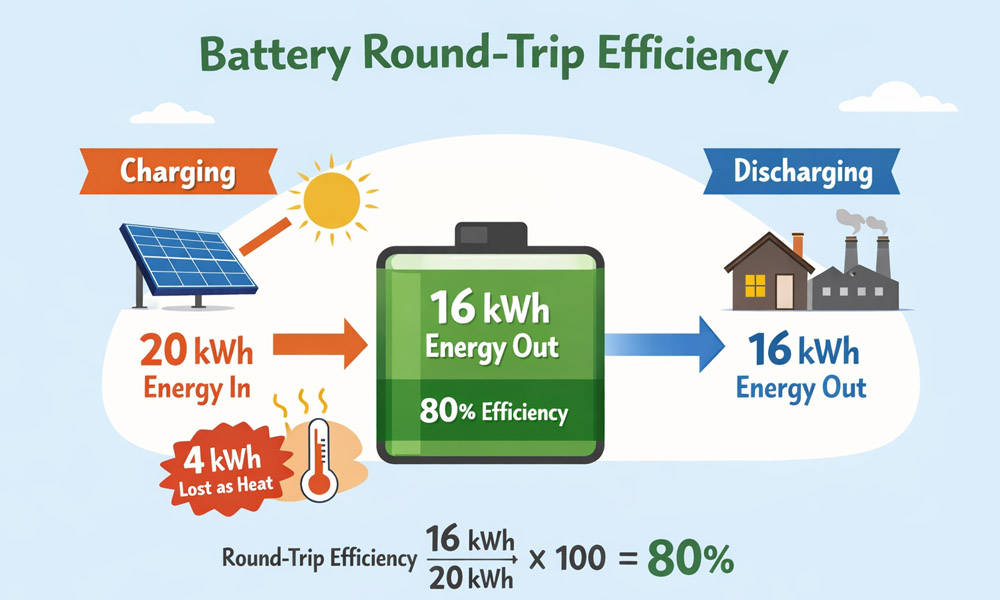
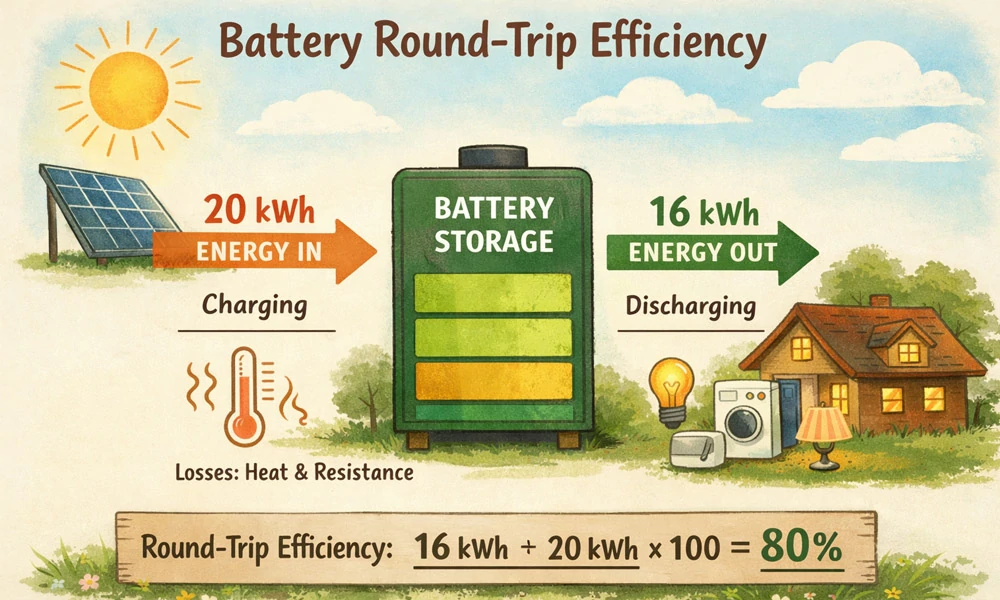
BESS round trip efficiency (RTE) measures how much energy a battery energy storage system returns after one complete charge-discharge cycle.
RTE (%) = Energy Discharged ÷ Energy Charged × 100
For example, if a BESS receives 100 kWh during charging and delivers 90 kWh during discharge:
90 ÷ 100 × 100 = 90% RTE
This means the system returns 90 kWh and loses 10 kWh during the full cycle through the battery, power conversion, wiring, thermal management, and auxiliary loads.
For an accurate BESS round trip efficiency comparison, energy input and output should be measured at the same system boundary, and the test should clearly state whether auxiliary loads are included.
What Is Battery Round Trip Efficiency?
Round-trip efficiency is the ratio between the energy you recover from a battery system and the energy you used to charge it in the first place. In standardized storage testing, the comparison is often made by bringing the system back to the same starting state of charge, then dividing total discharge energy by total charge energy.
During operation, energy flows through several stages:
- Electricity enters the battery during charging.
- The battery stores this energy in chemical form.
- The stored energy is later converted back to electricity during discharge.
Because each of these stages involves small losses, the amount of usable electricity coming out of the battery will always be slightly less than the energy used to charge it.
How to Calculate BESS Round Trip Efficiency: Step-by-Step
Suppose a BESS absorbs 500 kWh during charging and delivers 450 kWh during discharge.
Step 1: Record Energy Input
Energy charged = 500 kWh
Step 2: Record Energy Output
Energy discharged = 450 kWh
Step 3: Apply the RTE Formula
RTE = 450 ÷ 500 × 100 = 90%
Step 4: Calculate Energy Loss
500 − 450 = 50 kWh
The BESS therefore has a 90% round trip efficiency, with 10% or 50 kWh lost during the complete charge-discharge cycle.
You can also use our online calculator to perform the calculation directly.
BESS Round Trip Efficiency Calculator
Formula: RTE (%) = Energy Discharged ÷ Energy Charged × 100
A More Practical Way to Think About It
Imagine your BESS stores solar energy during the afternoon and delivers it in the evening.
- If your system has 92% RTE, every 10 kWh stored gives you about 9.2 kWh back.
- If your system has 80% RTE, every 10 kWh stored gives you only 8 kWh back.
That 1.2 kWh difference may seem small for one cycle, but over hundreds of cycles per year it becomes financially meaningful.
A daily-use system storing 10 kWh per day would move 3,650 kWh into storage over a year. At 92% RTE, you recover about 3,358 kWh. At 80% RTE, you recover only 2,920 kWh.
BESS Round Trip Efficiency Conversion Chart
| BESS RTE | Output from 100 kWh Input | Energy Loss | Input Needed for 100 kWh Output |
|---|---|---|---|
| 80% | 80 kWh | 20 kWh | 125.0 kWh |
| 85% | 85 kWh | 15 kWh | 117.6 kWh |
| 88% | 88 kWh | 12 kWh | 113.6 kWh |
| 90% | 90 kWh | 10 kWh | 111.1 kWh |
| 92% | 92 kWh | 8 kWh | 108.7 kWh |
| 95% | 95 kWh | 5 kWh | 105.3 kWh |
For example, a BESS with 90% round trip efficiency returns about 90 kWh for every 100 kWh charged. To deliver 100 kWh, the system would need approximately 111.1 kWh of input energy.
Why Round-Trip Efficiency Is Never 100%?
No battery system is perfectly efficient. Some energy is always lost between charging and discharging. DOE explains round-trip efficiency as less than 1 because of real losses during energy conversion and storage.
Where does that energy go?
- Internal resistance inside the battery: As current flows, electrical resistance turns some energy into heat. This is one of the most fundamental sources of loss.
- Electrochemical losses: Charging and discharging rely on reversible chemical reactions, but they are never perfectly reversible in real-world operation.
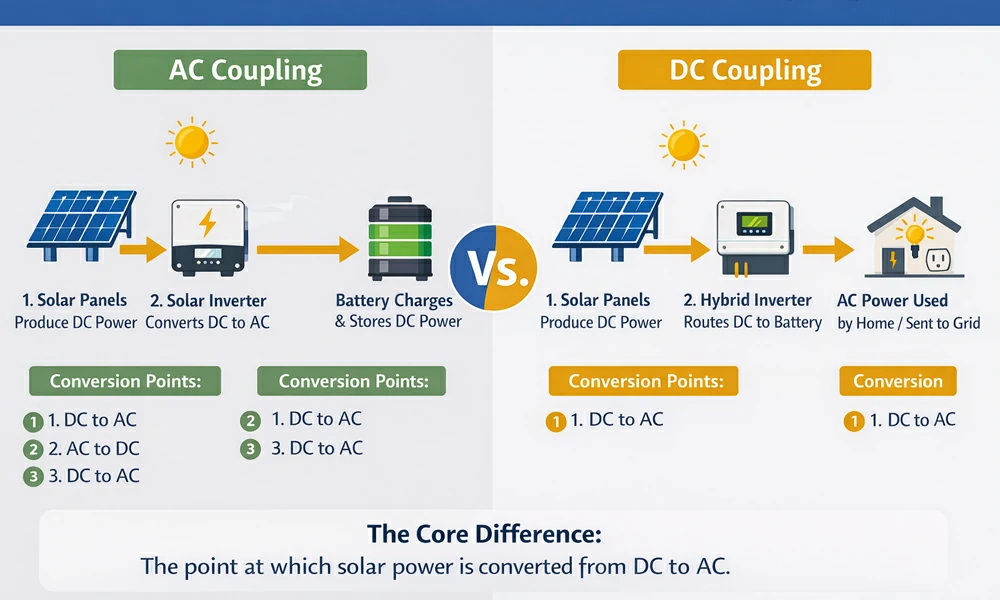
- Power conversion losses: If your system converts power from DC to AC, or AC back to DC, each conversion stage introduces additional losses.
- Thermal management and auxiliaries: Fans, pumps, controls, sensors, and battery management electronics consume power too.
- Idle or standby consumption: Even when the system is not doing much, it may still draw a small amount of electricity to remain ready and safe.
A detailed study of a stationary lithium-ion containerized system found that conversion round-trip efficiency can fall into the 70% to 80% range in some applications, and that overall system efficiency can be another 8 to 13 percentage points lower once auxiliary power consumption is considered. In low-utilization use cases, auxiliary power can dominate the losses.
What Affects Round-Trip Efficiency?
Round-trip efficiency is not fixed. It changes with chemistry, operating conditions, temperature, architecture, and equipment selection.
1. Battery Chemistry
Battery chemistry is one of the most important factors influencing round trip efficiency.
Different materials and chemical reactions produce different levels of energy loss.
| Battery Type | Typical RTE | Cycle Life |
|---|---|---|
| LiFePO4 (LFP) | 90–95% | 6000+ cycles |
| NMC Lithium | 85–92% | 2500–4000 cycles |
| Lead-acid | 70–85% | 300–1000 cycles |
| Flow batteries | 70–80% | 10,000+ cycles |
Lithium iron phosphate (LiFePO4) batteries have become widely used in residential and commercial energy storage because they offer:
- High round trip efficiency
- Long cycle life
- Strong thermal stability
- Low maintenance requirements
This is one reason why Avepower uses LiFePO4 chemistry in its home and commercial energy storage products. For solar storage users, LiFePO4 offers an excellent balance of efficiency, safety, durability, and long-term value.
2. Charge and Discharge Rate
The speed of charging and discharging (C-rate) impacts RTE. High rates generate more heat due to increased internal resistance, reducing efficiency. Slower, controlled charge/discharge cycles maintain higher efficiency and extend battery lifespan.
3. Temperature
Low temperatures increase resistance and reduce available capacity. High temperatures may improve near-term electrochemical performance but often accelerate aging and shorten battery life, electrolyte conductivity falls, resistance rises, and heat generation increases.
4. Depth of Discharge (DoD)
Depth of discharge describes how much of the battery’s stored capacity is used during each cycle.
- A battery discharged from 100% to 20% SOC has an 80% DoD.
Deep discharge cycles can affect long-term battery health and efficiency.
Lithium batteries typically tolerate deeper discharges better than lead-acid systems, but operating within an optimized SOC window (such as 20–80%) often provides the best long-term performance.
AC vs DC Coupling: Which Is More Efficient?
The system architecture changes the energy’s round-trip path.
A DC-coupled system can deliver solar DC power more directly to the battery energy storage system. In contrast, an AC-coupled system usually requires additional conversion stages, and each conversion step introduces some level of energy loss.
Because AC-coupled systems require extra DC/AC conversion steps, the round-trip efficiency during battery charging may be slightly lower than that of DC-coupled systems. As a result, DC-coupled solar charging efficiency is often slightly higher.
However, this does not mean that DC coupling is the best choice for every project. In some cases, AC-coupled systems provide greater flexibility for retrofitting existing solar installations and allow easier system integration. But if your primary goal is to minimize conversion losses and maximize energy efficiency, a DC-coupled design generally has an advantage.
To better understand AC and DC, please read our article on “AC vs DC Coupling: Key Differences in Solar Energy Systems”
Where Energy Loss Occurs in a Battery System
It is important to distinguish between battery-level efficiency and system-level efficiency when evaluating energy storage performance.
- Battery Efficiency: Battery efficiency measures the energy loss within the battery cells themselves, excluding other system components such as inverters or auxiliary equipment.
- System Efficiency: This measures energy loss across the entire energy storage system. In addition to the battery, it also includes components such as the inverter, electrical wiring, monitoring electronics, and cooling systems.
| Component | Typical Energy Loss |
|---|---|
| Battery charge/discharge | 5–10% |
| Inverter conversion | 3–5% |
| Battery management electronics | 1–2% |
| Thermal losses | 2–4% |
| Standby power consumption | 1–2% |
Combined losses typically result in a system round trip efficiency of around 80–90%.
The Importance of Round Trip Efficiency in Solar Energy Systems
Round trip efficiency becomes especially important when batteries are used with solar panels. If a battery system has low efficiency, a significant portion of the generated solar electricity will be lost during storage.
Imagine a battery that stores 10 kWh per day. Over a year, that is 3,650 kWh of charged energy. At 92% efficiency, you would recover 3,358 kWh and lose 292 kWh. At 85%, usable output drops to 3,102 kWh, with 548 kWh lost. At 80%, usable output becomes 2,920 kWh, meaning 730 kWh disappears over the year.
In a home system, poor efficiency means less usable nighttime solar. In a commercial system, it means weaker demand-charge reduction and higher energy loss. In a utility application, it means less revenue from each charge-discharge cycle.
Improving Round Trip Efficiency
Optimizing RTE involves careful attention to both battery choice and operational practices:
- Select High-Efficiency Batteries: Choose LiFePO4 or certified NMC batteries with verified RTE above 90%.
- Use Efficient Inverters: Hybrid inverters with >97% efficiency reduce DC/AC conversion losses.
- Manage SOC and DoD: Avoid extreme charge/discharge cycles; maintain batteries within optimal SOC ranges.
- Maintain Proper Temperature: Ensure good ventilation and climate control to prevent heat or cold-related efficiency drops.
- Monitor System Performance: Use monitoring software to track RTE in real time, update firmware, and perform routine maintenance.
Common BESS Round Trip Efficiency Mistakes
1. Comparing DC RTE With AC-to-AC RTE
Battery-level DC efficiency and complete system AC efficiency are not directly comparable.
2. Ignoring the Measurement Boundary
Always check whether RTE is measured at the battery terminals, PCS output, or grid point of interconnection.
3. Excluding Auxiliary Loads
HVAC, pumps, BMS, controls, and standby consumption can reduce real system efficiency.
4. Confusing One-Way Efficiency With Round Trip Efficiency
A 95% conversion efficiency in one direction does not mean the complete charge-discharge cycle has 95% RTE.
5. Comparing RTE Without Test Conditions
Temperature, C-rate, SOC range, DoD, system load, and operating conditions can all affect measured efficiency.
Why Avepower Batteries Are Well Suited for Efficient Energy Storage
When evaluating battery systems, efficiency should always be considered together with safety, lifespan, and application fit. A battery that looks efficient in isolation may not deliver the same value if it lacks thermal stability, intelligent protection, or long cycle life.
Avepower develops lithium battery energy storage products for home and commercial applications with a focus on practical performance. Key strengths include:
- LiFePO4 battery technology for high safety and high efficiency
- BMS protection for stable charging and discharging control
- international certifications such as CE, UL, RoHS, and ISO9001
- 10+ years of battery R&D and manufacturing experience
- support for product customization in capacity, design, and functions
- compatibility support for a wide range of energy storage applications
Looking for a high-efficiency lithium battery solution for home or commercial energy storage?
Avepower offers LiFePO4 battery systems designed for safety, durability, and strong real-world performance. Whether you need standard models or OEM/ODM customization, our team can help you find the right storage solution for your project.
Contact Avepower today to get product recommendations, technical support, and a customized energy storage solution built around your application needs.
Take Control of Your Energy with Avepower!
Reliable home solar battery solutions with OEM/ODM customization and in-house manufacturing, tailored to the needs of distributors, installers, and energy partners.
Conclusion
Round trip efficiency is a crucial measure of battery performance, especially for solar energy and residential energy storage systems. High RTE ensures maximum energy retention, lower costs, and better long-term sustainability. By understanding the factors that affect efficiency—battery chemistry, charge rates, temperature, and system design—users can make informed decisions to optimize energy storage and fully leverage their renewable energy investments.
Choosing high-efficiency lithium batteries, integrating efficient inverters, and maintaining proper system management are the keys to achieving superior round trip efficiency in modern energy storage solutions.
FAQ
BESS round trip efficiency (RTE) is the percentage of energy returned by a battery energy storage system compared with the energy used to charge it over a complete charge-discharge cycle.
Use the formula: RTE (%) = Energy Discharged ÷ Energy Charged × 100. If a BESS receives 100 kWh and returns 90 kWh, its RTE is 90%.
A higher RTE generally means less energy is lost, but the value must be compared at the same measurement boundary. Battery-side DC RTE is normally higher than full AC-to-AC system RTE because system-level efficiency can include PCS, transformer, wiring, cooling, and auxiliary losses.
Battery efficiency may describe the battery cells or DC battery block only. BESS RTE can represent the complete system, including power conversion and auxiliary equipment, depending on the measurement boundary.
It depends on where RTE is measured. AC-to-AC system RTE normally includes conversion losses, while battery-side DC RTE may not. Always check the stated measurement boundary.
Energy is lost through battery resistance, electrochemical processes, PCS conversion, transformers, wiring, thermal management, BMS operation, and standby loads.
A 90% RTE means approximately 10% of the input energy is lost over the complete cycle. For every 100 kWh charged, about 90 kWh is returned.